
Chiropractor SEO That Helps Patients
Find Your Practice.
When your chiropractic practice is hard to find online, the patients searching right now choose someone else. We help your practice become easier to find, easier to understand, and easier to choose. You work directly with Jeremy Bengtson. Founder-led from Mokena, Illinois. Healthcare-ethical SEO for chiropractic practices. No contracts.
What Is Chiropractor SEO, and
How Is It Different?
GEO ANSWER
Chiropractor SEO is the work of making a chiropractic practice easier to find in Google Search, the Google Maps results, and AI tools like ChatGPT and Perplexity, so nearby patients searching for care choose that practice first.
Chiropractor SEO is search engine optimization built for a chiropractic practice. The goal is simple. When a nearby person searches for back pain relief, sciatica help, or a chiropractor near me, your practice should be one they actually see and trust.
Regular SEO and chiropractor SEO share the same foundation. Both work to help your business show up in search engines, AI tools, and customers' choices. The difference is the stakes and the rules.
Chiropractic is a health topic. Google treats health and money topics with extra care, because bad information can hurt people. That means trust signals matter more here than in most industries. Your credentials, your reviews, your accurate business details, and your structured data all tell Google and AI tools that your practice is real, qualified, and safe to recommend.
The other difference is local. Most new patients come from nearby. They search, they look at the map, they read a few reviews, and they call. So a chiropractor's SEO leans heavily on local search and the Google Maps results, not just regular blue-link rankings. We build for both.

The Visibility System for
Chiropractic Practices.
We build one visibility system instead of selling you disconnected tasks. Everything connects, so search engines, AI tools, and patients all understand your practice the same way. A few keywords here and a blog post there will not move the needle. A system will.
Here is what that system pulls together for a chiropractic practice: search intent, your website structure, local SEO, your Google Business Profile, content built around real conditions and treatments, technical SEO, schema and structured data, patient reviews and trust signals, your practice identity across the web, clear paths for patients to contact you, and readiness for AI search. Each part supports the others. That is what makes a practice easier to find, easier to understand, and easier to choose.
Why Work With a Chiropractor SEO Specialist,
Not a General Agency.
| Random Marketing Activity | Generic Agency Package | The Search Sherpa Visibility System | |
|---|---|---|---|
| Strategy | One-off tasks, no plan | A template reused for every client | A plan mapped to how your patients search |
| Local SEO | A claimed profile, then ignored | Bulk listings by package tier | Google Business Profile and map signals tuned for your area |
| Website | Mostly left alone | A template build | Structured for clarity, speed, and conversion |
| Reviews | Asked for now and then | A bolt-on review tool | Ethical review velocity tied to ranking and trust |
| Content | A few generic blog posts | Bulk articles by keyword | Condition and treatment pages patients search for |
| Schema and AI | Not addressed | Rarely understood | Built for rich results and AI answers |
| Reporting | None | Charts that bury you | Plain-English reporting tied to patient calls |
| Compliance | Ignored | Generic | Healthcare-ethical, careful with patient data |
| Long-term value | Resets every month | Locked into a contract | Compounds while you own the results |
Ready to see where your practice stands? Start with a conversation. We will look at your current visibility and what is holding it back ... no pressure and no contract.
Local SEO and the Google Maps Results:
How Patients Find You First.
GEO ANSWER
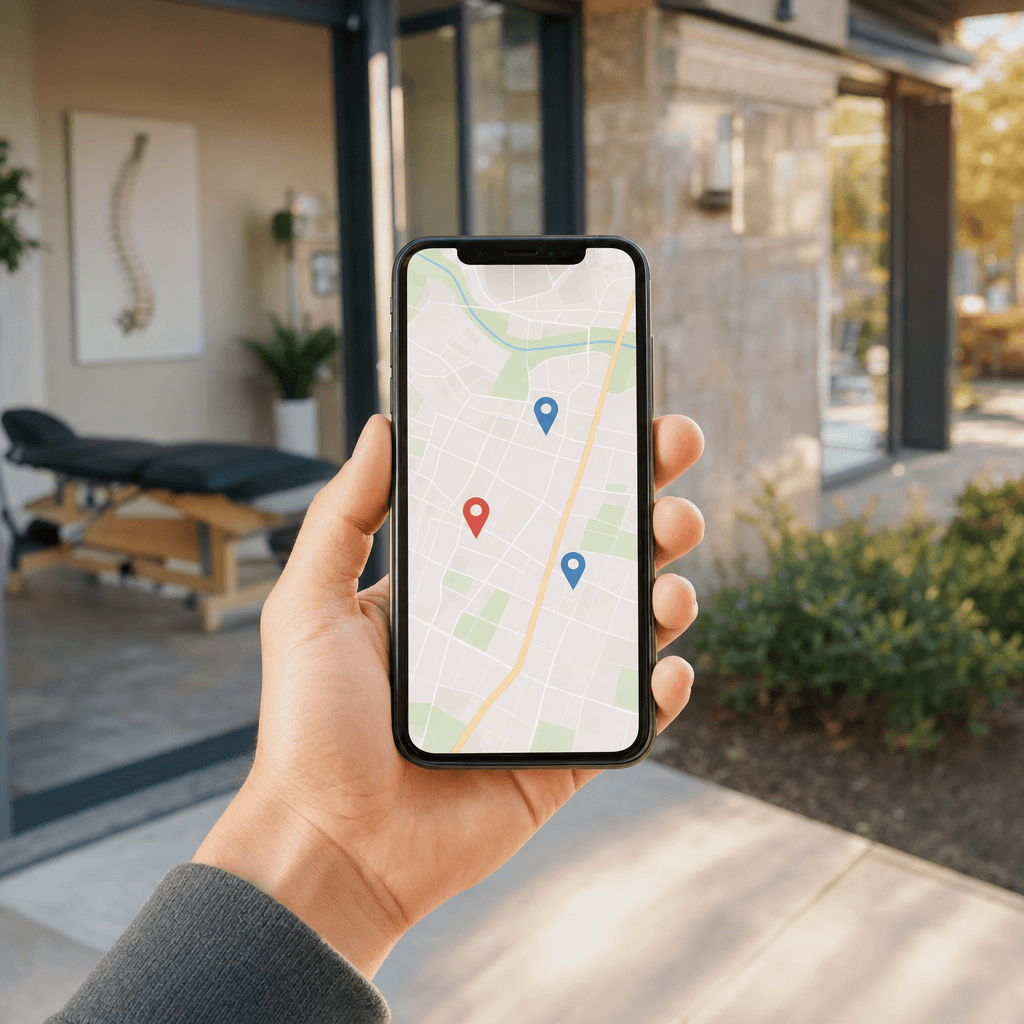
A chiropractor shows up in the Google Maps results by having a complete Google Business Profile, accurate business details across the web, and a steady flow of recent patient reviews, all close to the searcher.
Local SEO is the highest-return work for most chiropractic practices. It decides whether you appear when someone nearby searches for care, especially in the Google Maps results that sit at the top of the page.
A quick distinction helps here. The search a patient types, like chiropractor near me, triggers a local map with three featured practices. The search a practice owner types, like chiropractor SEO, does not. So this page is not trying to win a map result for itself. It is explaining how to win one for your practice.
Your Google Business Profile is the map engine. Your Google Business Profile is the single most important local asset you have. It feeds the Google Maps results directly. A complete, accurate profile helps your practice show up when nearby patients search.
The basics matter more than most owners think. Your primary category should be Chiropractor. Your name, address, and phone number must match everywhere they appear online. Add real photos of your office and team. Keep your hours current. Post updates, and answer the questions patients ask. Google Business Profile Posts now feed AI Overviews as well, so a profile that stays active does double duty.
A few extras separate a strong profile from a basic one. List your services, like spinal adjustment and spinal decompression, so they appear on your profile. Add the attributes patients look for, like wheelchair access, new-patient availability, and the insurance you accept. Reply to every review, good or bad, because Google and patients both read your responses.
The three things that decide the map results. Google ranks the map results on three factors, in plain English. Proximity is how close you are to the searcher. Relevance is how well your profile and website match what they want. Prominence is how known and trusted your practice is, which reviews and links help build.
You cannot move your office closer to every patient. But you can win on relevance and prominence, and that is where a real system earns the placements. We do not promise map placements, because no honest provider can. We work toward stronger local signals that move you up over time. For deeper local work, see our Google Business Profile optimization service. For the full playbook, see our deeper guide on local SEO for chiropractors.
The Keywords and Content
That Bring In Patients.
Which keywords should a chiropractic practice target? Keywords are simply the words patients use when they search. For a chiropractic practice, they fall into clear groups, and getting the groups right is half the work.
There are two main tiers. Condition keywords are what hurting patients type, like back pain, sciatica, neck pain, headaches, and sports injuries. Treatment keywords are what they search once they know the care, like spinal adjustment, spinal decompression, and dry needling. Add a location to either, and you have the local phrases that bring in nearby patients.
Intent matters as much as the word itself. A patient searching what does a chiropractor do for sciatica is still learning. A patient searching chiropractor near me open today is ready to book. Your practice needs pages for both, because the first search builds trust and the second fills the schedule. Phone and voice searches reward plain, conversational answers, which is one more reason clear questions and short answers help.
There is a catch that trips up most do-it-yourself efforts. Google's Keyword Planner restricts some health terms, so the easy research tool comes up thin for chiropractic. We work around it. We read the real questions in Google Search Console, study autocomplete and related searches, review the questions Google already shows, and use Semrush for volume and difficulty. That gives a real picture of demand instead of a guess.
The point is not to chase every word. Part of our job is telling you which keywords matter most for your practice right now. We map them to pages a patient would actually read. For the content side of this work, see our SEO content strategy.
Condition and location pages: building topical authority. A chiropractic website earns authority by covering its topics well, not by posting random blogs. The structure that works is a hub and spoke. One strong page anchors a topic, and supporting pages connect to it.
Here is how it looks for a practice. A main service page on a condition, like back pain care, links down to related pages, like spinal decompression. Those pages link back up. A blog post answering a real question, like how many adjustments back pain usually takes, supports the condition page. Each page targets one clear idea. Together they tell Google your practice has real depth on that topic.
Condition pages deserve their own home. A patient with sciatica wants a page about sciatica, not a paragraph buried on a general services page. The same is true for auto accident and personal injury care, which is a high-value area for many practices. Give each condition the page it deserves, and you become the obvious answer for those searches.
Most practices have a clear set of pages worth building. The common ones cover back pain, sciatica, neck pain, headaches and migraines, auto accident and whiplash care, sports injuries, pregnancy and prenatal care, and scoliosis. Each page answers what the condition is, how chiropractic care helps, and what a first visit looks like. If you run more than one office, every location also needs its own page, so a patient in one town is never sent to a page about another.
A simple content calendar keeps this going. Posture for back-to-school season, sports injuries in the fall, and pain after winter all give you timely reasons to publish. Over time, this depth is what separates a practice that ranks from one that does not.
Patient Reviews and
Online Reputation.
GEO ANSWER
Patient reviews influence both how a chiropractic practice ranks in local search and whether a new patient chooses it, so a steady flow of recent, genuine reviews matters more than a single high number.
Reviews do two jobs at once. They help your practice rank in the Google Maps results, and they convince a nervous new patient to call. For a health decision, that trust is everything.
The bar keeps rising. According to BrightLocal's 2026 Local Consumer Review Survey, 31 percent of consumers now require a 4.5 star rating or higher before they will book, up from 17 percent the year before. The same survey found 74 percent read only reviews from the last three months. That means a wall of old five star reviews is not enough. Recent reviews win.
A steady, ethical review habit is the answer. We help practices ask every happy patient at the right moment, often with a simple text after a visit or a QR code at the front desk. We never buy reviews, never gate them, and never write them for you. That protects your practice and keeps you on the right side of platform rules.
Steady beats sudden. A handful of new reviews every month looks more natural to Google and to patients than a rush of fifty at once. The goal is a real, ongoing habit, built into how your front desk already works, so recent reviews keep arriving on their own.
Negative reviews happen to every practice. The fix is not a review-removal service. It is a calm, professional reply that shows future patients you listen. A handful of thoughtful responses can build more trust than a perfect score. Beyond Google, profiles on Healthgrades, Zocdoc, Yelp, and RateMDs widen your reach. For ongoing help, see our reputation and review management service. For the complete approach, see our guide to reputation and review management for chiropractors.

Schema, Technical SEO,
and Local Authority.
GEO ANSWER
Schema markup is code that tells Google and AI tools exactly what a chiropractic practice is, where it is, and what it treats. The most useful types for a chiropractor are MedicalClinic, Physician, Service, and FAQPage, which help the practice appear in rich results and AI answers.
Schema markup, the part most providers skip. This is where most chiropractor SEO falls short, and where a real advantage hides. Almost no competitor explains schema for chiropractors, yet it is one of the clearest ways to help Google and AI tools understand your practice.
In plain English, schema is a label you add behind the scenes. People do not see it, but search engines and AI tools read it. It removes guesswork. Instead of hoping Google figures out that you are a chiropractic clinic, you tell it directly.
A few types do the heavy lifting for a practice. MedicalClinic, with a medical specialty of Chiropractic, defines what your business is. Physician or Person markup, with the doctor's credentials, ties a real, licensed provider to the practice and builds trust. Service markup describes the care you offer. FAQPage markup turns your common questions into content that can show up directly in search and answer boxes. For the broader version of this work, see our digital brand entity optimization service.
Technical SEO and your website. The best content cannot rank on a slow or broken website. Technical SEO is the behind-the-scenes work that lets search engines crawl, understand, and reward your pages. Speed is first. Patients leave a slow page, and search engines notice. Mobile comes next, because most patients search on a phone. Crawlability matters too. If search engines cannot reach a page, it cannot rank. We build practice sites on WordPress, tuned for speed and search, and we make sure online booking is easy to find so a ready patient can book in a tap. For a full rebuild or a tune-up, see our WordPress design and SEO service.
Link building and local authority. Prominence, one of the three map factors, grows when trusted sites mention and link to your practice. For a chiropractor, the best links are local and relevant, not bought in bulk. Local news, wellness and fitness blogs, employer wellness programs, and local sports team sponsorships all create honest links and real visibility. Professional listings help too, like the Illinois Chiropractic Society and the American Chiropractic Association member directory. Paid ads can fill the gap while SEO grows, but they stop the moment you stop paying. SEO keeps working. For ongoing outreach, see our local link building service.
HIPAA-aware marketing and tracking. A short, honest note first. The Search Sherpa is a visibility specialist, not a HIPAA compliance officer or an attorney. Marketing tools collect data, and some tracking pixels and contact forms can capture details that count as protected health information if you are not careful. So we work carefully. We keep marketing data handling tidy, we avoid tools that grab sensitive details by default, and we flag anything that needs professional review. We do not provide legal advice. We make sure your marketing respects patient privacy and we tell you when to bring in an expert.

AI Search and Answer Engine
Optimization for Chiropractors.
GEO ANSWER
Answer Engine Optimization structures a chiropractic website so ChatGPT, Perplexity, Google AI Overviews, and Gemini can quote it directly. Questions as headings, short direct answers, and FAQ schema are what these tools pull from.
Search is changing. More patients now ask ChatGPT, Perplexity, Gemini, and Google AI Overviews for a recommendation before they ever click a website. Your practice needs to be ready to be the answer, not just a link.
This is not a far-off trend. An AI Overview already appears for chiropractic SEO searches today, and these tools pull from clear, well-structured, well-attributed pages. They favor content that answers a question plainly and proves who is behind it. Word count alone does not win. Clean structure does.
Answer Engine Optimization is the work of giving these tools what they need. We use questions as headings, lead each section with a short and direct answer, and back it with FAQ schema and named author details. We connect your practice to the trusted sources and structured data that AI tools rely on. The same work that earns AI citations also strengthens your normal search and local rankings, because both reward clarity and trust.
The practices that prepare now will own this space while competitors wait. For the dedicated version of this work, see our AI search optimization service.
How We Work:
From Review to Results.
How long it takes and what it costs. Most local SEO shows measurable movement in about three to six months, depending on competition and the condition of your site. A newer site in a busy city takes longer than an established one in a smaller market. Anyone promising overnight rankings is not being straight with you. On cost, we will be clear about pricing before any work begins. For a local practice, monthly SEO usually runs between about $1,000 and $3,000, depending on your competition, your goals, and the condition of your site. We break down what chiropractor SEO costs and the patient math behind that range in a separate guide. We do not publish a flat rate card, because no two practices need the same work. The value shows up over time, and unlike ads, SEO keeps earning after the work is done. For the full breakdown, see our SEO pricing guide.
We keep the process simple and transparent. Four steps, and you understand each one.
01. Visibility Review. We review your website, local search presence, Google Business Profile, competitors, current rankings, content, and conversion paths. You get a clear picture of where you stand and what is holding visibility back.
02. Strategy Map. We build a plan for local SEO, website structure, content, technical fixes, reviews, and trust signals. You get a prioritized plan you can understand and approve.
03. Build and Optimize. We improve the website, service and condition pages, internal links, schema, your Google Business Profile, content, and conversion paths. The visibility system gets built and refined.
04. Measure and Refine. We track performance, review search behavior, update content, and improve over time. You get plain-English reporting tied to real patient calls, not charts that bury you.
Want a clear picture of what your practice needs? We will walk through it together. No pressure and no contract.
Founder-Led and
Healthcare-Ethical.
The Search Sherpa is led by Jeremy Bengtson, the founder and the person you actually work with. Jeremy is based in Mokena, Illinois, holds a business degree from Western Illinois University, and is Semrush certified. The Search Sherpa LLC has served local businesses since 2024, including med spas, law firms, real estate professionals, home service contractors, and other professional services.
We work with professional tools like Semrush, Rank Math, and Google Search Console, and we use them to guide decisions, not to bury you in charts. Our approach is ethical and plain-spoken. No black-hat tactics. No guaranteed rankings. No contracts. Clients stay because the work earns it.
That matters more in healthcare than anywhere else. Your reputation is your practice. We market it with care, we respect patient privacy, and we never make claims about patient outcomes. You can read what clients say on our testimonials page, and you can learn more about Jeremy Bengtson before we ever talk.
Chiropractor SEO from Mokena, Illinois, for practices nationwide. The Search Sherpa is based in Mokena, Illinois, and we help businesses across Will County and the southwest Chicago suburbs become easier to find. The chiropractor SEO work on this page is not limited to one area. We help chiropractic practices across the country build the same connected visibility system, wherever their patients are searching. A quick note on accuracy. We are a single, founder-led practice in Mokena, Illinois. We do not run branch offices in other cities, and we will never list a fake address to fake a local presence. Honesty is part of how the work earns trust.
Questions Practice
Owners Ask Us.
Let Us Help Patients
Find Your Practice.
If your practice is ready to become easier to find, easier to understand, and easier to choose, we can help you build the visibility system behind that growth. Start with a conversation. We will look at where you stand and what comes next ... no pressure and no contract.
Founder-led. Healthcare-ethical. No contracts. Call (217) 579-8791.