

Med Spa Marketing ROI: A Practical Owner’s Guide to PPC, SEO, and What Actually Drives Patient Growth
Every med spa owner reaches this crossroads eventually. The paid ads are producing leads, sometimes great ones, sometimes expensive ones, and someone suggests that maybe SEO would work better in the long run. Or the reverse: an organic strategy has been running for months, results are slow, and the pressure to just turn on Google Ads and get the phones ringing is real.
The question of PPC versus SEO for med spas isn’t really a question of which channel works. Both work. The more useful question is: what does each channel actually buy you, what does it cost per acquired patient across different execution scenarios, and when should your investment be weighted toward one versus the other?
This breakdown gives med spa owners a grounded, numbers-first view of both channels, including real benchmarks, patient acquisition cost scenarios, and a practical framework for deciding how to allocate growth budget based on where your business is right now.
What PPC Actually Buys You
Paid search and paid social do one thing better than any other channel: they create immediate, controllable demand flow. When a campaign is set up properly and the budget is live, you are buying visibility in front of people who are actively searching for your treatments or who fit the profile of someone likely to book.
For med spas, the two main paid channels work differently. Google Search captures high-intent, in-market demand: people typing “botox near me” or “laser hair removal [city]” are close to a decision. Meta (Facebook and Instagram) operates differently, reaching people who match a demographic and behavioral profile but may not be actively searching; it tends to generate higher consultation volume at a lower cost per lead, but with a lower lead-to-patient conversion rate because intent is softer.
The benchmarks for Google Ads in the med spa space are meaningful:
- Cost per click (CPC): $4 to $12 for botox and filler terms; $6 to $18 for laser and body contouring
- Conversion rate on lead forms or calls: 5% to 15%
- Cost per lead (CPL) on Google Search: $40 to $120
Meta campaigns typically run at $30 to $80 CPL, with lead-to-consult conversion rates of 15% to 35%. The lower cost per lead on Meta is real, but so is the additional follow-up work required to convert those leads, which means the economics only favor Meta when a practice has tight follow-up systems in place.
What PPC does not buy you is permanence. When spend stops, visibility stops. Every patient acquired through paid search has a direct, attributable cost attached. That is fine; many businesses run entirely on paid acquisition, but it means your CAC (customer acquisition cost) has a floor determined by auction prices that you don’t control. As more med spas enter the Google Ads auction for botox terms in a given market, CPCs rise, and the efficiency of the same dollar decreases over time.
The practical implication: paid campaigns are excellent for controlling timing, testing offers, capturing demand for specific treatment launches, and keeping your consultation calendar full in the near term. They are less suited to building an inbound machine that compounds over time.
What SEO Actually Buys You
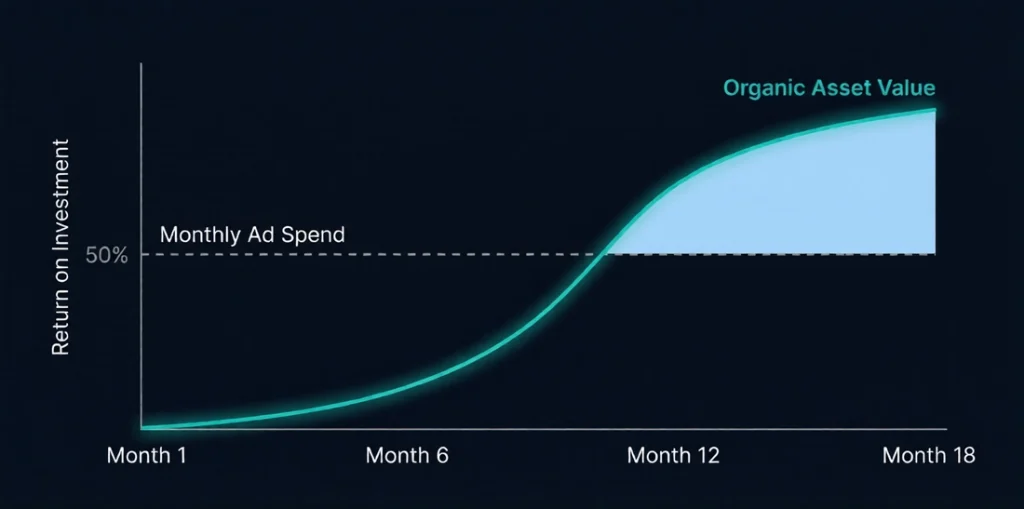
Organic search optimization works on a fundamentally different asset model. When you invest in SEO for a med spa, you are building pages, authority signals, and local visibility that remain on the internet, and in Google’s index, long after the work is done. A well-optimized treatment page for “microneedling [city]” that ranks in position two or three is generating consultation requests without a per-click cost every time someone finds it.
Effective SEO for a med spa is not a single tactic. It usually includes treatment pages optimized for local and service intent, location pages for each market the spa serves, internal linking between relevant content, technical site health (page speed, mobile experience, crawlability), Google Business Profile optimization, citation building and accuracy, review generation and management, before-and-after photography as conversion content, and ongoing content production that answers treatment-stage questions patients have before booking.
Done right, that package of assets produces compounding returns. A review strategy that brings a practice from 150 reviews to 400 reviews over 18 months doesn’t just improve conversion rates, it improves map pack rankings, it improves trust on every other paid or organic channel, and it produces durable signal that no competitor can instantly erase by outbidding you on a keyword.
The trade-off is time. SEO rarely produces meaningful new patient volume in month one or two. Typical trajectories look more like measurable movement in months three through five, traction in months six through nine, and a well-functioning organic inbound system somewhere around month 10 to 18, depending on market competitiveness, the starting state of the website, and how aggressively the program is executed.
Pricing for med spa SEO follows the same published tiers as our cost page. A one-time roadmap is $2,000, credited toward the first month if you continue. A suburban or moderate-market single location is $1,500 to $2,500 per month. A competitive metro single location is $2,500 to $4,500 per month. Multi-location groups sit above that, because each location needs its own pages, profile, and review operation. Cost depends on your site, your competition, and your goals. We will be clear about pricing before any work begins.
The Real Cost Per Patient: Side by Side
Here is where the channel comparison gets concrete. Patient acquisition cost is simply total channel investment divided by new patients acquired in a given month. For PPC, the calculation is: cost per lead divided by your lead-to-patient conversion rate. For SEO, the math takes longer to arrive at because organic traffic and conversion build gradually, not in a stable month-one pattern.
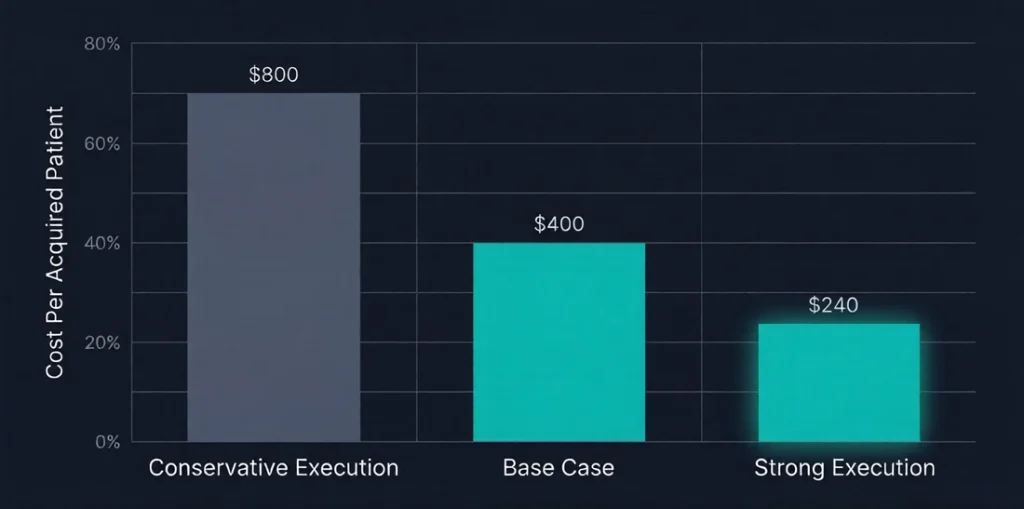
PPC acquisition cost scenarios at $4,000 monthly ad spend:
| Execution level | CPL | Lead-to-patient rate | New patients | CAC |
| Conservative | $120 | 15% | 5 | $800 |
| Base case | $80 | 20% | 10 | $400 |
| Strong execution | $60 | 25% | 16 to 17 | $240 |
What the table reveals is that the difference between a $240 CAC and an $800 CAC at the same ad spend is almost entirely execution: the quality of the landing page, the strength of the offer, the speed and skill of front-desk follow-up. Poor lead handling is one of the primary reasons paid campaigns underperform in med spas; a campaign generating a $60 CPL becomes wildly expensive if only one in ten leads ever books a consultation.
SEO acquisition cost scenarios at a $2,500 monthly investment:
| Phase | Monthly patients | CAC |
| Early months (ramp period) | 3 to 6 | about $417 to $833 |
| Established traction | 10 to 18 | about $139 to $250 |
The early-months SEO numbers look worse than PPC on paper because they are. SEO costs money before it produces patients. But the established-traction numbers tell a different story: once rankings, conversion systems, and review volume mature, organic acquisition cost competes favorably with even well-run paid campaigns, and does not increase as Google auction prices rise.
The most important insight across both tables: every patient number in the PPC column assumes consistent ad spend, and every patient number in the SEO column assumes the website and content assets remain live. Stop the ads, lose the PPC patients. Keep the SEO assets, keep the organic patients, even if active investment slows.
Budget Planning by Growth Stage
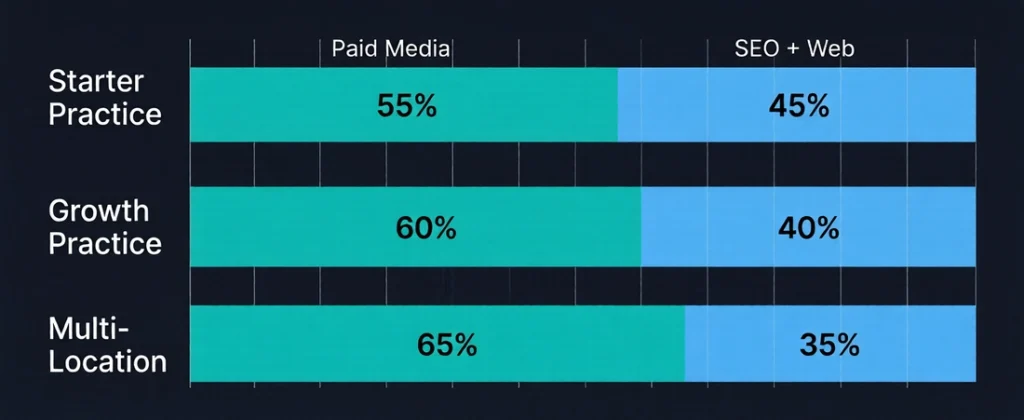
Most med spa marketing conversations fail because they treat budget as a single number rather than as an allocation decision with a strategic rationale. Here is a practical framework by growth stage.
Starter single-location practice: $5,000 to $7,500 per month total
A practical split is $2,500 to $4,000 in ad spend alongside $1,500 to $2,500 in SEO and website improvement. This gives the practice immediate lead flow through paid while simultaneously building treatment pages, a review generation system, local landing pages, and conversion infrastructure. The ads support revenue today; the SEO investment builds assets that will reduce CAC over the next 12 to 18 months.
Growth-stage practice, scaling 2 to 4 treatment lines: $8,000 to $12,500 per month
At this stage, the realistic allocation is $4,000 to $8,000 in ads, potentially split across Google Search and Meta depending on treatment mix, plus $2,500 to $4,500 in SEO, content production, conversion rate optimization, and local authority building. The SEO investment here also protects the practice from full dependency on paid traffic, which becomes a meaningful business risk when a single channel accounts for most consultations.
Multi-location or competitive metro market: $12,000 to $26,500+ per month
At scale, ad budgets may run $8,000 to $20,000 or more across locations and campaigns. SEO investment typically starts at $4,500 per month when each location needs its own treatment and location pages, backlink profile, review operation, and map pack presence. Multi-location practices that under-invest in local SEO often find that their second and third locations produce a fraction of the organic lead volume of their flagship, not because the market is weaker, but because the digital local presence was never properly built.
Break-Even Math Every Owner Should Run
Before debating channels, it helps to know how many new patients each channel needs to produce to justify its cost. The math is simple when you know your gross profit contribution per new patient.
For a med spa focused on injectables and facial aesthetics, a reasonable blended gross profit contribution per new patient in the first 12 months, after provider cost, consumables, and direct fulfillment expense, is approximately $1,200. That figure varies by treatment mix and pricing, but it gives a workable anchor.
Break-even new patients = monthly channel investment ÷ $1,200 gross profit per patient
| Channel model | Monthly investment | Break-even patients needed |
| Starter PPC | $2,500 | 2.1 |
| Growth PPC | $6,000 | 5.0 |
| Balanced SEO | $2,500 | 2.1 |
| Premium SEO | $4,500 | 3.8 |
| Blended growth model | $8,500 | 7.1 |
What this makes clear is that the break-even bar for either channel is modest at typical med spa contribution margins. A starter PPC program breaks even with three new patients. A balanced SEO program breaks even with three new patients. Neither channel requires a transformation in patient volume to justify the investment; they require consistent execution and effective conversion from lead or visitor to booked consultation.
The real risk in med spa marketing is not which channel you choose. It is paying for traffic or leads that never become patients because the website does not convert, because the front desk does not follow up, or because the offer and creative are weak. Both channels will underperform in the same practice that has broken conversion infrastructure.
When Each Channel Wins
There is a third line on that budget now, and what a clinic pays for AI search work prices it and runs the break-even math the same way this page does for paid and organic.
Rather than a blanket recommendation, here is a direct assessment of when each channel is the right tool.
Lead with PPC when:
- The practice is new or in a new market and needs booked consultations within 30 to 60 days
- You are launching a new treatment line and want to test offer messaging and demand before investing in long-form content
- There is a seasonal promotion or limited-time offer that needs immediate reach
- The website is already optimized and converting well, so paid traffic has somewhere productive to land
Lead with SEO when:
- The practice has stable revenue and wants to reduce its dependence on paid traffic over 12 to 24 months
- You are competing in a market where Google Maps pack rankings and review volume are the primary trust signals for high-intent patients
- CAC is climbing on paid channels and the long-run economics of owned traffic are increasingly attractive
- The website has significant treatment content gaps, thin location pages, or poor organic visibility that a competitor is actively exploiting
Do both when:
- You want immediate consultation volume and are willing to invest in long-run acquisition efficiency at the same time
- The practice is growing aggressively and cannot afford either a traffic gap or an escalating paid-media dependency
- You are building toward a multi-location model where local organic presence at each location matters for enterprise value
A Practical Playbook for Med Spa Owners
Add one more habit to that playbook and check what the answer engines say about your clinic each quarter, which our med spa AI search visibility guide shows you how to do properly.
Regardless of where you start, the mechanics of a well-run med spa marketing program look like this:
Treat the website as a revenue asset, not a brochure. Every treatment page should explain what the treatment does, who it is for, what to expect, and why your practice is the right place to receive it. Thin pages, two paragraphs and a call button, convert poorly from both organic and paid traffic. Pages with real clinical detail, before-and-after photography, provider credentials, and patient FAQs convert better from every source.
Build a review generation system, not a hope. Map pack rankings for high-intent local searches are heavily influenced by review volume and recency. Practices with 300+ reviews in a market where competitors have 80 win the trust comparison before a patient even visits the website. That requires a systematic ask, at the end of every appointment, through automated post-visit text, embedded in the patient journey in multiple places.
Track what actually matters. Clicks, impressions, and organic sessions are directional metrics. The metrics that tell you whether marketing is working are booked consultations by channel, new patients per month, CAC by channel, and gross profit per acquired patient. If your reporting stops at leads or cost per lead, you are optimizing the wrong number.
Audit your follow-up speed. Paid campaigns are a common scapegoat for poor results when the actual failure is front-desk response time. Leads that are not responded to within minutes, not hours, on high-intent treatment inquiries convert at a fraction of the rate of immediate-response leads. If the consultation calendar is not filling despite lead volume, follow-up handling is the first thing to investigate.
Allocate for both channels when you can. The strongest med spa marketing position is not “we’re an SEO shop” or “we run ads.” It is a practice that has immediate paid visibility, growing organic rankings, a strong review profile, a website that converts across every entry point, and a follow-up system that turns inquiries into booked consultations consistently. That combination is more defensible, more efficient, and more valuable than either channel alone.
The Bottom Line
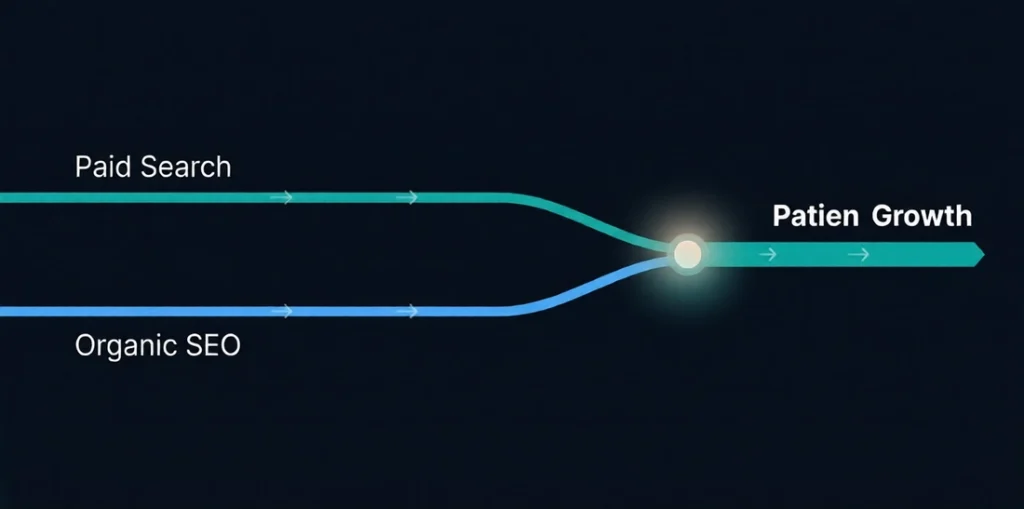
PPC and SEO are not competing strategies for med spas; they are complementary channels that solve different problems on different timelines. Paid advertising creates immediate demand capture and is the right tool for speed, seasonal offers, and treatment launches. SEO and website investment build the owned asset that makes acquisition progressively cheaper over time and makes the practice less exposed to rising click costs and platform risk.
The most common mistake med spa owners make is treating this as an either/or decision when the actual risk is over-indexing on one channel to the point where the business becomes dependent on it. Over-dependence on paid traffic means every year you pay more per patient as competition increases. Over-dependence on organic means slow starts, missed opportunity during high-demand windows, and vulnerability to algorithm changes.
The right allocation depends on where your practice is today but for most med spas, the answer to “PPC or SEO” is: both, in proportions matched to your current growth stage and 12-month revenue goals.
Ready to Map Out Your Med Spa Marketing Budget?
At Search Sherpa, we work with med spas at every stage, from single-location practices building their first patient acquisition system to multi-location groups looking to reduce CAC and build long-term channel resilience. Our med spa SEO services focus on building the organic side of that mix.
If you want a clear-eyed look at what a blended PPC and SEO strategy would cost, what it would realistically produce for your market, and how to prioritize investment given where you are right now, we’re happy to walk through it with you.
Schedule a free strategy consultation →
No pitch. Just a straightforward conversation about your numbers, your market, and what a realistic growth plan looks like.
About Search Sherpa: Jeremy and the Search Sherpa team are search marketing specialists focused on helping businesses build smarter, more efficient inbound systems. We work in paid search, SEO, and conversion strategy, and we care about the actual business outcome, not just the campaign metrics.
Explore This Topic


Join Over 400,000 Entrepreneurs Getting Our Weekly Newsletter
Recent Posts

October 12, 2026
A YouTube demo shows only part of a provider’s work. Learn what to verify about AI review, access, backups, testing, ownership, and support

October 12, 2026
Watch a 129-second AI Dialogue about coding permissions, approval fatigue, and the risk of giving an AI agent control you cannot evaluate.

October 8, 2026
How to choose an SEO consultant in Chicago: consultant, agency, or freelancer, a decision tree, a vetting checklist, red flags, and rates in