

SEO for financial services is how a bank, a payments company, or an advisory firm becomes easy to trust and easy to find. The work is clear service pages, a compliance read on every fee claim, a fast website, and a Google Business Profile where a real office exists. Those facts have to stay clear for search engines, AI tools, and customers.
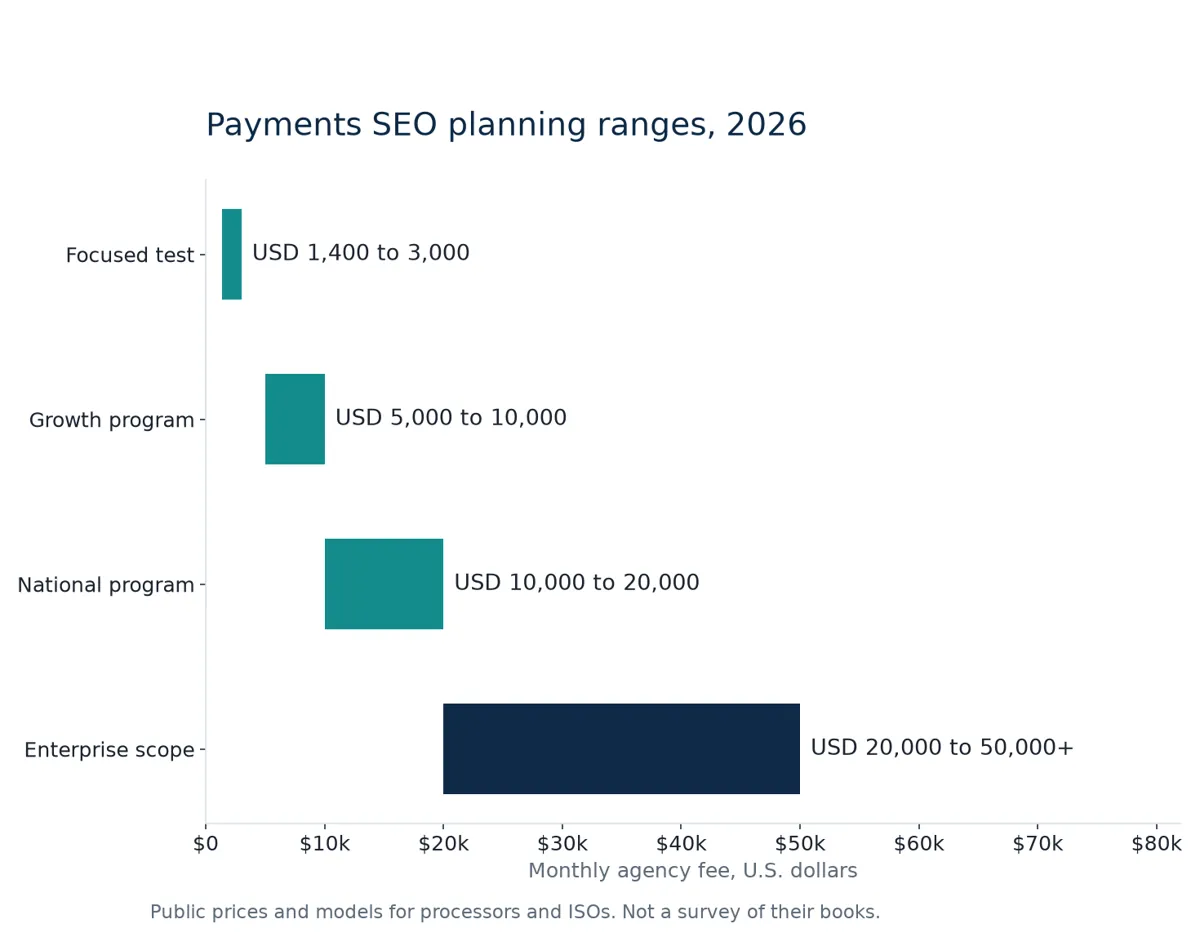
Part of that visibility system is AI search optimization. ChatGPT, Perplexity, Gemini, and Google AI Overviews need a clear company to cite. For a payment processor or an independent sales organization (ISO), a growth program is often planned at $5,000 to $10,000 a month. A narrow test can start near $1,400. National work often runs $10,000 to $20,000 before any ads. Those figures are planning ranges from public agency prices, gathered on September 21, 2026. They are not a quote from The Search Sherpa.
Card fees are a different bill. Merchants often pay about 1.5% to 3.5% of a sale to accept a card. This page is not that price list. It is the cost to be found by the merchants, partners, and software firms you want to sign.
Google treats money topics as Your Money or Your Life pages. The quality bar is very high. A generic local retainer will not cover the research, the fee proof, or the compliance read a processor needs. Movement usually takes three to six months, depending on competition and the condition of your site.
What SEO for financial services includes
People who search this phrase want the work, not a slogan. The guides that rank walk through trust, compliance, the website, and local profiles. A processor needs the same list, aimed at merchant acquisition.
Think of one visibility system, not a pile of disconnected tasks. The pieces below are the ones that change whether a merchant can find you, understand you, and choose you.
Google Search
Build one strong page for each way you get paid. Card-present, online checkout, ACH, a gateway, and high-risk acceptance should not share one thin page. Restaurants, healthcare, professional services, and field crews often need their own page too.
Each page should say who the offer is for, how pricing works in plain English, and what proof you can show. Fee claims need a source. A page that promises the lowest rate with no math will not earn trust, and it can create a compliance problem.
Your website
The site has to load, explain the offer, and track an application. Speed, mobile layout, and a clean path to apply are part of the job. So is the tracking that tells you which page led to a started application.
If the site looks fine and still does not bring qualified merchants, look at structure and proof. A new color will not fix that. WordPress design and SEO belong in the same project when the theme fights the content.
Google Maps and your Google Business Profile
A national processor gets less from a city-page package than a territory ISO does. If you have a real office, or agents who sell in named cities, the Google Business Profile still matters. The name, address, phone, and categories should match the website.
Keep posts, services, and reviews current. Do not invent offices you do not have. Google Business Profile management is the local piece. It is not a substitute for the product pages.
AI answer tools
Merchants now ask ChatGPT, Perplexity, Gemini, and Google AI Overviews which provider to call. Those tools repeat brands they can verify. Your name, your leaders, and your product facts need to agree across the site and the profiles you control.
That work is digital brand entity optimization. It is how a payments brand becomes easier to find, easier to understand, easier to choose. A blog post alone will not do it.
Content and proof
Publish answers merchants already ask. Interchange plus pricing, surcharging rules, and reserves are common ones. Put a date on the page. Name the author. Link the rule or the rate table you used.
SEO content marketing strategy is this layer. For payments, two careful articles a month beat eight thin ones. A specialist content program is often planned at $5,000 to $20,000 a month when it is the main offer.
Why a payments company pays more than a local shop
A broad SEO survey puts the average agency retainer near $3,209 a month. Local work in that same survey averages about $1,557. About 63% of providers in the survey reported $500 to $5,000 a month. Those numbers are a floor. They are not a payments quote.
Payments sits above that floor for clear reasons. Head terms such as merchant services and credit card processing are crowded. High-risk files need careful language about underwriting, chargebacks, and reserves. Several products and several merchant types multiply the pages.
You also need a compliance pass before a fee claim goes live. You need reporting on applications and activations, not just visits. Jeremy Bengtson, founder of The Search Sherpa, puts it this way to payments clients. Separate three numbers before you hire anyone. Look at the agency fee, the ad budget, and the cost of a merchant who starts processing.
What the monthly SEO fee usually covers
Use the bands below as a planning map for a U.S. processor or ISO. The low end is a constrained program. The high end is a multi-product or national fight. Do not add the top of every row and call it your budget.
| Level | Monthly fee | What you usually get |
|---|---|---|
| Focused test | $1,400 to $3,000 | Technical cleanup, a keyword map, light on-page work, a little content, and a report |
| Growth program | $5,000 to $10,000 | Technical work, a few expert pages a month, vertical pages, and pipeline reporting |
| National program | $10,000 to $20,000 | Faster content, digital PR, more products, and stronger technical support |
| Enterprise scope | $20,000 to $50,000+ | Multi-market strategy, a large content program, and compliance workflow |
One-time audits sit outside the retainer. A basic audit is often $500 to $1,500. A broader small-business audit is often $1,500 to $5,000. A large or messy site can run $8,000 to $25,000 or more. Ongoing monitoring, without a big rebuild, is often $500 to $1,500 a month.
A fair page budget, when no public payments rate card exists, is about $750 to $2,500 for one substantial page. That model includes research, copy, a compliance read, on-page work, and build time. It is an estimate, not an industry average.
What a fintech marketing agency publishes as a price
Fintech marketing agency is its own search, about 320 U.S. queries a month, and the ads bids are high. The results are mostly agency lists. Very few of those firms print a full rate card. Where a price is public, compare the scope, not the sticker.
These figures were on the providers’ own sites in a September 21, 2026 research pass. Confirm the live page before you treat one as an offer. A low sticker can be 30 keywords and a light report. A higher sticker can be a team.
| Published example | Price seen | How to read it |
|---|---|---|
| Payments SEO, low anchor | About $1,400 a month, or $2,000 for high-risk | Useful floor. It should not set the middle of the market. |
| Financial-services SEO retainer | $3,000 setup, then $6,000 a month | A named execution plan. Ads were 12% of spend, or a minimum, on top. |
| Fintech SEO plans | $4,050, $6,885, and $12,600 | Strategy, done-for-you, and a larger plan. The best published rate was tied to 12 months. |
| Fintech content program | $5,000 to $20,000 a month | Content and acquisition help, not a full media budget. |
| One fintech service, or a bundle | $4,000 to $8,000, or $8,000 to $15,000 | A single service versus a wider bundle. Ask which is which. |
Some firms will not publish a price at all. A 2026 review of fintech agencies found that only a small minority print a monthly rate. Hourly quotes and project minimums are more common. That is a reason to ask for a written scope, not a reason to pick the cheapest PDF.
In-house or outside help
A U.S. SEO specialist is commonly reported around $65,000 to $114,000 in base pay. A fully loaded cost, with benefits, taxes, tools, and training, is often estimated at $95,000 to $145,000 a year. One hire knows your products. One hire rarely covers technical work, writing, digital PR, and reporting together.
At $5,000 to $10,000 a month, outside SEO costs $60,000 to $120,000 a year. That can be the rational choice when you do not have the team. At $15,000 to $25,000 a month, a hybrid is often cleaner. Keep an owner inside, and buy the specialist production you do not have.
What paid search costs on top of the fee
The SEO fee does not buy the clicks. Media spend is separate. Management is separate again. A common public model is 10% to 20% of ad spend, often with a minimum.
The click prices below are directional. They come from public keyword tools, and they mix dates and methods. They are not a current U.S. Google Ads forecast. Refresh the live forecast in your own account before you approve a budget.
| Keyword | Directional cost per click | How to use it |
|---|---|---|
| merchant services | About $38 to $40 | Very commercial. A small test will not cover it. |
| payment processing | About $29 to $59 | High commercial intent. Volume reports vary by tool. |
| credit card processing | About $55 to $58 | Very commercial. Treat the middle as a planning center, not a bid. |
| Finance category average | $3.46 | A 2025 blend of many finance searches. Do not plan head terms with it. |
That $3.46 average also came with a 2.55% conversion rate and about $83.93 per lead, across finance and insurance. It blends brand searches and research searches. Your head terms can cost many times more because one activated merchant can pay you for years.
Here is the stress test. At $40 to $60 a click, $5,000 buys about 83 to 125 clicks. Some of those clicks will be the wrong merchant, a bad form, or a lost sale. That is why a national attack on these terms needs more media than a local plumber campaign.
A practical learning floor for one business-to-business campaign is often $3,000 to $5,000 a month in media. A growth test across a few verticals is often planned at $10,000 to $35,000. Management on a $10,000 media budget, at 20%, is $2,000. Do not hide that fee inside the media number.
A planning budget for an ISO or a processor
The totals below are models. They are not a claim about what the average processor spends. Each total keeps the SEO fee, the ads, the ad management, and the other management apart. Software, events, sales pay, and legal review are outside the total unless you add them on purpose.
| Scenario | Monthly total | SEO | Ad media | Ad management | Other management |
|---|---|---|---|---|---|
| Small ISO | $7,500 | $2,500 | $3,000 | $1,000 | $1,000 |
| Growth company | $23,000 | $6,000 | $10,000 | $2,000 | $5,000 |
| Regional processor | $58,500 | $12,000 | $30,000 | $4,500 | $12,000 |
| National processor | $140,000 | $25,000 | $75,000 | $10,000 | $30,000 |
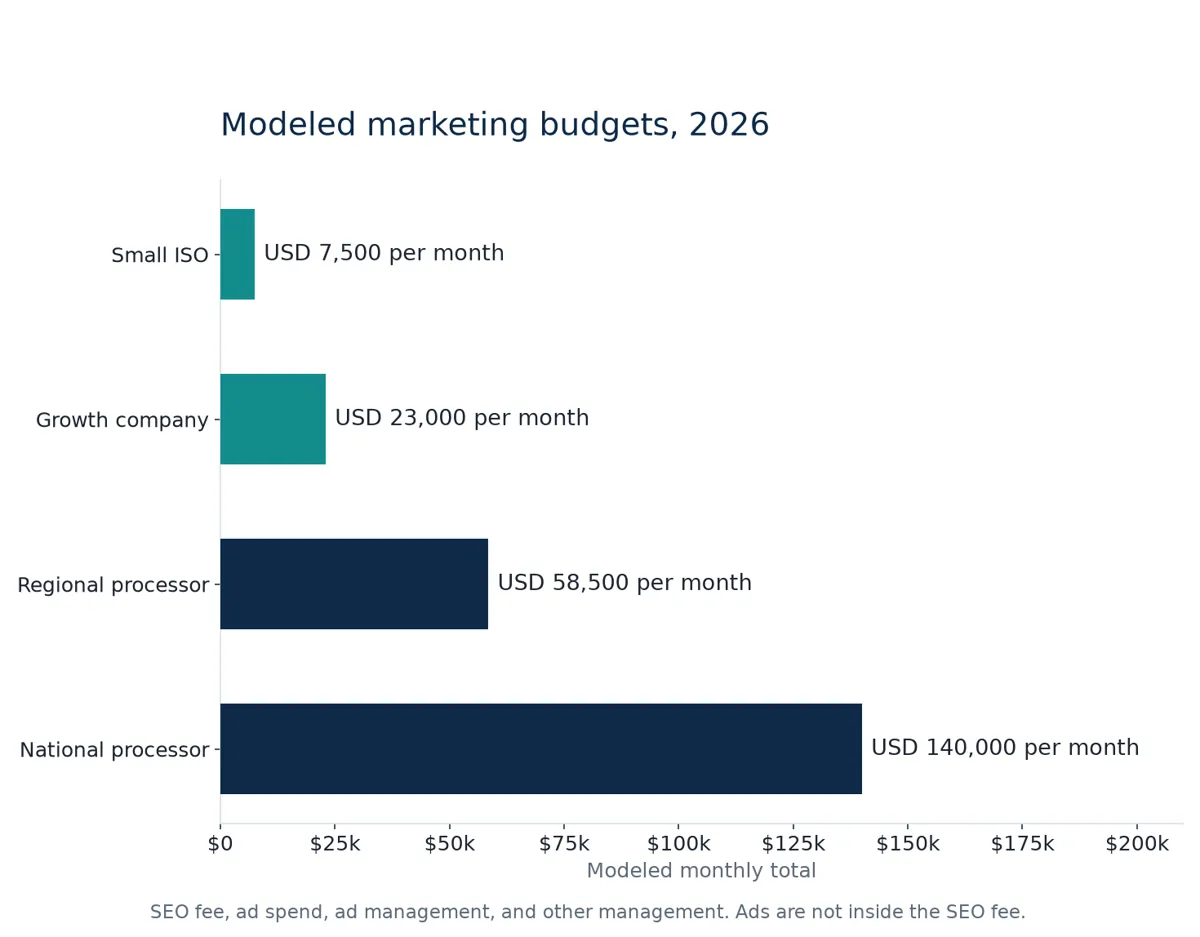
A small ISO at $7,500 should pick one wedge. One metro, one merchant type, or one partner channel. Pretending that budget covers every industry is how the test fails. A $5,000 month is even tighter. It can fund a focused SEO start and a small ad test, not national head terms.
The growth model lines up with public fintech bundles that often sit around $8,000 to $15,000 before media. The regional and national models pay for more landing pages, more proof, and enough search volume to learn. Public fintech guidance often puts mid-market agencies at $15,000 to $40,000 a month, before the media.

How agencies charge, and what to refuse
Most serious SEO work is sold as a monthly retainer. Hourly help fits an audit or a coach for your own team. Ask what the hour includes before you compare it with a monthly fee. A project fee fits a migration or a one-time audit. It does not keep compounding after the project ends.
A pay-for-rank deal, or a pay-per-lead deal with a fuzzy definition, needs extra care. The incentive can point at empty keywords. It can also point at leads your sales team will reject. If you use it, define a sales-accepted merchant in the agreement. Keep a base fee so the work does not depend on a trick.
Refuse a guarantee of a number one ranking. Google says no one can promise that. Also refuse a deal that leaves Google Search Console, analytics, and the website login only in the agency’s name. You should own the accounts on day one. When to hire an SEO consultant walks through that choice in plain English.
Some published fintech rates look best when you commit for 12 months. Read that term before you compare stickers. Jeremy Bengtson works from Mokena, Illinois, and the rule is simple. No contracts. Clients stay because the work earns it. We will be clear about pricing before any work begins.
What to count besides website visits
A shared merchant lead, a booked meeting, and an activated merchant are different products. Public lead vendors have shown shared records from a few dollars up to about $20. Scheduled appointments often land around $50 to $80. Qualified meetings often land around $250 to $450. An exclusive appointment is sometimes advertised “as low as” $600. That phrase is not an average.
There is no audited, public U.S. average for the full cost to activate a merchant. Marketing cost is not the whole number. Sales time, underwriting losses, equipment, and onboarding belong in the full cost. Reporting only the ad spend per activation will make the program look cheaper than it is.
Picture a 12-person ISO. One new merchant processes $30,000 a month. At a 15 basis point markup, the residual is about $45 a month before churn and service costs. Over five years, before those costs, that is about $2,700. This is one public illustration, not your book. It shows why a $7,500 test has to aim at merchants who stay. A huge national click budget does not fit that office.
Judge the channel on contribution per activated merchant, by vertical. A small restaurant and a large healthcare group should not share one target cost. If the payback is weak, fix the page, the offer, or the sales follow-up before you buy more clicks.
Questions about SEO for financial services
Is SEO still worth it in 2026?
Yes, when a new merchant stays and the fee is sized to that residual. A growth payments program is often planned at $5,000 to $10,000 a month, and movement usually takes three to six months. SEO does not replace sales. It helps the right merchants find you before they hire someone else.
Can ChatGPT do an SEO audit?
No. ChatGPT can draft a checklist. It cannot see Google Search Console, the crawl, or your fee pages unless you upload them. A basic audit is often $500 to $1,500, and a broader one is $1,500 to $5,000. Keep merchant data out of a public chat.
What is the 80/20 rule in SEO?
It is a planning habit, not a Google rule. A few pages usually create most of the pipeline. For a processor, start with product pages and the merchant types you actually want. A $1,400 test that chases every keyword will not teach you much.
What are the best SEO practices for financial planners?
Name the author, date the advice, and give each service its own page. Planners with an office should keep the Google Business Profile complete. A processor can copy the trust habits, not the city pages. Fee claims still need a source, because Google holds money topics to a very high bar.
How much does SEO for financial services cost?
A focused payments program is often $1,400 to $3,000 a month. Growth work is often $5,000 to $10,000. National programs run $10,000 to $20,000, and some enterprise scopes pass $50,000. A broad agency average is about $3,209 a month. These are September 2026 public prices, not a quote.
How much does a fintech marketing agency cost?
Published fintech plans often start near $4,050 to $6,885 a month. Larger scopes are published near $12,600, and content programs run $5,000 to $20,000. A $1,400 offer and a $6,000 offer are not the same scope. Ask what is included, who owns the accounts, and whether ads are extra.
Sources for the ranges on this page
The ranges come from a U.S. payments marketing benchmark dated September 21, 2026. That paper combined public agency prices, a provider survey, finance ad benchmarks, and labeled models. It is not a survey of processor books. The search demand for the main query comes from Google Ads data, United States, pulled on September 22, 2026.
- Ahrefs SEO pricing survey for the broad retainer average near $3,209 and the local average near $1,557.
- Google’s Search Quality Rater Guidelines overview for why money topics face a very high quality bar.
- WorkStream’s 2025 Google Ads benchmarks for the finance category click and lead figures.
- Rock The Rankings fintech pricing for the published $4,050, $6,885, and $12,600 plans.
- Upgrow financial services for the published $3,000 setup and $6,000 monthly plan.
Keyword click prices are tool observations, not a live U.S. Keyword Planner export. If two sources disagree, the label on the table tells you which kind of evidence you are reading. Use your own residuals before you copy any total on this page.
Explore This Topic
SEO for Financial Services: The Work and What It Costs

SEO Consultant Cost (2026): Hourly, Project and Retainer Rates Explained

Google Business Profile Management Pricing (2026): What the Work Costs and What the Profile Is Worth

Reputation Management Pricing (2026): What Each Price Tier Buys, and What No Price Can Buy

Law Firm SEO Cost (2026): Pricing and the Math on a Signed Case
Join Over 400,000 Entrepreneurs Getting Our Weekly Newsletter
Recent Posts
September 21, 2026
SEO consultant cost in 2026: $75 to $200 an hour, $1,000 to $3,000 a month for a local business, plus how that compares
September 20, 2026
Google Business Profile management pricing in 2026: the profile is free, management runs about $330 to $890 a month, and here is the
September 19, 2026
Reputation management pricing in 2026: software at $75 to $415 a month, review work inside a $1,000 to $3,000 local band, and what