
Which free hosting plan can a business website use?
Only Vercel’s free Hobby plan states a non-commercial rule in its terms. Vercel says the plan is for non-commercial personal use only. For Netlify Free and Cloudflare Pages Free, we read each provider’s agreement and found the same thing: no non-commercial clause found in the agreement text, as of November 2026.
That is not the same as a yes. Both Netlify and Cloudflare keep the right to change or end their free service, and Cloudflare restricts card payments on free services. Each free plan also stops in a different way when your site gets busy.
The table below puts the three plans side by side. Every figure and quote comes from the provider’s own pricing or legal page, as of November 2026.
| What to check | Vercel Hobby | Netlify Free | Cloudflare Pages Free |
|---|---|---|---|
| Monthly price | $0 | $0, which Netlify calls free forever | $0 on the Free plan |
| What the terms say about business use | Non-commercial personal use only | No non-commercial clause found in the agreement text. Netlify may remove free sites at any time. | No non-commercial clause found in the agreement text. Cloudflare may end free services at its sole discretion. |
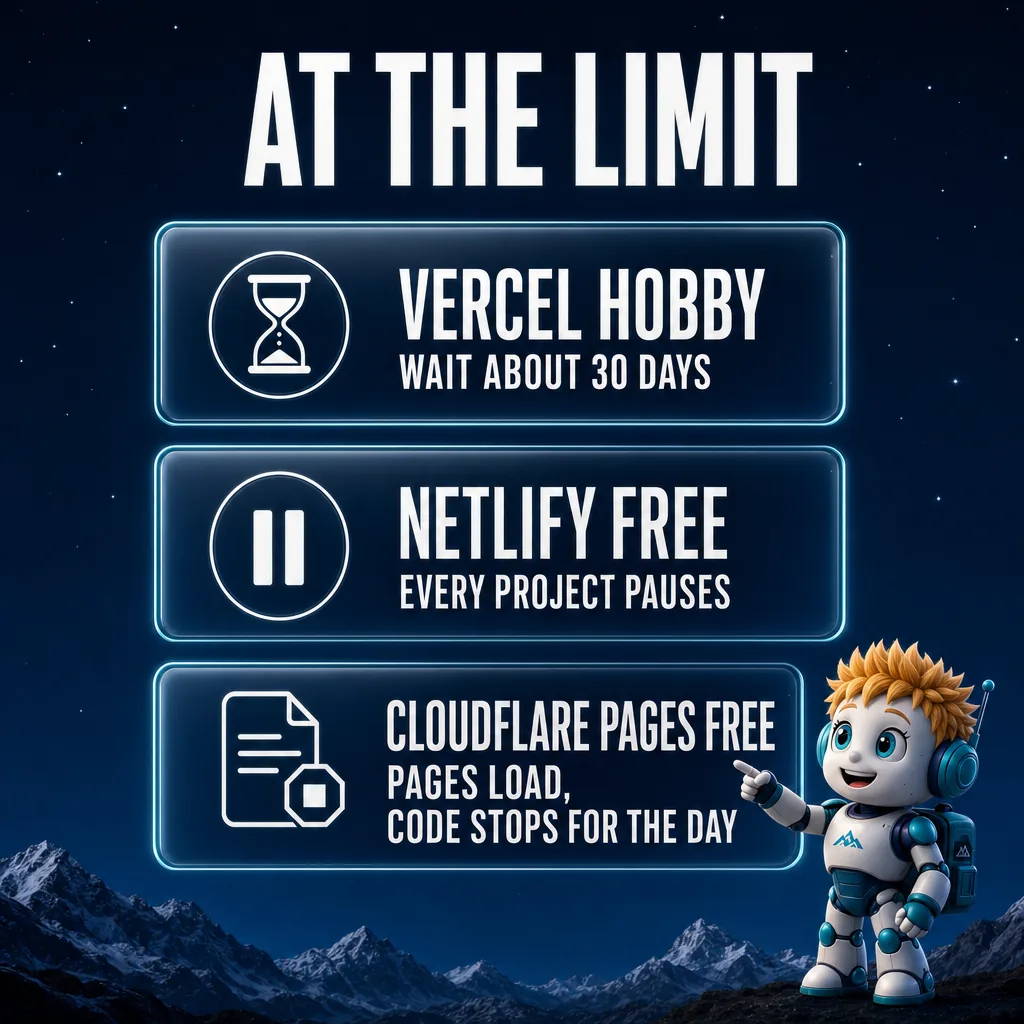
| What happens at the limit | You usually wait 30 days | The site pauses until the next billing cycle, and so does every project on the account | Pages keep loading. Requests that run code stop after 100,000 a day. |
| Card payments | Taking payment from visitors counts as commercial use | Its Acceptable Use Policy bars collecting, storing or transmitting payment card data through Netlify Forms, Functions and related services. It says card data must be collected directly by a PCI DSS-compliant payment provider. | Restricted on free services. Read the exact clause below. |
| First paid tier | Pro, $20 a month | Personal, listed from $9 a month, with the exact price shown in your Netlify dashboard | Workers Paid, $5 a month minimum |
This article is general information, not legal advice. If your case feels borderline, ask the provider in writing before you launch.
Vercel’s free plan is for personal projects only
Vercel’s fair use guidelines are direct. As of November 2026, they say: “Hobby teams are restricted to non-commercial personal use only. All commercial usage of the platform requires either a Pro or Enterprise plan.” One of Vercel’s own examples of commercial use is “Advertising the sale of a product or service.”
If a Hobby site goes over its limits, the Hobby plan docs say you usually wait 30 days before that feature works again. Vercel’s pricing page adds that you cannot buy extra usage on Hobby. Vercel Pro costs $20 a month with $20 of usage credit included, as of November 2026. We explain whether Vercel’s free plan is allowed for a business in a separate guide, including what Pro adds to your bill.
Is Netlify free for a business website?
Netlify’s Free plan costs $0, which Netlify describes as free forever, as of November 2026. It includes custom domains with SSL and a limit of 300 credits a month. Netlify’s pricing page says the free plan has “hard monthly limits that cannot be exceeded or incur any costs.” So it never sends you a bill.
On the terms, the answer is less tidy. We read Netlify’s Self-Serve Subscription Agreement, Terms of Use and Acceptable Use Policy as of November 2026. There was no non-commercial clause found in the agreement text. The same agreement gives Netlify wide room on the free tier.
Section 5.1 of the Self-Serve Subscription Agreement says Netlify “offers the Free Usage Tier at its sole discretion and may change its features, limits, or availability, or discontinue it, at any time.” It adds that Netlify “may suspend, disable, or remove any site or application on the Free Usage Tier at any time, with or without notice.” It also “makes no service level commitments” for the free tier.
Netlify’s plan docs call the Free plan “ideal for smaller experiments that don’t need a lot of resources, security, or monitoring.” That is Netlify’s own positioning, not a rule. It still tells you who the plan was built for. If your phone calls depend on the site, confirm your use with Netlify before you launch.
What 300 Netlify credits cover
Netlify meters the free plan in credits rather than visits or gigabytes. As of November 2026, its pricing page lists these rates for the main things a small site uses:
- A production deploy, which happens each time you publish changes to the live site: 15 credits
- Bandwidth, the data your pages and images send to visitors: 20 credits per GB
- Web requests, which include page views and image loads: 2 credits per 10,000 requests
Here is the simple arithmetic on those published rates. It is not a measurement of any real site. If a site spent credits only on bandwidth, 300 credits would cover 15 GB a month. If it spent them only on publishing, they would cover 20 production deploys. A real site spends on both, plus requests, from the same 300 credits.
Is Cloudflare Pages free for a business website?
Cloudflare Pages has a Free plan with generous limits for a small site. As of November 2026, Cloudflare’s Pages limits page lists these for the Free plan:
- 500 builds a month, one build at a time, each with a 20-minute timeout
- 20,000 files per site, and 25 MiB per file
- 100 custom domains per project, and 100 projects per account
Cloudflare’s Pages Functions pricing page says requests for static assets are free and unlimited on free and paid plans. A static request is one that only delivers a page or a file. Anything that runs code, which Cloudflare calls Pages Functions, counts toward a shared Workers Free limit of 100,000 requests a day. Cloudflare’s developer platform terms also let it temporarily limit requests that would put an undue burden on its network.
On the terms, we read Cloudflare’s Self-Serve Subscription Agreement and its Developer Platform terms, which cover Pages, as of November 2026. There was no non-commercial clause found in the agreement text. Like Netlify, Cloudflare keeps control of the free tier. Its agreement says a free service lasts until, among other things, “termination of the Free Service by Cloudflare in our sole discretion.” It also says: “We will have no liability for any harm or damage arising out of or in connection with any Free Services.”
The rule about card payments on Cloudflare’s free services
One clause matters for any business that wants to sell online. Section 2.2.1 of Cloudflare’s Self-Serve Subscription Agreement begins: “Unless otherwise expressly permitted in writing by Cloudflare, you will not and you have no right to:” Item (h) on that list reads, as of November 2026:
(h) process or collect personal or business credit card information on any web property that is receiving Free Services (as defined below);
If your site will take payments, read that clause with whoever handles your payments. If anything is unclear, ask Cloudflare in writing before you launch. This is general information, not legal advice.
Is Cloudflare replacing Pages with Workers?
Not according to anything we found. As of November 2026, Cloudflare still maintains its Pages documentation, and the Pages limits page was updated in September 2026. Cloudflare also publishes a guide to move a Pages project to Workers. That guide says static requests are free on both, and that Workers has a broader set of features. We found no Cloudflare statement that Pages is being retired. A simple business site does not need to move just because the guide exists.
What happens when each free plan hits its limit
Free plans do not send surprise bills. Instead, each one stops something when you reach the ceiling, and each stops in a different way. Here is what each provider says, as of November 2026.
- Vercel Hobby: in most cases you wait 30 days before the feature works again, according to the Hobby plan docs. You cannot buy more usage, according to Vercel’s pricing page.
- Netlify Free: the site enters a paused state until the start of the next billing cycle. Netlify emails you at 50, 75 and 100 percent of usage. If one project goes over, every project on your account pauses, according to Netlify’s pricing page.
- Cloudflare Pages Free: static pages keep loading. Requests that run code stop after 100,000 a day, until midnight UTC. Depending on a route setting, Cloudflare either returns Error 1027 or skips the code, according to its Workers limits page. Builds stop at 500 a month.
Here is a hypothetical example. Say your contact form runs on your own code at Cloudflare. It could stop for the rest of the day, while your pages still load. On Netlify, your site and every other site on the account stay paused until the cycle resets. On Vercel, the affected feature can stay off for a month.
The pattern is the same for all three. The cost of a free plan shows up as downtime, and downtime tends to land in your busiest week.
Put the account and the domain in your business’s name
Whoever controls the hosting account controls the website. That matters most on free plans, which often come with one seat. Netlify’s Free plan, for example, is limited to one free member and one Team Owner, as of November 2026.
Cloudflare’s agreement adds a rule worth knowing if someone else is setting things up for you. Item (a) sits in the same section 2.2.1 list, under the same “Unless otherwise expressly permitted in writing by Cloudflare” opening. As of November 2026, it reads:
(a) rent, lease, loan, export, or sell access to the Services to any third party, or sign up for the Services on behalf of a third party;
The practical step is simple, and it is not a legal reading. Open the hosting account in your own business name, with a business email, and invite your web person into it.
Use your own domain too, not only the free address the platform gives you. Cloudflare’s developer platform terms say it may change pages.dev and workers.dev names “for any or no reason.” That right does not apply to your custom domain. At The Search Sherpa, clients own their domains and hosting accounts, and we work through manager or agency access. If you are hiring someone to build your site with AI tools, ask whose name the accounts will be in before work starts.
What you pay once you outgrow the free plan
Each platform’s first paid tier is modest. The bigger difference is what each one meters once you are on it. Here are the entry prices as of November 2026:
- Vercel Pro: $20 a month, with $20 of usage credit included. Usage beyond the credit is billed on top, according to Vercel’s pricing page.
- Netlify Personal: listed from $9 a month, with the exact price shown in your Netlify dashboard (as of November 2026). It includes 1,000 credits a month, according to Netlify’s pricing page. Netlify Pro, for teams, starts at 3,000 credits a month.
- Cloudflare Workers Paid: a minimum of $5 a month per account, which also covers Pages Functions. It includes 10 million requests a month, then $0.30 per additional million. Cloudflare charges nothing for data transfer, and static requests stay free, according to its Workers pricing page.
For a small business, hosting is usually a small line next to the cost of the website itself. If you are budgeting the whole project, start with what a custom WordPress website costs.
When none of the three is the simpler choice
A disclosure first. We build WordPress websites for local businesses, so we are not a neutral party here.
Vercel, Netlify and Cloudflare Pages are developer platforms. They expect your site to live as code in a repository, with a build step each time something changes. When a build fails, someone has to read the error and fix it. That works well when a developer is on call, or when your site was already built that way.
Most local service businesses need something plainer. A homepage, a few service pages and a contact form do not need a developer platform. A managed WordPress host on a flat monthly fee lets you edit pages yourself, and the price is easier to plan around. Check any host’s traffic limits, support hours and renewal price before you commit. This is the same choice a custom WordPress design and SEO build works through with you before anything is built.
A quick checklist before you pick a free plan
You do not need to be technical to choose well. Ask these six questions of any free plan, and of whoever recommends it.
- Do the provider’s current terms limit business use? Read them on the day you sign up.
- Will your site take card payments? If you are considering Cloudflare’s free services, read its clause first.
- What happens at the limit: a wait, a pause or an error?
- If one site goes over, do your other sites stop too?
- Is the account in your business’s name, on your own domain?
- Who fixes a failed build at 9pm on a Friday?
Questions business owners ask about free website hosting
Is Netlify free for a business website?
Netlify’s Free plan costs $0 with a 300-credit monthly limit, as of November 2026. We read its agreement and there was no non-commercial clause found in the agreement text. The same agreement says Netlify “may suspend, disable, or remove any site or application on the Free Usage Tier at any time, with or without notice.” Confirm your use with Netlify before you launch.
Is Cloudflare Pages free for a business website?
Cloudflare Pages has a Free plan with 500 builds a month, and static requests are free and unlimited, as of November 2026. We read Cloudflare’s agreement and developer terms, and there was no non-commercial clause found in the agreement text. The agreement also lets Cloudflare end a free service in its sole discretion, and it restricts card payments on free services.
Can a Cloudflare Pages free site take card payments?
As of November 2026, Cloudflare’s Self-Serve Subscription Agreement says: “Unless otherwise expressly permitted in writing by Cloudflare, you will not and you have no right to:” and item (h) reads “process or collect personal or business credit card information on any web property that is receiving Free Services (as defined below);” Read that clause with whoever handles your payments, and ask Cloudflare in writing if you are unsure.
What happens when a Netlify free site runs out of credits?
As of November 2026, Netlify says a site that reaches its monthly limit enters a paused state until the start of the next billing cycle. Netlify emails you at 50, 75 and 100 percent of usage. If one project exceeds its limits, all projects on your account are paused. The Free plan has no auto recharge option, so you cannot pay to stay online that month.
What do 300 Netlify credits cover?
As of November 2026, Netlify charges 15 credits per production deploy, 20 credits per GB of bandwidth and 2 credits per 10,000 web requests. On that arithmetic alone, 300 credits would cover 15 GB of bandwidth if nothing else were used, or 20 production deploys. A real site draws on all of these from the same 300 credits.
Is Cloudflare Pages being replaced by Workers?
As of November 2026, we found no Cloudflare statement that Pages is being retired. Cloudflare still maintains the Pages documentation and also publishes a guide for moving a Pages project to Workers. That guide says static requests are free on both, and that Workers has a broader set of features.
Which is cheapest once I need a paid plan?
By entry price as of November 2026, Cloudflare Workers Paid has a $5 monthly minimum per account. Netlify Personal is listed from $9 a month, with the exact price shown in your Netlify dashboard. Vercel Pro is $20 a month with $20 of usage credit. Entry price is only part of the answer, because each platform meters usage differently on its paid plans.
Pick the plan your busiest month can live with
Free hosting can be fine for a test site. For a business, read the current terms, know what happens at the limit, and keep the account in your name.
The Search Sherpa is a founder-led SEO practice in Mokena, Illinois, and you work directly with Jeremy Bengtson. If you are deciding where your business website should live, Book a Free Discovery Call. You can also call (217) 579-8791.
Explore This Topic

SEO for Auto Repair Shops (2026): How Independent Shops Get Found
SEO for Real Estate Investors: How Motivated Sellers Find You
Vercel vs Netlify vs Cloudflare Pages: Which Free Plan Allows a Business Website?
Best Fonts for Medical and Healthcare Websites: Readable, Accessible, Licensed
Do You Still Need a Website If You Have a Google Business Profile?
Join Over 400,000 Entrepreneurs Getting Our Weekly Newsletter
Recent Posts
November 9, 2026
SEO for auto repair shops in 2026: Google Business Profile categories, repair pages, honest reviews, estimate and warranty copy, and what SEO costs.
November 8, 2026
SEO for real estate investors: build seller-situation pages, set up Google Business Profile within the rules, earn seller trust and track signed deals.
November 8, 2026
Choose fonts patients can read: a verified shortlist for medical and healthcare websites, plus WCAG 2.2 text benchmarks, sizes, spacing and licensing.