

Someone sent you a video. A confident person on screen builds a website in 12 minutes, pushes a button, and says the hosting is free. No credit card. No monthly bill. It looks easy, and it looks like the thing you have been overpaying for since you opened your doors. If you are a business owner who has ever squinted at a hosting invoice and wondered what you were actually paying for, that video lands hard.
Here is the part the video leaves out. The person building that site is usually a developer making a portfolio page, a demo, or a side project that 300 people will visit. You are building the front door of a business. It has to stay open at 2am, and on the busiest day of your year, and on the morning a local news story sends a month of traffic through in an hour. Those are two different jobs, and they are priced very differently.
Table of Contents
The Short Answer: Is Vercel Free for a Business Website?
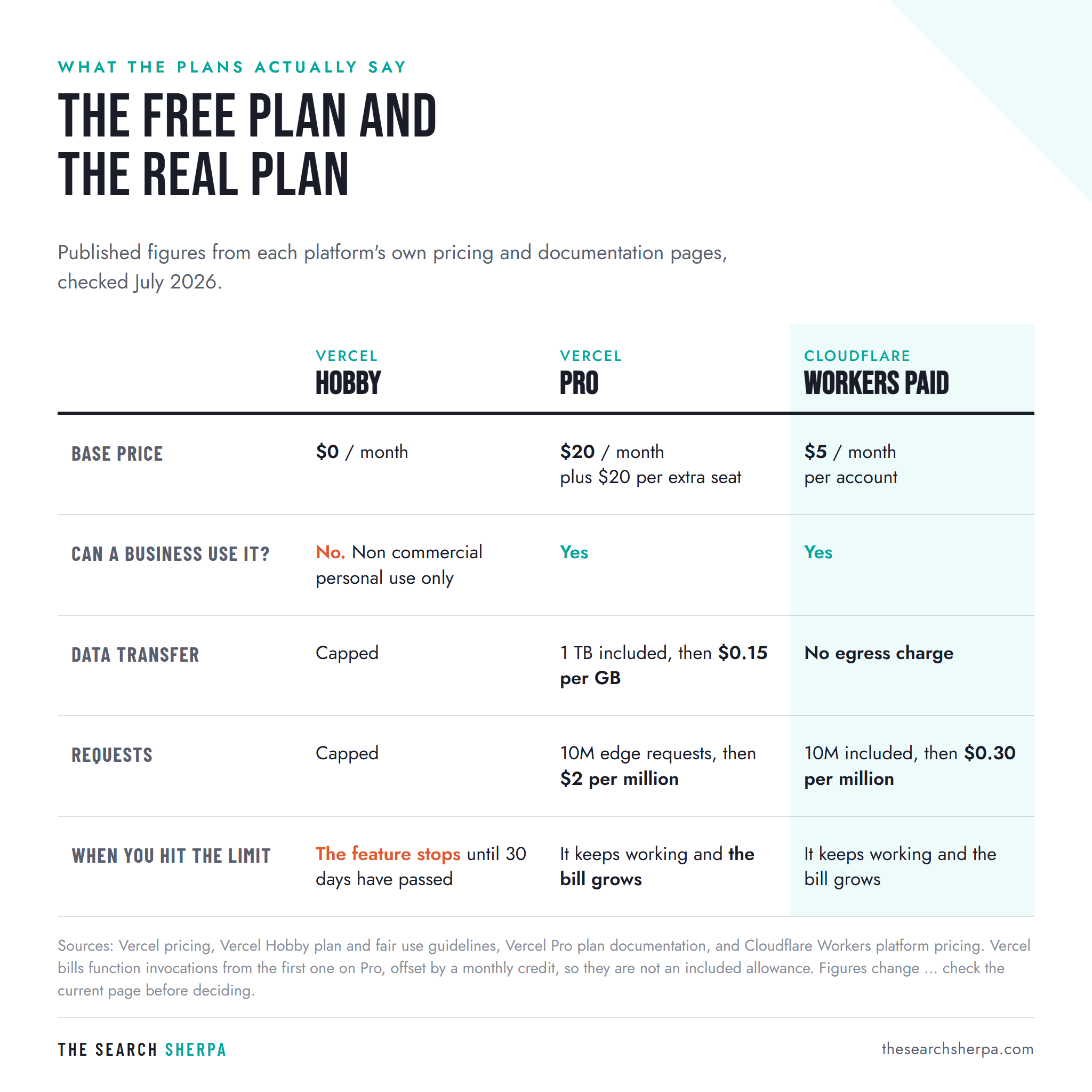
Yes and no. Vercel’s Hobby plan really is $0, with no trial clock and no credit card. But Vercel’s own fair use guidelines restrict Hobby teams to non-commercial personal use only, and say that all commercial usage of the platform requires a Pro or Enterprise plan. So Vercel is free for a personal project, and it is not free for a business website. The paid tier, Vercel Pro, starts at a $20 monthly platform fee plus $20 for each additional seat, and then charges for what you use on top of that, including $0.15 per gigabyte of data transfer after the first terabyte.
That is the verdict, but the reasoning underneath it is what actually helps you. There are two separate problems, and they arrive at different times. The first is a permission problem, and it applies from the day you launch: the terms say a revenue-generating site does not belong on the free plan. The second is a pricing problem, and it shows up later: on the paid plan your bill moves with how much your site is used, and not all of that use comes from customers.
One disclosure before we go further, since this article is partly about whose advice to trust. We build WordPress websites for local businesses, so we benefit when someone chooses that route. Every figure below is linked to the vendor’s own page so you can check it yourself rather than taking our word for it.
Why the Video Made It Sound So Simple
Most of the people making these videos are not lying to you. They are answering a different question than the one you are asking. Their question is how a developer can put a personal project online quickly and at no cost. Your question is where a business should run the website that its phone calls depend on. Those two questions have different right answers, and the video only ever had time for one of them.
It also helps to know how that content gets paid for. Short videos reward simple answers. A creator who says free hosting in the first 10 seconds keeps more viewers than one who explains licensing terms and per-gigabyte transfer rates. Some of these videos also carry sponsorships or affiliate links, which is not dishonest by itself, but it does mean the recommendation was not made by someone looking at your books. Nobody in that video knows whether your site sells anything, what your busy season looks like, or what happens to you if the site goes dark for a week.
The tell is simple. Ask whether the person recommending the platform runs a business on it, or just a project. A developer platform is a genuinely good product for developers. That is who it was designed for, who it is priced for, and who its support is written for. You are allowed to be skeptical when a tool built for one audience gets recommended to a completely different one.
The Free Plan Is Not Written for a Business
This is the single most important fact in this article, and it almost never makes it into a video. Vercel’s fair use guidelines say that Hobby teams are restricted to non-commercial personal use only, and that all commercial usage of the platform requires either a Pro or Enterprise plan. That is not fine print invented by a competitor. It comes straight from Vercel’s own published documentation, and you can read it yourself in about a minute.
Commercial use is a broader idea than most owners assume. It is not only an online store taking payments. The plain reading is wide: a site that books appointments, generates leads, or advertises services you charge for looks commercial rather than personal. That describes almost every local business website ever built, including a simple five-page site for a plumber or a med spa. If your case feels borderline, ask Vercel directly and read the current guidelines before you decide. This is general information and not legal advice.
So the practical position a business owner ends up in is this. You can run your site on the free plan and sit outside the terms you agreed to, which is a quiet risk you carry for as long as it lasts. Or you can move to the paid plan, which is where the second problem starts. Either way, the decision deserves more thought than a video gave it.
What Happens When You Reach the Ceiling
Every hosting plan has a ceiling. What separates them is what happens when you reach it. Usually the service stops, the bill grows, or the host slows you down. Flat-fee hosts have limits too, so ask any of them about throttling, suspension, and what the price becomes at renewal.
On Vercel’s free plan, things stop. The Hobby plan documentation says that if you exceed your usage limits, you have to wait until 30 days have passed before you can use that feature again. Depending on which limit you hit, that can take part of your site offline or all of it. Read that as a business owner rather than a developer. The month you get written up in the local paper is exactly the month you are most likely to hit a cap. A hobby project going quiet is an inconvenience. A business website going quiet during your best month is revenue you do not get back.
On the paid plan, nothing stops and the meter runs. Vercel Pro includes one terabyte of data transfer and 10 million edge requests, and past those points it charges $0.15 per gigabyte and $2 per million requests. One detail is worth knowing. Function invocations are the work your site does behind the scenes. On Pro they are billed from the very first one, rather than coming out of an included allowance, with a monthly credit offsetting some of it.
What It Would Actually Cost You
Here is the part most articles skip, and it cuts both ways. Run the numbers for a normal local business and Vercel Pro is not expensive at all. A terabyte is a lot of website. At a generous two megabytes per page view, one terabyte covers roughly 500,000 page views in a month. A service business doing 5,000 visits a month is nowhere near that. On ordinary customer traffic, that business pays the $20 and never sees an overage.
So the honest version of the warning is not that your customers will bankrupt you. It is that the meter does not only count customers. Take the crawler case reported on Vercel’s forum below. Two terabytes of transfer is one terabyte past the included amount, which at $0.15 per gigabyte works out to roughly $150 on top of the base fee, before request charges are added. That is an illustration using published rates rather than a quote, and your own numbers will differ. The point is the shape of it: ordinary traffic sits inside the allowance, and the exposure comes from activity you never asked for.
Hosting Stopped Being Priced Like Rent
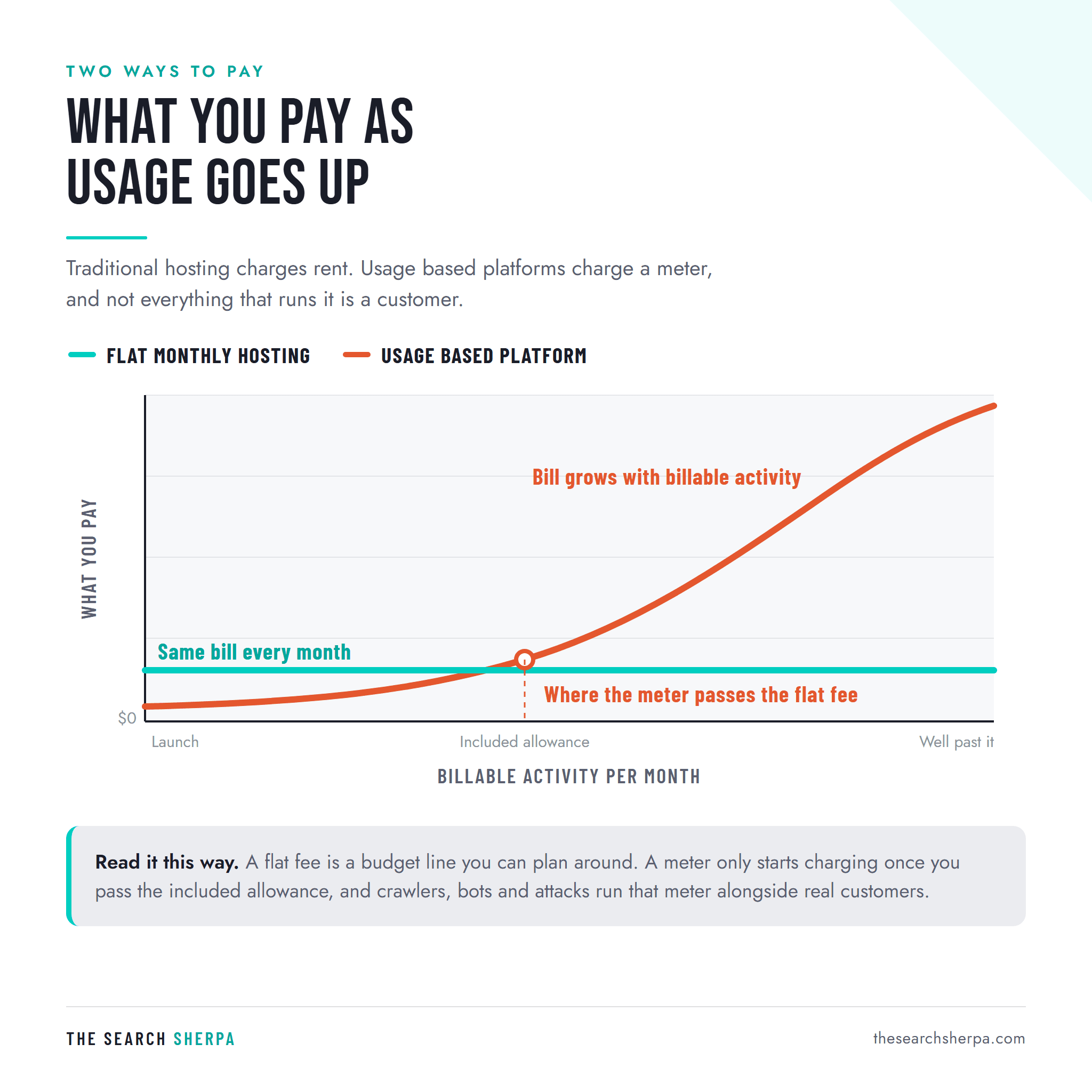
For 20 years, web hosting worked like rent. You paid a set amount every month, you knew the number, and it went on the same budget line as your phone bill. Busy months and slow months cost the same. That predictability is the reason nobody used to think very hard about hosting.
Modern developer platforms are priced like a utility meter instead. You are billed for data transferred, for requests served, and for computing time used. That model is genuinely better for some businesses, because you pay very little while you are small. It also moves a specific risk onto you, because you do not choose all of your traffic. Search engine crawlers, AI training bots, scrapers, and outright attacks consume the same metered resources that real customers do. A flat monthly fee absorbs that noise. A meter passes it through.
Cloudflare is worth naming here, because it shows that the rate is a choice rather than a law of physics. Cloudflare’s Workers Paid plan is $5 a month for the account with 10 million requests included, then $0.30 per million after that, and Cloudflare does not charge for data transfer at all. So Cloudflare is metered too. It is metered at a lower rate and without an egress charge, which is the actual point. Their free tier also carries no personal-use restriction. None of that makes Cloudflare the right answer for a plumber in Mokena, Illinois, because it is still a developer platform. It does mean that when a platform bills you per gigabyte, someone chose that number.
These Bills Are Not Hypothetical
You do not have to take this on theory. Vercel runs a public community forum, and owners post there when a bill goes wrong. In a June 2026 thread, a customer reported that their bill normally ran between $20 and $60, and that after a denial-of-service attack pushed two terabytes through their site the charge came to $231.71. They wrote that support told them it was non-refundable. In a July 2026 thread, another customer reported bandwidth and request overages running many times their usual monthly cost after sustained automated crawler traffic, and receiving only a partial credit. These are individual customer reports on a public forum, and we have not independently verified them.
To be fair to Vercel, they do have a policy here. Vercel states that traffic blocked by their web application firewall is not billed, and that denial-of-service mitigation itself is free. The gap is that the waiver applies when the firewall actually flags the traffic. Automated crawlers that look like ordinary visitors do not trip those rules, so they bill like ordinary visitors. Anything past that appears to be handled case by case as a goodwill credit rather than a guaranteed refund.
The lesson is not that Vercel is dishonest. Vercel publishes its prices clearly and its terms plainly, which is more than many hosting companies do. The lesson is that a usage-based bill hands you a specific risk, and that risk is heaviest for the people least able to absorb it. A software company with a finance team can handle a surprise month. An owner-operated business with eight employees generally cannot.
What a Local Business Website Actually Needs
Here is the honest answer, and it is a little boring. Most local businesses do not need a developer platform at all. A service business with a homepage, a handful of service pages, a location page, and a contact form is not a technically demanding website. It is a demanding marketing problem wearing the costume of a technical one.
For that kind of site, ordinary managed WordPress hosting on a flat monthly fee is usually the simpler fit, and a flat fee is easier to budget against. Check any host’s traffic limits, overage rules, support channel, and renewal price before you commit, because those vary widely. We build client sites on WordPress with Theme.co Cornerstone for that predictability, and because it is a platform you can take with you. This is the same decision a custom WordPress design and SEO build works through with you before anything gets built.
What actually decides whether your website earns its keep is not the hosting platform. It is whether the right people can find you at the moment they are looking. That means local SEO, a complete Google Business Profile, pages built around how people really search, and a structure that search engines, AI tools, and customers can all understand the same way. A site nobody can find is not saved by fast hosting, and a site people can find is rarely ruined by ordinary hosting. If your site looks fine but the phone is too quiet, the fix usually starts with why your business is not showing up on Google, not with where the files live.
Five Questions to Ask Before You Follow Hosting Advice
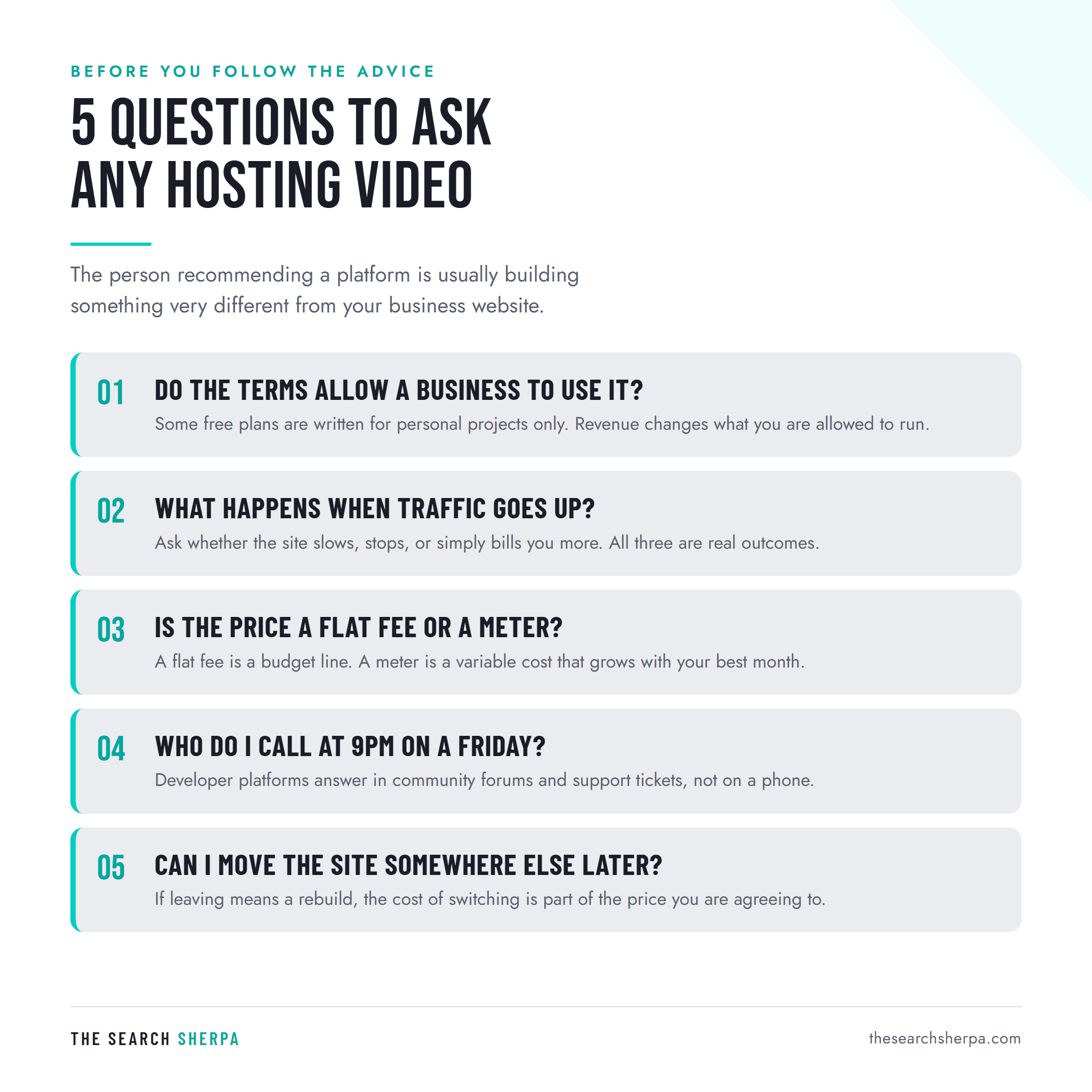
You do not need to become technical to make a good decision here. You need five questions, and you can ask them of a video, a developer, a nephew who is good with computers, or us. The answers tell you almost everything.
- Do the terms allow a business to use it? Some free plans are written for personal projects only. The moment your site helps you earn money, that clause applies to you.
- What happens when I reach the limit? Usually the service stops, the bill grows, or you get throttled. Make whoever is advising you say which one out loud.
- Is the price a flat fee or a meter? A flat fee is a budget line you can plan around. A meter is a variable cost, and bots and attacks run it too.
- Who do I call at 9pm on a Friday? Developer platforms answer through community forums and support tickets. If your site going down costs you bookings, that difference is worth real money.
- Can I move the site somewhere else later? Platforms encourage you to use features that only exist there. If leaving means paying for a rebuild, the cost of switching is part of the price you are agreeing to today.
What This Means for Your Website Budget
Free hosting is not a scam, and paid hosting is not a rip-off. The useful way to think about it is simpler. Hosting is one small line in what a website actually costs you. It is also the line people argue about most, because it is the easiest one to see. The build, the content, and the ongoing work of being findable are all larger numbers, and they are the ones that decide whether the site pays for itself.
If you want the fuller picture before you talk to anyone, we wrote a plain-English breakdown of how much a custom WordPress website costs for a local business. It covers what drives the number up and what usually gets oversold. Cost depends on your site, your competition, and your goals. We will be clear about pricing before any work begins.
And to close the loop on the disclosure at the top, because this article spent its length questioning other people’s incentives: we build websites, so we are not a neutral party either. The difference we can offer is a published position you can hold us to, and vendor links you can check without trusting us at all. We do not promise rankings, lead counts, or map placements, because no honest provider can. No black-hat tactics. No guaranteed rankings. No contracts. Clients stay because the work earns it.
About The Search Sherpa
The Search Sherpa is a founder-led internet marketing and local SEO practice based in Mokena, Illinois, serving Will County and the southwest Chicago suburbs. When you work with us, you work directly with Jeremy Bengtson, not an account-manager layer. Jeremy Bengtson holds a business degree from Western Illinois University and is Semrush certified. The Search Sherpa LLC has served local businesses since 2024, including med spas, law firms, real estate professionals, home service contractors, and other professional services. The approach is one connected visibility system across local SEO, your website, your Google Business Profile, and your content, explained in plain English so you always know what is being done and why.
If a video convinced you to move your business website somewhere and you are not sure it was the right call, that is a good conversation to have before anything breaks. You can reach The Search Sherpa in Mokena, Illinois at (217) 579-8791. When you are ready, schedule a digital visibility consultation and we will look at where your site stands and what comes next … no pressure and no contract.
Frequently Asked Questions
Can I use Vercel free for commercial use?
No. Vercel’s fair use guidelines state that Hobby teams are restricted to non-commercial personal use only, and that all commercial usage of the platform requires a Pro or Enterprise plan. Commercial is broader than an online store. A site that books appointments, generates leads, or advertises services you charge for is commercial use, which covers almost every local business website.
How long can I use Vercel for free?
Indefinitely, as long as the project stays personal and non-commercial and you stay under the plan limits. There is no trial clock that runs out. The limit is not time, it is what the site is for and how much traffic it uses. A business website falls outside the free plan on day one, not after some grace period.
What happens if I go over the limit on a free hosting plan?
On Vercel’s Hobby plan the affected feature stops working, and their documentation says you have to wait until 30 days have passed before you can use it again. On a paid plan nothing stops and the bill grows instead. Flat-fee hosts usually throttle you or ask you to upgrade. Whichever plan you are on, it is worth knowing which of those three you have bought before you find out the hard way.
Is free web hosting a good idea for a business?
Usually not, for two reasons that have nothing to do with quality. The terms often exclude commercial use, and the caps tend to bite during your busiest month rather than your slowest one. Free hosting is a good fit for a personal project, a portfolio, or something you are learning on. It is a poor fit for the front door of a business that depends on the phone ringing.
How much should I pay to host a business website?
For a typical local service business, ordinary managed WordPress hosting on a flat monthly fee is enough, and predictability matters more than the exact number. The more useful question is what the whole website costs, because hosting is a small line next to the build, the content, and the ongoing work of being findable. Cost depends on your site, your competition, and your goals, and we will be clear about pricing before any work begins.
Do I need a developer platform like Vercel for my business website?
Almost certainly not. A homepage, a set of service pages, a location page, and a contact form is not a technically demanding website. Developer platforms are genuinely good products built for developers shipping web applications. Most local businesses are solving a marketing problem rather than an engineering one, and the platform choice matters far less than whether the right people can find you.
Is Cloudflare a better choice than Vercel for a small business?
It depends on what you are building, and for most local businesses neither is the natural answer. Cloudflare’s Workers Paid plan is $5 a month per account with 10 million requests included, then $0.30 per million after that, and no charge for data transfer. Its free tier also carries no personal-use restriction. Whether it actually costs you less depends on your traffic and which services you use. It is still a developer platform, so a standard WordPress site on managed hosting is usually the simpler fit.
Explore This Topic


Join Over 400,000 Entrepreneurs Getting Our Weekly Newsletter
Recent Posts

September 16, 2026
A practical WordPress heading guide for local businesses using Rank Math. Learn the H1 rule, the three titles people mix up, and download
September 4, 2026
Paid for SEO and saw nothing? Here is what an honest SEO report shows, what rankings alone do not prove, and the questions

August 17, 2026
What pest control SEO costs in 2026, what a 90-day plan includes, and the contract math: cost per lead versus what a recurring