
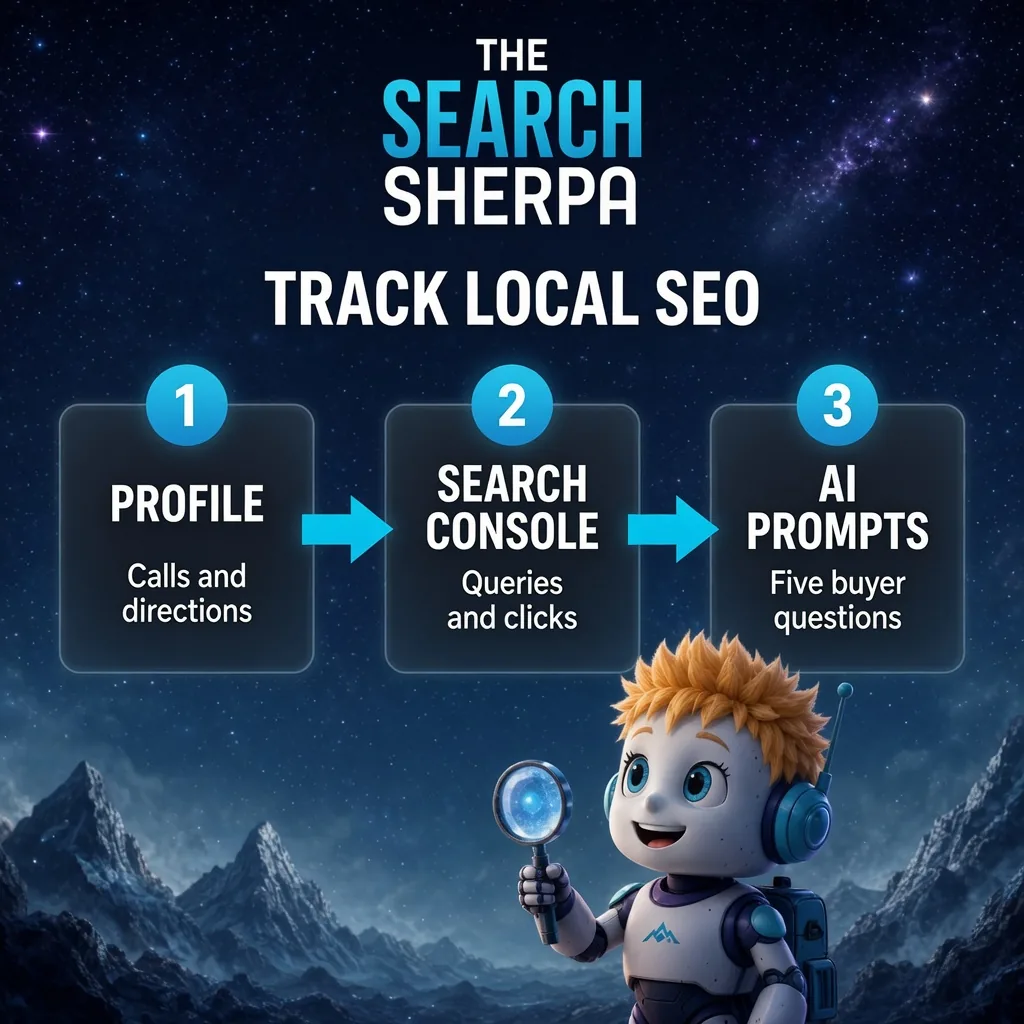
Track local SEO with three free sources first: Google Business Profile insights, Google Search Console, and a short monthly AI check. Paid rank tools help later. They do not replace those three.
This is the system we use inside local SEO services for owners who want calls and direction requests, not a vanity rank chart.
Google Search Console already told us the question. In the 90 days ending 19 September 2026, "how to track local seo performance across ai and traditional search engines?" earned 36 impressions at average position 32.4 and landed on an AI tools post. The searcher wanted a scorecard. Here it is.
The scorecard (print this)
| Surface | What to log each month | Where it lives | What "better" looks like |
|---|---|---|---|
| Map results | Profile views, calls, direction requests, website clicks | Google Business Profile insights | More actions from the same town |
| Organic search | Queries, pages, impressions, clicks, average position | Google Search Console | Clicks rising on local service queries |
| AI search | Did ChatGPT, Google AI Overviews, Perplexity, or Gemini name you for 5 buyer prompts? | Manual prompt log, plus Google's generative AI report | Named correctly, with the right city and service |
| Site health | Crawl errors, missing titles, broken links | Semrush Site Audit or Search Console | Fewer errors on money pages |
You do not need every column in week one. You need the same columns every month.
Step 1. Track the Google Business Profile like a storefront
Open Google Business Profile insights. Log four numbers for the last 28 days:
- Profile views
- Website clicks
- Calls
- Direction requests
Add UTM tags on the profile website link so Google Analytics 4 can show those clicks as a real source. Google Search Central documents this pattern. A simple tag is enough: `utm_source=google` and `utm_medium=organic` and `utm_campaign=gbp_listing`.
If views rise and calls do not, the profile is being seen and not chosen. Fix photos, categories, hours, and the first lines of the description. That is local SEO performance, not a keyword tool problem.
Step 2. Use Google Search Console as the question log
Google Search Console is the closest thing you have to a recording of what people typed.
Set the date range to 90 days. Export queries. Then do three filters.
Local queries. Contains your city, neighborhood, or "near me."
Question queries. A regex we actually ran on thesearchsherpa.com:
`(?i)(\?|^(who|what|when|where|why|how|is |are |do |does |can |should |will |which )|how much|how to|what is)`
That pull returned 226 question-shaped queries in 90 days. The useful ones were not trivia. They were cost, worth-it, and "who can help" questions from owners.
Striking distance. Position 4 to 20, material impressions, weak clicks. Those pages already have demand. They need a clearer first sentence.
Google rolled out the generative AI performance report to all websites worldwide as of 31 August 2026. Use it alongside the standard Performance report. It shows impressions from Google's generative AI features in Search. It does not show ChatGPT or Perplexity. Keep those in the manual log in step 3.
Step 3. Run a 20-minute AI citation check
Pick five prompts a buyer in your town would type. Keep them stable for 90 days.
Examples for a local service business:
- "Who should I hire for [service] in [city]?"
- "Best [service] near [landmark or town]."
- "How much does [service] cost in [city]?"
- "Is [your brand] a good [service] company?"
- "Who can help a local [service] company get found on Google and ChatGPT?"
Once a month, run the five prompts in Google (watch for an AI Overview), ChatGPT with search, Perplexity, and Gemini. Score each as: named, named with errors, or absent.
This is slower than a geo-grid tool. It is also the only way to see the sentence an engine will quote. BrightLocal's 2026 local AI visibility research makes the same point: you have to look at more than one engine, on an ongoing cadence.
Step 4. Keep a technical health floor
Rank tracking lies when the page is broken.
On 21 September 2026 our Semrush Site Audit for thesearchsherpa.com showed Health 80% across 173 crawled pages, with 154 errors, 72 warnings, and 407 notices. The top clusters were 404s, pages missing an H1, multiple H1s, and images missing alt text. That is not a ranking flex. It is a maintenance list.
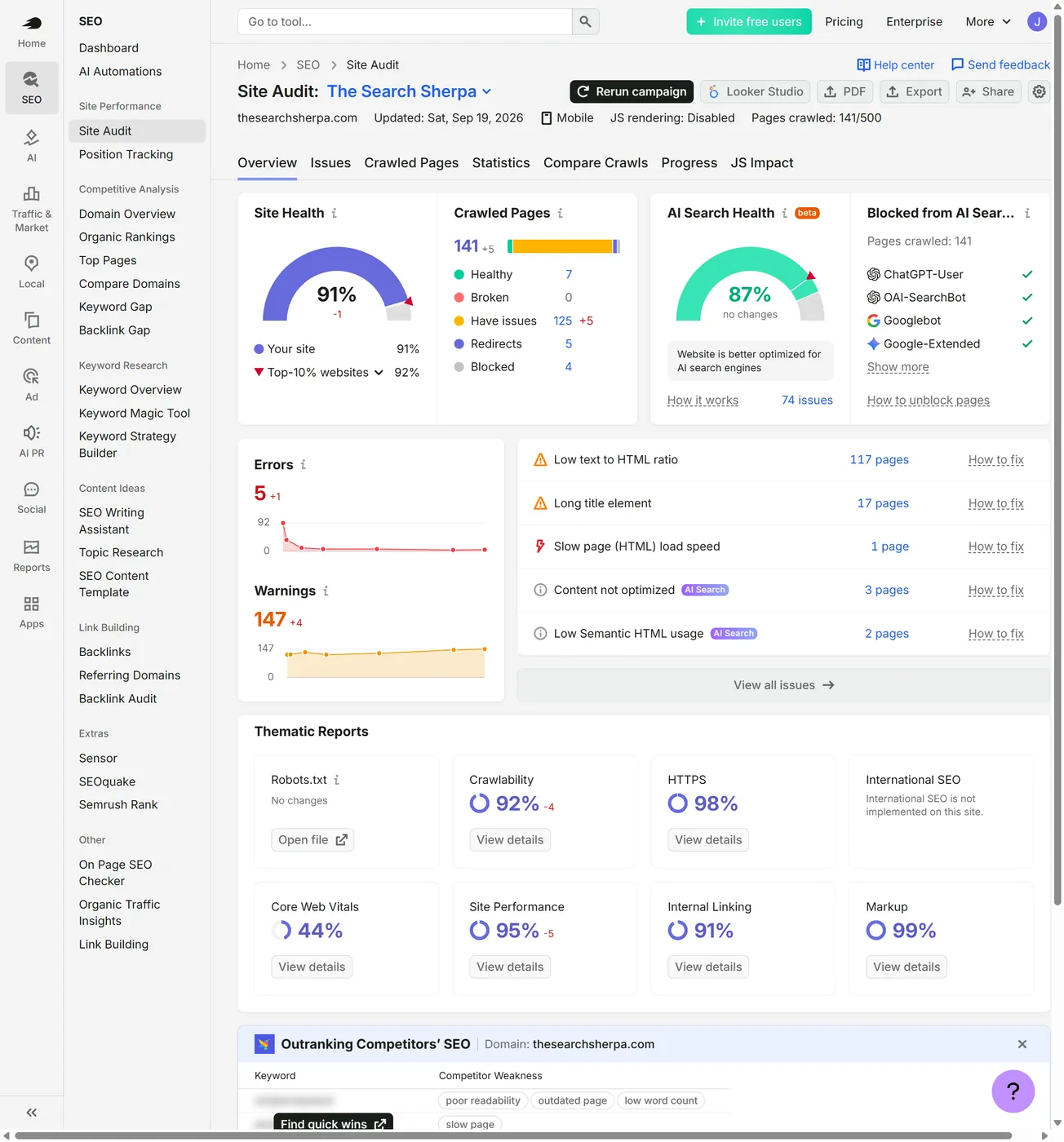
Log the health score and the count of 404s on money pages. Fix those before you buy another rank tracker.
Step 5. Read traffic last, not first
Semrush Domain Overview (US desktop, 20 September 2026) estimated 68 organic visits for thesearchsherpa.com, up 74%, on 166 organic keywords, up 33%. We treat that as a direction check. Google Search Console remains the system of record for queries.
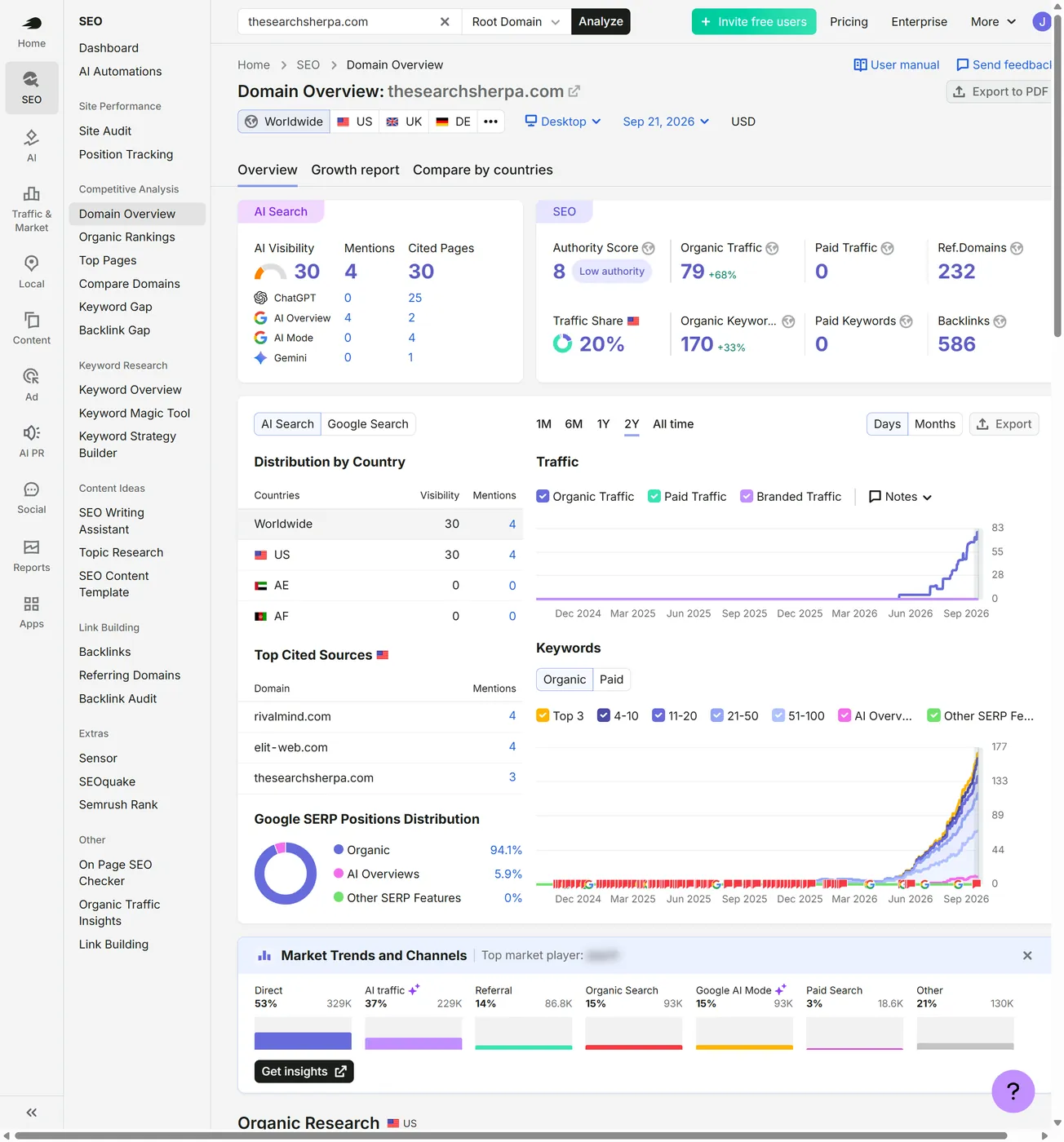
If estimated traffic rises while Search Console clicks on "near me" queries stay flat, you grew the wrong queries. That is why the question log in step 2 sits above the traffic chart.
A monthly 45-minute routine
Jeremy Bengtson runs this as a short block, not a dashboard ritual:
- Ten minutes: Google Business Profile actions.
- Fifteen minutes: Search Console queries and the generative AI report.
- Fifteen minutes: the five AI prompts.
- Five minutes: write one sentence on what to change next month.
If you want the same cadence without building it alone, the SEO reporting article lists the numbers an agency should put in front of you. Pair it with Google Business Profile management when the profile is the leak.
Frequently Asked Questions
How can I track my SEO performance?
Start with Google Search Console clicks and impressions, Google Business Profile calls and direction requests, and a monthly check of five buyer prompts in ChatGPT and Google AI Overviews. Rank charts are optional. Those three sources already tell you if nearby customers can find you, understand you, and choose you.
How can I measure my SEO performance?
Measure actions, not only positions. Log profile calls, direction requests, Search Console clicks on city-plus-service queries, and whether AI tools name your business correctly. Revisit the same date range each month so the trend is comparable and the owner can see the change.
What is the best SEO rank tracker local?
For a single-location small business, Google Business Profile insights plus Google Search Console beat a paid geo-grid until you have more than one location or a wide service area. Grid tools such as Whitespark or Local Falcon help when you need a map of neighborhoods. They do not replace query data.
Is SEO dead now with AI?
No. AI answers still pull from websites, profiles, and reviews. If you only track blue-link rank, you will miss whether Google AI Overviews or ChatGPT named you. Add the five-prompt log so AI search sits next to traditional local search.
What is the 80/20 rule in SEO?
Track the few numbers that change owner decisions: local calls, direction requests, clicks on service queries, and accurate AI mentions. Extra metrics, such as every SERP feature or every competitor URL, wait until those four are in a monthly sheet.
What is the best SEO monitoring tool?
The best first tool is Google Search Console because it is free and it lists the queries you already appear for. Add Google Business Profile insights the same week. Add Semrush or a local rank tracker when you need competitive context, not before the free sources are in a routine.
Explore This Topic
How to Track Local SEO Performance Across Google and AI Search
Does a Small Business Need a Full-Time SEO?

SEO Audit Cost (2026): What a Real Audit Includes and What a Free One Leaves Out

SEO for Financial Services: The Work and What It Costs
SEO Consultant Cost (2026): Hourly, Project and Retainer Rates Explained
Join Over 400,000 Entrepreneurs Getting Our Weekly Newsletter
Recent Posts
September 23, 2026
Does a small business need a full-time SEO hire? Compare in-house salary, hours, and agency work for owners who need local visibility without
September 22, 2026
SEO audit cost in 2026: free scans, $2,000 to $10,000 for a professional audit, what a real audit includes, and how to read
September 22, 2026
SEO for financial services costs about $1,400 to $20,000 a month for a payments firm. See the work, the fee models, and a