
If you paid for SEO and nothing happened, you are owed a straight answer about what you were buying. Every month, an honest SEO provider should show you three things: what work was done, what changed in your search visibility, and how many real inquiries reached your business. Rankings alone are not one of the three.
You might already know this feeling. Some blogs got posted, nothing really happened. They showed us rankings but the phone never rang. No leads, just traffic. They gave us a report full of numbers that meant nothing. The agency had sixty clients, they did not know our business. When the reporting never connects to the phone ringing, you end up paying for activity and calling it marketing.
This article is written for the second conversation, the one that happens after the first provider did not work out. It is not a list of red flags and it does not tell you to fire anyone. It is the standard you can hold the next invoice against, whether that invoice comes from us or from someone else.
The three things you should see every month
Work completed, named specifically. Not “on-page optimization” and not “content updates”. The actual pages that were touched, and what changed on them. If a provider restructured your service page, you should be able to open that URL and see the change.
Visibility change, with the source named. How many people saw your business in search, how many clicked, and where that number came from. Google Search Console is the source of record for this and it is free. If a report quotes visibility numbers and never names where they came from, that is the question to ask.
Inquiries, with the counting rules stated. Calls, forms, and messages that reached you, and what was excluded. Spam filtered out. Repeat callers counted once. A provider who cannot tell you how a lead was counted cannot tell you whether the number is real.
Why a rankings screenshot is not proof
A rankings screenshot is the most common thing a burned client was shown, and it is the weakest evidence in the report.
Search results are personalised and localised. The same query returns different results depending on who is searching, where they are standing, what they searched last week, and which device they are holding. A provider standing in their own office, signed into their own Google account, is not seeing what your customer in Mokena sees.
Rankings are also volatile in a way revenue is not. A keyword can move from position 14 to position 8 and produce exactly zero additional phone calls, because nobody searches that phrase, or because the people who do are not ready to buy. Movement on a chart is not movement in the business.
None of this makes rankings useless. They are a leading indicator and they belong in the report. The problem is rankings presented instead of impressions, clicks and inquiries, rather than alongside them. A report built entirely on positions is a report built on the one number that can improve while nothing else does.
What an honest report actually contains
An honest monthly report is usually shorter than a dishonest one. Length is often a substitute for substance. Here is what should be in it.
- The work, with URLs. Every page touched, listed by address, with a one-line description of what changed. This is the part you can verify yourself in about five minutes.
- Search visibility, from Google Search Console. Impressions, clicks, average position, and which queries and pages drove them. Search Console is Google’s own data about your site, it is free, and you should have access to it in your own name.
- Local visibility, if local matters to you. Views, calls, direction requests and website clicks from your Google Business Profile. For a service business, this is often where the phone calls actually come from.
- Inquiries and how they were counted. The number, the source, and the exclusions.
- What is planned next, and why. In priority order, tied to what the data just showed.
We work in Google Search Console, Google Analytics, Semrush and Rank Math, and we will tell you which tool a number came from. That matters less because the tools are special and more because a number without a source cannot be checked, and a number that cannot be checked is not reporting.
If you want the fuller picture of what the underlying work involves, our local SEO services page walks through the pieces, and SEO pricing covers what this range of work typically costs.
The questions that get a straight answer
These are not gotchas. A good provider will answer all of them quickly and without getting defensive, because they are the questions any competent person expects. What you are listening for is whether the answer is specific.
- “Which pages did you change last month, and can you send me the links?” A straight answer is a list of URLs. An evasive answer describes categories of work without naming a single page.
- “Where does this visibility number come from?” A straight answer names the tool and the date range. An evasive answer says it comes from their proprietary dashboard and stops there.
- “How are you counting a lead?” A straight answer states the rules, including what gets excluded. An evasive answer treats every form fill as a customer.
- “Which of these keywords do you expect to actually produce calls?” A straight answer separates the terms that convert from the terms that look impressive. An evasive answer treats all rankings as equally valuable.
- “What did not work this month?” A straight answer has one. Every real month has something that underperformed.
- “Do I own my Google Business Profile, analytics and domain?” A straight answer is yes, in your name, with the provider holding manager access. Anything else is worth resolving now rather than at the end.
- “If I left, what would I keep?” A straight answer is everything, because the accounts were always yours.
What nobody can honestly promise you
This section is credibility, not fine print. If a provider will not say these out loud, that is information.
- No guaranteed rankings. Nobody controls Google’s results. A guarantee of position one is either a misunderstanding or a sales tactic.
- No guaranteed timeline. A date certain for a specific ranking is not something anyone can honestly offer.
- No control over what an AI system says. ChatGPT, Perplexity and Google AI Overviews belong to other companies. You can make your business easier to find, verify and quote, which is what answer engine optimization actually is, but nobody can guarantee an AI system names you.
- No guaranteed lead count. Anyone promising a specific number of calls per month is promising something outside their control.
What a reasonable timeline looks like
Local SEO usually takes about three to six months to show measurable movement. Timelines vary by market competition and by the condition of your site when the work starts. A site with technical problems spends the first stretch getting fixed before anything can improve.
That said, the reporting should be useful from month one even when the results are not there yet. Month one should show you what was found and what was done about it. If three months have passed and you still cannot tell what work happened, the problem is not the timeline.
If you need something faster than organic visibility can move, paid search can fill the gap while the organic side builds. That is a strategic decision about where to put money first, not a faster-versus-slower binary.
What to do next if you are already mid-contract
Do not start by firing anyone. Start by asking for three things in writing.
- The list of pages changed in the last ninety days, with links.
- Direct access, in your own name, to Google Search Console, Google Analytics and your Google Business Profile. This is your data and you are entitled to it.
- The counting rules behind whatever lead number you have been shown.
A capable provider sends all three within a few days. If the request produces friction, you have learned something useful without ending anything. And if you are still deciding whether to hire someone at all rather than reviewing someone you already pay, when to hire an SEO consultant covers that earlier question.
Frequently Asked Questions
What should an SEO report include?
Three things at minimum: the work completed with the URLs it touched, the change in search visibility with the tool it came from, and the inquiries that reached your business with the rules used to count them. Anything beyond that is useful context. Anything less than that cannot be checked.
How do I know if my SEO agency is actually doing anything?
Ask for the list of pages changed in the last ninety days, with links, and then open a few of them. Page changes are visible and verifiable in a way that summaries are not. If the list cannot be produced, that answer is the answer.
Is it normal to see no results after three months?
It can be normal to see no revenue change at three months, since local SEO usually takes about three to six months to show measurable movement, depending on competition and the condition of your site. It is not normal to see no reporting. By month three you should be able to see what was found, what was done, and which direction impressions and clicks are moving.
My rankings went up but I got no calls. What went wrong?
Usually the rankings improved on terms that do not lead to buying, or on terms almost nobody searches. Ranking well for a phrase with no demand produces no calls, and neither does ranking well for research terms when your business sells a service people book. Check which queries actually brought impressions and clicks in Google Search Console, then compare that list to the terms a customer would use right before they call.
Should my SEO agency lock me into a contract?
No. Clients stay because the work earns it. Long lock-ins exist to protect the provider during the months when nothing is happening, which is exactly the period you most need the freedom to leave.
What questions should I ask my current SEO provider?
Ask which pages they changed last month and for the links, where each visibility number came from, how they count a lead, and what did not work this month. Every one of those has a specific correct answer. You are not testing their knowledge, you are checking whether the work is documented.
Can I get my accounts back if I leave my agency?
You should never have needed to get them back, because they should have been yours the whole time. The Search Sherpa commits to absolute client ownership of digital assets: you own the domain, the hosting, the Google Business Profile and the analytics properties, and we operate through manager access. If a current provider registered any of these in their own name, ask for ownership to be transferred to you now rather than during an exit.
If you want a second opinion
If you are holding a report you cannot make sense of, bring it. We will look at where you actually stand in search, what the numbers in front of you do and do not show, and what would come next. You will get a straight read even if the answer is that your current provider is doing fine.
The Search Sherpa is founder-led by Jeremy Bengtson, based in Mokena and working with service businesses across Will County and the southwest Chicago suburbs. Start with a conversation at work with me, or call (217) 579-8791.
Explore This Topic


Join Over 400,000 Entrepreneurs Getting Our Weekly Newsletter
Recent Posts
October 15, 2026
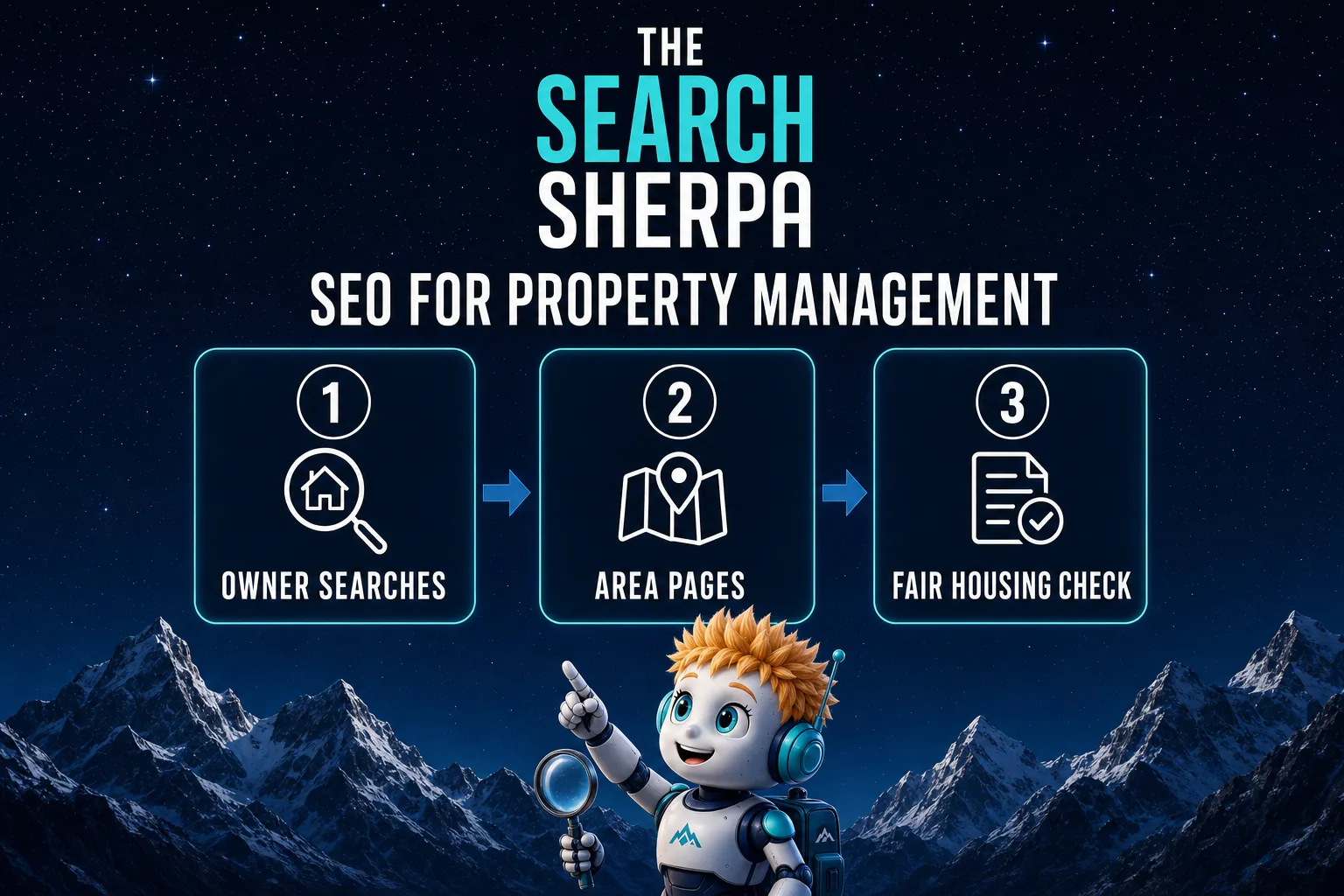
SEO for property management in 2026: reach rental owners with a Google Business Profile, area pages, Fair Housing-safe copy, honest reviews, and cost.

October 15, 2026
SEO for insurance agencies in 2026: Google Business Profile setup, line and town pages, honest reviews, ad-rule checks, and what local SEO costs.

October 12, 2026
A YouTube demo shows only part of a provider’s work. Learn what to verify about AI review, access, backups, testing, ownership, and support