
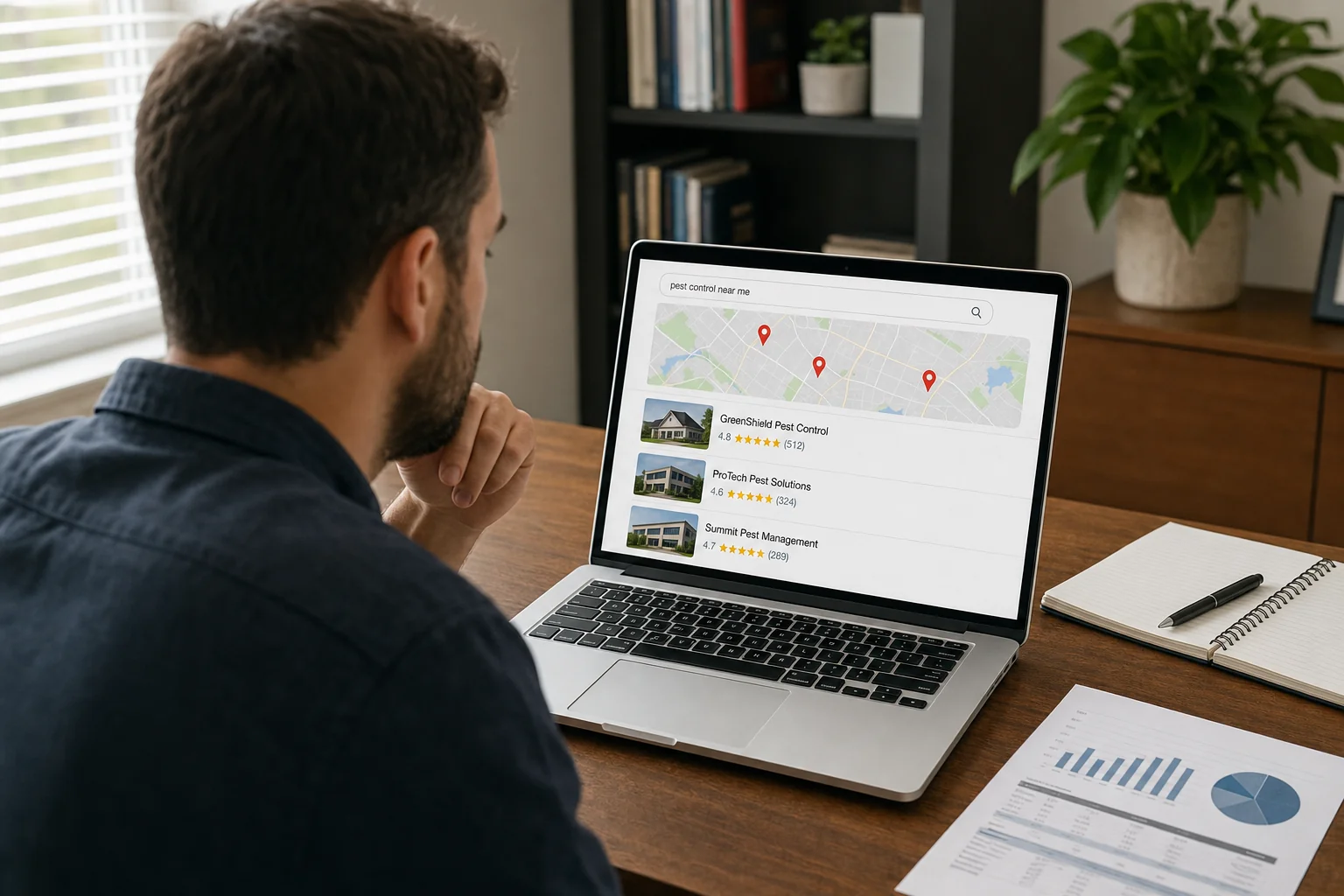
By Jeremy Bengtson, founder of The Search Sherpa.
Pest control owners ask me the same two questions every trade owner asks. What does pest control SEO cost, and will it pay for itself. Most pest control marketing companies dodge both.
I will give you honest price ranges for 2026, cover what a 90-day plan includes, and spend real time on the part that decides the answer: the contract math. Pest control does not live on one big sale the way a roofer does. It lives on quarterly and bi-monthly accounts that renew, which changes what a lead is worth.
What does pest control SEO cost in 2026?
For most pest control companies, pest control SEO costs between about 1,500 and 3,500 dollars a month, with a single-town operator lower and a multi-county route higher. There is no flat rate, because your route width, your pest lines and your competition all move it.
Pest control SEO usually costs 1,500 to 3,500 dollars a month, or it can start as a one-time strategy roadmap credited toward a retainer. Pest control sits at the competitive end of local SEO pricing because the service area is a route across many towns rather than a single address, and because one company has to win for termites, ants, rodents and bed bugs at once.
That range matches what pest control companies already spend. In Coalmarch’s 2026 pest and lawn benchmark report, built on more than 11 million dollars of tracked spend across companies from 500,000 to 20 million dollars in revenue, the average pest control company put 2,748 dollars a month into organic search in 2025, up 1.3 percent from 2,713 in 2024 (Coalmarch, 2026). Our SEO pricing page puts local businesses at 1,000 to 3,000 a month, and our contractor SEO cost guide sets the tiers below. The HVAC, plumber and roofing guides cover neighboring trades, and small business SEO packages covers a lighter engagement.
| Engagement | 2026 price | Best fit |
|---|---|---|
| Strategy roadmap, one time | credited toward a retainer | Plan before commitment |
| Single-market retainer | $1,500 to $2,500 a month | One town or branch |
| Multi-town retainer | $2,500 to $4,500 a month | Several suburbs |
| Multi-branch retainer | $4,500 to $7,500 and up | Several offices or a metro |
It is also less new money than it sounds. The 2025 Pest Control Industry Cost Study from the National Pest Management Association and PCO Bookkeepers, covering 246 firms with 584 million dollars of combined revenue, puts industry average marketing spend at 6.6 percent of revenue (NPMA and PCO Bookkeepers, 2025). For a one million dollar company that is about 66,000 dollars a year, or roughly 5,500 a month across every channel. SEO is one line in that budget, not a new budget.
Two cautions. Be wary of a company that hides pricing until a sales call, and of a bargain package advertised for a couple of hundred dollars a month that promises the top of Google. Our SEO pricing page states the threshold plainly: packages below 500 dollars a month cannot sustain the labor-intensive work legitimate organic growth requires.
What you are actually paying for in pest control SEO
You are paying to be the obvious choice the moment a nearby homeowner finds droppings in the pantry or a swarm on the windowsill. Nearly all of it is local work.
Pest control SEO pays for local search foundations: an optimized Google Business Profile, a page for each pest you treat and each town you run, technical and speed fixes, content that answers homeowner questions, a steady review habit, and the tracking that shows whether any of it turns into booked service.
We optimize your Google Business Profile, build a page for each pest line you actually sell rather than one thin general pest page, and add a page for each town on your route instead of a single service-area list. Our local SEO service covers that work, and local link building plus reputation and review management are the signals that most often separate the first three map results from the rest.
What has changed is where the traffic goes. In that same pest control dataset, monthly organic sessions fell 27.9 percent in 2025 while organic leads rose 7.4 percent, and blog clicks fell 44.34 percent while service clicks rose 18.34 percent (Coalmarch, 2026). AI Overviews are absorbing the how-do-I-get-rid-of-ants questions. The searches that book service are holding. A plan built to chase blog pageviews is buying the part of the market that just disappeared.
What changes the price of pest control SEO
| What moves the price | Why |
|---|---|
| Width of the route | Every town is its own page, signals and competitors |
| Number of pest lines | Termite, bed bug, rodent and mosquito each need a page |
| Commercial as well as residential | Commercial buyers research differently and need their own pages |
| Condition of the site | A slow or thin site needs technical work first |
| Review volume and recency | A thin review profile takes months before map rankings respond |
| Market competition | A dense metro with national brands bidding costs more than one suburb |
What a 90-day pest control SEO plan includes
A fair way to judge a price is the scope behind it. Your plan shifts with what your site already has, but the bones are the same.
Days 1 to 30: audit and foundation
Month one is about seeing clearly: an audit of how you show up in Google and the map results across every town on your route, a technical and speed check, a review of your profile categories against the pest lines you actually sell, and a priority list of the searches that lead to booked service rather than to reading. We also set the baseline, because you cannot show progress from an unrecorded number.
Days 31 to 60: structure and content
Month two is where the fixes ship. We clean up your site structure so each page has one clear headline and a direct answer, build or rewrite your pest pages and town pages, add the structured data that tells search engines and AI assistants what you treat and where, and publish the pages that answer what your office gets asked on the phone.
Days 61 to 90: reinforce and measure
Month three checks the scoreboard. We reinforce local signals, build the review habit into how your technicians already close out a job, earn early local links, and report against the baseline. Our SEO pricing page states the timeline: early ranking movement within three to six months, meaningful pipeline usually six to twelve.
The recurring-revenue economics of pest control SEO
This is where pest control differs from every other trade in this cluster. A roof replacement is worth thousands, so one job carries months of marketing. A single treatment cannot. But a pest control company is not selling a treatment. It is selling an account that bills every quarter and renews on its own.
A quarterly residential pest plan runs about 98 to 178 dollars a visit, roughly 390 to 710 dollars of recurring revenue in the first year, and 85.4 percent of residential pest control service revenue is recurring. An organic lead cost pest control companies about 44 dollars in 2025, against 96 dollars for a Local Services Ads lead and 148 for a Google Ads lead. That gap is the argument for SEO in this trade.
What a pest control account is actually worth
Start with what the homeowner pays. A quarterly plan runs about 98 to 178 dollars a visit, and a one-time treatment averages 223 dollars nationally, within a 158 to 288 dollar range (Fixr, updated January 2025). Four quarterly visits at 98 to 178 dollars is 392 to 712 dollars in year one. A second national guide puts a quarterly visit at 100 to 300 dollars and termite work at 225 to 8,000 (Today’s Homeowner, updated April 2025). The first job is small. The contract is not.
Now add what makes this trade unusual. In the 26th edition of A Strategic Analysis of the U.S. Structural Pest Control Industry, a survey of 800 owners and managers, recurring revenue accounted for 85.4 percent of residential pest control service revenue in 2025, up from 85.2 percent, across nearly 13.29 million residential customers (NPMA, 2026, reporting Specialty Consultants data; also covered by Pest Management Professional, 2026). Industry-wide, the cost study above puts recurring revenue at 74 percent of income.
Then add retention. The long-standing benchmark is 82 to 87 percent residential retention and greater than 94 percent commercial (Kemp Anderson, in Pest Control Technology, 2020), and in the 2026 State of the Industry survey 95 percent of pest management professionals expected to keep more than 75 percent of their customers (Pest Management Professional, 2025). At the 85 percent midpoint you lose 15 percent a year, so an average account lasts about six or seven years, putting one quarterly plan in the low thousands over its life. That last step is a model on two sourced inputs, not a measured figure.
What a pest control lead costs when you buy it
Compare buying a lead to earning one. These are pest control figures, not home services averages.
| Channel | 2025 cost per pest control lead | Change from 2024 |
|---|---|---|
| Organic search | $44 | down 4.34% |
| Google Local Services Ads | $96 | up 11.63% |
| All paid combined | $111 | up 16.84% |
| Google search ads | $148 | up 30.97% |
Those rows come from the year-end pest control channel table in Coalmarch’s 2026 report (Coalmarch, 2026). Two notes on reading them. The report averages each company individually rather than pooling totals, so dividing its spend columns by its lead columns will not reproduce these figures, and it says so itself. But the one triple it publishes in full does reconcile: pest control search ads averaged a 14.47 dollar click at a 9.5 percent conversion rate, and 14.47 divided by 0.095 is about 152 dollars, within roughly three percent of the 148 reported. That click cost 9.81 dollars in 2024, a 47.5 percent rise in a year. Pest control services is also an eligible Local Services Ads category, where you pay per lead (Google Local Services Ads Help).
The number that matters: cost per acquired account
A lead is not an account. No public study publishes a pest control lead-to-sale rate, so rather than invent one, run this as a stress test with a pessimistic assumption: only one lead in four closes. A 44 dollar organic lead then costs about 176 dollars per new account, against 392 to 712 dollars of recurring revenue in that account’s first year alone. The same rate against a 148 dollar search-ad lead costs about 592 dollars, roughly a full year of a mid-priced quarterly plan. Improve the close rate and both fall, but the ranking between them does not change.
Where SEO changes the math
Buying leads is a cost that repeats forever and rises as more companies bid. Note the direction of travel in that table: paid cost per lead climbed in every row while organic fell. SEO is a fixed fee against a growing denominator, and 85.4 percent of residential revenue renews on its own, so the compounding runs both ways. That is arithmetic, not a promise about how many accounts you will win.
Why pest control seasonality changes the SEO calendar
Pest demand is not flat, and that changes when you should start. Spring is when large numbers of winged termites, the swarmers homeowners actually see, emerge inside homes (University of Kentucky Department of Entomology, EntFact 604). The NPMA’s spring and summer 2026 Bug Barometer forecast warm, wet conditions boosting termites, mosquitoes and ants early in the Southeast, and ant and cockroach invasions indoors after heavy rain across the Great Lakes and Midwest (Pest Management Professional, 2026). Its fall and winter forecast says that once cooler conditions arrive, rodents will likely seek shelter indoors (NPMA Bug Barometer, 2025).
The marketing data follows the bugs. In the pest control ad dataset, the strongest months ran July through September, and December saw the sharpest decline in conversions (Coalmarch, 2026). Ads can be switched on in May and off in November. SEO cannot. Rankings for termite and rodent searches take months to build, so the work that wins your summer gets paid for in winter. The expensive mistake here is signing in June, judging the program in August, and cancelling before the pages have aged into their season.
Is pest control SEO worth it?
For most established pest control companies, yes, as long as it is priced honestly and measured properly. The contract math is the reason. Organic leads cost about 44 dollars in 2025 against 148 for search ads, a quarterly account brings in 392 to 712 dollars in year one, 85.4 percent of residential revenue renews, and the benchmark for holding those accounts is 82 to 87 percent a year. An account you win once and keep for years is the best possible match for a channel that costs the same every month.
The honest caveat is timing. Movement takes three to six months and pipeline usually six to twelve, which is why many pest control companies run Local Services Ads alongside SEO for immediate calls. Ads fill the schedule this month. SEO gets cheaper and stronger every year. Most companies should do both, shifting weight toward organic as it matures.
How to read a pest control SEO quote
Most agencies will not publish a price, and most describe results vaguely. Beat that low bar by asking any company, including me, three questions. What does this cost and exactly what does it include. Does your monthly report connect leads to spend and to booked accounts rather than to rankings alone. And which pest lines and towns are you building for, in what order, so I can tell whether the plan matches my route.
I also want to be plain about what I can and cannot promise. We do not promise rankings, map placements, lead counts, or a set number of new accounts, because no honest provider controls how Google ranks you. What I can do is quote an honest range, ship a clear scope, and report the real numbers. We are founder-led out of Mokena, Illinois, and we work without lock-in contracts, so the work has to keep earning its place. If you want the wider picture rather than the pest control numbers, our contractor SEO and home services marketing page covers how the whole program fits together.
Frequently asked questions
How much does pest control SEO cost?
For most pest control companies, pest control SEO costs about 1,500 to 3,500 dollars a month, with a single-town operator lower and a multi-county route higher. It can also start as a one-time strategy roadmap credited toward a retainer. There is no flat rate; cost depends on the width of your route, how many pest lines you sell, and your competition.
Is SEO worth it for a pest control company?
For most established companies, yes. Organic leads cost pest control companies about 44 dollars in 2025 against 148 dollars for Google search ads, and a quarterly residential plan is worth roughly 390 to 710 dollars in its first year. With 85.4 percent of residential pest control revenue recurring, an account you win once tends to keep paying. The trade-off is time, usually three to six months.
How is SEO different from buying pest control leads?
Bought leads stop the moment you stop paying, and their price rises as more companies bid. In one year, pest control search-ad cost per lead rose about 31 percent and Local Services Ads about 12 percent, while organic fell about 4 percent. SEO builds an asset you own whose cost per account falls because the fee is fixed while traffic grows.
How long does pest control SEO take to work?
Most businesses see early ranking movement within three to six months of consistent work, and meaningful pipeline usually takes six to twelve months. Pest control adds a seasonal wrinkle: paid performance peaks from July through September, so the pages that win your summer must be built and aged during the slow months. Anyone promising top rankings in 30 days is selling something they cannot control.
What is the cheapest way to get new pest control customers?
Over the long run, organic search and referrals tend to be the lowest cost per acquired account, because the leads are exclusive and the asset compounds. In 2025 organic ran about 44 dollars per pest control lead. Among paid options, Local Services Ads were cheaper at about 96 dollars per lead against 148 for search ads.
Does pest control SEO include Google Business Profile and AI search?
Yes. For a pest control company, your Google Business Profile and the map results are the heart of the plan, not an add-on. AI search readiness is built in too, and it matters more here than in most trades: pest control organic sessions fell 27.9 percent in 2025 while organic leads rose 7.4 percent, because AI Overviews now answer the informational questions.
If your pest control company is ready to be easier to find, easier to trust, and easier to choose across Google and AI search, we can build and measure the system behind it. Start with a conversation, no pressure and no contract. You can work with Jeremy or request a free website and SEO review. You can also call us at (217) 579-8791.
Explore This Topic

Join Over 400,000 Entrepreneurs Getting Our Weekly Newsletter
Recent Posts

October 1, 2026
12 med spa marketing ideas in priority order, lowest effort and cost first, with the Google Ads, review, photo, and texting rules that

October 1, 2026
Therapist SEO cost in 2026: about $1,000 to $3,000 a month for a local practice, the caseload math to judge it, and the

September 30, 2026
Local SEO in DuPage County: $1,000 to $3,000 a month for Naperville and Downers Grove, from a Mokena firm.