

By Jeremy Bengtson, founder of The Search Sherpa.
Almost every small business owner who shops for SEO ends up looking at the same thing. A proposal with three columns, a stack of bullet points, and no honest way to tell what separates the middle column from the cheap one. Most of those bullets are written to sound alike.
So this guide is not about what SEO costs. Our SEO pricing page already answers that with real tiers and real numbers. This one is about what sits inside a package at each tier, what actually changes as you move up, and how to read a proposal closely enough to tell a real scope of work from a padded one. No hype and no promises I cannot keep.
What is included in a small business SEO package?
A small business SEO package is a fixed monthly scope of work, and for a local business it falls into five buckets. Your Google Business Profile and local listings. The service and city pages that need to rank. The technical condition of the site. The content that answers what customers ask. And the reporting that shows what any of it did.
A small business SEO package is a fixed monthly scope covering five things: Google Business Profile and local listings, the service and city pages that need to rank, technical and speed fixes, content that answers real customer questions, and reporting you can verify. Miss one of the five and it is not a complete package.
What that scope costs is a separate question, and our SEO pricing page answers it in dollars. The short version is that an honest monthly package for a small local business lands in the low thousands, and that a package priced at a few hundred dollars a month is usually selling a report rather than the work. Your industry moves you inside that band, which is why we publish the numbers vertical by vertical, including what real estate agents and brokerages actually pay for SEO. If you would rather see the plan first, a one-time SEO roadmap hands you the priorities.
The more useful thing to study is what a package leaves out. Most proposals are generous on the cheap items and quiet on the expensive ones, so the gaps sit in the same four places. Who writes the content. How many towns are covered. Who fixes the technical problems. And whether a human reads the report.
The three package tiers, and what changes between them
Nearly every agency sells three tiers, whatever the names on the columns happen to be. What changes underneath is narrower than the names suggest, and it is worth knowing before you put two proposals side by side, because the distance between a middle column and a top column is usually volume, not a different kind of work.
SEO packages are almost always sold in three tiers, and moving up a tier buys four things: more pages worked on each month, more towns or service areas covered, content that is written rather than only tuned, and a person who reviews the numbers with you. The tactics do not change much. The volume and the attention do.
| What you are buying | Foundation tier | Growth tier | Competitive tier |
|---|---|---|---|
| Google Business Profile | Optimized once, monitored | Optimized and posted monthly | Managed across locations |
| Service and city pages | Existing pages tuned | New pages built | Built and expanded monthly |
| Technical and speed | One-time cleanup | Ongoing fixes | Fixes plus rebuilds |
| Content | None, or one rewrite | Published on a schedule | Published plus refreshed |
| Listings and citations | Core listings corrected | Corrected and monitored | Monitored and expanded |
| Links and digital PR | None | Opportunistic | Active outreach |
| Reporting | Dashboard access | Monthly report | Report and a call |
Read that table the way you would read a job description. The left column is the work. The tier columns are how much of it you are buying. If a proposal names its tiers but never says which cells it fills, that is the first question to ask.
The foundation tier: fix what is already there
The lowest honest tier is repair, not growth. It corrects your Google Business Profile, fixes the listings where your name, address, and phone disagree, clears the technical problems holding the site back, and tunes the pages you already have so each has a single clear subject. For a one-location business with a neglected website, this is often the right starting point. What it does not do is create anything new, so the gains flatten after a few months.
The growth tier: build the pages and publish
This is where most small businesses belong. The foundation work continues, and on top of it the agency builds the pages you do not have yet: one for each service you sell and one for each town you serve, instead of one thin service-area page listing twenty city names. Content ships on a schedule, schema is added so search engines and AI assistants understand where you work, and reporting becomes a conversation. This is where local SEO starts compounding.
The competitive tier: more markets, more pressure
The top tier is for businesses fighting on more than one front: several locations, a crowded metro, or a category where every page-one result is well funded. The work is the same, run at higher volume, which usually means local link building, deeper content, and reporting tied to revenue. Most small businesses do not need this tier, and an agency that pushes it before the foundation is finished is selling volume rather than a plan.
How to tell a real SEO package from a padded one
Padding is rarely a lie. It is usually a real deliverable, counted generously and priced as though it were the hard part of the job. Four patterns account for nearly all of it, and each one has a question that deflates it in about ten seconds.
The four common padding patterns in an SEO package are deliverables counted by volume instead of by outcome, a keyword list presented as a strategy, reporting sold as the service itself, and add-ons charged for work that should already be included. The test for all four is the same: ask what changes on your website this month, and who does it.
Deliverables counted by volume
Thirty directory submissions. One hundred keywords tracked. Five social posts. Numbers like these are cheap to produce, easy to inflate, and describe no outcome. Thirty sloppy listings are worse for a local business than four accurate ones, because inconsistent listings confuse the search engines you are paying to convince. Ask what each number is for, and what would be different if it were half as big.
A keyword list is not a strategy
Most proposals open with a keyword list, because a list looks like research. The list is the cheapest part of the job. What matters is which page will target each term, what has to be written or rebuilt to make that page competitive, and in what order it ships. A real strategy assigns keywords to pages and pages to months.
Reporting sold as the service
Every agency has a dashboard, and a dashboard is not a deliverable, it is a window. What you pay for is somebody reading it and changing the plan because of what it says. Ask which numbers appear every month, what a bad month would look like in them, and what would happen next. We built analytics and CRM integration into our own work for that reason: a report should end at the booked jobs, not a traffic chart.
Add-ons for work that should already be included
Watch for line items charged separately for things a complete package already needs. Profile optimization is not an upgrade for a local business, it is the center of the plan, and our Google Business Profile checklist shows how ordinary most of it is. The same goes for schema markup and for AI search optimization, which is the same foundation aimed at ChatGPT, Perplexity, and Google AI Overviews. Charging twice for one foundation is the most common padding of all.
What a good package delivers in the first 90 days
A fair way to judge a package is to look at the first ninety days behind it. The plan shifts based on what your site already has, but the bones are the same, and any provider should be able to hand you this shape in writing before you sign.
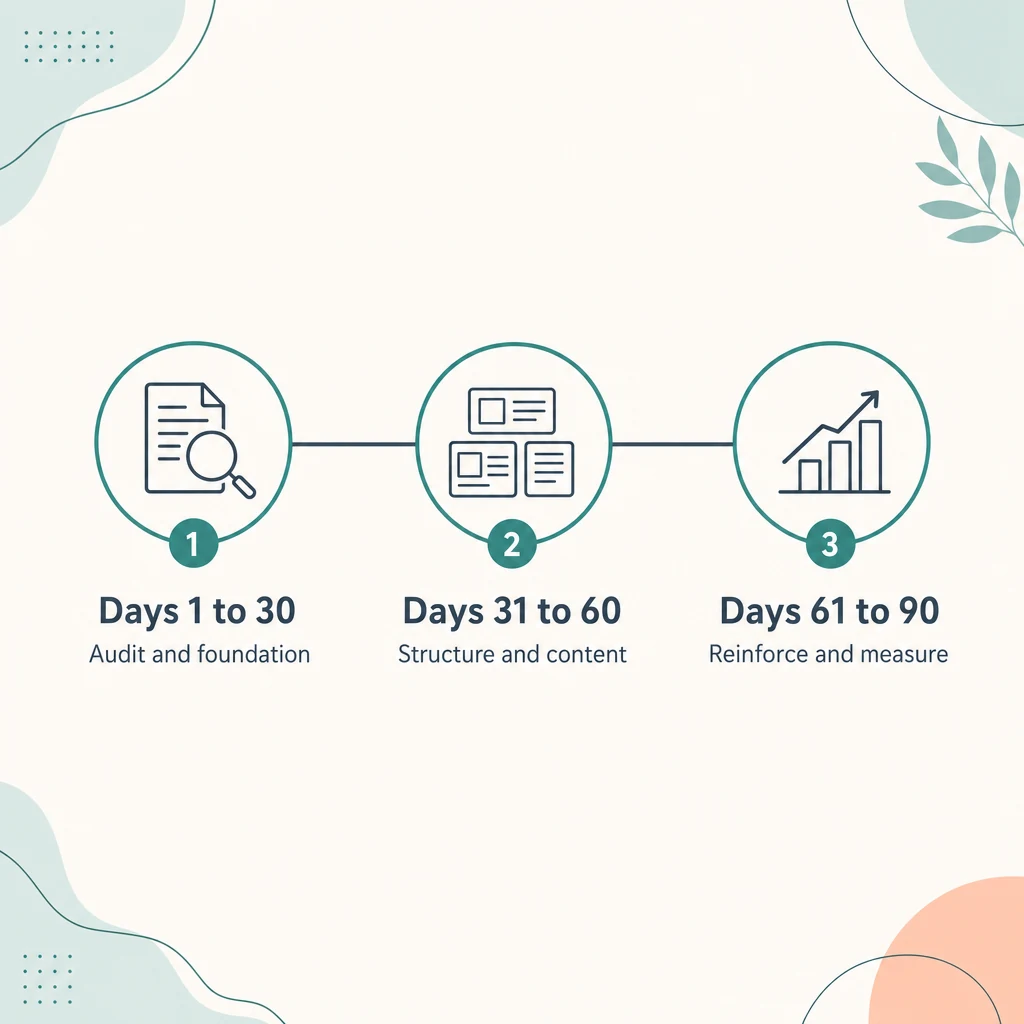
Days 1 to 30: audit and foundation
The first month is about seeing clearly and fixing what is broken. That means a full audit of how you show up in Google and the map pack today, a technical and speed check of the site, a review of your Google Business Profile, a look at which competitors are winning your towns, and a priority list of the searches that lead to customers. It also means recording the baseline numbers, because you cannot show progress from a number nobody wrote down.
Days 31 to 60: structure and content
The second month is where the fixes ship. Site structure gets cleaned up so each important page has one clear headline, service and city pages are built or rewritten, schema is added, listings are tightened, and the first content lands. If a proposal cannot tell you which pages get built in month two, it is not a scope of work yet.
Days 61 to 90: reinforce and measure
The third month connects everything and checks the scoreboard. Local signals get reinforced across the web, listings stay consistent, early reviews and links come in, and the first real report runs against the month-one baseline. Ninety days is usually enough to see early movement, though durable results tend to compound over six to twelve months.
Are SEO packages worth it for a small business?
For most established small businesses, yes, as long as the tier matches the result you are expecting from it. A package is a way to buy a predictable amount of work every month, and predictability is worth real money when the alternative is an open hourly arrangement nobody tracks. The risk is not the format. The risk is buying a foundation tier while expecting growth-tier results.
The honest caveat is timing. SEO does not switch on. In most local markets it takes six to twelve months to build real momentum, and the first ninety days buy a foundation rather than a flood of calls. That is why many small businesses run ads alongside the first two quarters and shift toward organic as it matures.
How an honest package compares to the typical agency package
Two patterns show up again and again in the packages I read. Most agencies will not publish a price at all. And most describe the work in language nobody can check: improved visibility, ongoing optimization, monthly enhancements. You can beat that low bar by asking any provider, including me, two direct questions. What is in this tier that is not in the one below it, and what numbers will you report each month. Our guide on when to hire an SEO consultant covers the rest.
I also want to be plain about what I can and cannot promise. We do not promise rankings, lead counts, or a set number of jobs, because no honest provider can control how Google ranks you or how many people call. What I can do is quote an honest range, ship a clear scope, and report the real numbers, calls, form fills, rankings, and profile actions, so you always know where your money went. Anyone who guarantees you first place or a flood of leads should worry you.
Frequently asked questions
What is included in a small business SEO package?
A complete package covers five things: Google Business Profile and local listing management, work on the service and city pages that need to rank, technical and speed fixes, content that answers real customer questions, and monthly reporting you can verify. Packages differ mainly in how much of each you get, not in which tactics they use. If one of the five is missing, the package is incomplete.
How much should a small business pay for an SEO package?
An honest monthly package for a small local business generally lands in the low thousands, with the exact number depending on your market, your competition, and how much groundwork your site already has. Our SEO pricing page breaks the tiers down in dollars. Be cautious of packages priced at a few hundred dollars a month, because at that price you are usually buying a report rather than the work.
Are SEO packages worth it for a small business?
For most established small businesses, yes, when the tier is matched to the result you expect. A package buys a predictable amount of work each month, which is easier to judge than an open hourly arrangement. The trade-off is time. Plan on six to twelve months to build real momentum, with the first ninety days spent building a foundation rather than producing calls.
How do I know if an SEO package is padded?
Look for deliverables counted by volume rather than described by outcome, a long keyword list with no pages assigned to it, reporting presented as the service itself, and separate charges for work a complete package already needs. The quickest test is to ask what changes on your website this month and who does it. Padding rarely survives that question.
What should be in a monthly SEO report?
A monthly report should say what was done, what changed, and what happens next. At a minimum that means calls and form fills, rankings for an agreed set of priority searches, Google Business Profile actions, and the specific pages or fixes shipped that month. A dashboard link on its own is not a report.
Do SEO packages include Google Business Profile and AI search?
They should. For a local business the Google Business Profile is the center of the plan rather than an upgrade, and a package that charges for it separately is charging twice for the same foundation. AI search readiness works the same way. Getting cited in ChatGPT, Perplexity, or Google AI Overviews comes from clear structure, schema, and trustworthy content.
If your business is ready to become easier to find, easier to trust, and easier to choose across Google and AI search, we can build and measure the system behind it. Start with a conversation. We will look at your market and what comes next … no pressure and no contract. You can work with Jeremy or request a free website and SEO review any time. You can also call us at (217) 579-8791.
Explore This Topic

SEO for Financial Services: What It Costs in 2026

SEO Consultant Cost (2026): Hourly, Project and Retainer Rates Explained

Google Business Profile Management Pricing (2026): What the Work Costs and What the Profile Is Worth

Reputation Management Pricing (2026): What Each Price Tier Buys, and What No Price Can Buy

Law Firm SEO Cost (2026): Pricing and the Math on a Signed Case
Join Over 400,000 Entrepreneurs Getting Our Weekly Newsletter
Recent Posts
September 22, 2026
SEO for financial services costs about $1,400 to $20,000 a month for a payments firm. See the work, the fee models, and a
September 21, 2026
SEO consultant cost in 2026: $75 to $200 an hour, $1,000 to $3,000 a month for a local business, plus how that compares
September 20, 2026
Google Business Profile management pricing in 2026: the profile is free, management runs about $330 to $890 a month, and here is the