

This 66-second short is from Jeremy Bengtson, founder of The Search Sherpa in Mokena, Illinois. It opens a new series on how AI changes the pace of technological progress, and it starts with the comparisons people reach for first: electricity, the automobile, the internet, and the spreadsheet.
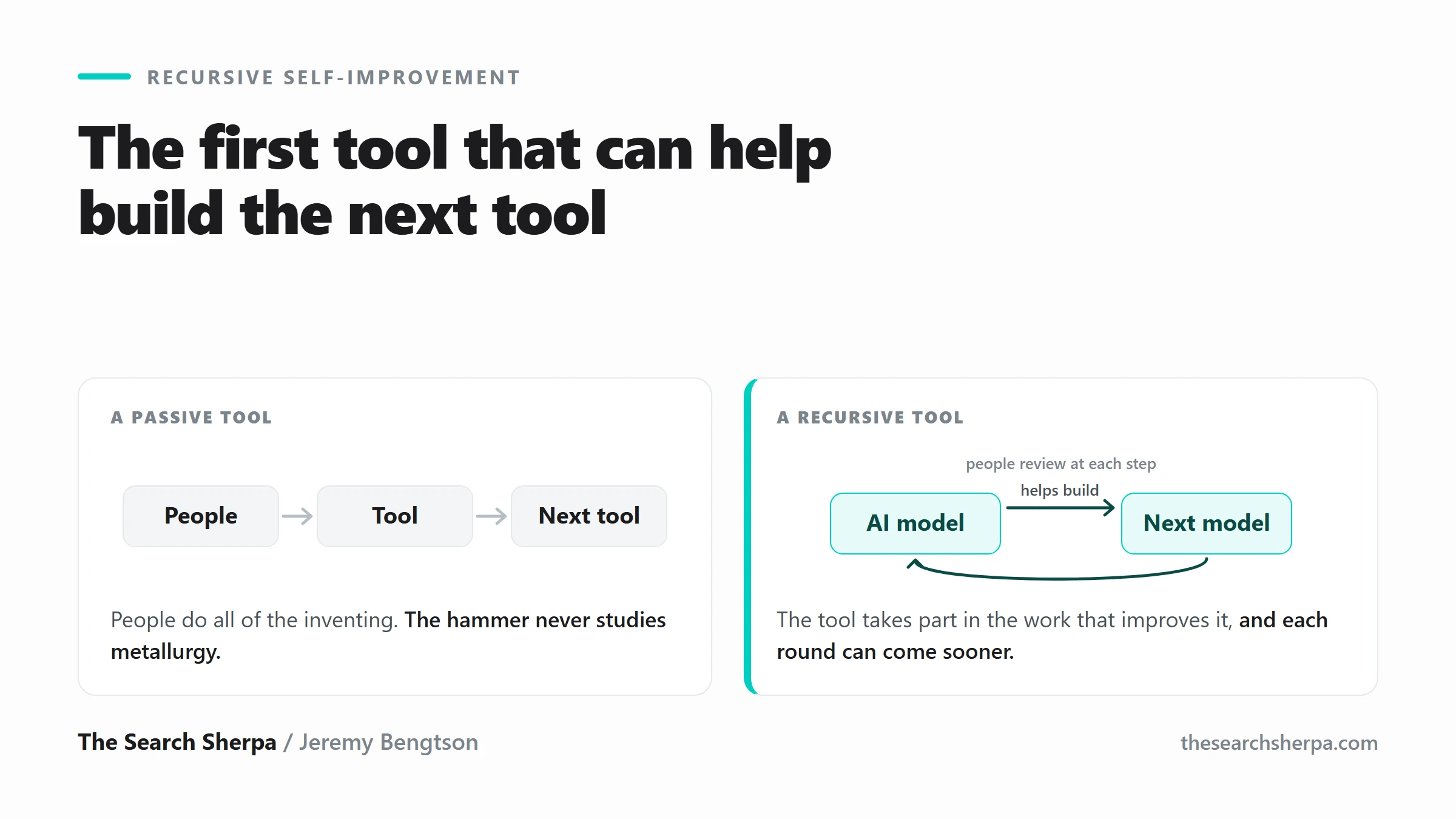
Every one of those tools changed the world. None of them helped design its own next version. The hammer never studied metallurgy, and the spreadsheet never rewrote its own software. The short argues that AI is different in one specific way: it can take part in the work that improves AI itself.
That is the idea researchers call recursive self-improvement. The point here is not that progress becomes infinite. It is narrower than that. Forecasts built for passive tools assume people do all of the inventing, and those forecasts fail as soon as the pace moves faster than their assumptions.
The companion guide explains where the idea came from, what AI is already doing to speed up its own research, what the skeptics say, and what a local business owner can sensibly do with any of it.
Read the full guide: Recursive Self-Improvement: What Happens When AI Helps Build Better AI →
Video Transcript
…intelligence by comparing it to technologies we already survived. Electricity, the automobile, the internet, the spreadsheet.
But every one of those comparisons quietly assumes the same thing. The tool remains a tool.
The hammer never studies metallurgy. The tractor never designs another tractor. The spreadsheet never rewrites its own software.
AI introduces a stranger possibility. The tool may begin participating in the process that improves the tool.
And once invention becomes partially automatable, technological progress becomes reflexive.
The important question may no longer be how quickly humans adopt AI. It may be how quickly AI becomes useful in producing the next generation of science, software, machines, and AI itself.
We may be trying to predict a recursive technology using historical models built for passive ones.
The future does not have to become infinite for those models to fail. It only has to start moving faster than their assumptions.
Read the full guide on recursive self-improvement and what it changes →
INTERNET MARKETING SERVICE • MOKENA, ILLINOIS
Ready to Improve Your Online Visibility?
Get a digital visibility consultation for your business.
Join Our Newsletter
Recent Posts
October 3, 2026
Recursive self-improvement is when AI helps build the next AI, so each round can come sooner. Here is where the idea came from,

October 2, 2026
Write honest local title tags and meta descriptions yourself, with Google’s own rules, fictional examples, and a free Claude skill. Or ask The

September 28, 2026
Watch AI SEO creator Joshua Albanese explain why a local business should ask some happy customers for a Reddit post as well as