

TL;DR
- Hire an SEO consultant when organic traffic isn’t converting, you’re invisible in local search, or technical issues keep breaking your rankings.
- Expect short-term wins (meta fixes, GBP edits) in 30–90 days; sustained lead growth takes 3–12 months.
- Vet every candidate with a scoped paid pilot before signing a long retainer.
- Always retain ownership of your content assets and insist on raw access to Search Console and Analytics.
- No legitimate consultant can guarantee a #1 ranking — deliverables and timelines are the only contract-worthy promises.
Table of Contents
Is It Time to Hire an SEO Consultant? Start Here.
The right time to hire an SEO consultant is when the gap between what organic search could deliver and what it’s actually delivering is costing you leads. If your website gets traffic but the phone isn’t ringing, if competitors consistently own the local pack, or if technical problems keep resetting your progress, a consultant provides the diagnostic expertise and prioritized roadmap your internal team can’t produce alone.
This guide gives you five clear signals that indicate you’re ready, a vetting checklist for evaluating candidates, and a realistic timeline of results to hold any consultant accountable to.
5 Business Signals That Mean You Should Hire an SEO Consultant
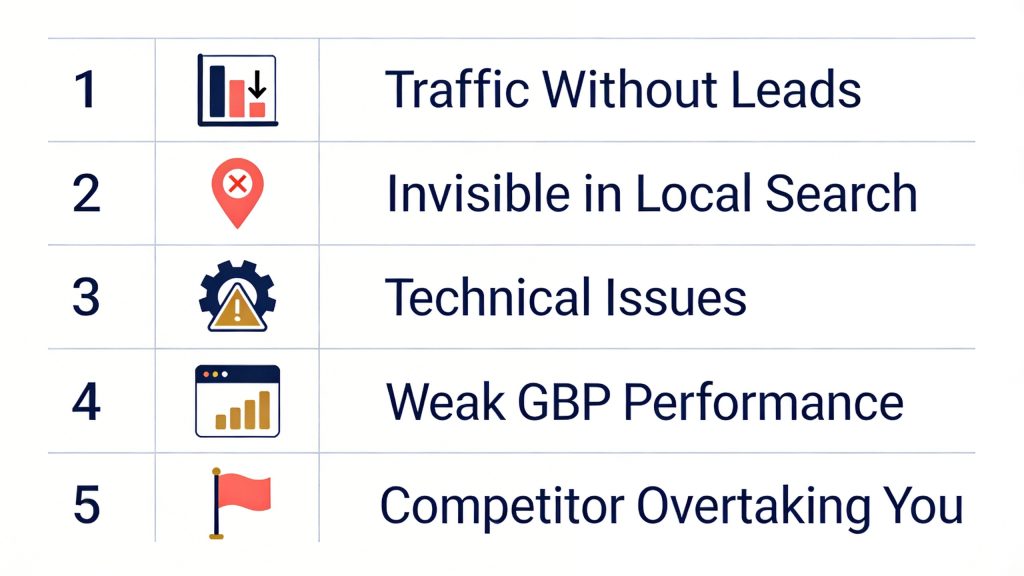
1. Organic Traffic Is Coming In — But Leads Are Not
Traffic that doesn’t convert is a diagnostic problem, not a content problem. When organic sessions hold steady or rise while phone calls, form fills, and booked appointments fall, the gap usually lives across systems: broken conversion tracking, misaligned landing page intent, or a keyword mix that attracts browsers instead of buyers.
An SEO consultant maps traffic to revenue touchpoints, finds the choke point, and builds a prioritized fix list. Without that cross-system view, your team keeps optimizing the wrong variables.
2. You’re Invisible in Local Search Despite Doing Everything Right
If your target neighborhoods never appear in the Google local pack — even though competitors consistently do — the issue is almost always Google Business Profile signals, citation consistency, or on-page local relevance. These aren’t one-time fixes; they compound over months.
A consultant audits your GBP completeness, NAP consistency across directories, and local landing page structure, then sequences fixes in order of impact. This is exactly the type of work that produced a 30% increase in calls for a dental practice that expanded into two new service areas.
3. Technical Issues Keep Resetting Your Progress
Deindexed pages, Core Web Vitals failures, broken canonical rules, or duplicate location pages are red flags that compound. They don’t just suppress rankings — they make every content investment you make worth less than it should be.
One HVAC company discovered its organic leads had been recorded as direct traffic for months due to misconfigured UTMs and broken canonicals. Fixing those two issues, not publishing new content, unlocked verifiable lead growth within three months.
4. Your Google Business Profile Is Underperforming
Inconsistent business name/address/phone data, unclaimed duplicate listings, and unanswered reviews are each local ranking suppressors on their own. Together they signal low trust to Google’s local algorithm.
If your GBP is driving fewer calls and direction requests than it should be relative to your service area, a consultant should run a full GBP audit before touching anything else on your site.
5. A Competitor Consistently Outranks You on Your Core Revenue Keywords
Ranking reports feel abstract until you calculate the lead volume sitting on page one of a query you should own. If a direct competitor holds top-three visibility for your primary commercial keywords despite similar on-site content quality, the gap is almost always off-page: authority, local signals, or structured data.
Before you decide to hire an SEO consultant, list your five highest-revenue keywords and search them from your target location. If you’re not on page one for any of them, that’s your brief.
What Does an SEO Consultant Actually Do?
A consultant’s core deliverable is prioritized diagnostic clarity — not content production, not link building as a standalone service, and not ranking reports. The work typically includes:
- Technical audit — crawl errors, indexation, Core Web Vitals, mobile usability, and site architecture
- Keyword and intent mapping — aligning your pages to the searches your buyers actually use
- GBP and local signals review — NAP consistency, citation cleanup, category selection, and review strategy
- Conversion instrumentation — verifying that Analytics and Search Console reflect true organic performance
- Roadmap with sequenced priorities — fixes ranked by impact so execution effort is never wasted
What a consultant is not: a magic ranking guarantee, a replacement for your development team, or a source of vague monthly “SEO work” with no measurable KPIs attached.
Audit vs. Retainer: Which Engagement Model Do You Need?
| Model | Best For | What You Get | Trade-Off |
|---|---|---|---|
| One-Time Audit | Teams with internal implementation bandwidth | Prioritized roadmap, technical findings, keyword gaps | Pays off only if your team executes the steps |
| Short Pilot (6–8 weeks) | First-time buyers or new vendor relationships | Baseline audit + 2–3 prioritized fixes + verification window | Lower commitment, slower long-term progress |
| Monthly Retainer | Businesses without internal SEO bandwidth | Ongoing implementation, reporting, and iteration | Higher cost; requires clear KPI accountability |
The smartest risk-mitigation move: always start with a paid pilot that converts to a retainer only after you verify the baseline audit quality and first fixes produce measurable movement.
Questions to Ask Before You Hire an SEO Consultant

Use these during discovery calls. Skip any consultant who deflects or gets defensive.
- “Can you show me a recent local case study with contactable references?” — Competence is provable. Vague logos on a homepage are not.
- “What KPIs will you report on monthly, and where does that data come from?” — The only acceptable answer cites Search Console, Analytics, and GBP Insights — not a third-party rank tracker.
- “Who owns the content assets you create?” — You do. Non-negotiable. Get it in the contract.
- “What happens if I cancel?” — Require a 30-day cancellation clause with deliverable handoff.
- “What do you need access to, and at what permission level?” — Legitimate consultants need: CMS editor access, delegated GBP access, and read-level Analytics/Search Console. Full hosting credentials are rarely needed up front.
- “What will you NOT do in the first 90 days?” — This question reveals strategic judgment. A good consultant says link outreach and heavy content production; they prioritize technical and local fixes first.
What Results Should You Expect? A Realistic Timeline
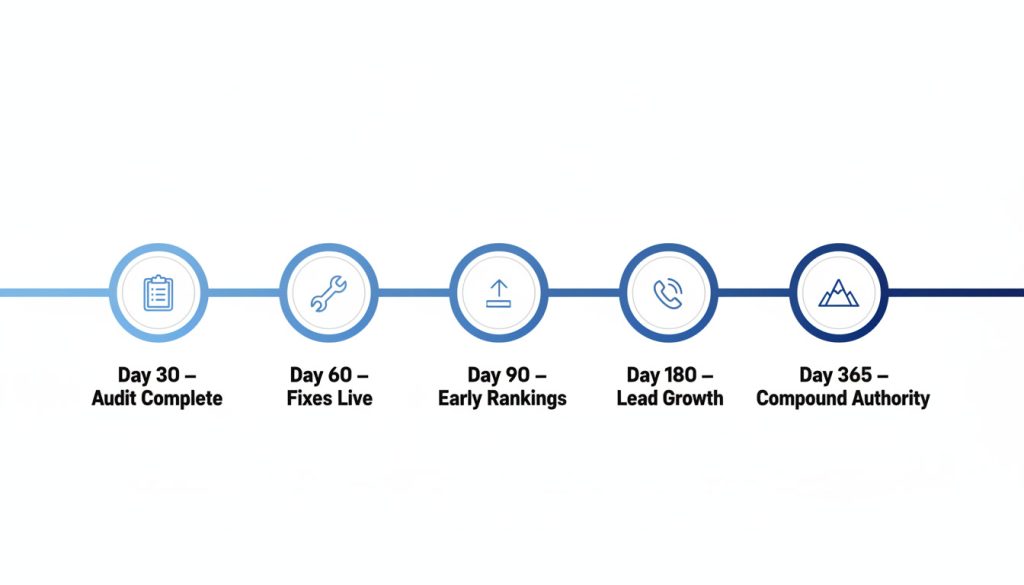
When you hire an SEO consultant, hold them to this milestone framework. Any proposal that promises dramatically faster results should raise your skepticism.
| Timeframe | Realistic Milestones | KPIs to Track |
|---|---|---|
| 30 Days | Baseline audit delivered; technical issues identified; GBP and tracking errors corrected | Search Console impressions; GBP actions (calls, directions) |
| 60 Days | Priority fixes implemented (canonicals, meta, indexation); local landing pages revised | Crawl error count; organic CTR on priority pages |
| 90 Days | Early ranking movement on low-competition keywords; GBP call volume improving | Organic sessions by landing page; GBP calls/week |
| 180 Days | Measurable lead growth from organic; content gaps addressed | Organic goal completions; cost-per-organic-lead |
| 365 Days | Compound authority gains; reduced CPL vs. paid; defensible rankings on revenue keywords | YoY organic revenue contribution; total organic conversions |
Key principle: short-term fixes like title/meta updates and GBP corrections show measurable movement in 30–90 days. Sustained lead growth requires 3–12 months because content authority and local signals compound slowly. (Source: Google Search Central)
What Does It Cost to Hire an SEO Consultant?
Fees vary by scope, market, and engagement model, but here’s a grounded benchmark for local service businesses:
| Engagement Type | Typical Fee Range | What Drives Cost Up |
|---|---|---|
| One-Time Audit | $500–$3,000 | Market competitiveness; site size; technical complexity |
| Short Pilot (6–8 weeks) | $1,000–$4,000 | Number of prioritized fixes; local vs. multi-location |
| Monthly Retainer | $750–$5,000+/month | Execution bandwidth included; number of locations |
The hidden cost trap: low monthly retainers that cap hours and shift execution back to your team. Budget for implementation, not just strategy. A consultant who delivers a roadmap and leaves you to build it alone slows results in competitive markets.
Key Takeaways
- Hire an SEO consultant when organic traffic isn’t converting, you’re invisible locally, or technical issues are compounding.
- The right first step is gathering three months of Analytics, Search Console, and GBP Insights — with or without a consultant.
- Vet every candidate with a paid pilot before committing to a retainer.
- Insist on: raw data access, content ownership in writing, measurable KPIs, and a 30-day cancellation clause.
- Realistic timeline: 30–90 days for early signals, 3–12 months for compounding lead growth.
- No reputable consultant guarantees specific rankings — only deliverables, timelines, and measurable KPIs.
Ready to take the next step? Prepare your data, shortlist two or three consultants, and ask each for a scoped pilot proposal tied to measurable outcomes. Get in touch →
Frequently Asked Questions
How quickly will I see results after I hire an SEO consultant?
Short-term fixes — title and meta updates, GBP corrections, removing blocking robots rules — can produce measurable changes in 30–90 days. Sustained ranking and lead growth typically takes 3–12 months because content authority, backlinks, and local signals compound slowly. The timeline depends on your market’s competitiveness and how quickly technical fixes are implemented.
Can an SEO consultant guarantee a number-one ranking?
No. A guarantee of a specific ranking position is a red flag in any proposal. A credible consultant guarantees deliverables and timelines for work items — audits, technical fixes, content pieces — not positions. Expect measurable outcome commitments (organic leads, GBP call volume, Search Console impressions) rather than rank promises.
What’s the difference between an SEO audit and a monthly retainer?
An audit is a one-time diagnostic product: you receive a prioritized roadmap of findings and recommended fixes. It only pays off if your team implements the steps. A retainer buys continuity — the consultant implements the roadmap, reports monthly, and iterates. If you lack internal SEO bandwidth, a retainer (or a short pilot that converts to one) is the better investment.
How much access should I give an SEO consultant?
Provide the minimum required for execution: editor-level CMS access for content changes, delegated access to Google Business Profile, and read-level permissions to Analytics and Search Console. Full hosting credentials are rarely needed up front and should only be granted on a task-specific basis for technical work.
What should I require in a monthly SEO report?
At minimum: organic sessions tied to goal conversions, Google Business Profile actions (calls, direction requests), Search Console impressions and CTR by query, and a short prioritized task list mapping completed work to impact. Require raw data access — not exported screenshots — so you can verify numbers independently.
What should I look for in a local SEO case study from a consultant?
Look for specific results tied to verifiable KPIs: call volume increases, organic lead growth, or GBP action improvements with before/after data. Contactable references are the gold standard. Be wary of case studies that cite only ranking improvements without connecting those rankings to business outcomes (leads, revenue, calls).
Is it better to hire an SEO consultant or bring SEO in-house?
Hire a consultant when fixes cross multiple disciplines — dev, content, listings, paid media — and your team lacks time or expertise to diagnose and prioritize. A consultant costs more per hour than an in-house hire but reduces wasted effort by finding and prioritizing high-impact changes first. For ongoing execution at scale, an in-house SEO specialist eventually makes more sense, but a consultant is the faster path to a working baseline.
What contract terms are non-negotiable when I hire an SEO consultant?
Four non-negotiables: (1) you retain ownership of all content assets created during the engagement; (2) a clear deliverables list with timelines is attached to the contract; (3) a cancellation clause with no more than 30 days’ notice required; and (4) a transition/handoff process so you keep access to all accounts, assets, and documentation if the relationship ends.
Explore This Topic

Pest Control SEO Cost (2026): Pricing and Contract Math for Pest Control Companies

Chiropractor SEO Cost (2026): Pricing and Patient Math for Chiropractors

Small Business SEO Packages (2026): What Is Inside Each Tier

How Much Does Dental SEO Cost in 2026? (Honest Pricing Guide)
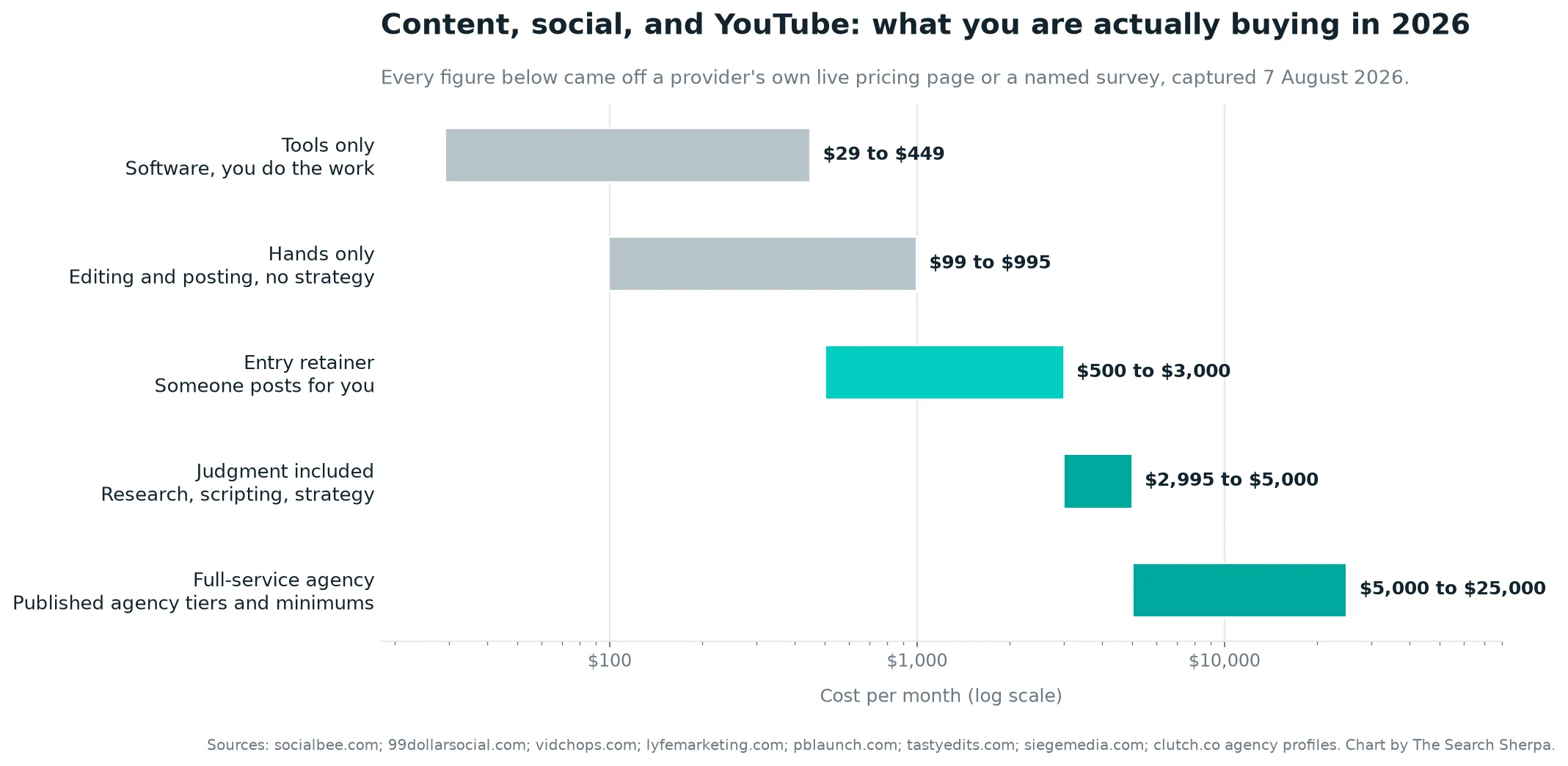
Social Media Management Pricing in 2026: What Content, Publishing, and YouTube Really Cost
Join Over 400,000 Entrepreneurs Getting Our Weekly Newsletter
Recent Posts
August 17, 2026
What pest control SEO costs in 2026, what a 90-day plan includes, and the contract math: cost per lead versus what a recurring
August 15, 2026
What chiropractor SEO costs in 2026, what a 90-day plan includes, and the honest patient math: cost per lead versus what a new
August 7, 2026
What is actually inside a small business SEO package at each tier, what changes as you move up, and how to tell a