
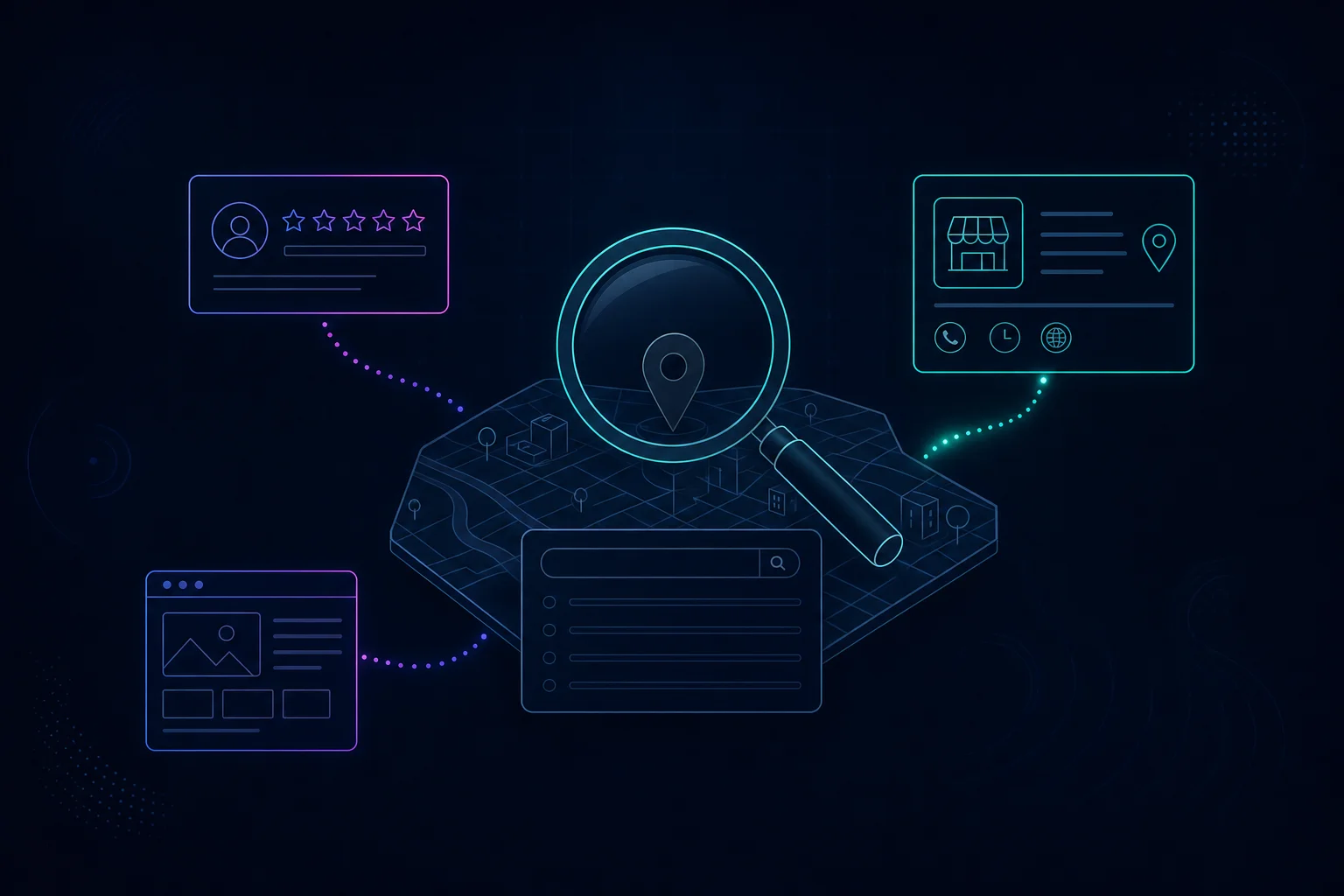
You launched a website, maybe printed some cards, and told your friends. Then you searched your own business name, or the service you sell, and you were not there. It is one of the most common and most discouraging moments for a new local business owner, and it almost never means your business is the problem. It usually means your business is not yet visible in the places Google looks.
In a short video where AI SEO creator Joshua Albanese acts out why nobody can find a newly launched business, he plays both a business owner and a clone running through the same checklist we use with clients: reviews, Google Business Profile, and tracking. This guide takes that checklist apart in plain English so you can find your own gap and fix it.
Table of Contents
The Short Answer: Why Your Business Is Not Showing Up on Google
Your business is not showing up on Google for one of five reasons: Google has not crawled or cannot read your website yet, you do not have a Google Business Profile or it is incomplete, you have too few reviews to earn a spot in the local results, you are searching from a location outside your service area, or you have no way to tell whether any of it is working. New businesses usually have more than one of these at once. The good news is that every one of them is fixable, and most of the fixes are free or close to it.
There are two different kinds of “Google” you can show up in, and it helps to keep them separate. The map results (the little map with three business listings) are powered by your Google Business Profile. The regular blue links below the map are powered by your website. A brand-new business often shows up in neither, and each one has its own list of causes. We will take them in the order that fixes the most, fastest.
Reason 1: Google Cannot Find or Read Your New Website
When the owner in the video says “I launched my website today, but nobody is visiting it,” this is usually the first culprit. A website going live does not mean Google has seen it. Google has to crawl the site (visit and read it) and index it (add it to the searchable list) before it can appear for anyone. On a new site that can take days to weeks, and it does not happen at all if something is blocking it.
The three most common blockers we find on new local sites: a “Discourage search engines” setting left switched on from the build (in WordPress this is a single checkbox that hides the whole site), pages with no real text for Google to read because everything lives inside images or a slider, and a missing or unsubmitted sitemap. Any one of these can keep a good-looking site completely invisible. This is exactly the gap our WordPress design and SEO service is built around: a site that looks finished but was never set up to be found.
You can check the basics yourself. Search site:yourdomain.com in Google. If nothing comes back, Google has not indexed a single page yet. If a few pages come back but not the ones that matter, your important pages are not being read. From there it is a question of removing the block, giving each page real headings and text, and submitting a sitemap in Google Search Console so Google knows where to look.
Reason 2: Your Google Business Profile Is Missing or Incomplete
“Did you fill out your Google Business Profile completely? No.” For a local business, this is often the single biggest reason you are missing from the map. Your Google Business Profile is the free listing that powers the map pack, and Google will not rank a listing it does not trust. A profile with no categories, no hours, no photos, and no description reads as incomplete, and incomplete listings lose to complete ones every time.
To be eligible at all, the profile has to be claimed and verified, which for most businesses means requesting a postcard, a call, or a video verification from Google. After that, completeness is the work: the right primary category, every relevant secondary category, real service areas, accurate hours, your service list, and photos of the actual business. Our Google Business Profile optimization checklist walks through 42 specific items, and our Google Business Profile management service handles it for owners who would rather not.
One quiet detail matters more than people expect: your business name, address, and phone number have to be spelled exactly the same everywhere they appear online. When your website says one thing and your profile says another, Google is not sure they are the same business, and that uncertainty costs you rankings. Consistency is not glamorous, but it is one of the strongest local signals you control.
Reason 3: You Have Few Reviews, or You Never Ask
“Do you regularly ask for customer reviews? No.” Reviews do two jobs at once. They help you rank in the map results, and they help a real person choose you once they see you. A new business with zero reviews sitting next to competitors with dozens has a steep hill to climb, and the fix is not complicated: ask every happy customer, every time, with a direct link that lands them on the review form.
Most owners do not have a review problem so much as an asking problem. They wait, they forget, or they feel awkward about it, and the reviews never come. A simple habit (ask at the moment the customer is happiest, hand them the link, follow up once) changes the picture within weeks. We cover the exact approach in our guide to how to get more Google reviews, and our reputation and review management service builds the whole system for you. Note that Google prohibits paying for reviews or gating out negative ones, so the goal is more real reviews, not fake ones.
Reason 4: You Are Searching From Outside Your Service Area
Sometimes your business is actually showing up, just not for you. Google’s local results are heavily tied to where the searcher is standing. If you check from home three towns over, or on office wifi in a different suburb, you may see very different results than a customer down the street. People conclude they are invisible when they are simply searching from the wrong spot.
Test it honestly. Search from your actual place of business on your phone with wifi off, or use the location settings in a fresh browser to check from the neighborhoods you serve. If you appear near your address but fade a few miles out, that is not a bug, that is how local ranking works, and it is exactly what a local SEO program is designed to widen. Showing up across a whole service area, rather than just your own block, is earned through content, citations, and reviews over time.
Reason 5: You Cannot Tell Whether It Is Working
“Are you tracking phone calls, when somebody fills out a form, or even booked jobs and revenue? No.” This one does not keep you off Google, but it keeps you from knowing anything. Without tracking, you cannot tell whether nobody is finding you or whether people are finding you and not calling. Those are two completely different problems with two completely different fixes, and guessing wrong wastes months.
The starting kit is small: Google Search Console to see which searches show your site and how often people click, Google Business Profile insights to see calls and direction requests from the map, and simple call and form tracking so a real lead is never mistaken for a wasted month. When those connect back to booked jobs and revenue, you finally have plain-English answers instead of a report full of numbers that mean nothing. Our SEO analytics and CRM integration service wires exactly this together. It is also what lets you tell whether AI tools like ChatGPT and Google’s AI Overviews are sending you anyone, which is its own growing question we cover in answer engine optimization for local businesses.
How to Diagnose Your Own Google Visibility
You can run a rough self-check in about twenty minutes before you spend a dollar. Work through it in order and write down what you find.
- Search
site:yourdomain.com. Zero results means Google has not indexed your site. Fix the block before anything else. - Search your business name in quotes. If your own name does not bring you up, both your site and your profile need work.
- Look yourself up on Google Maps from your actual address. Not there means your Google Business Profile is missing, unverified, or incomplete.
- Count your reviews against the businesses that do show up above you. A large gap is a ranking gap.
- Open Google Search Console (it is free). No data usually means the site was added recently or was never verified.
- Check whether a single call or form fill would be recorded anywhere. If not, you are flying blind.
The pattern of what fails tells you where to start. All map, no website means fix the site. All website, no map means fix the profile. Nothing anywhere usually means the site is blocked or the profile was never verified. If you would rather not sort it out alone, this is the exact diagnosis we run on a free consultation call.
What It Costs to Fix
Much of the first round of fixes costs nothing but time. Claiming and completing your Google Business Profile is free. Removing a “discourage search engines” checkbox is free. Asking your customers for reviews is free. Submitting a sitemap in Search Console is free. If you are comfortable following instructions, you can do a real amount of this yourself, and you should, because it is your business.
Where owners bring us in is the ongoing work: building content that helps your business show up across a service area, earning citations and links, keeping the profile active, and reading the data every month so the plan actually adjusts. Cost depends on your site, your competition, and your goals. We will be clear about pricing before any work begins, usually on the first call. And we work founder-led. Clients stay because the work earns it.
Set your expectations on timing, too. Most local SEO shows measurable movement in about three to six months, depending on competition and the condition of your site. Some fixes (a blocked site going live, a profile getting verified) can change things in days. We do not promise rankings, lead counts, or map placements, because no honest provider can.
About The Search Sherpa
The Search Sherpa is a founder-led local SEO practice based in Mokena, Illinois, serving Will County and the southwest Chicago suburbs. When you work with us, you work directly with Jeremy Bengtson, not an account-manager layer. Jeremy Bengtson holds a business degree from Western Illinois University and is Semrush certified, and The Search Sherpa has served local businesses since 2024. The approach is one connected visibility system across local SEO, your website, your Google Business Profile, and your content, explained in plain English so you always know what is being done and why. The goal is simple to state and specific to execute: make your business easier to find, easier to understand, and easier to choose.
If you searched for your business and were not there, that is the problem we solve, and the first conversation is free. You can reach The Search Sherpa at 18750 Ruth Dr, Mokena, IL 60448, or call (217) 579-8791. When you are ready, schedule a digital visibility consultation and we will walk your results together.
Frequently Asked Questions
Why does my business show up for me but not for my customers?
Google personalizes local results by location and past activity, so you often see your own business when a customer standing somewhere else does not. Test from your actual address with wifi off, or check from the neighborhoods you serve. If you appear near your address but fade a few miles out, that is normal local ranking, and it is what a local SEO program is built to widen over time.
How long until my new business shows up on Google?
A new website can take days to a few weeks to be crawled and indexed, and only if nothing is blocking it. A Google Business Profile can appear within days of verification. Ranking well is slower: most local SEO shows measurable movement in about three to six months, depending on your competition and the condition of your site. We never promise a specific ranking or timeframe.
Does my business need a website to show up on Google Maps?
No. Google Maps results are powered by your Google Business Profile, which is free and separate from your website, so you can appear on the map with no site at all. A website still matters, because it powers the regular search results and gives Google and customers more reason to trust and choose you. The two work together, and most businesses need both.
Why did my business disappear from Google after showing up before?
Common causes are a suspended or edited Google Business Profile, a website change that removed or blocked pages, duplicate listings competing with each other, or inconsistent name, address, and phone details across the web. Start by confirming your profile is active and your site is still indexed with a site colon search. If both look fine, the drop is usually a ranking shift worth diagnosing properly.
Can I get my business to show up on Google for free?
Yes, a large part of it is free. Claiming and completing your Google Business Profile, submitting a sitemap in Search Console, and asking customers for reviews all cost nothing but time, and they move the needle. Paid help is for the ongoing work of content, links, and monthly analysis that widen your visibility. We are happy to point you at the free steps first on a no-cost consultation call.
Explore This Topic


Join Over 400,000 Entrepreneurs Getting Our Weekly Newsletter
Recent Posts
October 15, 2026
SEO for property management in 2026: reach rental owners with a Google Business Profile, area pages, Fair Housing-safe copy, honest reviews, and cost.

October 15, 2026
SEO for insurance agencies in 2026: Google Business Profile setup, line and town pages, honest reviews, ad-rule checks, and what local SEO costs.

October 12, 2026
A YouTube demo shows only part of a provider’s work. Learn what to verify about AI review, access, backups, testing, ownership, and support