
By Jeremy Bengtson, founder of The Search Sherpa.
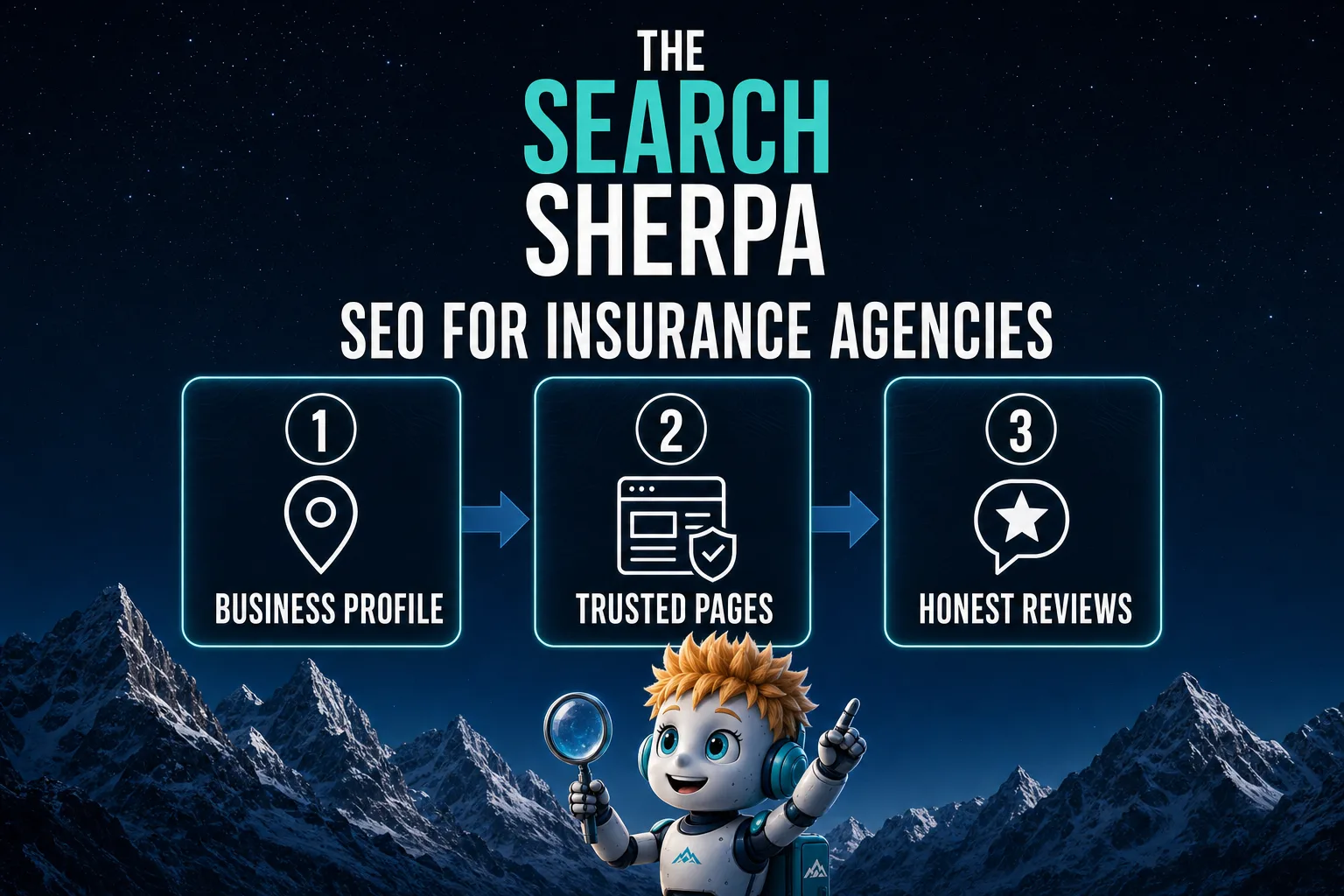
SEO for insurance agencies is the work of making a local agency easy to find, easy to check, and easy to call when someone nearby searches for an agent. It runs on four things you control: your Google Business Profile, your website, your reviews, and the accuracy of everything you publish about coverage.
The work below is your Google Business Profile, your pages, and your reviews. The Search Sherpa is an SEO practice, not an insurance producer. We do not sell, buy, or pass along insurance leads. The Illinois section explains that line.
What SEO for insurance agencies includes
Our playbook for a local agency has five parts: a complete Google Business Profile under your real name, a page for each line you write and each town you serve, a steady flow of honest reviews, the same name, address, and phone on every listing, and copy that follows your state’s insurance advertising rules and your carrier agreements.
Most of the parts match any local service business. Here is how SEO, local SEO, and a Business Profile differ. We build agency pages for the searches a person nearby uses to find an agent, such as insurance agent in [town] or [line] insurance agent in [town].
Independent and captive agencies need different setups
An independent agency markets under its own name. Use that name on the profile. If you are the only public-facing agent at a branded location, Google says it is best to share one profile with the organization, named in the format “[brand/company]: [practitioner name].” Google also says a business that is “an authorized and fully dedicated seller of the branded product or service” may use the underlying brand name. When several agents work at the office, or when the role is lead generation for the carrier, follow the profile rules in the next section. Read the carrier agreement before you change the profile or the site. It may restrict how you use the brand name even when Google would allow the profile.
What SEO does not do
SEO does not buy position. Google’s page on how local results are ranked says “There’s no way to request or pay for a better local ranking on Google.” Its guide on whether you need an SEO adds that “Google never accepts money to include or rank sites in our search results.” SEO makes your agency easier to find and easier to trust. It does not hand you policyholders. A vendor who promises policyholders is describing a different service.
Your Google Business Profile as an insurance agent
The map results draw on your Google Business Profile: name, category, address or service area, hours, photos, and reviews. Google’s Business Profile guidelines speak to insurance agents by name.
Agency profile or agent profile
Google says “Doctors, dentists, lawyers, financial planners, and insurance or real estate agents are all individual practitioners.” A practitioner should have their own profile when they work in a public-facing role and “can be contacted directly at the verified location during stated hours.” When several agents work at one office, Google says the organization should have its own profile for the location, separate from each agent’s. And one line rules out a common shortcut: “Sales associates or lead generation agents for corporations aren’t individual practitioners and aren’t eligible for a Business Profile.”
Name, phone, address, and categories
Use your real name. Google says “Your name should reflect your business’s real-world name, as used consistently on your storefront, website, stationery, and as known to customers,” and that adding unnecessary information to the name “isn’t permitted, and could result in the suspension of your Business Profile.” So keep sales phrases and keywords out of the agency name. For the phone, Google asks for “a local phone number instead of a central call center helpline number whenever possible,” so list the office line, not a national number.
Use a real office. Google says a rented mailing address you do not operate from, “also known as a virtual office,” is not eligible, and that a co-working office qualifies only if it has clear signage, receives customers during business hours, and is staffed by your business during those hours.
For categories, Google says “Use as few categories as possible to describe your overall core business from the provided list,” and “Do not use categories solely as keywords or to describe attributes of your business.” Its category help page says “Select a primary category that best describes your business.” If the list includes Insurance agency and that is your core business, make it the primary. Add a secondary category only for a line you actually write, and only if the list offers one for it. Then list the lines you write under services, add photos of the office and the people who answer the phone, and describe the agency in plain language with the towns you serve. Our guide to choosing Google Business Profile categories walks through the choice, and our Business Profile optimization checklist covers the rest of the profile.
How Google ranks local results, and the links an agency can earn
Google says “Local results are mainly based on relevance, distance, and popularity.” It describes prominence as how well-known a business is, based partly on “how many websites link to your business and how many reviews you have,” and says “More reviews and positive ratings can help your business’s local ranking.” Distance depends on where the searcher is, so the parts you can work on are relevance and prominence. For an agency, our list is a complete profile, one clear page per line you write, the same name, address, and phone on every listing, and links you can earn: the find-an-agent page of a carrier you represent, if it lists agents, your association directory, and the local chamber. Google’s spam policies name “Buying or selling links for ranking purposes” as link spam, so buy no links, and skip directories that exist to sell insurance leads.
Pages worth building for an insurance agency
A page for each line and each town
Most agency sites need a page for each line of insurance you actually write, such as auto, home, renters, life, or business, and a page for each town you genuinely serve. Write about that town. Do not copy one page and swap the town name. Build those pages for searches a person uses to find a local agent, such as insurance agent in [town] or home insurance agent in [town], and only for towns you serve. We would leave national phrases such as cheap car insurance to the carriers. If you write commercial lines, a page for each kind of business you actually insure, such as contractors or restaurants, does the same job for business owners. A headline that promises savings or coverage you cannot document is the section 149(1) problem described below. On each page, name the line, the area, who answers the phone, when the office is open, and how a person starts a conversation. Agencies with more than one office can follow our notes on multi-location SEO.
Insurance can be a Your Money or Your Life topic
Google treats topics that can affect a person’s financial stability as Your Money or Your Life topics, and insurance advice can fall in that group. For those topics Google says content must be highly accurate and consistent with expert consensus.
Google’s guide to creating helpful content says “our systems give even more weight to content that aligns with strong E-E-A-T for topics that could significantly impact the health, financial stability, or safety of people,” and it calls these “Your Money or Your Life” topics. The same page says trust is the most important part, and that E-E-A-T itself is not a specific ranking factor. On an agency site, trust is a named author, a photo, the lines that person writes, and an explanation that stays general and points to the policy.
Reviews for insurance agencies: ask every client, offer nothing
Google’s policy on fake engagement does not allow merchants to “Discourage or prohibit negative reviews, or selectively solicit positive reviews from customers,” and it bans incentives “such as payment, discounts, free goods and/or services” in exchange for a review. That rules out a gift card for a review and asking only the clients whose claims went smoothly.
What works within those rules is simple. Google’s review tips say “you can ask customers to visit a Google link or scan a QR code.” Ask every client the same way, at the same points, such as after a new policy is bound or a renewal is done, and reply to every review. The same page says “Your replies are public” and “Never share a reviewer’s private information.” Thank the client or acknowledge the complaint. Leave what the policy paid, any coverage conclusion, and any personal detail out of the reply, and invite the person to call the office. Here is a realistic system for getting Google reviews.
Insurance advertising rules: the Illinois example
In Illinois, anyone who advertises insurance may not misrepresent a policy’s terms or benefits, or suggest that the state approved a company or policy. For life, annuity, and accident and sickness advertising, Illinois rules make the insurer responsible for ads no matter who wrote them, so check your carrier agreements before you change your website or profile.
The rules below come from the Illinois Insurance Code, 215 ILCS 5/149, and the Illinois Administrative Code. This is marketing guidance, not legal advice. If you advertise in another state, use this section as the shape of the check, then confirm that state’s rules with your carriers or with counsel.
Do not misrepresent policy terms
Section 149(1) says no company, agent, broker, “or any other person” shall circulate “any estimate, illustration, circular, or verbal or written statement of any sort misrepresenting the terms of any policy issued or to be issued by it or any other company or the benefits or advantages promised thereby.” For SEO, that covers page headings, meta descriptions, and Business Profile posts.
Do not imply state approval
Section 149(4) bars advertising that suggests a company, its policies, or its claims payments “are approved, endorsed, or guaranteed by the State of Illinois or United States Government or the Director or the Department.” Do not describe your agency or a policy as approved, endorsed, or guaranteed by the state, and use no wording that implies it. Section 149(5) sets a penalty of “not less than $200 nor more than $10,000” for violations of the section. The penalty is quoted from the statute. It is not a determination about any page you have published.
Who answers for an insurance ad
For life insurance and annuities, 50 Ill. Adm. Code 909.30 says those ads, “regardless of by whom written, created, designed or presented, shall be the responsibility of the insurer.” For accident and sickness insurance, 50 Ill. Adm. Code 2002.30 applies to ads made “either directly or indirectly by or on behalf of an insurer, agent or broker,” and makes them “the responsibility of the insurer whose policies are so advertised.” We did not find an Illinois rule that sets the same review process for other lines, so check your carrier agreements before you publish new copy about any carrier’s products. If you market Medicare Advantage plans, carrier agreements are not your only check. Federal rules at 42 CFR 422.2260 define marketing for those plans and name “independent agents and brokers” among third-party marketing organizations. Confirm those rules before you publish.
Why we never offer insurance leads
Section 149(7) reaches anyone “not authorized to transact an insurance business in this State” whose advertising or requests for information are “designed to result in a solicitation for the purchase of insurance.” Its examples include material that “is intended to result, in the generation of leads for further solicitations.” The Search Sherpa is not licensed to transact insurance, so we work only on your own website and profile, and the inquiries they bring go straight to you.
| Illinois rule | What it says, in short | What it means for your SEO copy, and our practice |
|---|---|---|
| 215 ILCS 5/149(1) | No statement misrepresenting a policy’s terms, benefits, or advantages | Headings, meta descriptions, and posts describe coverage accurately or not at all |
| 215 ILCS 5/149(4) | No suggestion that the state or the Department approved a company or policy | No claim of state approval and no wording that implies state approval |
| 215 ILCS 5/149(7) | Reaches unlicensed parties whose material is designed to produce solicitations or leads | Our practice: we do not sell or generate insurance leads |
| 50 Ill. Adm. Code 909.30 | Life and annuity ads are the insurer’s responsibility, whoever wrote them | Check your carrier agreements before publishing |
| 50 Ill. Adm. Code 2002.30 | Accident and sickness ads by an insurer, agent, or broker are the insurer’s responsibility | Check your carrier agreements before publishing |

Confirm your obligations with your carriers, the Illinois Department of Insurance, or counsel who works with insurance producers.
What SEO for an insurance agency costs
For a local insurance agency, SEO usually costs $1,000 to $3,000 a month, the band we publish for local businesses. Before monthly work comes a one-time $2,000 roadmap, fully credited toward future services if you choose to move forward with us. Packages below $500 a month cannot sustain the work.
These figures come from our page on what SEO costs a local business in 2026, and the roadmap has its own page, the Custom SEO Roadmap. Cost depends on your site, your competition, and your goals. We will be clear about pricing before any work begins. For local context, see local SEO cost in the Chicago suburbs.
Our pricing page also says what the local band covers. It names four kinds of work:
- Google Business Profile optimization
- Local citation cleanup
- Service-plus-city landing pages
- Targeted content built to capture customers in your immediate service area
For an insurance agency, those four kinds of work are visibility on your own profile and your own site. The calls and form fills go to you. We do not sell, buy, or pass along insurance leads. Our pricing page says most businesses see early ranking movement within three to six months of consistent work, and that results you can clearly tie to new revenue usually take six to twelve months. Read those figures as the ranges published for local businesses in general. We do not promise rankings, lead counts, revenue, or map placements for your agency, because no honest provider can. Track what changes with a monthly local SEO scorecard. To scope the work for your agency, Book a Consultation.
What to ask any SEO provider
Google’s guide to hiring an SEO suggests asking for examples of past work, whether the provider follows Google Search Essentials, what results to expect and when, and whether every change to your site will be shared. It also says to walk away from anyone who promises first place. For an agency, add two questions: will the provider follow your carrier agreements, and do they sell leads to anyone? Our checklist on what to look for in a local SEO company covers the rest.
Frequently asked questions
How should a local insurance agency get found on Google?
Start with a complete Google Business Profile under your real name, then publish a page for each line you write and each town you serve. Ask every client for a review in the same way. Keep every statement about coverage accurate, do not suggest the state approved a policy, and check your carrier agreements before you publish.
How long does SEO for an insurance agency take?
Our pricing page says most businesses see early ranking movement within three to six months of consistent work, and that results you can clearly tie to new revenue usually take six to twelve months. We do not promise rankings, lead counts, revenue, or map placements for your agency.
Can I do SEO myself?
Often, yes. Google says “If you run a small local business, you can probably do much of the work yourself,” and recommends starting with its SEO starter guide. If you hire help later, knowing the basics helps you spot a technique Google does not recommend.
Can an insurance agent have their own Google Business Profile?
Yes, if they qualify. Google lists insurance agents as individual practitioners, who may have their own profile when they work in a public-facing role and can be contacted at the verified location during stated hours. Google says lead generation agents for corporations are not eligible.
Can an insurance agency say a policy is approved by the state?
No. In Illinois, 215 ILCS 5/149(4) bars advertising that suggests a company or its policies are approved, endorsed, or guaranteed by the State of Illinois, the federal government, the Director, or the Department.
Does The Search Sherpa sell insurance leads?
No. The Search Sherpa is an SEO practice and is not licensed to transact insurance. Illinois law, 215 ILCS 5/149(7), reaches unlicensed parties whose material is meant to generate leads for insurance solicitations, so we work only on the visibility of your own website and Business Profile.
The Search Sherpa is a founder-led SEO practice in Mokena, Illinois, and you work directly with Jeremy Bengtson. If you run an insurance agency and want to be easier to find, easier to understand, and easier to choose, Book a Consultation. You can also review SEO pricing for local businesses first, or call (217) 579-8791.
Explore This Topic

Join Over 400,000 Entrepreneurs Getting Our Weekly Newsletter
Recent Posts
October 15, 2026
SEO for property management in 2026: reach rental owners with a Google Business Profile, area pages, Fair Housing-safe copy, honest reviews, and cost.

October 12, 2026
A YouTube demo shows only part of a provider’s work. Learn what to verify about AI review, access, backups, testing, ownership, and support

October 12, 2026
Watch a 129-second AI Dialogue about coding permissions, approval fatigue, and the risk of giving an AI agent control you cannot evaluate.