

By Jeremy Bengtson, founder of The Search Sherpa.
SEO for moving companies is the work of making a mover easy to find, easy to check, and easy to call when someone nearby searches for help with a move. According to the Census Bureau’s American Community Survey, the share of people who moved to a different residence fell from 12.1 percent in 2023 to 11.8 percent in 2024. Those are people who moved, not jobs a mover booked.
SEO is one part of moving company marketing. This guide covers lead sources, the Google Business Profile, the advertising rule for interstate movers, regulators’ red flags, reviews, seasonality, and cost.
What SEO for moving companies includes
SEO for movers is the work that puts a moving company in Google’s map results and organic results for the towns it serves, and gives searchers enough proof to call. It covers the Google Business Profile, a website with real service and city pages, honest reviews, and, for interstate movers, the registration details federal rules require in every advertisement.
Most of the parts match any local service business. Our page on SEO for home-service contractors covers that shared foundation, and here is how SEO, local SEO, and a Business Profile differ. Two things set movers apart. Interstate movers are regulated by the Federal Motor Carrier Safety Administration (FMCSA), whose rules reach into advertising, including your website. And on its Protect Your Move site, FMCSA says “Thousands of Americans report experiencing moving fraud each year,” and it gives consumers a list of red flags and a search tool for a mover’s registration and complaints. Good SEO for a mover makes those checks easy to pass.
Where moving leads come from
Leads from Google can start in three places, and each runs on different inputs.
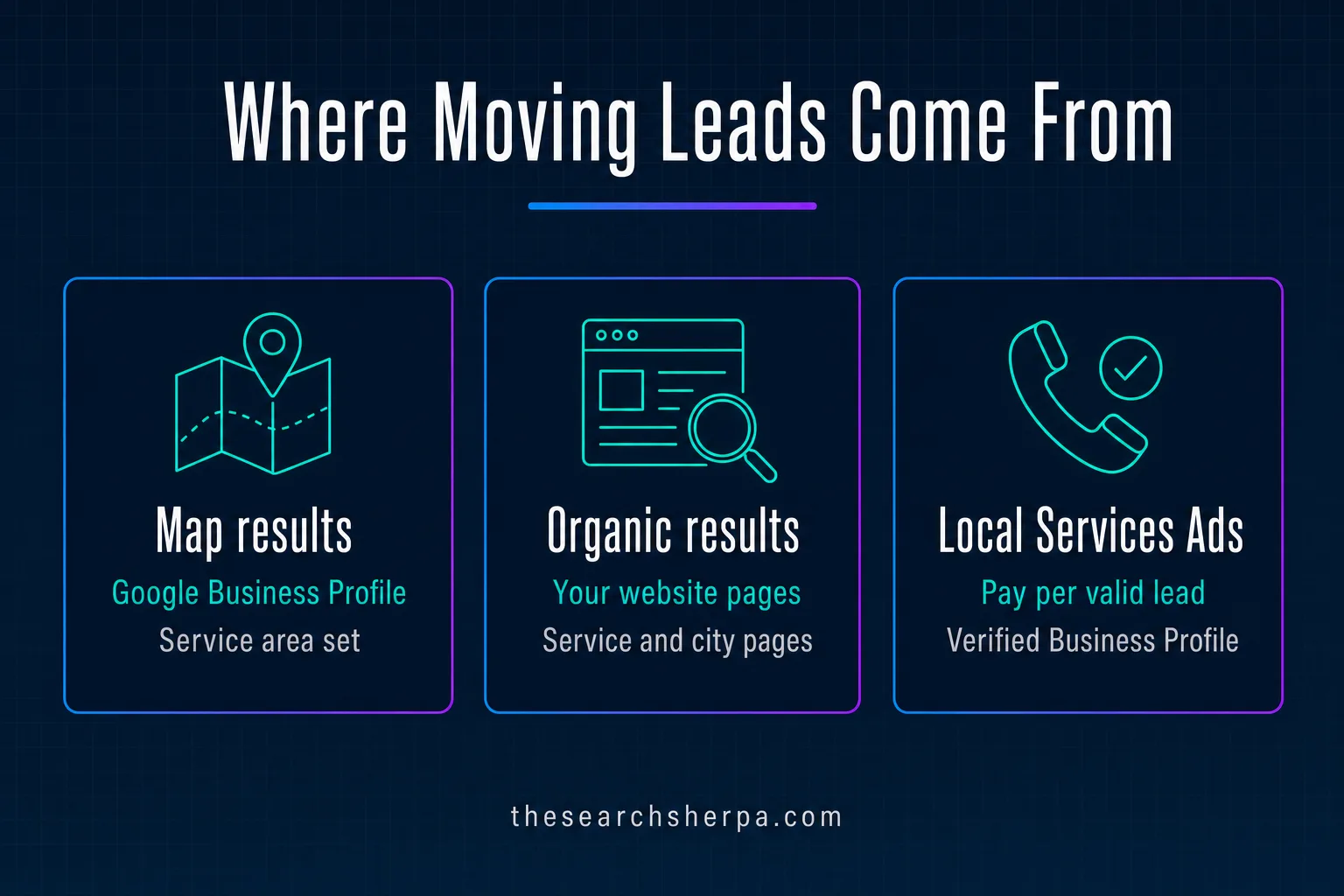
The map results and your Google Business Profile
The map results draw on your Google Business Profile: name, category, service area, hours, photos, and reviews. The profile section below covers the rules that matter most for movers.
Organic results and your website
The organic results draw on your website. A mover’s site earns its place with a page for each main service, such as local moves, long-distance moves, packing, and storage, and a page for each area you genuinely serve, written about that place rather than copied with the town name swapped. Each page should make the next step obvious, which is the job of landing pages that turn visits into calls.
Local Services Ads for movers, as of October 2026
Local Services Ads are bought from Google, not earned through SEO. As of October 2026, Google’s Local Services requirements page for the United States lists Moving: “Moving professionals pack, move, store, and unpack belongings among other services.” Availability varies: Google’s list of Local Services providers opens “Depending on the country and locality you’re searching from,” then names moving services. For Moving, Google lists a business check and a business representative check (for select users only), general liability and professional liability insurance, and a business license on state level, and says screening takes three to four weeks on average after submitting your documents.
Google also says “Local Services advertisers must have a public and verified Google Business profile to advertise with Local Service Ads.” Its page on how leads work says “With Local Services Ads, you pay for valid leads,” with prices that may vary by location, job type, type of lead, or bidding mode. Google prints no dollar figure, so we do not either. One example Google gives of a lead it will not credit is a customer who was “researching potential projects or prices related to a service you offer.”
Two changes are under way. First, Google’s page about the Google Verified badge says it is “simplifying our advertiser badging by launching a single badge for all advertisers,” ending the money-back program tied to its older badge, and that “Local Services Ads ranking won’t be affected by this change.”
Second, as of October 2026, Google’s Performance Max transition page says existing Local Services Ads campaigns will be automatically migrated “Over the upcoming months” to a Performance Max campaign type built for pay-per-lead goals, and advertisers “still only pay for valid leads (such as phone calls and messages) rather than ad clicks.” Before you sign up, read Google’s current Local Services pages rather than an older guide.
Your Google Business Profile as a moving company
Under Google’s Business Profile guidelines, a business without a storefront that travels to customers at their locations is “allowed one service-area Business Profile,” and “If you’re a service-area business, you should hide your business address from customers.” A mover with a storage office that customers visit can use a hybrid profile that shows the address and sets a service area, provided the location is staffed during its stated hours. A virtual office does not qualify unless it is staffed during business hours.
For long-distance movers, Google says the boundaries “shouldn’t extend farther than about 2 hours of driving time from where your business is based,” though larger areas may suit some businesses. Set the profile around your local area and let the website explain long-distance service.
Use your real name. Google says your name “should reflect your business’s real-world name, as used consistently on your storefront, website, stationery, and as known to customers,” and that adding unnecessary information is not permitted and could get the profile suspended. Interstate movers have a second reason: federal rules tie the name in your ads to the name on your USDOT record.
For categories, choose the primary category that best describes the business, and “Use as few categories as possible to describe your overall core business from the provided list.” Our guides to choosing Business Profile categories and a 42-item Business Profile checklist cover the rest.
Advertising rules for movers: USDOT numbers and state licenses
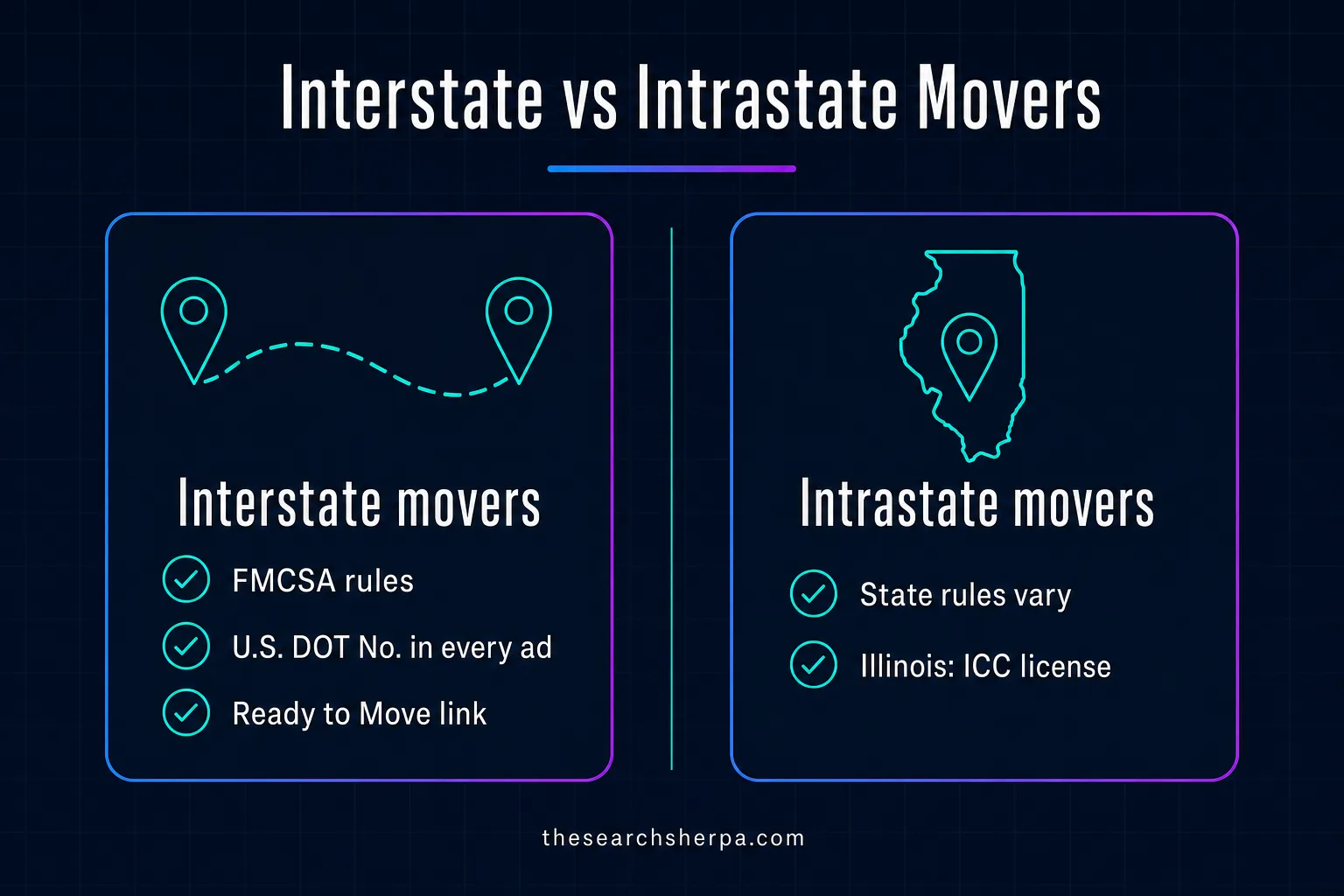
Interstate household goods movers must show their name and their U.S. DOT number in every advertisement, and federal rules count website listings as advertisements. Movers that work only within one state answer to that state’s rules; in Illinois, the Illinois Commerce Commission requires a Household Goods License.
Interstate movers: the U.S. DOT number in every ad
FMCSA’s guide to choosing a mover says “A U.S. DOT number is required by FMCSA for interstate moves,” and that for moves within a state, requirements vary. For interstate household goods carriers, 49 CFR 375.207 requires your name or trade name, as it appears on your USDOT record, and your U.S. DOT number “in all advertisements for all services,” and your agents must do the same. The number may appear in one form only: “U.S. DOT No. (assigned number).” Under 49 CFR 375.103, an advertisement “includes written or electronic database listings of your name, address, and telephone number in an on-line database or displayed on an Internet website.”
Our advice, not the rule’s wording: put the number in the footer of every page and in each ad and listing you control, and keep it out of the Business Profile name field, which Google reserves for the real-world name. A second rule, 49 CFR 375.213, says a carrier with a website must display prominently a link to the DOT publication Ready to Move? on the FMCSA website, or a true and accurate copy of it.
MC numbers, currently and as proposed
FMCSA’s MC number FAQ says for-hire interstate carriers in general currently need “interstate operating authority (MC number) in addition to a DOT number.” Its registration modernization FAQ adds: “FMCSA has proposed no longer assigning MC Numbers.” It calls the change “under consideration,” with a Notice of Proposed Rulemaking still to come, so list both numbers accurately for now.
Carrier or broker: say which you are
FMCSA’s page on movers and brokers describes a mover as a company that “Owns trucks and employs moving staff,” and a broker as one that “Does not own trucks or have professional movers” and “Acts as a middleman; not authorized to transport goods.” Both interstate movers and brokers must register with FMCSA, and brokers must state in their ads their physical location, MC number, and status as a broker that arranges moves rather than performing them. If you own the trucks, say so plainly on your site.
Intrastate movers: the Illinois example
Moves inside one state are regulated by that state, and the rules differ. The Illinois Commerce Commission says “Any business or individual engaged in the transportation of household property on a for-hire basis must obtain a Household Goods License from the ICC, must publish and file a list of their services and prices (in a document referred to as a Tariff).” Its May 4, 2026 release said “Intrastate moving companies in Illinois must be licensed with the ICC,” and told consumers how to check “if a mover is properly licensed or to view any complaints against a company.” We did not review whether Illinois sets a rule on showing the license in ads, so ask the ICC. Showing it on your site makes the consumer’s check easy. Movers elsewhere should read their own state’s rules.
| Question | Interstate movers | Intrastate movers (Illinois example) |
|---|---|---|
| Who sets the rules | FMCSA | The state; in Illinois, the ICC |
| Registration | Registered with FMCSA, with a U.S. DOT number | Varies by state; Illinois requires an ICC Household Goods License and a filed tariff |
| In every ad | Name, plus “U.S. DOT No. (assigned number)” | Check with the ICC |
| On the website | A prominent link to Ready to Move? or a true copy | Follow your state’s rules |
| Estimates | Written, based on a physical survey the shipper may waive | Follow your state’s rules |
| Where customers check | FMCSA’s mover search: registration status and complaints | The ICC: license and complaint history |
This is marketing guidance, not legal advice. Confirm your obligations with FMCSA, your state regulator, or counsel who works with carriers.
Turn FMCSA’s red flags into proof on your site
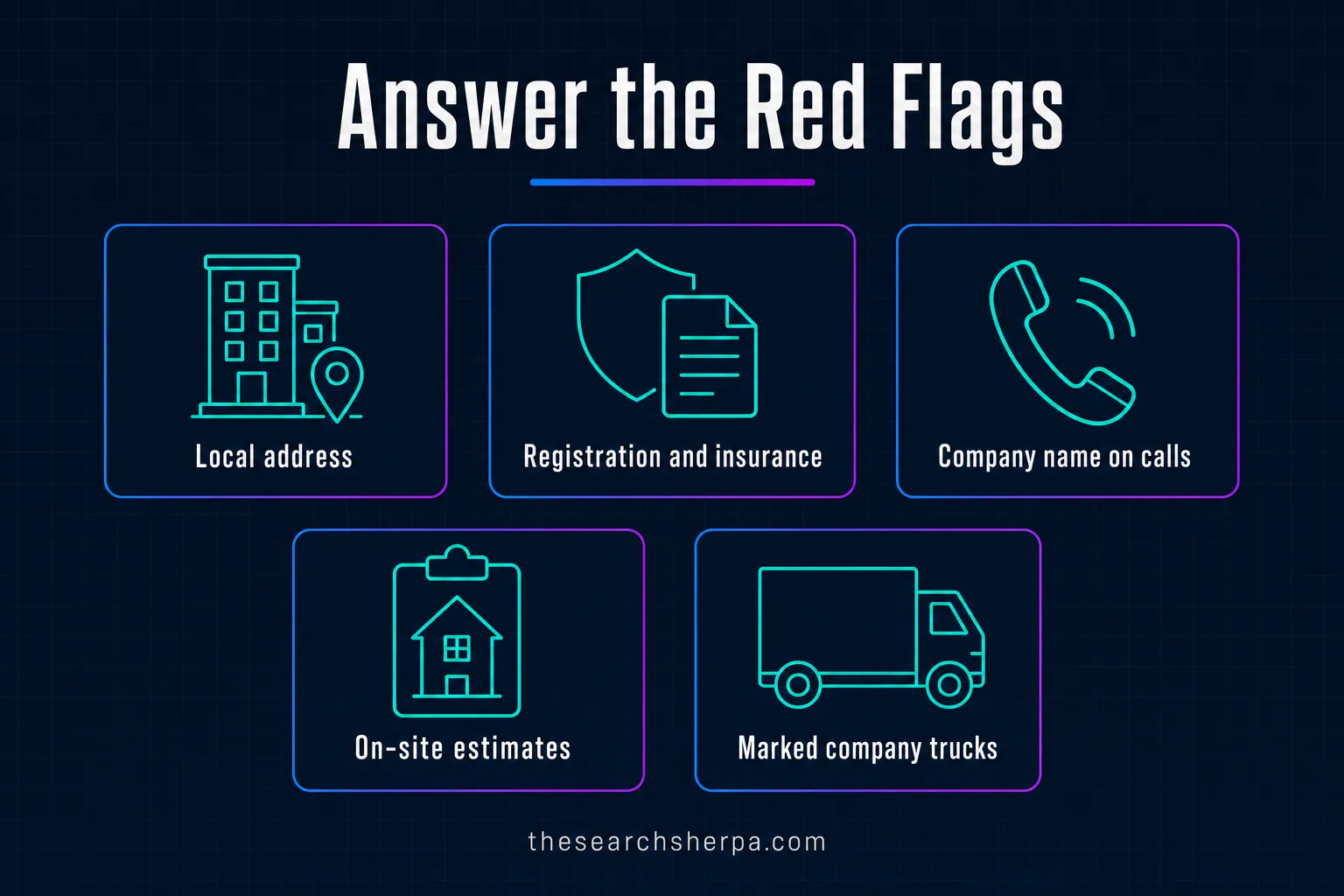
FMCSA publishes red flags for consumers choosing a mover, and several describe a mover’s website and phone line. Read them as a customer would, then check your own site against each one. Among them:
- An estimate given over the telephone or online, sight unseen, without an on-site inspection.
- “The company’s website has no local address and no information about their registration or insurance.”
- A phone answered with a generic “Movers” or “Moving Company” rather than the company’s name.
- A demand for cash or a large deposit before the move.
- A rental truck on moving day rather than a company-owned or marked fleet truck.
Each flag has an opposite your site can show. Put a real local address on your website, even if your Business Profile hides it, plus your registration numbers and insurance. Answer the phone with the company name. Explain how estimates work, including on-site surveys. State deposit and payment terms in writing. Show your own marked trucks and crew, not stock photos.
Two federal rules affect how an interstate mover describes estimates. Under 49 CFR 375.401, “You may not impose a charge for providing a non-binding estimate.” And FMCSA’s guide to choosing a mover says movers are required by law to deliver your goods for no more than 10 percent above the price of a non-binding estimate, which is “known as the 110 percent rule.” One caution: FMCSA says it “does not have the authority to resolve claims against a moving company,” so never suggest a complaint to FMCSA brings a refund.
Reviews for movers: ask every customer, offer nothing
Google’s policy on fake engagement does not allow merchants to “Discourage or prohibit negative reviews, or selectively solicit positive reviews from customers,” and it bans incentives such as payment, discounts, or free goods or services in exchange for a review. That rules out a discount on the next move for a review, and asking only the customers whose moves went well.
What works within those rules is simple: ask every customer after every job, the same way, with a direct link to your profile, and reply to the reviews that come in, good and bad. Here is a realistic system for getting Google reviews. That advice fits movers and other trades. Therapists, counselors, and other licensed healthcare providers check their professional code first. Those codes include APA 5.05, the 2014 ACA Code C.3.b, and NASW 4.07(b). Google’s policy binds every business.
Plan your SEO around the moving season
Moving has a season. FMCSA’s booklet Your Rights and Responsibilities When You Move describes peak season rates as “Higher line-haul charges that may be applicable during busy moving season,” usually between May and September. The ICC’s May 2026 release, cited above, opened “With the spring moving season approaching.” SEO should be in place before spring.
Most local SEO shows measurable movement in about three to six months, depending on competition and the condition of your site. Starting in the fall or winter gives that movement time to arrive before the next busy season.
The Census Bureau’s migration research says both the number of movers and the percentage of people moving declined from 2006 to 2019. The American Community Survey data cited above show that in 2024, moves within the same state (8.9 percent) far outnumbered moves to a different state (2.1 percent), so most moves stay inside one state.
What SEO for a moving company costs
For a local moving company, SEO usually costs $1,000 to $3,000 a month, the band we publish for local businesses. We start with a $2,000 Custom SEO Roadmap, which is credited toward the first month if you go ahead with the work. Packages below $500 a month cannot sustain the work.
These figures come from our page on what SEO costs a local business in 2026, and the roadmap has its own page, the $2,000 Custom SEO Roadmap. Cost depends on your site, your competition, and your goals. We will be clear about pricing before any work begins. For comparison, see how contractor SEO is priced and a trade-business cost guide.
Our pricing page also says what the local band covers. It names four kinds of work:
- Google Business Profile optimization
- Local citation cleanup
- Service-plus-city landing pages
- Targeted content built to capture customers in your immediate service area
Local Services Ads are a separate, per-lead budget. Results you can clearly tie to new revenue usually take six to twelve months.
We do not promise rankings, lead counts, or map placements, because no honest provider can.
What to ask any SEO provider
Ask for the monthly work in writing, which pages will be built, how calls are tracked, and who owns the website and Business Profile. See what your SEO agency should report each month. Be wary of anyone promising a ranking position or a number of booked moves.
Frequently asked questions
How do I promote my moving company?
Start where customers look for a mover: a complete Google Business Profile with an honest service area, a website with a page for each service and area, and a habit of asking every customer for a review. Add Local Services Ads where Google offers them for moving. If you move household goods between states, federal rules require your name and U.S. DOT number in every advertisement, including website listings.
How much does it cost to hire someone to do SEO?
For a local business, including a moving company, SEO usually costs $1,000 to $3,000 a month, the band on our pricing page. Our $2,000 Custom SEO Roadmap is credited toward the first month if you go ahead, and packages below $500 a month cannot sustain the work. The right figure depends on your site, your competition, and your goals.
How to get leads for moving companies?
Moving leads come mainly from three places on Google: the map results, which run on your Business Profile; the organic results, which run on your website; and Local Services Ads, where Google says you pay for valid leads. SEO builds the first two over months. Local Services Ads need a verified Business Profile and Google’s screening, which Google says takes three to four weeks on average after submitting your documents.
What are red flags for moving companies?
FMCSA’s red flags include an estimate given by phone or online without an on-site inspection, a website with no local address and no registration or insurance information, a phone answered with a generic name rather than the company’s name, a demand for cash or a large deposit before the move, and a rental truck instead of a company-owned or marked truck.
Do all moving companies need a USDOT number?
No. FMCSA says a U.S. DOT number is required for interstate moves, and that for moves within a state, requirements vary. Intrastate movers follow their own state’s rules. In Illinois, for example, the Illinois Commerce Commission says intrastate moving companies must be licensed with the ICC.
Can moving companies use Google Local Services Ads?
Yes, where Google offers them. As of October 2026, Google’s Local Services pages list moving, note that availability depends on the country and locality, and require a verified Google Business Profile, insurance, and a state-level business license. Google says it is migrating Local Services Ads campaigns to a pay-per-lead Performance Max campaign type, and advertisers still pay for valid leads rather than clicks.
The Search Sherpa is a founder-led SEO practice in Mokena, Illinois. If you run a moving company and want to be easier to find, easier to understand, and easier to choose, start with a conversation, with no pressure. Review SEO pricing for local businesses, then start a conversation about your moving company, or call (217) 579-8791.
Explore This Topic
SEO for Moving Companies (2026): How Movers Get Found in Local Search

How to Remove a Google Review (2026): What Google Will and Won’t Take Down

Local SEO for Home Services Companies Joliet IL

Watch: AI Is the First Tool That Can Help Build the Next Tool

Recursive Self-Improvement: What Happens When AI Helps Build Better AI
Join Over 400,000 Entrepreneurs Getting Our Weekly Newsletter
Recent Posts
October 5, 2026
Google lets owners report a review, not delete it. It removes policy violations, and unlawful content by legal request. How to flag, appeal,
October 3, 2026
Local SEO for a single-location home services company in Joliet: $1,000 to $2,500 a month. Competitive or multi-town work costs more.
October 2, 2026
Write honest local title tags and meta descriptions yourself, with Google’s own rules, fictional examples, and a free Claude skill. Or ask The