
By Jeremy Bengtson, founder of The Search Sherpa.
SEO for auto repair shops is the work of making an independent shop easy to find, easy to check, and easy to call when a driver nearby searches for a repair. It runs on four things you control: your Google Business Profile, your website, your reviews, and how plainly you explain estimates and warranties.
This guide covers each one, the rules behind it, the local market, and the cost. The Search Sherpa is a founder-led SEO practice in Mokena, Illinois. The work happens on your own profile and website.
What SEO for auto repair shops includes
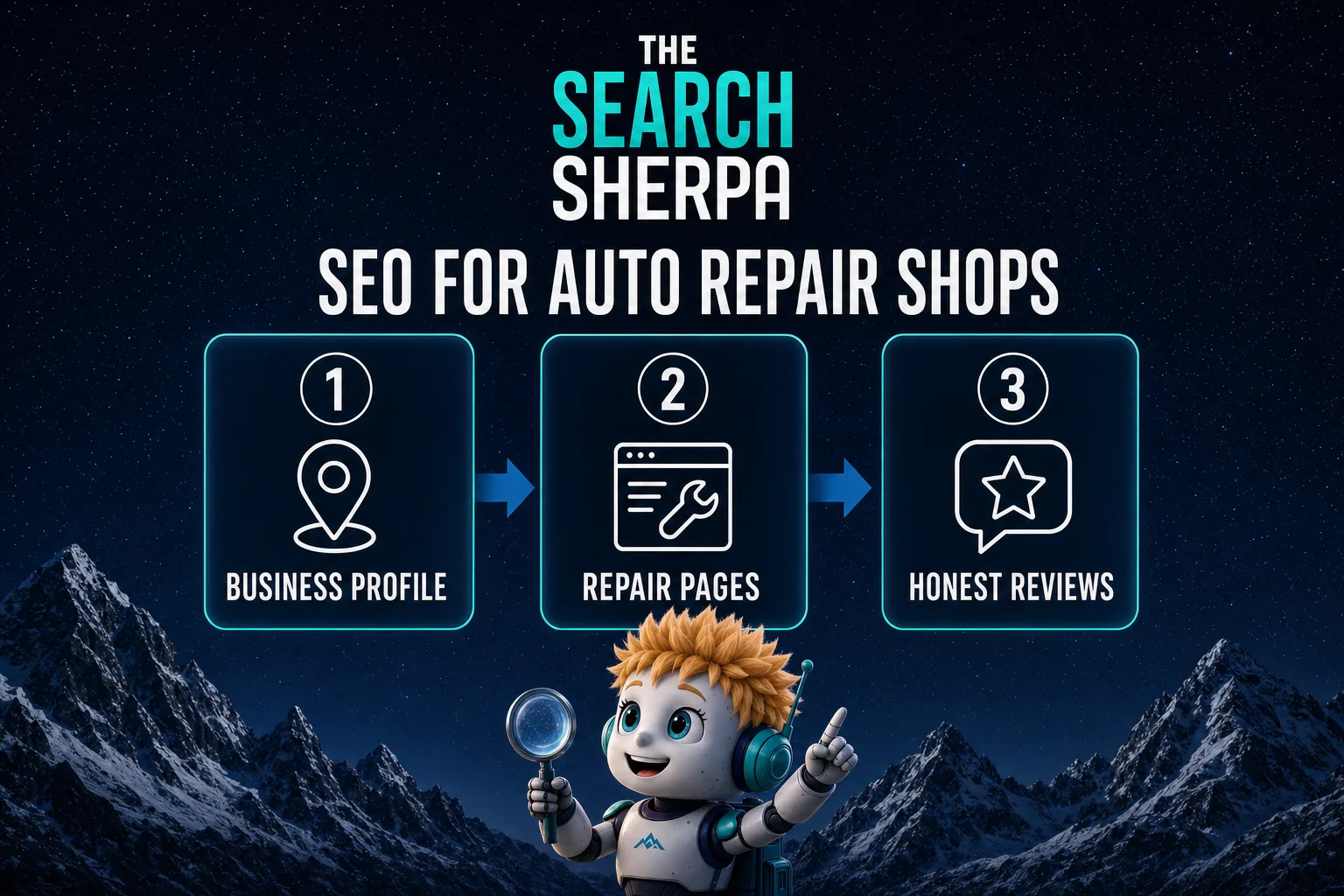
Our playbook for an independent auto repair shop has five parts: a complete Google Business Profile with the right primary category, one page for each repair type you do, plain estimate and warranty copy, a steady flow of honest reviews, and real photos of your bays and your team. Each part answers a driver’s question before they call.
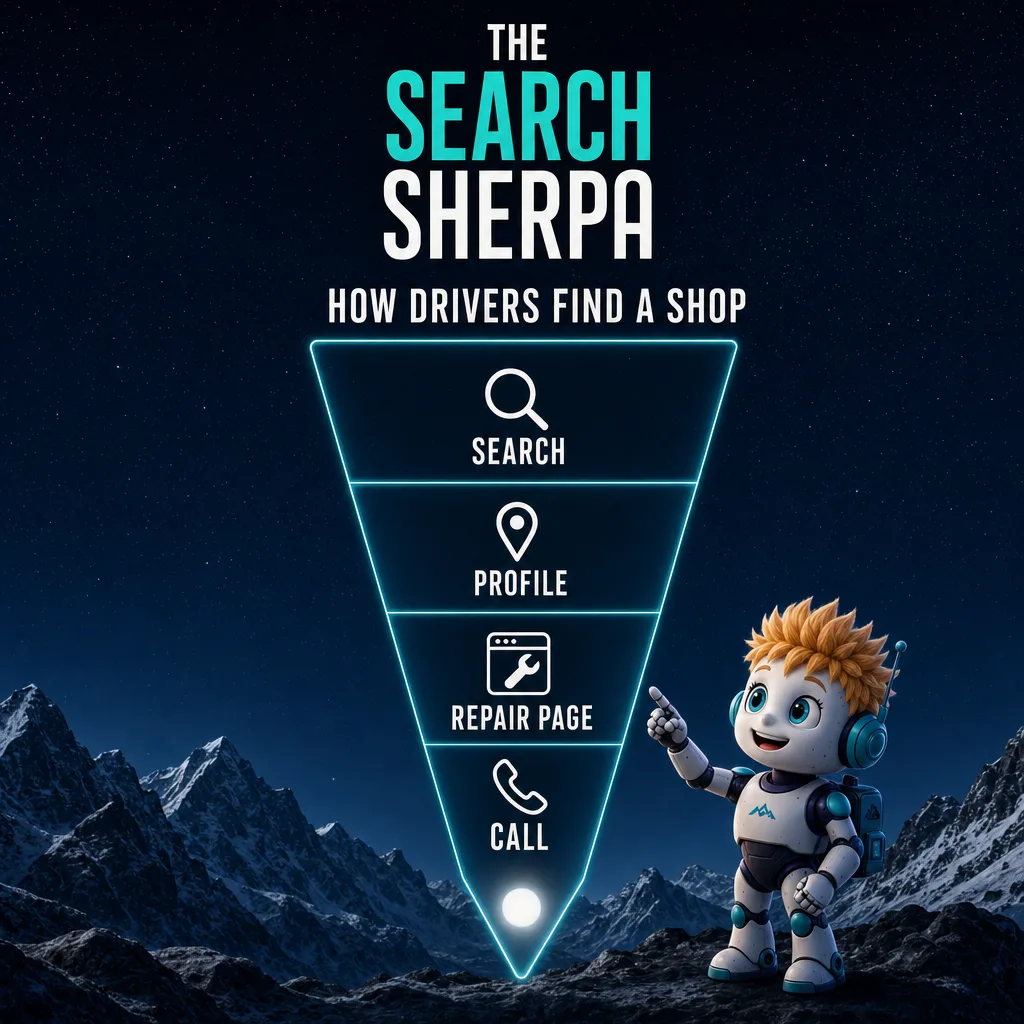
We plan for one path: a search, your Business Profile, a repair page, then a call. The sections below follow it in order.
How Google ranks shops in the map results
Google’s page on how local results are ranked says “Local results are mainly based on relevance, distance, and popularity.” Distance is how far your shop is from the driver who is searching, so you cannot change it. Relevance and prominence you can work on. Google says prominence draws on “how many websites link to your business and how many reviews you have,” and that “More reviews and positive ratings can help your business’s local ranking.” It also says “Businesses with complete and accurate info are more likely to show up in local search results.”
SEO does not buy position: “There’s no way to request or pay for a better local ranking on Google.” Google’s guide on whether you need an SEO adds that “Google never accepts money to include or rank sites in our search results.”
How many shops compete for the same map
The Census Bureau’s County Business Patterns file for 2023 counts 478 establishments in the category automotive repair and maintenance in Will County. DuPage County has 620, and Cook County has 2,694. In Will County, 304 of those 478 had fewer than five employees. Because distance is one of Google’s factors, the shops nearest your customers are your first competition.
Your Google Business Profile as an auto repair shop
The map results draw on your Google Business Profile: name, categories, address or service area, hours, photos, and reviews. Google’s guidelines for representing your business even name auto repair shops directly. Start with the name.
Google says “Your name should reflect your business’s real-world name, as used consistently on your storefront, website, stationery, and as known to customers.” Adding unnecessary information to the name “isn’t permitted, and could result in the suspension of your Business Profile.” A name with services or towns tacked on is a risk, not a shortcut.
Choose one primary category and few others
Google’s category help page says “Select a primary category that best describes your business,” and “The categories you select affect your local ranking on Google.” If most of your work is general repair and the list offers a general auto repair category, make it the primary. A transmission or brake specialist should pick the most specific category the list offers.
Add others sparingly. Google says “Do not select a category for every product or service,” and “Do not use categories solely as keywords or to describe attributes of your business.” Its test: a category completes the statement “This business IS a,” not “this business HAS a.” Before you edit, note that “you might be asked to verify your business again.” Our guide to choosing Google Business Profile categories walks through the choice.
Storefront, roadside service, and the hybrid setup
If drivers come to your garage, Google’s guidelines use your trade as the example: “Some businesses, like auto repair shops that have a garage for repairs and offer roadside service, are hybrid service-area businesses. These businesses can show their storefront address and designate a service area on their Business Profile.” The condition is that the location “should be staffed by your team and able to receive customers during its stated hours.”
Google’s page on managing service areas allows as many as 20 service areas by city, postal code, or other area, but not a radius. A mobile mechanic without “permanent on-site signage” is “not eligible as a storefront and should be listed as a service-area business.”
Photos that show the real shop
Google’s photo guidelines say “When you add an exterior photo, it helps customers recognize your business when they visit,” and a photo “should be in focus and well lit, and have no significant alterations or excessive use of filters.” Show the entrance and sign, the bays, the drop-off counter, and your team. Skip stock photos. Our Business Profile optimization checklist covers the rest, and Google Business Profile management is the service if you want it handled.
One page for each repair type
Your website does the explaining a profile cannot. We build one page for each repair type a shop wants to be found for, such as brake repair, check engine light diagnostics, transmission work, or wheel alignment. Each page answers the questions that come before a call.
What belongs on a repair page
A repair page should read like a short talk at your counter. We put these parts on every one:
- What the repair involves and the signs that bring drivers in
- How you diagnose and estimate, in plain words
- How long the repair usually takes at your shop
- The warranty terms you actually offer, matching your written warranty
- The makes and models you work on, if you specialize
- Photos of the work and the team, and one clear way to book
Titles, headings, page copy, and page-level markup are on-page SEO work, where these pages get tuned.
Skip the copy-and-paste town pages
One page per repair type is not one page per repair per town. Google’s spam policies describe doorway abuse as pages “created to rank for specific, similar search queries,” including “pages targeted at specific regions or cities that funnel users to one page.” Name the towns you serve on your repair pages and your about page. Write a town page only when you have something true and specific to say.
Label your shop as a car repair business
Schema.org defines the AutoRepair type as a “Car repair business,” under LocalBusiness and AutomotiveBusiness. Google’s local business structured data guide says to “Use the most specific LocalBusiness sub-type possible.” Put it on your shop page, with the name, address, phone, and hours identical to your profile.
Estimate and warranty copy: the Illinois example
In Illinois, the Automotive Repair Act says paid work over $100 cannot start without the customer’s specific authorization after the required disclosures. Unless the customer waives it, a shop gives a written estimate or a written price limit, and cannot charge more than 10% over an estimate without consent. Explaining that on your website answers the cost question early.
The rules below come from the Illinois Automotive Repair Act, 815 ILCS 306. This is marketing guidance, not legal advice. The Act’s own finding is that “improved communications and accurate representations between automotive repair facilities and their customers will increase consumer confidence.” The Act does not apply to collision and body repair facilities as the Automotive Collision Repair Act defines them.
Explain your estimate process in plain words
Section 15 says “No work for compensation that exceeds $100 shall be commenced without specific authorization from the consumer after the disclosures set forth in this Section.” A shop gives a written estimate, kept within 10% unless the customer consents, or a written price limit. Estimates must “include all charges to be paid by the consumer to complete the repair, including any charges for estimates and diagnostics.” They must say whether major parts are new or used, and “whether the estimated repairs are required or suggested.” Section 45 says a waiver must be “voluntary and made without coercion.”
On a website, that becomes a short section on each repair page: how you diagnose, when you call for approval, and whether diagnostics cost extra. Section 60 already requires a “YOUR CUSTOMER RIGHTS” sign in the shop. Your site can say it in a friendlier voice.
Put warranty terms in writing, and keep ads accurate
Section 55 says “If a motor vehicle repair facility provides a warranty on repair parts and labor, the facility shall put the warranty in writing and give a legible copy to the consumer.” Any warranty on your website should match that written copy word for word. Section 80 makes “Advertising in a false, deceptive, or misleading manner” unlawful for a repair facility. Every coupon, price, or turnaround time on your site should be one you honor.
| Section of 815 ILCS 306 | What it says, in short | What to put on your website |
|---|---|---|
| 15(a) | Paid work over $100 needs the customer’s specific authorization after the disclosures | Explain when you call for approval before work starts |
| 15(b) | A written estimate kept within 10%, or a written price limit, including estimate and diagnostic charges | Say how estimates work and whether diagnostics cost extra |
| 15(b)(1) and (3) | Major parts new or used; repairs required or suggested | Use the same words on repair pages |
| 55(a) | A warranty offered on parts and labor goes in writing | Publish warranty terms that match the written warranty |
| 80(1) | False, deceptive, or misleading advertising is unlawful | Advertise only prices, coupons, and times you honor |
| 83 | Collision and body repair facilities are outside this Act | Body shops check the Automotive Collision Repair Act |

Reviews for auto repair shops: ask everyone, offer nothing
Reviews feed prominence, and they come with rules from two directions. Google’s policy on fake engagement does not allow merchants to “Discourage or prohibit negative reviews, or selectively solicit positive reviews from customers.” It bans incentives “such as payment, discounts, free goods and/or services” for a review, and pressure “to leave ratings or write reviews while on the premises.”
Federal rules point the same way. The Federal Trade Commission’s review rule went into effect on October 21, 2024, according to the FTC’s questions and answers on the rule, and it “authorizes courts to impose civil penalties for knowing violations.” The rule text at 16 CFR Part 465 bars incentives “conditioned expressly or by implication on, the writing or creation of consumer reviews expressing a particular sentiment.” It also bars implying your site shows most or all reviews while negative ones are suppressed. On asking only happy customers, FTC staff say the rule has no specific prohibition, but “this practice could violate the FTC Act.”
A review routine for the service counter
The fix is a routine, not a filter. Invite customers to leave a review without screening for positive ratings. Google’s review tips say “you can ask customers to visit a Google link or scan a QR code,” and its page on review links and QR codes says “Include it on your receipts.” Put the link on every invoice, for every customer. Reply to every review, remembering that “Your replies are public,” and “Never share a reviewer’s private information.” Here is a realistic system for getting Google reviews.
One note for readers outside auto repair: therapists, counselors, social workers and other licensed healthcare providers follow their own professional codes first (APA 5.05, ACA C.3.b, NASW 4.07(b)). The APA Ethics Code says psychologists “do not solicit testimonials from current therapy clients/patients” or other vulnerable people. The 2014 ACA Code, quoted in ACA’s Counseling Today, says counselors “do not solicit them from current clients, former clients, or any other persons who may be vulnerable to undue influence.” The NASW Code of Ethics says social workers “should not engage in solicitation of testimonial endorsements” from current clients or other vulnerable people.
Showing up in AI answers for repair questions
AI answers are another place a shop can appear. Google’s guide to AI features and your website says “There are no additional requirements to appear in AI Overviews or AI Mode, nor other special optimizations necessary.” To be shown as a supporting link, “a page must be indexed and eligible to be shown in Google Search with a snippet.”
The guide also lists fundamentals that fit a shop: “Making sure that important content is available in textual form,” “Making sure your structured data matches the visible text on the page,” and “Checking that your Merchant Center and Business Profile information is up-to-date.” So the repair pages are the AI work. We write them so any answer engine, whether ChatGPT, Perplexity, Gemini, Bing Copilot, Claude, or Google AI Overviews, finds a plain text answer: what you fix, where, how you estimate, and how to book. Pages that are blocked or never indexed are technical SEO work. Our AI search optimization builds on the same pages.
What SEO for an auto repair shop costs
For an independent auto repair shop, SEO usually costs $1,000 to $3,000 a month, the band we publish for local businesses. Before monthly work comes a one-time $2,000 roadmap, fully credited toward future services if you choose to move forward with us. Packages below $500 a month cannot sustain the work.
These figures come from our page on what SEO costs a local business in 2026, and the roadmap has its own page, the Custom SEO Roadmap. Cost depends on your site, your competition, and your goals. We will be clear about pricing before any work begins.
Our pricing page also says what the local band covers. It names four kinds of work:
- Google Business Profile optimization
- Local citation cleanup
- Service-plus-city landing pages
- Targeted content built to capture customers in your immediate service area
For a shop, that means the profile, listings, and repair pages above. Most local SEO shows measurable movement in about three to six months, depending on competition and the condition of your site. Our pricing page says most businesses see early ranking movement within three to six months of consistent work, and that results you can clearly tie to new revenue usually take six to twelve months. We do not promise rankings, lead counts, or map placements, because no honest provider can. To scope the work for your shop, Book a Free Discovery Call.
What to ask any SEO provider
Google’s guide to hiring an SEO suggests asking for examples of past work and what results to expect, and when. It also suggests asking how success is measured and whether every change will be shared. For a shop, add one question: will the provider keep your estimate and warranty wording exactly as written? Our notes on hiring an SEO consultant in the Chicago area cover the rest.
Frequently asked questions
Is SEO worth it for a small auto repair shop?
Usually yes, if most of your customers live or work nearby. Google says local results are mainly based on relevance, distance, and popularity. You control the profile, the repair pages, and the reviews. Google also says a small local business can probably do much of the work itself, so start there.
What Google Business Profile category should an auto repair shop use?
Make the primary the one category that best describes most of your work. If the list offers a general auto repair category and that is your core business, use it. Specialists pick the most specific category offered. Add few others, never one per service, as Google asks. Editing categories can trigger re-verification.
How long does SEO take for an auto repair shop?
Most local SEO shows measurable movement in about three to six months, depending on competition and the condition of your site. Our pricing page says results you can clearly tie to new revenue usually take six to twelve months. We do not promise rankings or map placements, because Google says there is no way to pay for a better local ranking.
How much does SEO cost for an auto repair shop?
For a local shop, SEO usually costs $1,000 to $3,000 a month, the band we publish for local businesses. Work starts with a one-time $2,000 roadmap, fully credited toward future services if you choose to move forward with us. Packages below $500 a month cannot sustain the work. Cost depends on your site, your competition, and your goals.
Can my shop offer a discount for Google reviews?
No. Google’s merchant rules bar incentives such as payment, discounts, or free services in exchange for posting a review. The FTC rule also bars incentives tied to a positive or negative review. Invite every customer the same way, with a review link on the invoice, and offer nothing in return for the review.
Does an Illinois repair shop have to give a written estimate?
Generally yes, a written estimate or written price limit, for repairs over $100. The Automotive Repair Act requires a shop sign telling customers so. The sign’s exceptions are a waiver, a firm price quotation, or no face-to-face contact. A shop cannot exceed an estimate by more than 10% without consent. This is marketing guidance, not legal advice.
The Search Sherpa is a founder-led SEO practice in Mokena, Illinois, and you work directly with Jeremy Bengtson. If you run an independent auto repair shop and want to be easier to find, easier to understand, and easier to choose, Book a Free Discovery Call. You can also review SEO pricing for local businesses first, or call (217) 579-8791.
Explore This Topic
SEO for Auto Repair Shops (2026): How Independent Shops Get Found
SEO for Real Estate Investors: How Motivated Sellers Find You
Vercel vs Netlify vs Cloudflare Pages: Which Free Plan Allows a Business Website?
Best Fonts for Medical and Healthcare Websites: Readable, Accessible, Licensed

Do You Still Need a Website If You Have a Google Business Profile?
Join Over 400,000 Entrepreneurs Getting Our Weekly Newsletter
Recent Posts
November 8, 2026
SEO for real estate investors: build seller-situation pages, set up Google Business Profile within the rules, earn seller trust and track signed deals.
November 8, 2026
Vercel vs Netlify vs Cloudflare Pages for a business website: what each free plan’s terms say, what happens at the limit, and who
November 8, 2026
Choose fonts patients can read: a verified shortlist for medical and healthcare websites, plus WCAG 2.2 text benchmarks, sizes, spacing and licensing.