
What is hardscaping SEO, and how is it different from lawn care SEO?
Hardscaping SEO is local search work for hardscape, paver and patio contractors. It helps homeowners planning a patio, wall or driveway find you. They see work like theirs and ask for a design visit. It covers project pages, material pages, project photos, your Google Business Profile and reviews.
Hardscape work sells differently from lawn care. A maintenance customer buys the same visit again and again. A hardscape customer buys one large project and compares photos, materials and designs before calling.
So a hardscape site has to show finished work, explain materials and make a design visit easy to book. If you also sell mowing and seasonal care, see our guide to landscaping SEO for design-build and maintenance companies.
This page covers search and your Google Business Profile, not paid ads or social media. If you want to talk through the projects your website should support, Book a Free Discovery Call.
Homeowners search for the project, so plan pages by project
Few homeowners type “hardscaping” into Google. They search for the thing they want built: a paver patio, a retaining wall, a new walkway. Google’s own Business Profile service lists use job names too. As of November 2026, they include Patio paving and Retaining walls.
So plan your pages around projects. The table below is a starting point. Build pages only for work you actually do and want more of.
| Project | What the homeowner is deciding | What the page needs to show |
|---|---|---|
| Paver patio | Size, shape, pattern and material | Finished patios with the paver style named, and how your design visit works |
| Retaining wall | Whether the wall solves a slope or drainage problem, and how it will look | Walls you built on real slopes, the block or stone used, and what you check on a site visit |
| Paver driveway | Look, durability and what happens to the old driveway | Before and after photos, and how long the driveway is out of use |
| Walkways and steps | Safe access and a look that suits the house | Front entry and side yard examples, and the step materials you offer |
| Fire pit and outdoor kitchen | How the space will be used and what it connects to | Finished outdoor living spaces, and which other trades you coordinate with |
Start with the two or three projects that bring your best margins and fit your crews. A short list of strong pages beats a long list of thin ones. Our content strategy work starts the same way: which pages earn a place, and in what order.
A project page skeleton you can copy
You need two kinds of pages. A project-type page explains one kind of work, such as paver patios. A job write-up shows one finished project and proves you have done it.
The project-type page
A paver patio page should answer what a homeowner asks on the first call. Who is this for? Which materials do you offer? How does the design visit work? What changes the price? Which towns do you cover? What happens next?
You can answer the price question without a number. Size, material, site access, slope and extras such as steps or seat walls all move the quote. Say so plainly.
Link each type page to its best write-ups, and give every page its own title and description. Our guide to title tags and meta descriptions for local pages shows how. Our on-page optimization work covers headings, internal links and the rest of the page.
The job write-up
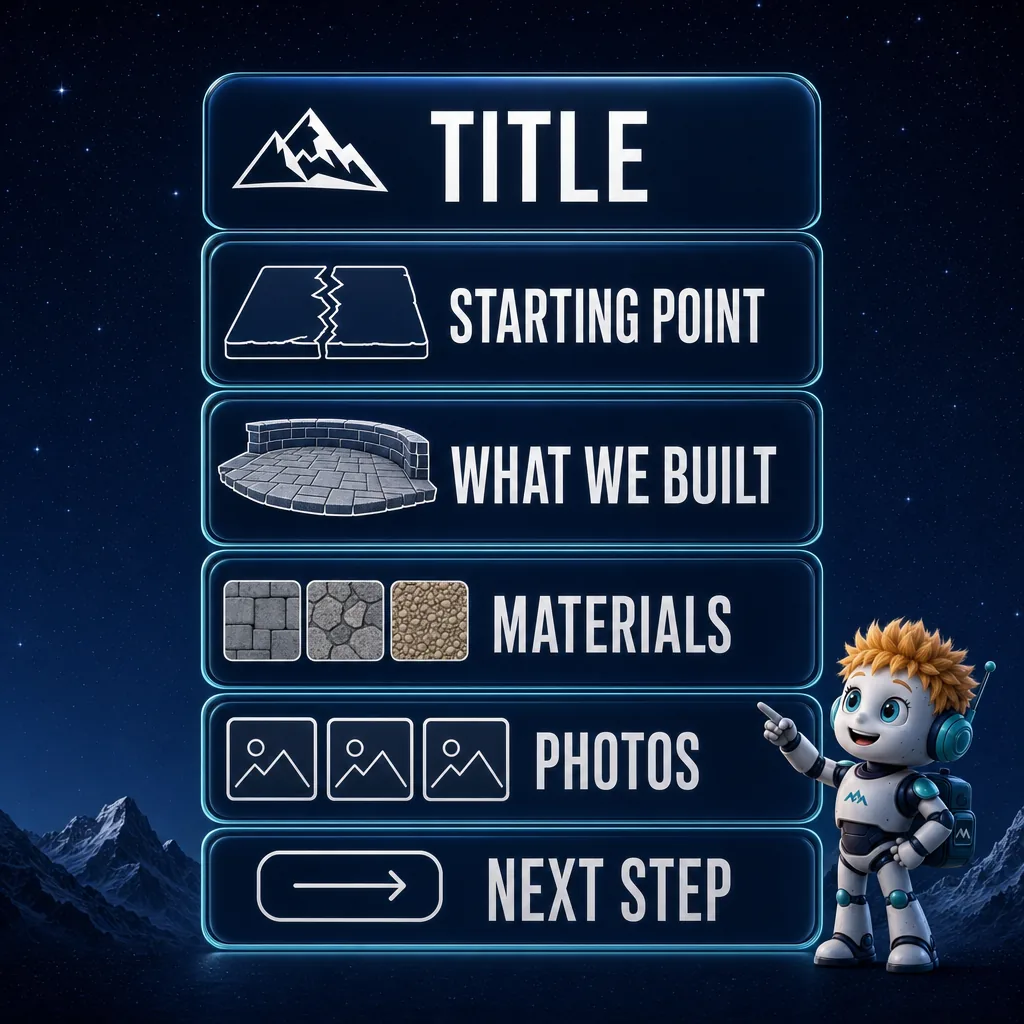
The skeleton below uses a hypothetical paver patio. It shows structure only. It is not a Search Sherpa client job.
| Section | What to write | Hypothetical example |
|---|---|---|
| Title | Project, material and town | Paver patio and seat wall, (your town) |
| Starting point | What the homeowner had and what they wanted | A cracked concrete slab that held water after storms, and room for eight chairs |
| What you built | Size in plain words, layout and features | A patio about twice the old slab’s size. It has a curved seat wall and two steps down to the lawn |
| Materials and why | Product type, color and the reason for the choice | Tumbled concrete pavers in a color that matches the brick on the house |
| Site conditions | Only what your crew recorded | A slope toward the house, regraded before the base went in |
| Photos | Before, during and after, each with a caption | The old slab, the base stage and the finished patio at dusk |
| In the owner’s words | A quote only with written permission | Left blank until the homeowner agrees |
| Next step | Links to the project-type page and the design visit form | “See more paver patios” and “Request a design visit” |
Keep each write-up honest and specific. Google’s guidance on helpful content asks whether a page shows first-hand expertise, the kind that comes from doing the work. A write-up of a job your crew built is direct evidence of that. Never invent a project, merge two jobs into one or borrow another company’s photos.
Material pages: when pavers, natural stone and concrete each earn a page
Material pages are tempting, because each material looks like a separate search. A material earns its own page when three things are true. Homeowners ask different questions about it. You install it often. And you have finished jobs in it to show. If any of those is missing, cover the material as a section on the project page instead.
| Material | Questions homeowners bring | Give it its own page when |
|---|---|---|
| Concrete pavers | Colors, patterns, upkeep and sealing | You offer several product lines and can show jobs in each |
| Permeable pavers | How water drains and where they suit | You install them regularly; leave drainage performance figures to the manufacturer’s own documents |
| Natural stone, such as bluestone, flagstone or limestone | Look, feel, weather and cost compared with pavers | You source it often and have stone jobs to photograph |
| Poured or stamped concrete | Patterns, cracking and cost compared with pavers | Concrete is a steady share of your work, not an occasional job |
| Brick | Matching the house, especially older homes | You often match existing brick or work on older homes |
Watch for near-copies. Google’s spam policies warn against doorway abuse. That means pages “created to rank for specific, similar search queries.” Say you have pages for “patio pavers”, “paver patio” and “paver patio installation”. If they say the same thing, they are really one page. Merge them into the strongest one.
Name any manufacturer program or trade certification your crew actually holds, and link to the issuer. The Concrete Masonry and Hardscapes Association, for example, runs a certification program.
Project photos that show the finished work
For a hardscape company, photos do much of the selling. On your website, name each photo file for what it shows, such as paver-patio-seat-wall.jpg rather than IMG_4021.jpg. Write alt text that describes the image in plain words. Google’s image guidance recommends descriptive filenames and alt text. It also warns: “Avoid filling alt attributes with keywords.” Place each photo beside its write-up, with a caption naming the project and material.
Before and after pairs should come from the same job and angle. Correct the exposure if needed, but never alter the work itself.
Your Business Profile photos follow Google’s own rules. As of November 2026, Google’s photo guidelines ask for JPG or PNG files between 10 KB and 5 MB. They recommend 720 by 720 pixels. They also say “the image should represent reality.” Add real job photos through the season instead of one batch a year.
Ask the homeowner before you show their yard, and keep house numbers and license plates out of frame. If your gallery loads slowly or crops photos badly, our WordPress website work can fix the page itself.
Google Business Profile categories and services for a hardscape contractor
Many owners look for a hardscaping category and cannot find one. As of November 2026, we found no category named Hardscape contractor, Paver contractor or Patio contractor in Google’s US English category list. The only patio category we found was Patio enclosure supplier, which describes a different business.
Google’s category help page says: “If the specific category you want isn’t available, select a general category that describes your business. You can’t create your own category.” Category lists change, so search the live category picker in your own profile before you decide.
Choose the category that describes your business
Google’s business guidelines say: “Do not use categories solely as keywords or to describe attributes of your business.” They also ask you to use as few categories as possible. So pick the one category that best describes your company. Then add only extras that are real lines of work.
Watch for supplier categories. Retaining wall supplier, Paving materials supplier and Natural stone supplier describe businesses that sell materials. If you install walls and patios, those categories describe someone else.
The table shows options we verified in Google’s US English list, as of November 2026. It includes some suggested services Google listed under each. Confirm both in your own profile, because either can change.
| If your company mainly | Category to consider | Suggested services we saw listed | Watch for |
|---|---|---|---|
| Designs and builds outdoor living spaces | Landscape designer or Landscaper | Landscape designer: Patio design, Retaining wall design. Landscaper: Hardscaping, Retaining walls | Landscape architect is a separate category for a different profession; choose it only if it describes your firm |
| Installs pavers for patios, walks and driveways | Paving contractor | Paver installation, Patio paving, Brick paver installation, Hardscaping | The same category covers asphalt and parking lot firms, so your services list matters |
| Builds stone and brick walls, steps and features | Masonry contractor | Stone masonry, Brick and block work | Use it as the main category only if masonry is the core of the business |
| Pours and stamps concrete patios and walks | Concrete contractor | Stamped concrete services, Retaining walls | Many listed services are foundation work; add only what you do |
| Builds decks or pergolas as a real second line | Deck builder, or Carport and pergola builder, as an additional category | Pergola construction, Patio decks | Add it only if you sell that work regularly |
Google also warns that adding or editing a category might mean verifying your business again. Change categories once, for a clear reason. For the case where nothing fits, see what to do when your category is not listed.
Put the job names in your services
Your category tells Google what kind of business you are. Your services list tells it what you build. Google’s services help page says you can pick suggested options. You can also “create and add custom services options.”
Add the projects from your page plan: paver patios, retaining walls, walkways, driveways and the rest. Write a short description for each one. Google says custom service names should not include “prices, or phone numbers,” among other things. Our guide to Google Business Profile optimization for contractors walks through the full setup.
Service area and a showroom or display yard
Hardscape crews build at the customer’s home, so a service area fits. As of November 2026, Google’s service area help page allows 20 service areas at most. It says the overall area “shouldn’t be more than about 2 hours of driving time from where your business is based.”
A showroom or display yard that customers visit makes you a hybrid business. Google says a location without permanent on-site signage is not eligible as a storefront. Show that address and also set a service area for the jobs you travel to. If you would rather hand off the ongoing profile work, see our Google Business Profile management service.
Winter decides your spring: when homeowners start searching
Hardscape searches follow the building season. As of November 2026, Google Trends shows a clear pattern across the past five years in the United States. Interest in “paver patio”, “retaining wall” and “outdoor kitchen” is lowest in December and January. It climbs through February and March and peaks around April and May.
Your own season may start earlier or later, so check last year’s quote and design visit dates too. New and improved pages take time to be found. Work finished in winter is in place before the spring climb. That is a planning choice, not a promise of results.
A winter list for a hardscape company might include the jobs below. Most of them use material you already have.
- Write up the best jobs from last season, with the homeowners’ permission.
- Rename and caption the photos from those jobs.
- Update each project-type page with new examples and the questions your estimators heard most.
- Add or correct services, and add new photos to your Business Profile.
- Test the design visit form and phone number on a phone.
Reviews: ask every customer, and let them describe the job
A common tip says to ask customers to mention “paver patio” in their review. Do not do it. Google’s Maps content policy says merchants should not “request that specific content be included” when they ask for reviews. It also bars businesses that “selectively solicit positive reviews from customers.”
The safe approach is simple. Ask every customer, in the same way, when the job is done. Google’s review tips suggest sending a Google link or a QR code. Offer nothing in return, because Google prohibits incentives for reviews. Crew members and relatives should not review the company either, since Google treats that as a conflict of interest.
Your reply is yours to write. Google’s tips say “Make your replies count” and advise being “conversational, not promotional.” A reply can thank the homeowner and mention the project naturally. It should never read like a list of keywords.
If you show reviews or testimonials on your project pages, take the same care there. The FTC’s Consumer Reviews and Testimonials rule bars businesses from writing or buying fake reviews. It also bars hiding low-rated or negative reviews while presenting the rest as most or all of them. This is marketing guidance, not legal advice.
When hardscaping SEO is worth paying for, and when it is not
SEO makes sense when more of the right requests would turn into jobs you want. These signs usually point to a good fit:
- Your crews have open weeks in the building season.
- You want more of one kind of project, such as retaining walls or outdoor kitchens.
- You own your website, or you are willing to move to one you control.
- You have real job photos, or a way to take them.
- You can give the work time. Search results change slowly, and the pace depends on competition and the condition of your site.
It is a poor fit if you are booked a season ahead or mostly subcontract for builders. The same goes if you need calls this week. A small crew can do much of this guide itself in winter. Outside help makes sense when the season leaves no time for it.
Measure what matters to the business. Count design visit requests and calls by project type, then compare them with the jobs you sold. Our guide on how to track calls and form requests explains the setup. We do not promise rankings, lead counts, or map placements, because no honest provider can. For general cost ranges, see our page on SEO pricing for local businesses.
Questions hardscape contractors ask
Is hardscaping SEO different from landscaping SEO?
Yes, in what the pages need to do. Landscaping and lawn care SEO centers on recurring services and the towns you cover. Hardscaping SEO centers on project pages, material choices and photos of finished work, because homeowners are buying one large project. A company that sells both needs both kinds of pages.
Is there a Google Business Profile category for hardscaping?
As of November 2026, we found no category named Hardscape contractor, Paver contractor or Patio contractor in Google’s US English list. Google says you cannot create your own category. Hardscape companies can choose from Landscaper, Landscape designer, Paving contractor, Masonry contractor or Concrete contractor. Pick the one that matches the core of the business, then list projects as services. Search the live category picker in your profile to confirm.
Should I make separate pages for pavers and natural stone?
Only when the material changes the homeowner’s questions, you install it often, and you have jobs in it to show. Otherwise, cover each material as a section on the project page. Several pages that say the same thing with a different material word can look like doorway pages to Google.
Can I ask customers to mention pavers or patios in their reviews?
No. Google’s Maps content policy says businesses should not request that specific content be included in a review. Ask every customer the same way, offer no incentive, and let them describe the job in their own words. You can mention the project in your own reply.
When should a hardscape contractor start SEO work for spring?
Before the spring rise in searches. As of November 2026, Google Trends shows US interest in paver patios and retaining walls climbing from February. Interest peaks around April and May. Job write-ups, photos and profile updates done in late fall and winter are in place before that rise.
Do I need a page for every patio I build?
No. Write up jobs that show something new: a different material, a hard site or a feature you want to sell. A handful of strong write-ups linked from each project-type page is more useful than dozens of near-identical posts.
Start with the projects you want more of
The Search Sherpa is a founder-led SEO practice in Mokena, Illinois, and you work directly with Jeremy Bengtson. Bring your list of projects, your best job photos and your Business Profile. We can look at which pages, photos and profile details need attention first. You can also meet Jeremy Bengtson before you get in touch.
Book a Free Discovery Call to talk about your hardscape company’s search priorities.
Explore This Topic

SEO for Auto Repair Shops (2026): How Independent Shops Get Found
SEO for Real Estate Investors: How Motivated Sellers Find You
Vercel vs Netlify vs Cloudflare Pages: Which Free Plan Allows a Business Website?

Best Fonts for Medical and Healthcare Websites: Readable, Accessible, Licensed

Do You Still Need a Website If You Have a Google Business Profile?
Join Over 400,000 Entrepreneurs Getting Our Weekly Newsletter
Recent Posts
November 9, 2026
SEO for auto repair shops in 2026: Google Business Profile categories, repair pages, honest reviews, estimate and warranty copy, and what SEO costs.
November 8, 2026
SEO for real estate investors: build seller-situation pages, set up Google Business Profile within the rules, earn seller trust and track signed deals.
November 8, 2026
Vercel vs Netlify vs Cloudflare Pages for a business website: what each free plan’s terms say, what happens at the limit, and who