

By Jeremy Bengtson, founder of The Search Sherpa.
Every spring, the phone rings faster than crews can quote. Landscaping SEO is local search work for landscaping, lawn care and hardscape companies. It builds the service pages, project pages and Google Business Profile that help nearby homeowners find you. It also covers reviews, because Google says more reviews and positive ratings can help local ranking.
The spring rush shows up in the search data. In Chicago, “landscaping near me” drew 140 searches in December 2025. In April 2026 it drew 1,600, per Google search volume via DataForSEO.
Those calls are not all the same job. Weekly mowing is a maintenance contract. A paver patio is a design-build project. Each buyer searches in different words, so each needs its own kind of page and proof.
What landscaping SEO covers
Landscaping SEO helps a landscaping, lawn care or hardscape company show up when nearby homeowners search for the work. It covers service pages, project pages, the Google Business Profile, reviews, and call and form tracking. It is SEO and Google Business Profile work only.
Google’s help page says “Local results are mainly based on relevance, distance, and popularity.” It says “Relevance is how well a Business Profile matches what someone is searching for.” It also says “Prominence means how well-known a business is.” That factor is also based on “info like how many websites link to your business and how many reviews you have.” Google is plain about money too: “There’s no way to request or pay for a better local ranking on Google.”
This page covers only the SEO and Google Business Profile part of landscaping marketing. Paid ads, including Local Services Ads, are a service we do not sell. The same goes for social media, email, direct mail and door hangers.
The Search Sherpa is based in Mokena, Illinois. We help businesses across Will County and the southwest Chicago suburbs become easier to find online. This page is the landscaping chapter of our contractor SEO for home service businesses.
Maintenance contracts and design-build projects: which pages to build
Start by sorting your work by buyer. One buyer wants the same care every week or every season. The other wants something built once. The diagram compares what each one searches, the page each needs, the proof that helps, and when demand comes. For a maintenance buyer, the proof is reviews that name the service.
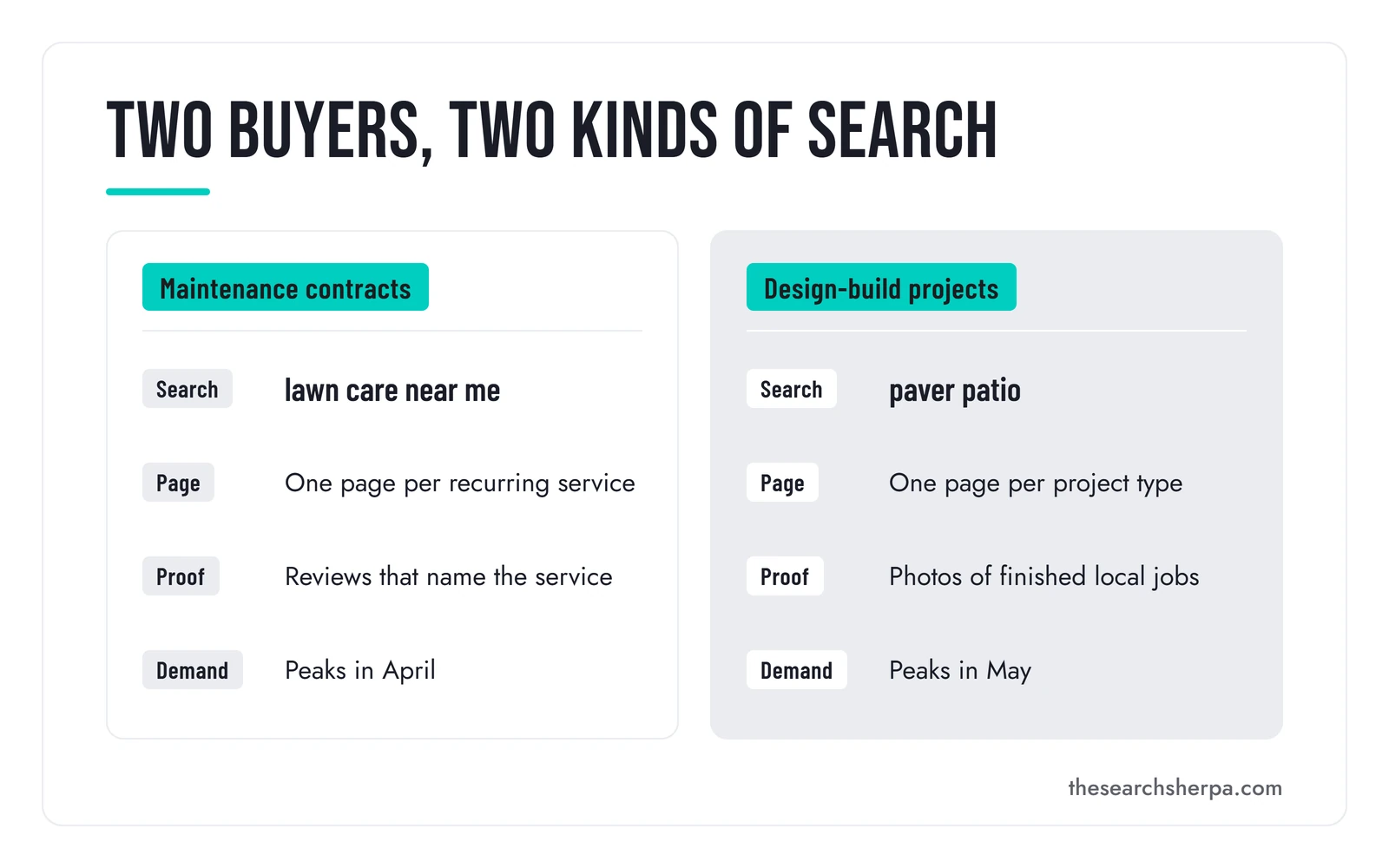
Build two sets of pages. Maintenance buyers need one clear page per recurring service, with the towns you cover and how to start. Design-build buyers need one page per project type, with photos of finished local jobs. If you plow snow, give winter its own page before fall.
The maintenance buyer: lawn care and recurring service
Maintenance work is sold by the visit or in packages. HomeAdvisor’s summary range is “Professional lawn mowing and care services cost between $50 and $205 per visit.” It adds that “you can purchase packages of weekly or monthly visits.” It also mentions “seasonal services like aeration, fertilization, weed control, and spring or fall cleanup.”
That list maps your service pages. Give mowing, fertilization and weed control, and aeration each a page. Say which towns you cover and how to get on the route. In Chicago, “lawn care near me” drew 90 searches in December 2025 and peaked at 880 in April 2026.
Some services are too small for a page of their own. “Spring cleanup” and “fall cleanup” each drew about 10 searches a month. They fit better as sections on a seasonal care page.
If you list weed control, check the license rules first. Illinois Extension says “If your lawn care business will offer pesticide application services, you’ll need the appropriate pesticide license.” It adds that “Every company must have at least one licensed Commercial Applicator.” If you hold the license, say so on the page. This is marketing guidance, not legal advice.
The design-build buyer: patios, walls and planting plans
Design-build work is a larger, one-time purchase. HomeAdvisor says “Building a patio costs most homeowners between $2,029 and $6,089,” with an average of $4,007. The price depends “on factors like location, size, and materials.” So build one page per project type, such as paver patios, retaining walls and landscape design. Each page can explain what drives the price.
Project searches move with the season too. In Chicago, “paver patio” drew 20 searches in December 2025 and peaked at 320 in May 2026. “Landscape design” was steadier, between 170 and 390 searches every month. So a design page can draw searches all year.
Build each page around the project name. “Paver patio contractors near me” and “patio installation” each drew about 10 searches a month. “Hardscaping” averaged 320 searches a month.
Snow removal as a winter service line
If your crews plow in winter, snow removal is a third kind of search. In Chicago, “snow plowing near me” drew 1,300 searches in November 2025. It had already climbed to 390 in October. By May, June and July 2026 it was down to 20 a month.
So a snow page published in December starts late. Publish or refresh it by early fall, and name the towns your plows cover. List snow removal as a service on your profile too.
Town pages that earn their place
If you serve several towns, it is tempting to make a page for each one. Google’s spam policies say “Doorway abuse is when sites or pages are created to rank for specific, similar search queries.” One example is “pages targeted at specific regions or cities that funnel users to one page.”
A town page earns its place when it has something only that town can show. That means finished jobs there, the services you sell there, and how your crews cover it. Without that, list the town in your service area instead. SEO for electricians sets its own bar for town pages, with permit offices and drive times.
Design-build project pages and the proof they need
A design-build buyer is picturing a finished yard. A good project page shows one. It names the town, what was built, the materials, and the problem the owner wanted solved. Its photos come from the job, not a stock library.

Project pages built from real jobs
Google’s helpful content guide asks whether content shows “first-hand expertise and a depth of knowledge.” A write-up of a patio your crew built is one way to show that.
Photos need the same care. Google’s image guide says images belong “near relevant text and on pages that are relevant to the image subject matter.” It advises “filenames that are short, but descriptive.” It calls alt text “The most important attribute” for image metadata. So name each photo for the project, and write alt text that says what it shows. Both are part of on-page optimization.
Give each project page its own title and description, as our guide to local title tags and meta descriptions shows.
Reviews that name the job
Reviews help both kinds of buyer. Google’s review tips put it simply: “you can ask customers to visit a Google link or scan a QR code.” They add, “Honest and balanced reviews can help potential customers decide.”
Google’s Maps content policy lists what it does “not allow merchants to” do. That includes “Offer incentives” for a review, and to “selectively solicit positive reviews from customers.” So ask every customer, and never pay or discount for a review.
Ask about the job by name, such as how the new patio turned out. A patio customer can be asked at the final walk-through, a maintenance customer after the first season. We build the review request into the job close. Our review and reputation management page covers that system.
Google Business Profile for landscaping and lawn care companies
Your profile needs the same two-buyer thinking as your site, starting with the service area, seasonal hours and the service list.
Service area, address and seasonal hours
Landscaping crews do their work at the customer’s property. Google’s guidelines say “If you’re a service-area business, you should hide your business address from customers.” Some companies also run a garden center or a stone yard that customers visit. Google calls that a hybrid business: “A business that serves customers at its business address but also directly visits or delivers to them.”
Google’s service area help page adds a test for that yard. It says “If your business doesn’t have permanent on-site signage, it’s not eligible as a storefront.” The rest of the rules are on our page about service-area rules for home service companies.
Google also says “If applicable, you may use your current seasonal hours as your regular hours.” That fits an office whose hours change between mowing season and winter.
Categories, services and photos
Pick categories by what your company is, not by everything it does. The same guidelines say “Choose the fewest number of categories it takes to describe your overall core business.” Their test is a category that will “complete the statement: “This business IS a” rather than “this business HAS a.”” So a lawn care company and a design-build firm may choose different primary categories.
Google says “When local customers search Google for an offering you provide, that service may be highlighted on your profile.” You can also “group services into categories and include additional details, like descriptions and prices.” A simple setup uses three groups: maintenance, design-build and snow removal.
Photos should come from your own jobs. Google’s photo rules say “the image should represent reality.” For the ongoing work, see our ongoing Google Business Profile management service. Our guide to Google Business Profile optimization for contractors covers the setup.
Who landscaping SEO fits, and who it does not
Landscaping SEO makes sense when more of the right calls would turn into booked work. These signs point to a good fit:
- Your crews have room for more maintenance routes or more projects in the season.
- You want more of one kind of work, such as lawn care contracts in two towns or patio projects.
- You control your website, or you are willing to move to one you own.
- You can give the work three to six months before you judge it.
It is a poor fit if your crews are booked solid with a waitlist. More calls will not help. It is also a poor fit if you want ads, social media posts or door hangers. We do not sell those.
Google says “If you run a small local business, you can probably do much of the work yourself.” Hiring help makes more sense when the season leaves no time for pages, photos and reviews.
What is included, and how the work runs
The table lists the work a landscaping SEO program covers. The mix and the order depend on your services, your towns and your site.
| Work | What it covers for a landscaper | Why it matters |
|---|---|---|
| Service pages | One page per recurring service, such as mowing, aeration and snow removal | Maintenance buyers search by the service |
| Project pages | One page per project type, built from finished local jobs | Google asks whether content shows first-hand expertise |
| Google Business Profile | Categories, services, service area, seasonal hours and real photos | Google says complete and accurate info helps a business show up |
| Review strategy | A Google link or QR code at the job close, for every customer | Google ties reviews to prominence |
| Citation cleanup | Your name, address and phone listed the same everywhere Google checks | Keeps your business details consistent |
| Town pages | Built only where the volume justifies it and you have real work there | Keeps clear of Google’s doorway policy |
| Site and page fixes | Internal links, schema (code that describes your business to search engines) and technical fixes | Part of the build-and-optimize work |
| Tracking and reporting | Call tracking, form tracking and Search Console reporting | Shows calls, forms, and which page earned them |
The work runs in four steps. First comes a Visibility Review of your website, local search, Google Business Profile, competitors, content and conversion paths. Next is a Strategy Map, a plan in priority order that you can understand and approve. Then comes Build and Optimize, the monthly work. Last is Measure and Refine, with reporting tied to calls and booked jobs, not vanity charts.
You work directly with Jeremy Bengtson. Strategy, content briefs, monthly reviews and the actual work happen with the same person who took your first call. We build on WordPress. You own the code, the content and the data.
As a general rule, an honest SEO provider should show you three things each month. Those are the work done, what changed in your search visibility, and how many real inquiries reached your business. Our guide to what an SEO provider should show you every month goes further.
What landscaping SEO costs
Small local businesses generally invest $1,000 to $3,000 a month for map pack visibility and local search. A single-market contractor in a smaller or less competitive area can expect $1,000 to $2,500 a month. Multi-town programs run $2,500 to $4,500 a month. Multi-location or major-metro programs run $4,500 to $7,500 or more a month.
Cost depends on your site, your competition, and your goals. For a landscaping company, the biggest factor is how many towns you want to win. Our contractor SEO cost guide says “In our pricing, service-area breadth is the single biggest price multiplier.”
Every engagement begins with a $2,000 Custom SEO Roadmap, built over about four weeks. Our pricing page lists what it includes: “a technical site audit, Google Business Profile review, backlink profile assessment, competitor analysis, keyword opportunity mapping, and a clear content strategy.” In plain terms, that is your site, your profile, the sites that link to you, your competitors, the searches worth winning and what to write. If you hire us to carry out the plan, the $2,000 is credited toward your first month. If you hand the plan to your own team, it is yours to keep.
Be careful with very cheap offers. SEO packages priced below $500 per month cannot sustain the labor-intensive work required for legitimate organic growth. We do not use long-term lock-in contracts. Our SEO pricing page covers the full ranges.
Local SEO usually takes about three to six months to show measurable movement. Timelines vary by market competition and the condition of your site. Our cost guide adds, “Seasonality does not change the price; it changes when the same spend pays off.” For a landscaper, that points to starting before the spring rush. Heating and cooling companies get the same timing advice in HVAC SEO by season. We do not promise rankings, lead counts, or map placements, because no honest provider can.
Frequently asked questions
Is SEO still worth it in 2026?
It can be, if people in your towns search for your work and your crews have room for more. In Chicago, “landscaping near me” averaged 590 searches a month over the 12 months to August 2026, per Google search volume via DataForSEO. Google says it never accepts money to rank sites, and organic results cost nothing to appear in. SEO is worth less if you are booked solid or need calls this week.
How much should I pay for SEO services?
Small local businesses generally invest $1,000 to $3,000 a month for map pack visibility and local search. A single-market contractor in a smaller or less competitive area can expect $1,000 to $2,500 a month. Multi-town programs run $2,500 to $4,500 a month. SEO packages priced below $500 per month cannot sustain the labor-intensive work required for legitimate organic growth. Our work starts with a $2,000 Custom SEO Roadmap. It is credited toward your first month if you hire us to carry out the plan.
What is the 80/20 rule in SEO?
The 80/20 rule comes from the Pareto Principle. Investopedia describes it as “an observation that 80% of consequences come from 20% of the causes.” It also notes that it “is based on anecdotal evidence, not scientific analysis.” In SEO, it is a reminder to focus on the pages that matter most. We usually sequence towns, starting with the ones where your close rate and margins are already best.
How long does landscaping SEO take to work?
Local SEO usually takes about three to six months to show measurable movement. Timelines vary by market competition and the condition of your site. The season adds a second clock. In Chicago, searches for “landscaping near me” rose every month from January to April 2026. Work started in fall or winter can be built before that climb.
Is lawn care SEO different from landscaping SEO?
It uses the same system with different pages. Lawn care SEO centers on recurring services, such as mowing, fertilization and weed control. Design-build landscaping SEO centers on project pages with photos of finished jobs. In Chicago, “lawn care near me” peaked in April 2026 and “paver patio” peaked in May. A company that sells both needs both kinds of pages.
Do you run ads or social media for landscapers?
No. We do not sell paid ads, including Local Services Ads, or social media management. We also do not sell email marketing, direct mail or door hangers. Our work is SEO and Google Business Profile work: the pages, the profile, reviews, citations and call tracking.
How to start
Start with two short lists: the maintenance services and the project types you want more of. Then add the towns where your crews already work.
Jeremy Bengtson founded The Search Sherpa LLC in 2024. He holds a business degree from Western Illinois University and is Semrush certified. We help owners in Mokena, Frankfort, New Lenox, Tinley Park, Orland Park, Homer Glen, Manhattan, Lockport, and Joliet.
To see where your company stands before spring, start with our SEO pricing and the $2,000 Custom SEO Roadmap. Or book a consultation, or call (217) 579-8791. Start with a conversation about where you stand and what comes next, with no pressure and no contract.
Explore This Topic

Hiring an SEO Consultant Chicago Businesses Can Trust

On-Page SEO Services: Improving the Pages You Already Have
Landscaping SEO for Landscapers: Two Kinds of Buyer, Two Kinds of Search

SEO Audit Services: A Prioritized Plan, Not a List of Problems

Multi-Location SEO: Local SEO for Businesses With Two or More Locations
Join Over 400,000 Entrepreneurs Getting Our Weekly Newsletter
Recent Posts
October 8, 2026
How to choose an SEO consultant in Chicago: consultant, agency, or freelancer, a decision tree, a vetting checklist, red flags, and rates in
October 8, 2026
On-page SEO services improve the pages you already have: titles, headings, copy, links, alt text, and schema. What is included, how it runs,
October 8, 2026
SEO audit services that prioritize every fix by impact and effort. Nine assets in four weeks for $2,000, credited to your first month