
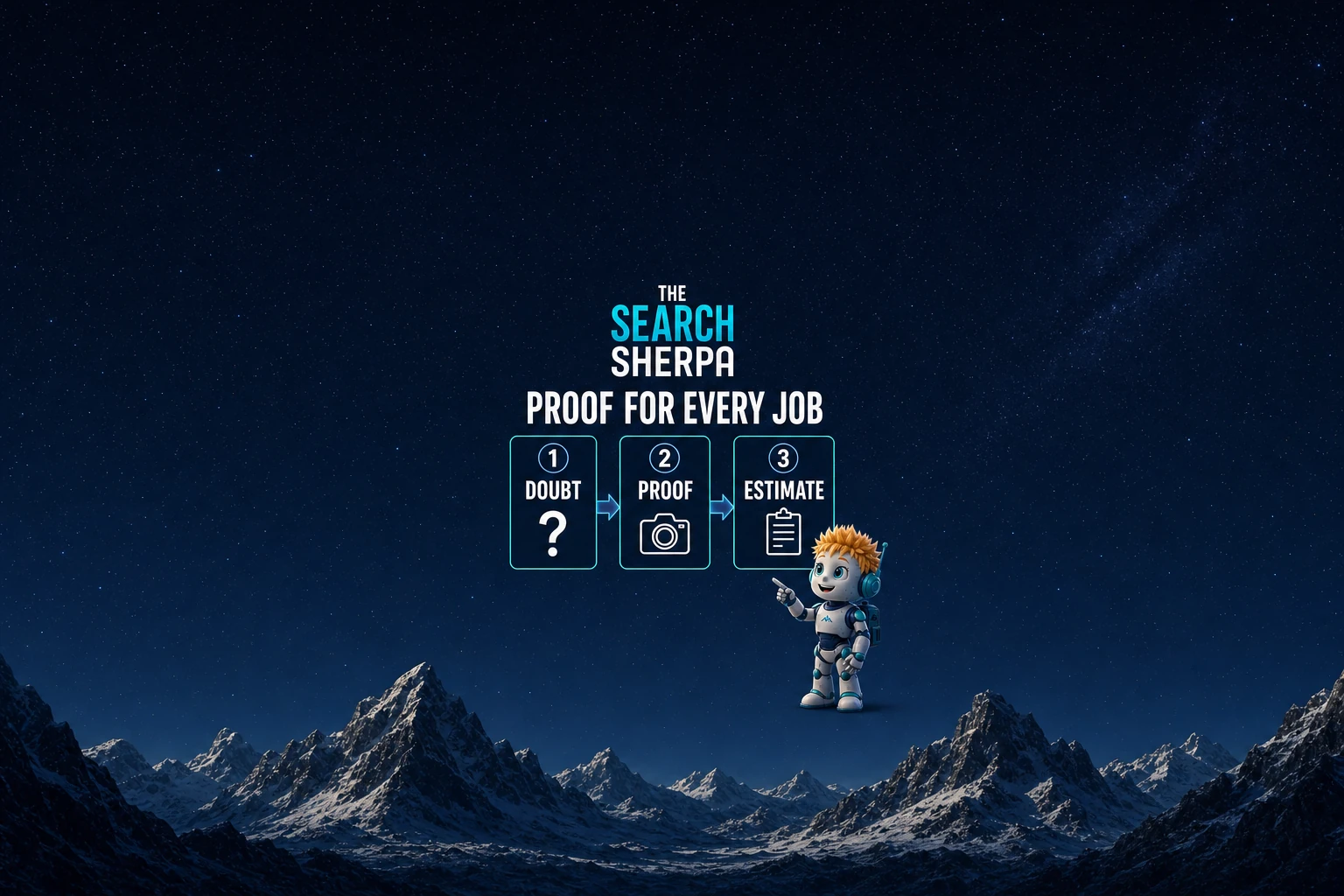
What should SEO do for a painting contractor?
SEO for painters should help the right customer find the painting service you offer through service pages and a Google Business Profile that show real proof. That customer can then send an estimate request your team can use. Build the plan by service line: interior painting, exterior painting, cabinet refinishing and commercial repaints.
This guide is for an owner judging SEO help. It is not a guide to painting methods, paint products or legal compliance.
You may already pay shared-lead platforms for jobs. A shared lead is attention you rent for one job. Your website and your Google Business Profile stay with your business. You can use both, as long as you can tell which source brings the jobs you want. For the wider trade picture, start with this overview of contractor SEO.
Start with a proof map for each painting service
A proof map lists each painting service you want more of. For each one, it names the customer’s main doubt, the real proof that answers it, and the claim your page should avoid. Build or improve a page only where you can supply that proof.
The table below uses suggested planning categories, not services every painter offers. Remove any line your business does not sell.
| Service line | The customer’s main doubt | Proof that answers it | Do not claim |
|---|---|---|---|
| Interior painting | How the crew works inside a lived-in home | Permitted photos of finished rooms, reviews in customers’ own words and a plain description of how a visit works | Results you cannot show |
| Exterior painting | The condition of the house and when the work can happen | Permitted photos of finished homes. For homes built before 1978, show your EPA lead-safe certification only if your firm holds it. A firm without EPA firm certification does not advertise covered pre-1978 work. | A certification you do not hold, or promises about weather or durability |
| Cabinet refinishing | Whether the finish will look right up close | Close-up permitted photos of finished cabinets and a clear description of what the service includes | Refacing or replacement you do not offer |
| Commercial repaints | Reliability, access and timing on a working site | Permitted project photos and a description of how you plan around occupied hours | Site types or contract types you do not take |
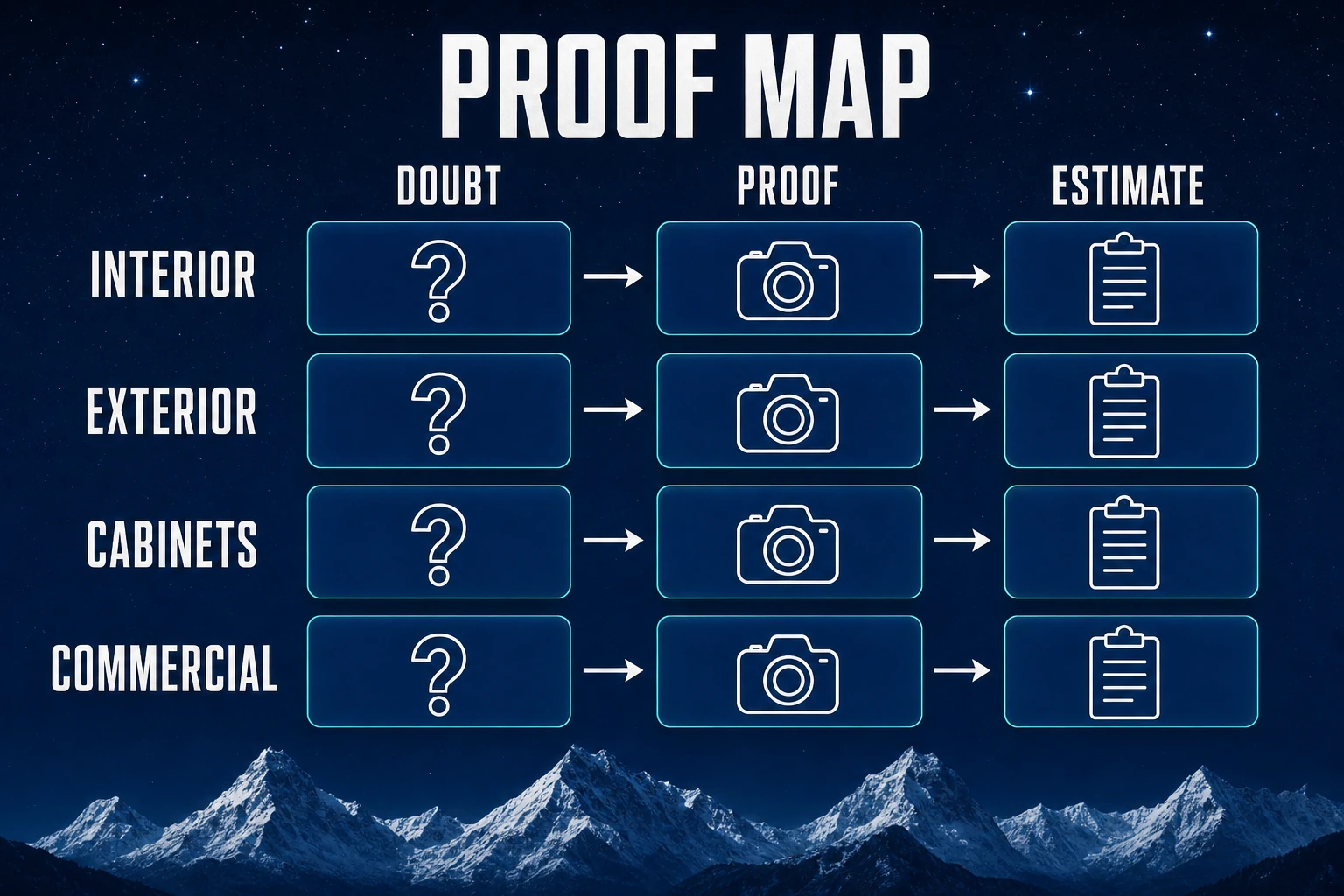
The proof column matters most. A page with only a service name and a phone number asks the customer to guess.
Decide which services need their own page
A service line earns its own page when it has its own customer questions and its own proof. Cabinet refinishing and commercial repaints are good tests. Ask whether their questions, photos and estimate details differ from your house painting page.
Customer searches tend to follow a few patterns. Some name a service and a place, such as cabinet painters in a nearby town. Some describe a problem, such as peeling exterior trim. Others name the property, such as an office repaint.
Google’s SEO Starter Guide asks for unique content, not a rehash of what others published. A page copied for every town with only the name changed falls short of that. Good service page content planning starts from those customer questions.
How should a painter show EPA lead-safe certification?
A painting firm that holds EPA lead-safe certification should show it clearly, accurately and only while it is current. EPA’s Renovation, Repair and Painting (RRP) Rule covers paid work that disturbs paint in homes and child-occupied facilities built before 1978. EPA lists painters among the special trade contractors it covers.
EPA also says a firm cannot advertise covered pre-1978 renovation work without firm certification.
In EPA’s words on its page for contractors, “Firms cannot advertise or perform renovation activities covered by the RRP Rule in homes or child-occupied facilities built before 1978 without firm certification.” This is marketing guidance, not compliance advice. Confirm your obligations with EPA or your state program.
A certified firm should follow EPA’s logo use guidelines when it shows the Lead-Safe Certified Firm logo. The logo must include your firm’s certification number and must not be altered. EPA allows it on websites.
EPA does not allow the logo once certification lapses. The logo may not suggest that EPA endorses your business. Do not let a firm that is not RRP-certified use your logo. That includes a subcontractor you hire.
EPA says on its firm certification page that firm certifications are good for five years. Keep the expiry date on file, and update your website and profile wording when you renew. Depending on where you work, the certification may come from EPA or from a state that runs its own program.
A firm without certification should not use the logo. It also should not publish pages that offer covered work on homes built before 1978. Describe the work you do perform. Keep the credential’s name exact as well.
Lead abatement is a different EPA program with its own certifications. Do not describe your RRP certification as abatement.
Customers care about the credential too. EPA recommends that homeowners planning RRP work in a pre-1978 home hire a lead-safe certified contractor. An accurate mention on the right service page answers that question before the first call.
Ask every customer for a review without suggesting what to write
Ask every customer for a review after the job. Ask the same way each time, and leave the wording to them. Google’s review policy says merchants should not pressure people to review on the premises, “nor should they request that specific content be included.”
The policy also bars incentives such as discounts. It bars asking only the customers you expect to be happy.
Crew members and relatives should not review the business, because Google treats that as a conflict of interest. Some customers name the cabinet project or the exterior repaint on their own. That review is useful proof, and you can reply naturally. The guide on how to get more Google reviews covers building a steady habit.
Put real project photos beside the work they prove
Project photos work as proof only when they show real jobs that customers have allowed you to share. Place each photo on the page for that service. Google’s SEO Starter Guide advises: “Use images that are sharp and clear, and place them near text that’s relevant to the image.”

Never present a stock photo or an AI-generated image as a customer’s home.
Write alt text that describes what the photo shows, such as a finished kitchen with painted cabinets. Google describes alt text as a short, descriptive explanation of how the image relates to your content. Add a caption that names the service and any limits of the example.
Make your Google Business Profile match the same services
Your Google Business Profile should describe the same painting services and the same real coverage as your website. Google’s business guidelines ask for your real-world business name and say not to use categories solely as keywords. Extra service words in a profile name are not a substitute for accurate categories.
If your crew works at customers’ properties, set the profile up as a service-area business.
Google’s guidelines say a service-area business should hide its address. Its service-area help page explains how to set the areas you serve. List only the places your crew really covers.
Google’s local ranking help page says, “Local results are mainly based on relevance, distance, and popularity.” The same page says, “There’s no way to request or pay for a better local ranking on Google.” That line covers local rankings, not paid ads. A profile that matches your website helps Google understand your business, but it cannot promise a map position. Google Business Profile management keeps both in step.
What should a painting estimate request ask?
A painting estimate request should collect what your team needs to decide whether to visit, quote or decline. Those details differ by service line. Keep each form short enough to finish on a phone. Say that a submission asks for an assessment, not a confirmed price.
The list below gives suggested fields for each painting service line.
- Interior painting: rooms, approximate size, walls, ceilings or trim, current condition, whether the home is occupied, preferred timing and photos.
- Exterior painting: property type, number of stories, visible condition, year built if known, photos and preferred timing.
- Cabinet refinishing: approximate number of doors and drawers, current finish, whether the kitchen stays in use, and photos.
- Commercial repaints: site contact, who approves the work, occupied hours, access limits, scheduling windows and the decision date.
Test each form on a phone and check that a submission shows a clear confirmation. If the form or page needs work, WordPress design and SEO can be part of the plan.
A hypothetical older-home exterior request
In this hypothetical example, a homeowner asks about repainting the outside of a house. The form shows a year built before 1978 and photos of the siding and trim.
For a certified firm, that one field flags the request for the firm’s own lead-safe process before anyone visits.
A firm without certification does not advertise covered pre-1978 work. For that firm, the field flags a request the office may need to decline, because covered pre-1978 work is work the firm does not offer. EPA’s RRP program pages define which work is covered, so check there rather than relying on the year alone.
In both cases, the year-built field helps the office decide what to do before it drives out.
When should exterior painting pages be ready?
Exterior painting pages should be ready before the part of the year when your own records show exterior requests arriving. Plan from your job history: when requests come in, when your crew can take exterior work, and which jobs you want first. A national trend does not describe your local calendar.
Update photos, availability and estimate details early.
During busy weeks, keep the response times on your website accurate. SEO is not a scheduling guarantee, so judge the plan on steady progress rather than a promised date.
What should a painting contractor SEO proposal ask you for?
A useful painting contractor SEO proposal asks you for the proof the plan depends on. Expect questions about the services you want and the ones you decline. Expect questions about photo permissions, your certification and its expiry date, the area your crew covers, and your records of requests and booked jobs.
Be careful with any proposal that does not ask for those things.
A promised ranking or job count is a warning sign, not a plan. So is one page repeated with different town names. Watch for review requests sent only to happy customers, or advice to use a credential logo you do not hold. The guide on what to look for in a local SEO company lists more checks.
Ask how progress will be measured. Google Analytics can show visits and form requests, and Google Search Console shows how your pages appear in search. Neither one shows booked jobs. Keep estimate requests, quotes and booked jobs as separate stages in your own records. SEO reporting and CRM integration explains how those records can work together.
Bring your service list to a discovery call
A first conversation about painting contractor SEO starts with your service list and the area your crew covers. Bring your certification details if you hold one, a few recent estimate requests and your website address. You do not need to send any customer details.
The Search Sherpa is based in Mokena, Illinois, and works with business owners remotely. You work directly with Jeremy Bengtson.
We do not promise rankings, lead counts, or map placements, because no honest provider can. Book a Free Discovery Call to review your pages and proof.
Frequently asked questions
Should cabinet refinishing have its own page?
Yes, when you offer cabinet refinishing as a separate service with its own photos, questions and estimate details. Keep the page to the work you actually do. Do not describe cabinet refacing or replacement unless your business offers those services too.
Can I ask customers to mention the job in their review?
No. Ask every customer for a review in the same way after the job, without incentives and without suggested wording. Google’s review policy says merchants should not request that specific content be included. If a customer names the project on their own, you can reply naturally.
My firm is not lead-safe certified. What should my website say?
Describe only the work your firm can perform. Do not show the Lead-Safe Certified Firm logo, and do not advertise covered work on homes built before 1978. If you decide to get certified, EPA’s firm certification page explains how to apply. This is marketing guidance, not compliance advice.
Will SEO replace the leads I buy now?
Not on a set schedule, and no honest provider can promise that it will. Some owners keep shared-lead services while visibility from their own website and Google Business Profile builds. Compare both sources by the jobs they book, not only by the number of leads.
How long does SEO for painters take?
Here is the expectation I give every client: Most local SEO shows measurable movement in about three to six months, depending on competition and the condition of your site. Clear service pages, real project photos and an accurate profile give that work a better starting point.
How much does SEO for a painting company cost?
Cost depends on your site, your competition, and your goals. We will be clear about pricing before any work begins. The Search Sherpa pricing guide explains general pricing. A painting business still needs a proposal based on its own site.
Explore This Topic

Join Over 400,000 Entrepreneurs Getting Our Weekly Newsletter
Recent Posts

November 20, 2026
Locksmith SEO starts with a Google Business Profile set up the way Google describes and proof customers can check: real name, honest address,

November 20, 2026
SEO for accountants should bring the work your firm wants. Plan pages by season, state CPA and EA credentials exactly, and set up

November 20, 2026
Foundation repair SEO should turn worried homeowner searches into useful evaluation requests. Plan symptom pages, service pages, intake and job tracking.