
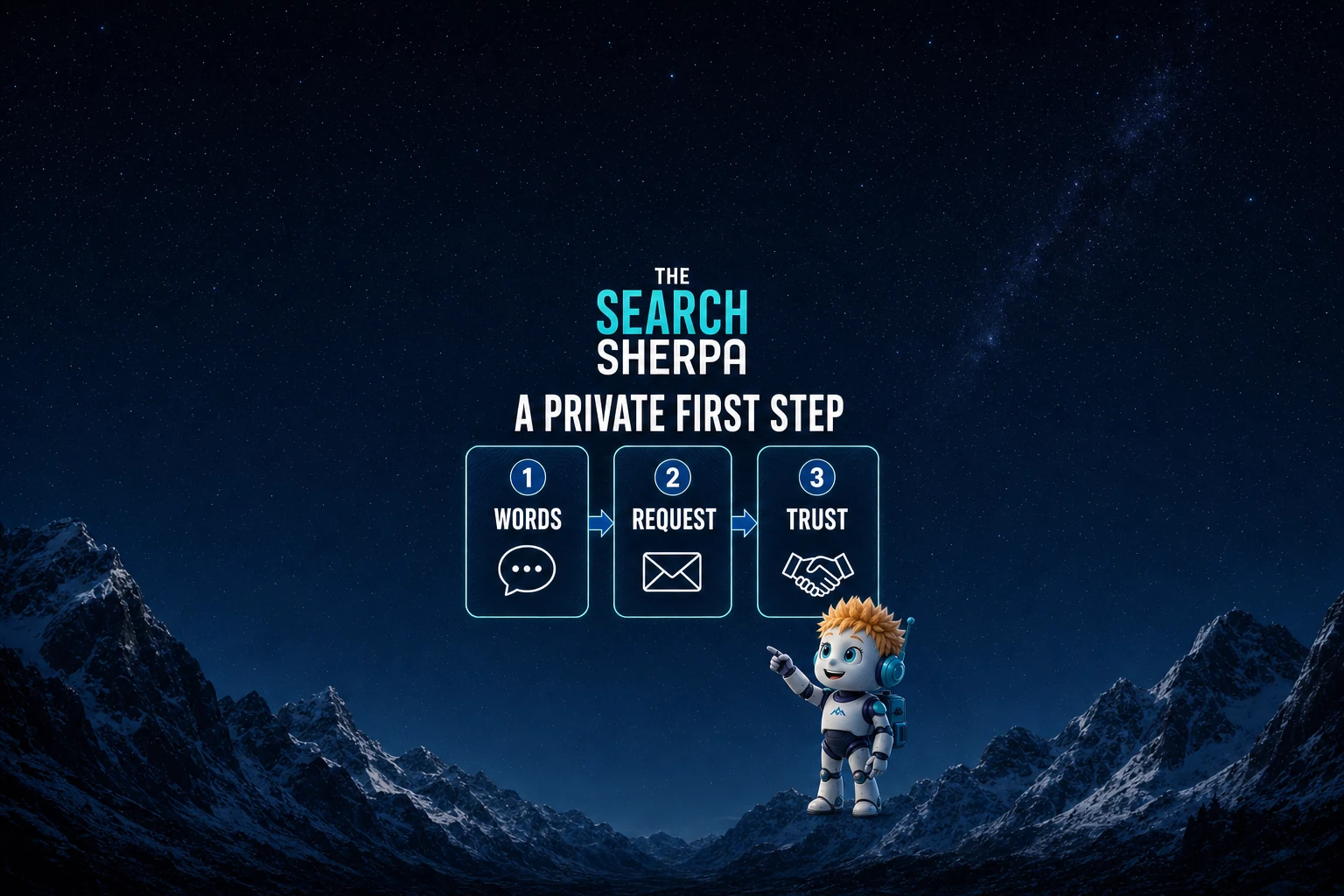
What does family law SEO cover?
Family law SEO helps people in Illinois with divorce, custody, or support questions find your practice. Good pages show which matters you take and how to reach you in private. The work ties together practice-area pages, your Google Business Profile, a careful consultation request, and an honest review habit. The Search Sherpa builds the work to respect Illinois rules on lawyer advertising, and your ethics counsel decides how those rules apply to your firm.
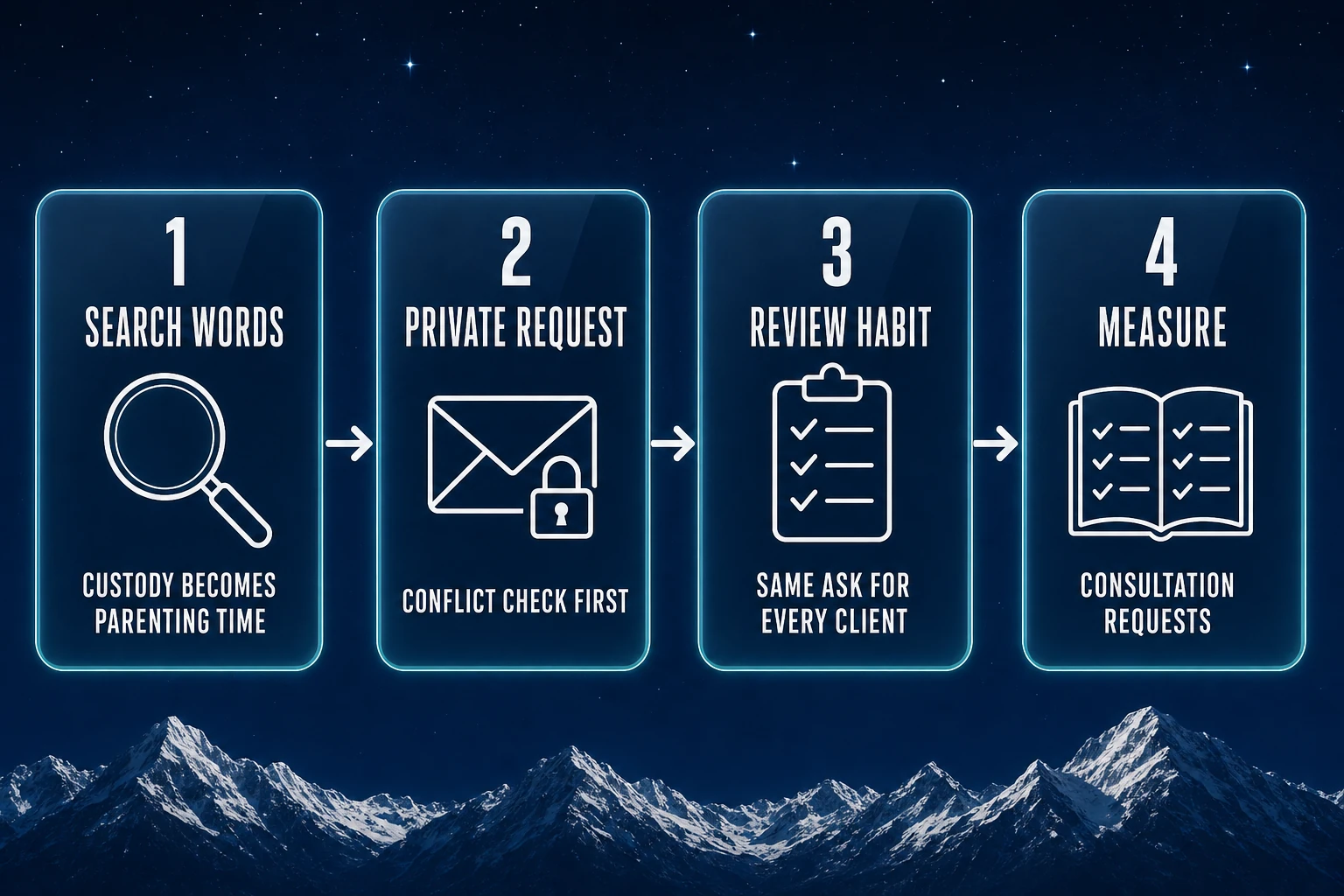
This guide follows the four steps in the diagram above. A search leads to a practice-area page written in the searcher’s words. The page leads to a private consultation request. The firm asks every client for a review in the same way. The firm tracks consultation requests, not only rankings.
The examples use Illinois laws and the Illinois Rules of Professional Conduct. Other states set their own rules. This is marketing guidance, not legal advice. Your firm and its ethics counsel decide how any rule applies to your practice.
Firm listings, town pages, and the wider advertising rules are covered in the guide to local SEO for law firms. This page stays with the matters and the people behind them.
Write each practice-area page in your clients’ words first
A family law practice-area page should start with the words a worried person types, then explain the Illinois term. A parent searches for custody, while Illinois law speaks of the allocation of parental responsibilities. Give each matter type one page that says who you help and how a first conversation works.
The table below gives the same pairing for divorce, child support, and spousal support, with a source link for each term.
| Matter type | Words people search | Term in Illinois law | What the page should explain |
|---|---|---|---|
| Divorce | divorce | dissolution of marriage (750 ILCS 5/401) | Who you help, how a first conversation works, and what to bring |
| Custody | custody, parenting schedule | allocation of parental responsibilities, parenting time, parenting plan (750 ILCS 5/600, 5/602.5) | The parenting questions your firm handles and how a consultation starts |
| Child support | child support | child support (750 ILCS 5/505) | What your firm handles and what to bring to a first meeting |
| Spousal support | spousal support, alimony | maintenance (750 ILCS 5/504) | What your firm handles and what to bring to a first meeting |
People may also search for prenuptial agreements or mediation. If your firm offers those services, give each one a page under the name your clients use.
The Illinois Supreme Court keeps the old word and the new term side by side. Its court rules include an article titled Child Custody or Allocation of Parental Responsibilities Proceedings. Your pages can pair the two in the same way.
Keep each page to the work your firm does. Leave out amounts, factors, likely outcomes, and case timelines.
Group closely related questions on one page instead of building a page for every phrasing. Google’s SEO starter guide asks for “helpful, reliable, people-first content.”
The Search Sherpa’s SEO content strategy work maps client questions to the pages that should answer them.
Name the field of practice, not a title
Illinois Rule 7.4(a) says “A lawyer may communicate the fact that the lawyer does or does not practice in particular fields of law.” A heading can name the field, such as divorce or parenting time.
Rule 7.4(c) limits the words certified, specialist, and expert, with exceptions the rule lists. The guide to local SEO for law firms explains those limits. Check the full rule with your ethics counsel before using those words.
Plan a private, conflict-aware consultation request
The Search Sherpa recommends a consultation form that asks first for conflict-check details, then how it is safe to reply, before any open box for the story. Your ethics counsel advises on your conflict-check process and writes any warning text.

Illinois Rule 1.18 says “A person who consults with a lawyer about the possibility of forming a client-lawyer relationship with respect to a matter is a prospective client.”
Comment [2] to Rule 1.18 names one risk. A consultation is likely to have occurred, the comment says, when a lawyer’s advertising “specifically requests or invites the submission of information about a potential representation without clear and reasonably understandable warnings and cautionary statements that limit the lawyer’s obligations,” and a person responds.
Comment [4] says a lawyer “should limit the initial consultation to only such information as reasonably appears necessary for that purpose.”
Comment [1] to Illinois Rule 7.3 says results “automatically generated in response to Internet searches” typically are not a solicitation.
Some people search on a shared phone or computer. That is why the form asks whether a voicemail or an email is welcome. The Search Sherpa also suggests that the phone script follow the same order, so a call and a form work alike.
Your ethics counsel decides what the form and the call must collect and say. The Search Sherpa’s landing page design work covers the page around the form.
Hypothetical inquiry: a parent asks about parenting time
In this hypothetical example, a parent searches for custody help late at night. The parent lands on a page about parenting time.
The request form asks for contact details and the conflict-check details the firm has chosen, then asks how it is safe to reply. The parent picks email only. The fuller story waits for the first conversation with an attorney.
Staff can see the matter type and the safe way to respond. The example shows no outcome, no fee, and no offer of representation.
Build a review habit that respects client privacy
A family law review habit accepts that some clients will prefer privacy. The Search Sherpa recommends asking every client in the same way once the matter closes, with no incentive, no screening for happy clients, and no suggested wording.
Google’s review policy says merchants “should not require or pressure users to leave ratings or write reviews while on the premises, nor should they request that specific content be included.”
The same policy bars incentives and asking only happy customers. Google also removes reviews based on a conflict of interest. Its examples include employment and “familial relationships.” Reviews from your staff or your relatives do not belong on your profile.
Illinois Rule 7.2(b) says that “A lawyer shall not give anything of value to a person for recommending the lawyer’s services,” with exceptions the rule lists. Your ethics counsel decides how that applies.
For replies, see replying to reviews without breaking confidentiality. For the general habit, read how to get more Google reviews.
Name and share one Google Business Profile for a solo family practice
Google’s rules for individual practitioners name lawyers: “Doctors, dentists, lawyers, financial planners, and insurance or real estate agents are all individual practitioners.” When a solo attorney is the only public-facing practitioner at a location and represents a branded firm, Google says “it’s best for the practitioner to share a Business Profile with the organization.”
Google then says to create a single profile “named using the following format: [brand/company]: [practitioner name].”
Practices with several attorneys follow other rules, and the guide to local SEO for law firms covers them. Whatever the setup, the name stays real.
Google’s guidelines say “Your name should reflect your business’s real-world name, as used consistently on your storefront, website, stationery, and as known to customers.” Unless those words are part of your firm’s real-world name, keep practice-area and town words out of the profile name.
Illinois Rule 7.5(a) also says “A lawyer shall not use a firm name, letterhead or other professional designation that violates Rule 7.1.”
Google says “Local results are mainly based on relevance, distance, and popularity.” For local rankings, Google also says “There’s no way to request or pay for a better local ranking on Google.” That line covers local rankings only; paid ads are a separate product.
The Search Sherpa’s Google Business Profile management service handles the profile alongside your website.
What should a family law SEO proposal explain?
A family law SEO proposal should name the matter pages it will build and the words those pages will use. The proposal should say who approves every claim before it goes live: someone at the firm or its ethics counsel. The proposal should also explain how the consultation form gets reviewed and what is reported beyond rankings.
Compare proposals with these questions. A careful provider answers each one in plain English first.
- Which practice-area pages will you build or improve, and which words will each one use?
- Who approves each claim, page, and profile change before it goes live?
- How will you review the consultation form and the phone path with our ethics counsel?
- How will you ask for reviews, and what will you never do?
- How will you word any page that shows past case results, and who approves it?
- Will you report consultation requests and Google Search Console data, or only rankings?
- Who owns the website, the Google Business Profile, and the analytics accounts?
Pages that show past case results need extra care. Comment [3] to Illinois Rule 7.1 warns that truthful results can mislead if they lead a reasonable person “to form an unjustified expectation that the same results could be obtained for other clients in similar matters.”
Cost depends on your site, your competition, and your goals. We will be clear about pricing before any work begins. For market context, see what law firm SEO costs.
We do not promise rankings, lead counts, or map placements, because no honest provider can. SEO cannot guarantee consultations or new cases either.
For a general hiring checklist, read what to look for in a local SEO company. For reporting, see how to track local SEO performance.
Paid connecting services versus visibility you own
Some firms pay a connecting service to reach potential clients instead of building visibility they own. Illinois Rule 7.2(c), amended effective July 1, 2025, says “A lawyer may accept a connection of a potential client through, and/or pay the usual charges of, an intermediary connecting service (ICS) provided that, at the time of the connection or at the outset of the representation, the lawyer discloses to the client the relationship between the lawyer and the ICS,” and it lists further conditions. Your ethics counsel should review any paid connecting service. A website and profile your firm owns stay under your firm’s control.
Bring your practice details to a first conversation
A first conversation about family law SEO goes best when you bring a few details. Bring the matter types you take, the words your clients use, how consultation requests reach you, and who approves your marketing claims. Those details keep the talk on your actual practice.
You work directly with Jeremy Bengtson. I help local practices link their website, Google Business Profile, and content, and I track the consultation requests that come in.
My business, The Search Sherpa, is based in Mokena, Illinois. My clients have included law firms and other local businesses.
Questions about SEO for family law firms
These short answers sum up the main points of this guide. The answers cover search words, the consultation form, reviews, the Google Business Profile, and timing. The sections above carry the full detail and the source links.
How is family law SEO different from general SEO for a law firm?
Family law SEO is organized around the matter and the person. That work covers the words people search, a private first contact, and a review habit that respects privacy. General legal local SEO covers firm listings, town pages, and the wider advertising rules. My guide to local SEO for law firms covers those in detail.
Should our pages say custody or allocation of parental responsibilities?
Use both. Lead with custody, the word people search. Then explain that Illinois law uses allocation of parental responsibilities, parenting time, and parenting plan, with a link to the statute. Other states use their own terms, so match the law where your firm practices.
Why does the consultation form matter so much in family law?
Under Illinois Rule 1.18, a person who consults about forming a client-lawyer relationship is a prospective client. Comment [2] to that rule says “a consultation is likely to have occurred” when advertising invites information without clear warnings “and a person provides information in response.” I recommend putting conflict-check details before the story. Your ethics counsel decides how the rule applies to your form and writes any warning text.
How can we earn reviews if clients want privacy?
I recommend asking every client in the same way once the matter is closed. Google’s review policy bars incentives, asking only happy customers, and requesting specific content. Illinois Rule 7.2(b) limits giving anything of value for a recommendation. Your ethics counsel decides how those rules apply. Some clients will prefer privacy and decline, and that is their choice.
Does a solo divorce attorney need a separate Google Business Profile?
Often no. When the attorney is the only public-facing practitioner at a location and represents a branded firm, Google says it is best for the practitioner to share one profile with the firm. Google’s format for that profile name is [brand/company]: [practitioner name]. Firms with several public-facing attorneys follow different practitioner rules.
How long does family law SEO take?
Here is the expectation I give every client: Most local SEO shows measurable movement in about three to six months, depending on competition and the condition of your site. No one can promise rankings, consultations, or new cases.
Explore This Topic

Join Over 400,000 Entrepreneurs Getting Our Weekly Newsletter
Recent Posts

November 20, 2026
Locksmith SEO starts with a Google Business Profile set up the way Google describes and proof customers can check: real name, honest address,

November 20, 2026
SEO for accountants should bring the work your firm wants. Plan pages by season, state CPA and EA credentials exactly, and set up

November 20, 2026
Plan SEO for painters around real proof: permitted job photos, honest reviews, EPA lead-safe certification when held and clear estimate requests.