

SEO for accountants starts with the work you want more of
SEO for accountants helps people find your firm when they search for a service you offer. Think tax returns, bookkeeping, or payroll. Good SEO ties together your service pages, your credentials, your Google Business Profile, and an easy way to ask for a consultation.
The goal is the right clients for the work you want. SEO cannot guarantee rankings, calls, or new clients.
I’m Jeremy Bengtson, founder of The Search Sherpa. This guide covers three choices: which work to bring in and when, how to state each credential, and how to set up your Google Business Profiles.
Match each service line to its buyer and its season
Match each service line to the people who search for it and to the part of the year it fills. A family looking for tax help asks different questions than a business owner who needs payroll. Some accounting work piles up around filing season. Other work runs all year.
Your own capacity decides which lines you want more of, and when.
| Service line | Who is usually searching | What they need to know first | Role in your year |
|---|---|---|---|
| Individual tax returns | Households and individuals | Which returns you prepare, what to bring, and how appointments work | Usually busy-season work |
| Business tax work | Owners of small businesses | Which business types you serve and how new clients sign on | Depends on your firm |
| Bookkeeping | Owners who need regular records | What is included each period and how records reach you | Year-round work |
| Payroll | Employers with staff | What you handle, what the employer still owns, and how setup works | Year-round work |
| Advisory and planning | Owners weighing a business decision | How a first conversation works and who leads it | Year-round work |
| IRS representation | People who received an IRS notice | Whether your credentials allow you to represent them | Depends on your credentials |
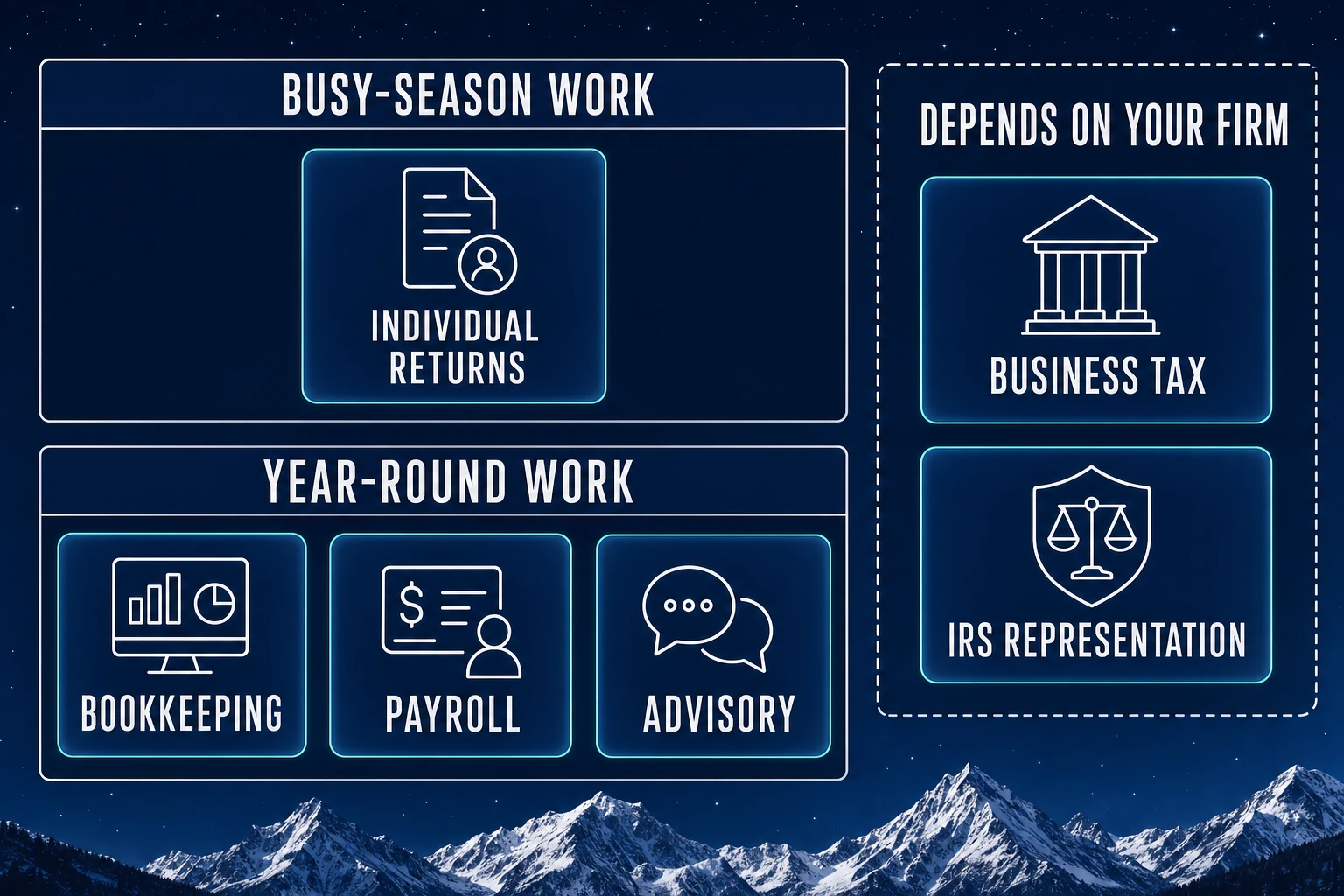
Update the pages for each service line before your busy months, not during them.
Hypothetical example: an enrolled agent practice that wants year-round work
In this hypothetical example, a two-person practice is fully booked with tax returns in the busy season. The owners want more bookkeeping and payroll clients the rest of the year. So they point their pages and their Google Business Profile at those services. Each owner is described as “enrolled to practice before the Internal Revenue Service” on every page.
The example shows a planning choice, not a predicted result.
Give each service its own useful page
A service gets its own page when its buyer, questions, and steps are different. Closely related requests can share one page. Each page should say who it serves, what is included, who does the work, and how to start.
Google’s SEO starter guide asks for content that is “helpful, reliable, and people-first.” My SEO content strategy service matches client questions to the pages that answer them.
State every credential exactly
State each person’s credential with the exact name the issuing body uses, on your site and on your Google Business Profile. The IRS explains what each credential allows. Treasury Circular 230 and the AICPA Code shape how you describe it. Only describe IRS help your firm can actually give.
What the IRS says about representation rights
The IRS page on preparer credentials and qualifications says: “Enrolled agents, certified public accountants, and attorneys have unlimited representation rights before the IRS.” Annual Filing Season Program participants have limited rights. The IRS says they “may only represent clients whose returns they prepared and signed, but only before revenue agents, customer service representatives, and similar IRS employees,” and that they “cannot represent clients regarding appeals or collection issues.” Preparers with only a preparer tax identification number (PTIN) “are authorized to prepare tax returns.” The same IRS page says: “They have no authority to represent clients before the IRS (except regarding returns they prepared and filed December 31, 2015, and prior).”
My recommendation: a firm whose preparers hold only a PTIN should not advertise IRS representation, such as help with audits, collections, or appeals, on its pages or profile.
Wording rules for enrolled agents and CPAs
Treasury Circular 230 sets wording rules. 31 CFR 10.30(a)(1) covers enrolled agents and some other practitioners. It says they, “in describing their professional designation, may not utilize the term “certified” or imply an employer/employee relationship with the Internal Revenue Service.” The rule lists acceptable wording, such as “admitted to practice before the Internal Revenue Service.”
For CPAs who are AICPA members, the AICPA Code of Professional Conduct says: “A member should refer to applicable state accountancy laws and board of accountancy rules and regulations for guidance regarding the use of the CPA credential.” Check your state board’s rules before you describe the credential online.
Choose a firm profile, practitioner profiles, or both
Google’s business representation guidelines describe three setups. A location with several public-facing practitioners gets a firm profile, separate from each practitioner’s own. A solo practitioner who is the only public-facing practitioner at a location and represents a branded firm shares the firm’s profile. No practitioner gets one profile per specialization.
Google’s practitioner examples do not name accountants or CPAs. My recommendation is to use Google’s definition: “a public-facing professional, typically with their own customer base.”
Google says a practitioner should create their own profile if they work in a public-facing role and “can be contacted directly at the verified location during stated hours.”
Here is how the guidelines word each setup:
- With several public-facing practitioners at one location, “The organization should create a Business Profile for this location, separate from that of the practitioner.” A practitioner’s own profile carries only the practitioner’s name.
- When one practitioner is the only public-facing professional at a branded firm, Google says to create one shared profile named “[brand/company]: [practitioner name].”
- “A practitioner shouldn’t have multiple Business Profiles to cover all of their specializations.” So a practitioner who handles tax, bookkeeping, and payroll keeps one profile per practitioner, not one per service.
Support staff should not create their own profiles. Use your firm’s real-world name, as Google’s guidelines require. Choose as few categories as possible, and do not use categories “solely as keywords,” in Google’s words. My guide to Google Business Profile categories explains the choice.
If you do not meet clients at your office, Google’s service-area guidance says to remove that address from your profile. Google’s local ranking page also says, “There’s no way to request or pay for a better local ranking on Google.” My Google Business Profile management service covers this setup.
Ask for reviews without exposing client information
Accounting firms can ask every client for a review in the same way. Offer no reward, and do not pick only happy clients. Google’s review policy says merchants should not “request that specific content be included.”
When you reply, thank the reviewer. For AICPA members in public practice, the AICPA Code bars sharing confidential client information without the client’s “specific consent,” so my recommendation is not to confirm the engagement or add client details.
Google’s review policy bars incentives. It also bars any effort to “selectively solicit positive reviews from customers.” It bars “Content that is based on a conflict of interest,” and Google’s examples include work and family ties. So do not ask staff or relatives for reviews.
My recommendation follows from Google’s rule against requesting specific content: never ask clients to mention a service, a result, or a named accountant.
The AICPA Confidential Client Information Rule (1.700.001) reads: “A member in public practice shall not disclose any confidential client information without the specific consent of the client.” My guide on how to get more Google reviews covers the asking process.
Keep every claim inside your professional rules
Treasury Circular 230 and the AICPA Code both bar false or misleading advertising. Section 10.30 covers IRS practitioners. AICPA section 1.600 covers how members in public practice may advertise and seek clients. Its rule is 1.600.001, and 1.600.010 lists what counts as misleading.
Every page, profile, and ad you publish should follow the rulebook that applies to you: Circular 230, the AICPA Code, or both.
Section 10.30(a)(1) bars “a false, fraudulent, or coercive statement or claim; or a misleading or deceptive statement or claim.” The table below pairs common claims with rule text from the AICPA Code and 31 CFR 10.30.
| Claim to avoid | Why it matters | Rule text |
|---|---|---|
| Refund, savings, or audit results stated as certain | Sets expectations no firm controls | AICPA 1.600.010: “create false or unjustified expectations of favorable results” |
| Hints of special influence with the IRS | Clients could think you get special treatment from the IRS | AICPA 1.600.010: “imply the ability to influence any court, tribunal, regulatory agency, or similar body or official” |
| An enrolled agent described as certified | Readers could think the IRS certified the agent | 31 CFR 10.30(a)(1): “may not utilize the term “certified”” |
| Published fees you may not honor | Clients could plan around a price that later rises | AICPA 1.600.010 .02c: a stated fee when it was “likely at the time” that fees “would be substantially increased” and the member “failed to advise” the client; 31 CFR 10.30(b): “may charge no more than the rate(s) published” |
If you publish fees for IRS matters, 31 CFR 10.30(b) sets out what fee information may be published and says a practitioner “may charge no more than the rate(s) published under paragraph (b)(1) of this section for at least 30 calendar days after the last date on which the schedule of fees was published.”
In my view, a marketing provider’s work counts too. The AICPA Code says “members must not do through others what they are prohibited from doing themselves.” My recommendation: approve everything written in your name before it goes live.
Rules differ by credential and by state. This is marketing guidance, not legal or professional advice. Confirm how these rules apply to your firm with your state board of accountancy or your own advisor.
Measure consultations and engagements, not just visits
Google Search Console shows how your pages appear in search. Website analytics shows visits. Neither one confirms a signed engagement. So record each step: inquiry received, good-fit request, consultation held, and engagement signed (a new client agrees to work with you).

Compare those steps by service line and by time of year.
Note why requests stall, such as a service you do not offer or a full calendar. My guide to tracking local SEO performance and my SEO analytics and CRM integration service cover the setup.
SEO for CPA firms: what a proposal should explain
An SEO proposal for an accounting firm should name the pages and Google Business Profile work it covers. The proposal should explain how the provider will learn your services, credentials, and capacity.
The proposal should also say who approves each claim before it goes live. That person should be you.
Ask how reports separate good-fit requests from general traffic. Ask who controls access to your website and profile. My guide on what to look for in a local SEO company covers the rest.
Here is how The Search Sherpa handles cost. Cost depends on your site, your competition, and your goals. We will be clear about pricing before any work begins. You can read more on the SEO pricing page.
One limit applies to every provider, including The Search Sherpa. We do not promise rankings, lead counts, or map placements, because no honest provider can.
Bring your service lines and credentials to the first conversation
A first conversation about accounting firm SEO goes best when you bring five things: your website, the services you want to grow, the part of the year you want to fill, each person’s credential, and your current Google Business Profile setup.
A short note on how consultations become engagements helps too.
At The Search Sherpa, I help local businesses connect their website, Google Business Profile, content, and inquiry tracking. You work directly with Jeremy Bengtson.
Frequently asked questions
Should I promote individual returns when my busy season is already full?
Not necessarily. If the busy season is already full, point your pages at work you can take on, such as bookkeeping, payroll, or advisory work. Keep your tax return pages accurate. Say plainly when you are not taking new clients for a service.
Can an enrolled agent describe themselves as certified?
Not for the enrolled agent designation. Treasury Circular 230 section 10.30(a)(1) says enrolled agents, in describing that designation, “may not utilize the term “certified”” for it. One acceptable description listed in the rule is “enrolled to practice before the Internal Revenue Service.” My recommendation: check your exact wording with your own professional advisor before you use it on your site, your profile, or in review replies.
Does Google treat an accountant as an individual practitioner?
Google does not say. Its examples of individual practitioners name doctors, dentists, lawyers, financial planners, and insurance or real estate agents. The examples do not name accountants or CPAs. My recommendation is to use Google’s definition: a public-facing professional, typically with their own customer base. Then follow Google’s profile rules for practitioners.
Can I share client success stories or a client list?
Only with care. The AICPA Code bars members in public practice from sharing confidential client information without “the specific consent of the client.” The Code also notes that even a client’s name can be confidential in some practices. As a marketing step, I suggest having the client approve the exact text and leaving out financial details. Confirm the consent rule with your state board.
Do I need separate pages for bookkeeping and payroll?
Only when the buyer and the steps differ. If the same owners ask the same questions about both, one clear page can cover them. Give a service its own page when it needs its own explanation of scope, staff, and first steps.
How long does SEO take for an accounting firm?
Here is the expectation I give every client: Most local SEO shows measurable movement in about three to six months, depending on competition and the condition of your site. Plan page updates before your busy months. SEO cannot guarantee rankings, inquiries, or new engagements, and no honest provider can.
Explore This Topic

Join Over 400,000 Entrepreneurs Getting Our Weekly Newsletter
Recent Posts

November 20, 2026
Locksmith SEO starts with a Google Business Profile set up the way Google describes and proof customers can check: real name, honest address,

November 20, 2026
Plan SEO for painters around real proof: permitted job photos, honest reviews, EPA lead-safe certification when held and clear estimate requests.
November 20, 2026
Foundation repair SEO should turn worried homeowner searches into useful evaluation requests. Plan symptom pages, service pages, intake and job tracking.