
Locksmith SEO starts before the ranking
Locksmith SEO is the work that helps a locksmith business show up in Google Search and Google Maps and earn the call. That work starts with two checks. Your Google Business Profile has to follow Google’s guidelines, and a worried customer has to confirm quickly that your business is real.
Google’s local ranking help says verifying a profile tells Google you are authorized to represent the business.
Google adds that complete, accurate information is more likely to show up in local results. The guide below covers the listing rules first, then the proof customers look for. For the trades in general, see our guide to contractor SEO and marketing.
Storefront, hybrid or service-area: pick the setup that matches how you work
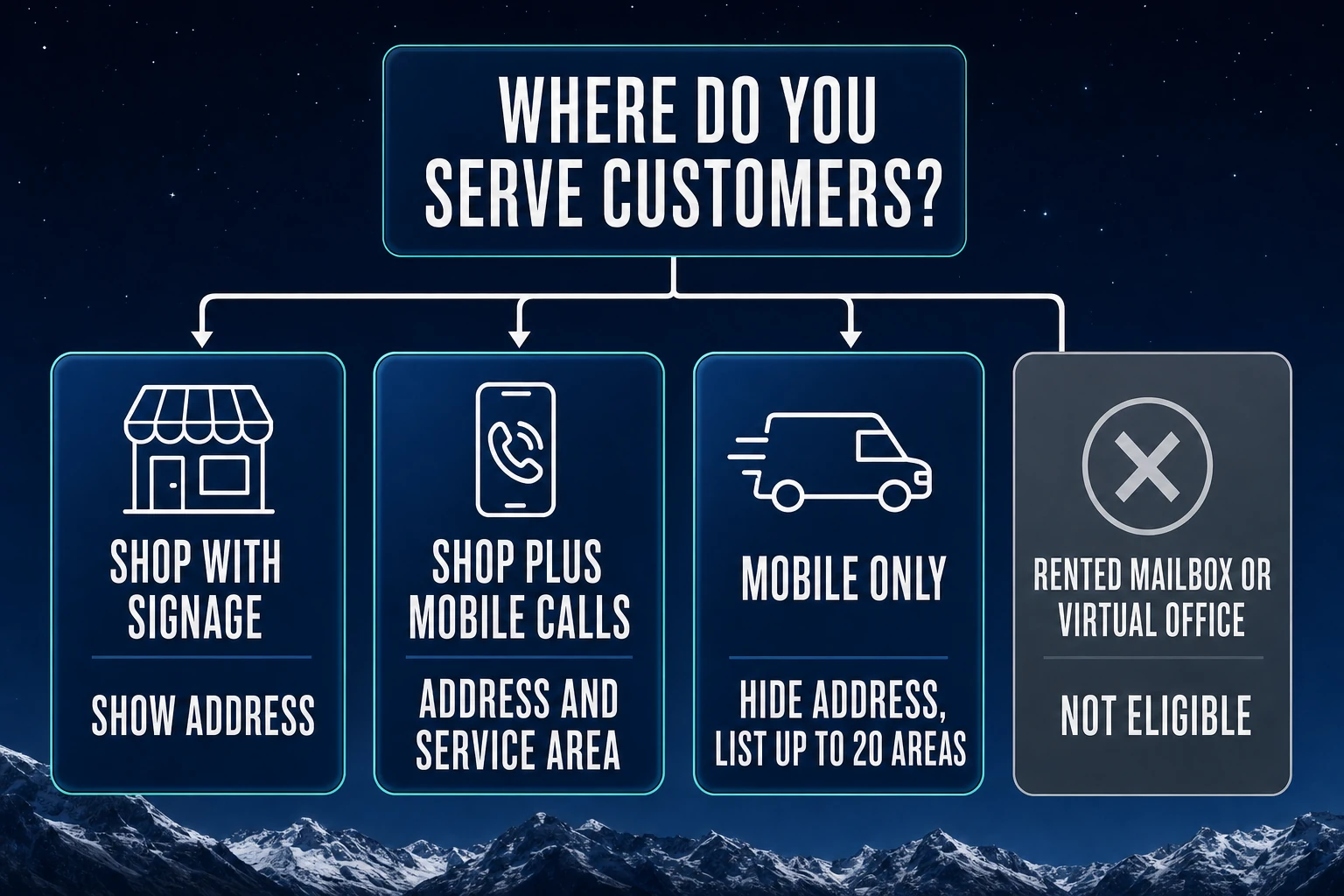
A locksmith’s Google Business Profile setup depends on where customers are served. A staffed shop with permanent signage shows its address. A shop that also runs mobile calls is a hybrid business and can show its address and a service area. A van-only locksmith hides the address and lists the area it serves.
| How you work | Setup | What Google’s guidelines say |
|---|---|---|
| A shop with permanent signage, staffed during your hours | Storefront | Show the address, and keep permanent signage with your business name there. |
| A shop that also runs mobile calls | Hybrid | Show the address and a service area. Keep the shop staffed and open to customers during its stated hours. |
| Mobile only, run from home or a van | Service-area | One service-area profile with the address hidden. Google’s own example is a plumber who works from a home address. |
| A rented mailbox or virtual office | Not eligible | A rented address you do not operate from is not eligible. |
| A second shop with its own staff and service area | Its own profile | Separate locations with separate staff and service areas may each have a profile. |
Those rows come from Google’s guidelines for representing your business. Google’s hybrid example is an auto repair shop that also offers roadside service, which is close to a locksmith shop that also runs mobile calls.
Set the service area by city or postal code. Google’s service area help allows up to 20 service areas and does not allow a radius. It also says the overall area should not reach more than about 2 hours of driving time from where the business is based. Our Google Business Profile optimization checklist walks through the other profile fields.
Use your real business name, not a keyword list
Your Google Business Profile name should match the name on your van, your shop sign and your invoices. Google warns: “Including unnecessary information in your business name isn’t permitted, and could result in the suspension of your Business Profile.”
So extra words like 24 Hour, Emergency or a city name stay out unless they are part of your real-world name, as used consistently on your storefront, website and stationery.
Google lists service or product information among the things a business name must not include. Your hours, services and service area each have their own fields.
Categories follow the same idea. Google asks you to use as few categories as possible, choose the most specific ones that describe your core business, and never use categories as keywords.
Keep one listing and a phone number you control
Google allows one Business Profile per business, or one per location with its own staff and service area. Google also says: “The phone number must be under the direct control of the business.” Extra listings for nearby towns break the first rule, and a number that hands callers to someone else breaks the second.
The same guidelines prefer a local phone number over a central call center helpline whenever possible.
Google’s guidelines also say not to use phone numbers or links that redirect or refer people to anyone other than the actual business. Google does not accept premium phone numbers.
If you use an answering service or a call tracking number, check the setup against these Google rules. The number should belong to your business, ring your business, and never pass the caller to another company.
Google reserves the right to suspend profiles that break its guidelines, so a shortcut here can cost you the whole listing.
Give lockouts, rekeys, car keys and commercial access their own paths
Give four common service paths their own clear pages: emergency lockouts, rekeys and lock changes, car keys, and commercial access. Each one brings a different customer with different questions. A locked-out driver needs to know fast whether you handle that vehicle in that area, while a property manager comparing access control has time to read.
The customer situations in this table are hypothetical examples. Fill in the other columns from your real service menu.
| Service | Hypothetical customer situation | What the page should make clear | What not to promise |
|---|---|---|---|
| Emergency lockout | A driver locked out of a car after dark | The home, car and business lockouts you handle, the area you cover, and how to reach you | An exact arrival time, or a price before you know the job |
| Rekey and lock change | New homeowners who want the old keys to stop working | Lock types you work on, rekey versus replacement, and how booking works | A price before you have seen the lock |
| Car keys | A driver who lost the only car key | Vehicles and key types you handle, and details to have ready | Work on every make and model |
| Commercial access | A property manager comparing access control for an office building | The commercial work you do, how site visits and quotes work, and who to contact | A price or start date before the site visit |
Google’s SEO starter guide asks for content that is helpful, reliable and people-first. Write each page from your real service menu, and split pages only when the situation, the questions or the booking steps change. Our SEO content strategy service builds those pages around each customer’s questions.
Skip the city-swapped pages
Do not publish near-identical pages that only swap one town name for another. Google’s spam policies call this doorway abuse. One of Google’s examples is “Having multiple domain names or pages targeted at specific regions or cities that funnel users to one page”.
Google describes doorway abuse as pages created to rank for specific, similar searches that lead people to pages less useful than the final destination.
If a provider offers one page per nearby town, ask how each page will help a different customer.
A stronger plan uses real service pages, an honest service area on your Google Business Profile, and city mentions only where you have something useful to say about working there.
Show proof a customer can check
Customers deciding whether to trust a locksmith look for details they can check. Beyond an honest business name, address or service area, and phone number, four kinds of proof help: an accurate license, a real quote policy, real photos, and genuine reviews.
- License: in Illinois, IDFPR licenses locksmiths and locksmith agencies and provides a public license look-up. Show the license you hold exactly as issued, and say how to check it.
- Quote policy: describe how your team really quotes, in plain words.
- Photos: put real photos of your vans, shop and work on your website. Google’s SEO starter guide recommends sharp, clear images near relevant text, with descriptive alt text.
- Reviews: ask customers for genuine Google reviews. Google’s review policy bars incentives and selectively asking happy customers, and says merchants should not pressure people, “nor should they request that specific content be included”.
Licensing rules vary by state, and this is marketing guidance, not legal advice. Our guide on how to get more Google reviews covers asking within the rules.
Answer urgent calls so the right jobs get booked
Search visibility only helps a locksmith when the call that follows goes well. Answer with the same business name your listing shows, ask which service the caller needs and where, and gather the lock or vehicle details. Explain how your firm quotes. Never promise an arrival time on the call or on the page.
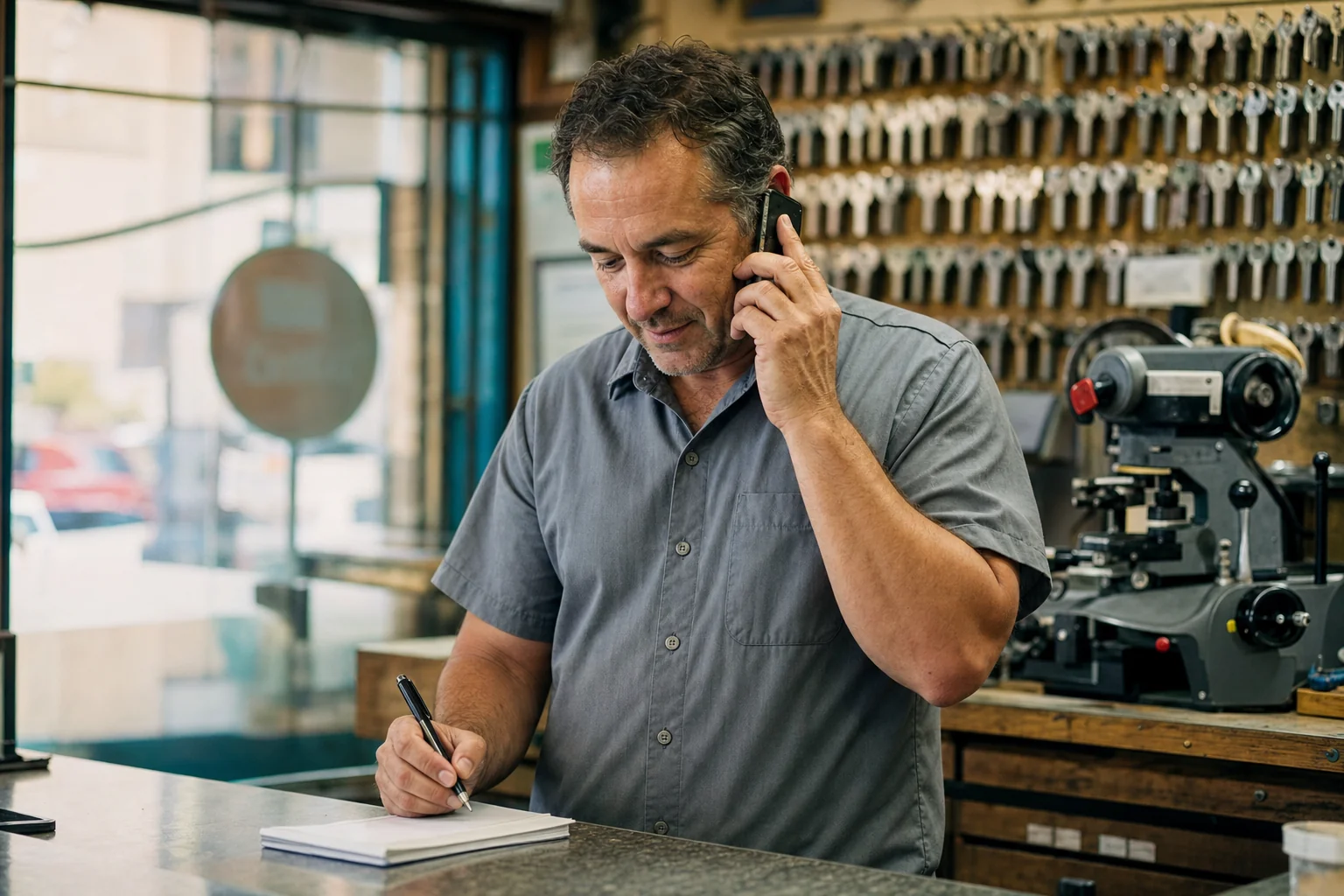
A short call script for each of these four service paths helps whoever answers ask the same useful questions.
Track calls by service type and note which ones became booked jobs. Calls are not the same as paid work, so record each stage separately. Our guide to tracking local SEO performance shows how to read Google Search Console and Google Business Profile data alongside your own job records.
What a locksmith SEO proposal should explain
A good locksmith SEO proposal explains what will be checked and changed in your Google Business Profile, your website and your call path, and how progress will be reported. Be wary of any offer that names a map position in advance, copies a page for every nearby city, stuffs keywords into your name or borrows an address.
Google says it plainly: “There’s no way to request or pay for a better local ranking on Google.”
We do not promise rankings, lead counts, or map placements, because no honest provider can.
Cost depends on your site, your competition, and your goals. We will be clear about pricing before any work begins. You can review our SEO pricing for buying context, and our guide on what to look for in a local SEO company lists more questions to ask.
Google also suggests Local Services ads to service-area businesses on its service area help page, a paid program with its own sign-up. This guide covers the unpaid side of being found.
Bring these details to the first conversation
A useful first conversation about locksmith SEO starts with how your business really works. Bring your service list, whether you run a shop, vans or both, the area you serve, how calls are answered, the license you hold, and the current state of your Google Business Profile. Those details give me a practical basis to judge fit.
You work directly with Jeremy Bengtson.
I run The Search Sherpa in Mokena, Illinois, and I help local service businesses connect local SEO, your website, your Google Business Profile, and your content into one visibility system. The Google Business Profile management service covers the profile work alongside your website.
Questions about SEO for locksmiths
These answers cover the Google Business Profile questions locksmith owners raise about names, home addresses, city pages, phone numbers, reviews and timing. Most answers rest on Google’s own published guidelines.
Can I put 24 Hour or my city in my Google Business Profile name?
Not unless 24 Hour or your city is part of your real-world name, as used consistently on your storefront, website and stationery. Google says a name must not include service information, and unnecessary information can lead to suspension. Put hours, services and your service area in their own fields.
Should a mobile locksmith show a home address on Google?
No. Google says a service-area business should hide its address, and gives the example of a plumber working from a residential address. A mobile locksmith with no storefront sets up one service-area profile listing up to 20 cities or postal codes.
Do I need a separate page for every city I serve?
No. Google’s spam policies list pages targeted at specific regions or cities that funnel users to one page as an example of doorway abuse. Build strong pages for your real services, set an honest service area, and mention a city only where you have something useful to say.
Can I use an answering service or tracking number on my listing?
Only if the number stays under your business’s direct control and rings your business, not another company. Google says the phone number must be under the direct control of the business, prefers a local number to a central call center, and does not allow numbers that redirect or refer callers to anyone else.
How do I ask for Google reviews without breaking Google’s rules?
Ask customers for honest reviews of real jobs. Google’s policy bars incentives, selectively asking only happy customers, and pressure, and says merchants should not request specific content. So do not suggest words, star ratings or staff names. Ask every customer the same simple way.
Will SEO put my business at the top of Google Maps, and how long does it take?
No one can promise that, and you should be cautious of anyone who does. Google says there is no way to pay for a better local ranking. On timing, this is The Search Sherpa’s stated expectation, not a Google figure. Most local SEO shows measurable movement in about three to six months, depending on competition and the condition of your site.
Explore This Topic
Join Over 400,000 Entrepreneurs Getting Our Weekly Newsletter
Recent Posts
November 20, 2026
SEO for accountants should bring the work your firm wants. Plan pages by season, state CPA and EA credentials exactly, and set up
November 20, 2026
Plan SEO for painters around real proof: permitted job photos, honest reviews, EPA lead-safe certification when held and clear estimate requests.
November 20, 2026
Foundation repair SEO should turn worried homeowner searches into useful evaluation requests. Plan symptom pages, service pages, intake and job tracking.