
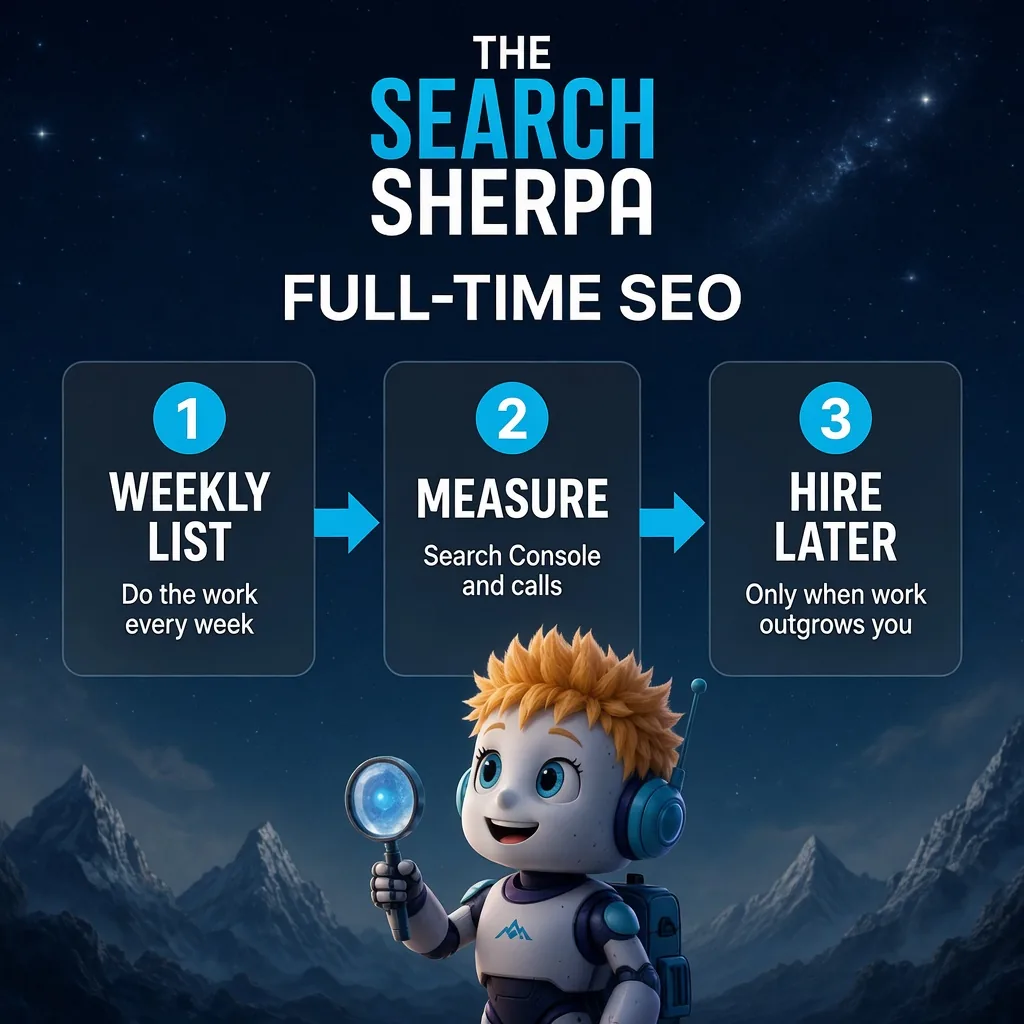
Most small businesses need SEO work every week. They do not need a full-time SEO employee on payroll to get it.
If you run a shop, clinic, or local service company, local SEO services already cover the jobs a junior hire would spend months learning: your Google Business Profile, your website, and the pages that answer the questions buyers type.
Google Search Console on thesearchsherpa.com shows the same pattern on our own site. In the 90 days ending 19 September 2026, the query "does a real estate company need a full time seo" earned 30 impressions at average position 11.8. It landed on a pricing page, not on a staffing answer. This article is that missing answer, written for owners who have 1 to 25 people and no marketing department.
Full-time SEO vs weekly SEO work, at a glance
| Decision | Full-time hire | Founder-led agency or consultant |
|---|---|---|
| Typical cash cost | Salary plus tools, benefits, and ramp time | Monthly work scoped to the site you have |
| Hours you buy | 40 hours, including meetings and admin | The hours that move visibility |
| Time to useful output | Often three to six months of ramp | Work starts on the live site in week one |
| Best when | You have a content team, a developer, and a manager | You need one connected visibility system |
| Risk | One person leaves and the system stops | You can stop. No contracts. Clients stay because the work earns it. |
What a full-time SEO actually does all week
A competent in-house SEO does not "set Google on page one." They research queries, write or brief pages, fix technical issues, update the Google Business Profile, build local mentions, and report.
A 2025 Morningscore survey of 75 SEO professionals found 59.7% spend 4 to 15 hours per week per website. That is a workload, not a 40-hour job, unless that person also writes every page, designs the site, and answers the phone.
For a single-location business in Will County, Illinois, the weekly list is shorter and more local:
- Check Google Search Console for queries with impressions and weak clicks.
- Update the Google Business Profile (photos, services, Q&A, posts).
- Improve one page that already ranks between positions 4 and 20.
- Reply to reviews and fix NAP (name, address, phone) mismatches.
- Note what ChatGPT, Google AI Overviews, and Perplexity say about you.
That is SEO work. It is not a full-time job unless you also run content, ads, and email for a larger company.
When a small business should skip a full-time hire
Skip the hire if most of these are true:
- You have one location, or a handful of nearby locations.
- The owner still approves every page.
- You do not have a developer who can ship technical fixes the same week.
- You cannot fill 40 hours of SEO work without inventing busywork.
- You were burned by an agency that showed rankings and no calls.
Jeremy Bengtson, founder of The Search Sherpa in Mokena, Illinois, puts it this way: "If the owner still has to translate every report, a full-time junior SEO becomes another person to manage, not a system that makes the business easier to find."
The burned-client pattern we hear in discovery calls is consistent. "They showed us rankings but the phone never rang." A salary does not fix that. A visibility system that ties local SEO, the website, the Google Business Profile, and the content to real questions does.
When a full-time SEO starts to make sense
Hire in-house when the work has outgrown one operator:
- You publish many pages a month and need an editor on staff.
- You have several sites or a national catalog.
- A marketing manager already owns the channel mix.
- You can keep the person busy with research, content, and technical work without pulling them into unrelated tasks.
Even then, many mid-sized teams keep strategy with a senior operator and keep production in-house. The job title is not the system.
What the work costs in hours, not slogans
If you do the work yourself, plan on a serious weekly block. The Morningscore range of 4 to 15 hours per site is a useful planning band, not a promise. A local service site with a handful of service pages sits at the low end. A content-heavy site sits at the high end.
A full-time salary buys 40 hours. Most of those hours, on a small site, will be filled with tasks that do not change whether nearby customers can find you, understand you, and choose you.
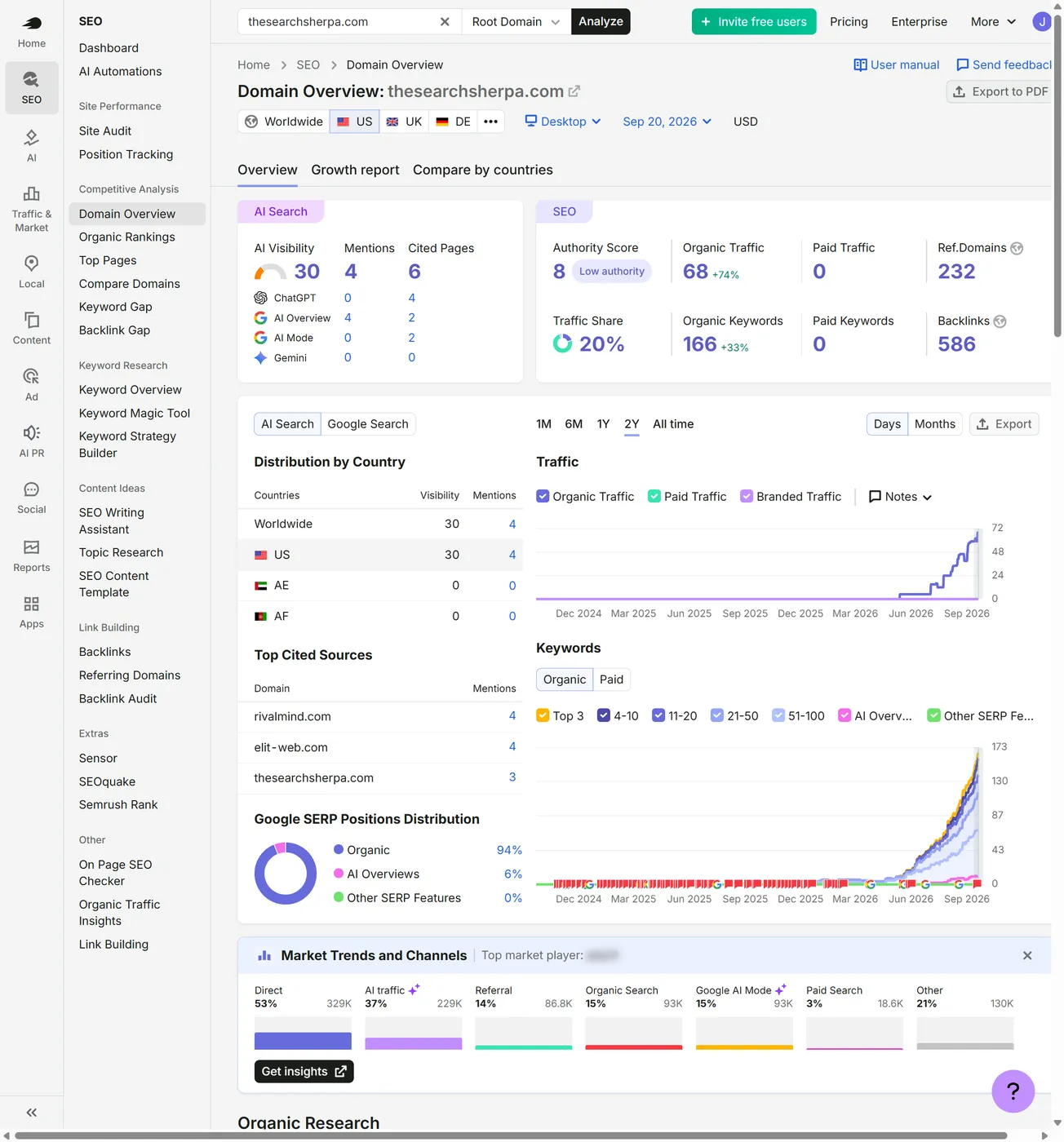
Semrush Domain Overview for thesearchsherpa.com (US desktop, 20 September 2026) shows what focused weekly work looks like on a small site: 166 organic keywords (+33%) and estimated organic traffic of 68 (+74%), with an Authority Score of 8. That is not a reason to hire a full-time employee. It is a reason to keep a weekly cadence and measure it.
A real estate example, because Search Console asked
Search Console sent us "does a real estate company need a full time seo." For a brokerage or a solo agent, the answer is the same as for a plumber or a med spa.
Agents need listing pages, a Google Business Profile that matches the office, city pages that tell the truth, and content that answers budget and timing questions. That is a connected visibility system. It is not a 40-hour specialist sitting in the bullpen unless the firm already has a marketing manager and a writer.
If you sell homes in the southwest Chicago suburbs, start with the pages buyers already use. Pair this article with the real estate SEO pricing guide when the question is budget, and with when to hire an SEO consultant when the question is timing.
How to staff SEO without a full-time seat
Use this sequence.
- Fix the system you already have. Claim and complete the Google Business Profile. Make the homepage and top service pages answer the query in the first 50 words.
- Measure with Google Search Console. Look for questions with impressions and almost no clicks. Those are the next pages.
- Buy hours that match the list. A founder-led operator who works the list beats a junior hire who needs a syllabus.
- Keep the door open. No contracts. Clients stay because the work earns it.
If you want help building that system, book an SEO consultation. Come with Search Console open. We will look at the questions you already rank for.
Frequently Asked Questions
Is SEO worth it for a small business?
Yes, when people already search for the service you sell and you can wait three to six months for measurable movement, depending on competition and the condition of your site. Local service businesses usually see the first useful signals in Google Search Console and Google Business Profile insights before a full-time hire would finish ramping.
More detail: skip SEO if nobody searches for what you sell, or if you need leads this week. Paid search covers the short window.
Is SEO still worth it in 2026?
Yes. Google still sends local buyers to websites and map results, and AI Overviews still cite pages that answer the question in plain language. On thesearchsherpa.com, Semrush shows 6% of tracked US SERP positions overlapping AI Overviews as of 20 September 2026. That is a slice to measure, not a reason to fire SEO.
Is SEO dead now with AI?
No. AI search reads the same pages, profiles, and reviews that local SEO already builds. If ChatGPT or Google AI Overviews cannot find a clear service, city, and contact path, they will name a competitor who published one. Keep the profile and the page complete.
What is the 80/20 rule in SEO?
For a small local site, about 80% of the gain comes from a short list: Google Business Profile completeness, the pages that match buyer queries, technical health, and reviews. The other 20% is expansion. A full-time hire often spends the extra hours on the 20% because the 80% does not fill a week.
Can I do SEO myself, or do I need to hire a professional?
You can do the weekly checklist yourself if you will protect the hours. Hire help when the list slips, when technical fixes stall, or when Search Console shows questions you cannot answer in writing. A professional should show the work in plain English, not a dashboard of rankings with no calls.
How long before a small business sees SEO results?
Plan on three to six months for measurable movement, depending on competition and the condition of your site. Earlier signals include new queries in Google Search Console, more profile views, and better click-through on pages that already had impressions. A full-time hire does not shorten that clock.
Explore This Topic
Does a Small Business Need a Full-Time SEO?

SEO Audit Cost (2026): What a Real Audit Includes and What a Free One Leaves Out

SEO for Financial Services: The Work and What It Costs
SEO Consultant Cost (2026): Hourly, Project and Retainer Rates Explained

Google Business Profile Management Pricing (2026): What the Work Costs and What the Profile Is Worth
Join Over 400,000 Entrepreneurs Getting Our Weekly Newsletter
Recent Posts
September 22, 2026
SEO audit cost in 2026: free scans, $2,000 to $10,000 for a professional audit, what a real audit includes, and how to read
September 22, 2026
SEO for financial services costs about $1,400 to $20,000 a month for a payments firm. See the work, the fee models, and a
September 21, 2026
SEO consultant cost in 2026: $75 to $200 an hour, $1,000 to $3,000 a month for a local business, plus how that compares