
By Jeremy Bengtson, Founder of The Search Sherpa
THE SHORT ANSWER
Local SEO for contractors is mostly recurring work. Post finished jobs to your Google Business Profile. Ask every customer for a review. Keep your profile and listings accurate. Build pages for the towns where you actually work. Most of it is simple. The hard part is doing it every week while you run jobs, and that is the part AI agents now handle well, as long as the decisions stay with you.
If you run an HVAC, plumbing, roofing, flooring, or remodeling company, you already know the phone is the business. When homeowners search for your service, they pick from the map and the first few results. Being there is not luck. Small, steady work makes it more likely, and most contractors know that work but have little time to keep it up.
This guide lays out the fifteen recurring tasks that support a home service business’s visibility on Google, in Google Maps, and in AI search tools. It also shows how we split that work into three lanes, so AI agents carry the routine tasks and you only hear about the decisions that belong to you.
Why contractors fall behind on local SEO
Most contractors are not short on good work. They are short on hours. The trucks are out, the office is answering the phone, and posting a job photo to Google comes last. Then a slow month hits, and the marketing gets attention again for a week or two.
Homeowners notice the difference. A profile that shows new work every week, fresh reviews, and accurate details looks like a real, busy business. One that wakes up twice a year does not.
There is a second trap. When an outside company does the work, every small task can turn into a question for the owner. Is this photo okay? Can we say this? Who do we serve in that town? The owner becomes the bottleneck, and the work slows down to the speed of a busy inbox.
The recurring work behind a visible home service business
Here is the work, grouped by how often it needs to happen. The free task kit below has the full steps for each one, so you can do every task yourself if you want to.
Weekly. Post a finished job to your Google Business Profile. Ask every customer for a review the day the job is done. Reply to every new review. Approve which job photos can be shown.
Monthly. Keep your Google Business Profile accurate, including emergency hours and your service area. Check that Google has indexed your pages. See where you show up on the map across your service area. Check your website on a phone. Add answers to the questions your office hears most.
Quarterly. Get pages and posts ready for the season ahead. Build pages for the towns where you do real work. Review page titles and descriptions. Check that your name, address, and phone number match on every listing. Confirm your license and insurance details. Ask AI tools like ChatGPT what they say about your business.
The season matters more in some trades than others. HVAC companies shift from cooling to heating every fall. Roofers see demand jump after storms. Plumbers get frozen pipe calls in winter. Flooring and remodeling work often peaks before the holidays and in early spring. The kit includes notes like these for each trade.
What an AI agent actually does, in plain words
An AI agent is software that carries out a defined task on a schedule and keeps a record of what it did. It is not a chatbot you have to talk to. It does not need you to open an app.
For a contractor, that can look like this. An agent turns this week’s approved job photos into Google Business Profile posts that name the service and the town. Another checks how you show up on the map from each town in your service area. Another compares your listings on Angi, Houzz, Yelp, and the BBB and flags any that show an old phone number. Each one writes down what it did, so the work can be checked.
The value is not that the agent is clever. The value is that the work runs on a schedule, and every run is recorded, including anything that failed or is waiting on you.
Three lanes: how the work gets done without pulling you in
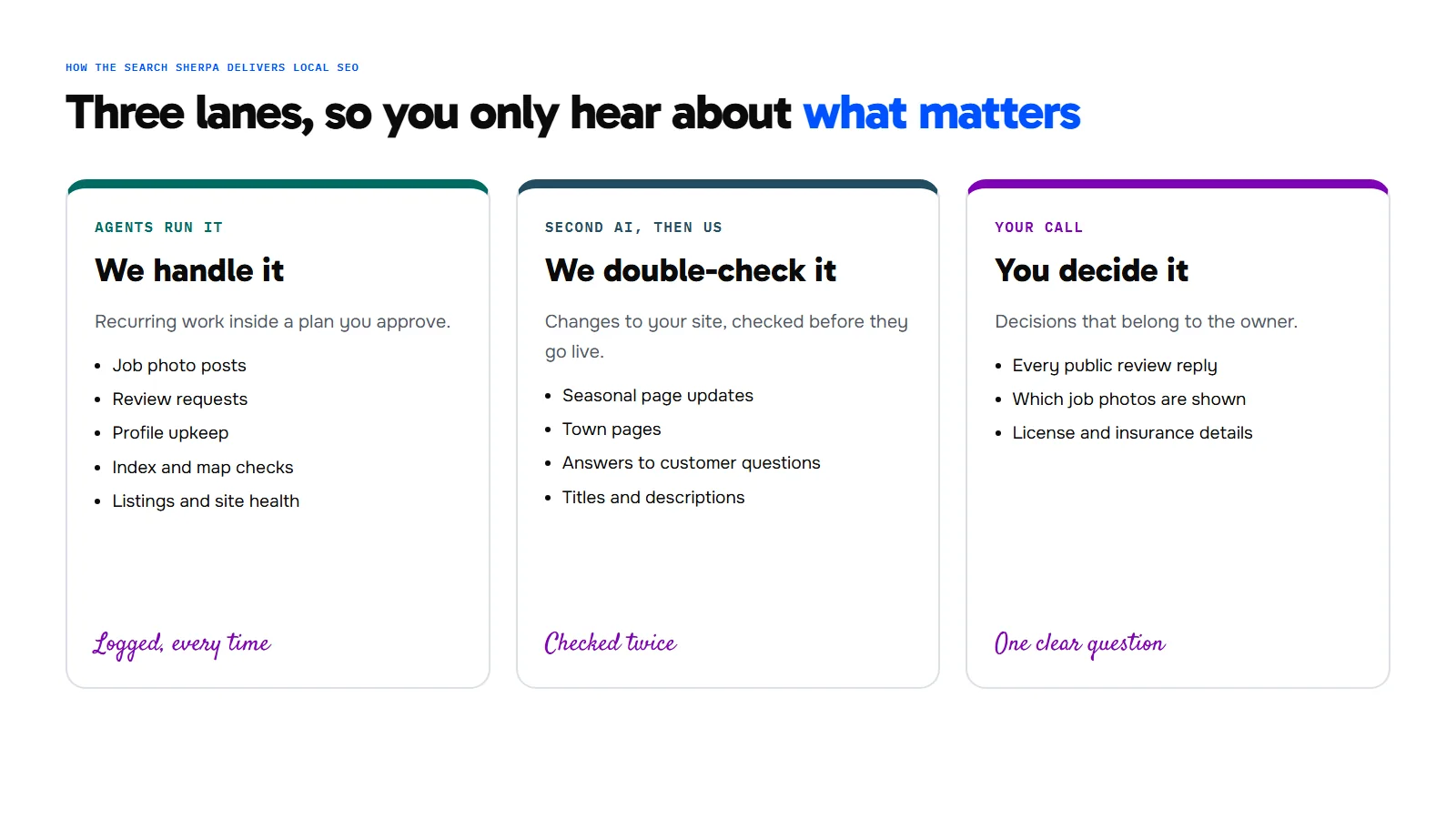
We sort every task into one of three lanes. The lane decides who acts and whether you hear about it. This is how we deliver local SEO for our clients, and it is the same split you will see on every task in the kit.
| Lane | What goes in it | Contractor examples | When you hear about it |
|---|---|---|---|
| We handle it | Recurring work inside a plan and rules you approve up front | Job photo posts, review request flow, profile upkeep, index checks, map tracking across your service area, site health, listings, AI search checks | In the activity log, any time you ask |
| We double-check it | Changes to what your site says | Seasonal page updates, town pages, answers to customer questions, page titles and descriptions | A second AI checks it before it goes live, then we review the result |
| You decide it | Calls that belong to the owner | Every public review reply, which job photos can be shown, license and insurance details | One clear question, when it matters |
The first lane is where most of the hours go, and it is where agents help the most. The second lane covers changes to what your site says, so a different AI checks the work before it goes live, and then we review the result. The third lane never runs without you.
What stays with you
Some decisions should never be automated.
Every public review reply is your call. A calm reply to a bad review can win more trust than the review costs you, but only you know what happened on that job. We watch for new reviews and draft a reply. You approve it or change it.
Job photos only go public with your approval. Some homeowners do not want their house online, so your crew asks first and you decide which photos are fine to use. We handle the captions, file names, and posting.
License numbers and insurance details are yours to confirm. Once you do, we make sure your site, your listings, and your Google Business Profile all say the same thing.
What this does not do
AI agents do not replace your office, your crews, or your judgment. They do not make Google rank anyone. They do the steady work that visibility depends on, and they leave a record of it.
We do not promise rankings, lead counts, or map placements, because no honest provider can. What we can show you is the work. Every action is logged, and you can see the log any time you ask. If your business is not showing up at all, start with why your business is not showing up on Google.
Get the Contractor Visibility Task Kit
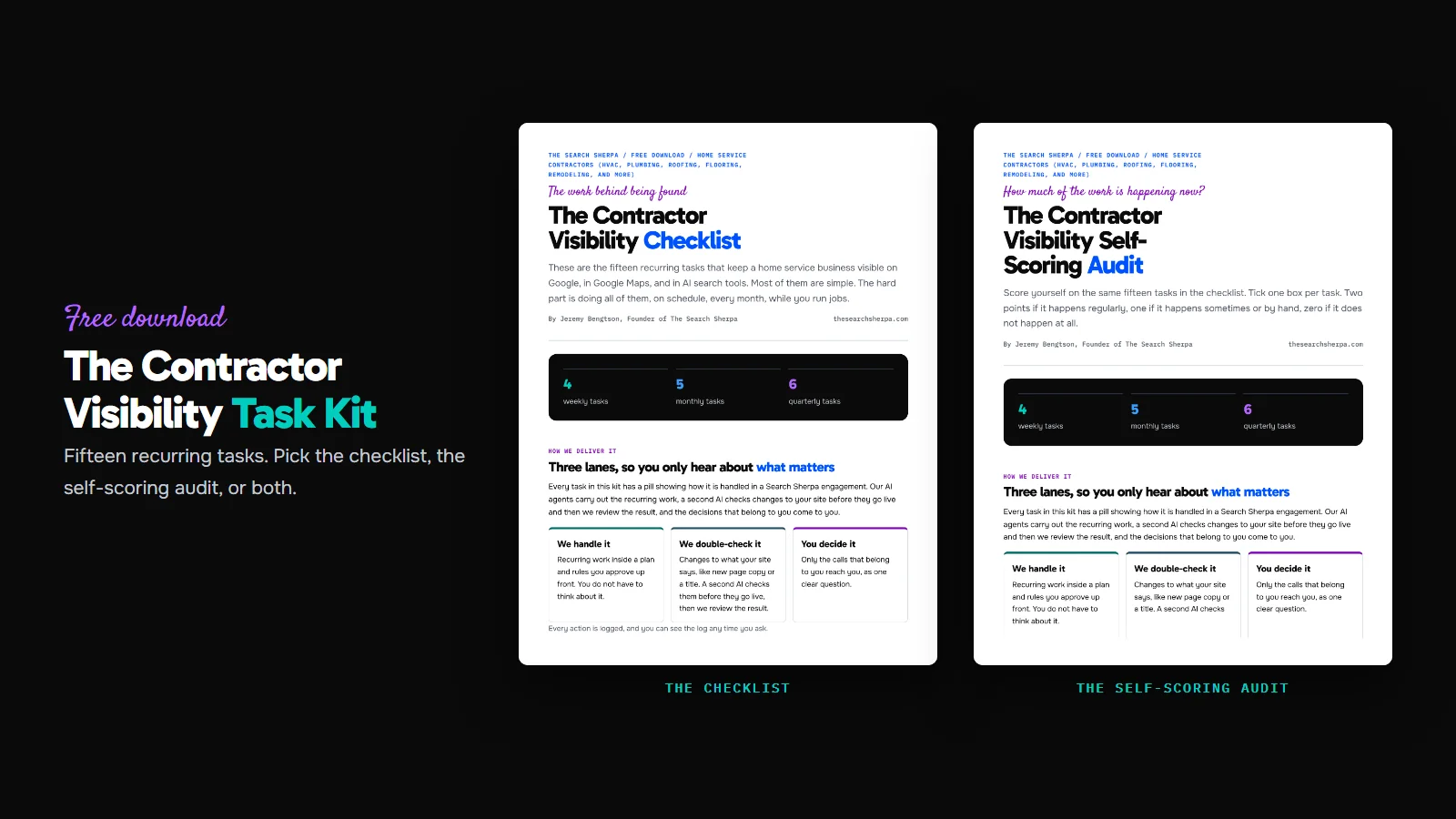
The kit is free, and it is the whole list with nothing held back. Choose the version that fits how you work.
The checklist gives you all fifteen tasks, with how often to do each one and the steps, using free tools like Google Business Profile and Google Search Console. The self-scoring audit uses the same fifteen tasks. Tick what happens now, add up your score, and see which lane would cover each gap. You can take both.
Questions contractors ask
Will an AI agent post things without my approval?
Routine posts follow rules you approve up front, using job photos you already cleared, so you do not have to sign off on each one. Anything that speaks for you in a way that is hard to undo, like a review reply, waits for your yes.
Do I need to learn new software?
No. The agents run on our side. You get a short question when a decision is yours, and a log of the work when you want to see it.
Can I do all fifteen tasks myself?
Yes. The checklist has every step, and most tasks use free tools. You can start that way and hand off the parts you would rather not do. What we sell is the doing, every week, without it landing on you or your office.
Does this work for my trade?
The fifteen tasks apply to most home service businesses. What changes is the timing and the photos. The kit calls out the differences for HVAC, plumbing, roofing, flooring, and remodeling.
What does it cost?
Cost depends on your site, your competition, and your goals. We will be clear about pricing before any work begins. Our guide to contractor SEO cost explains what drives the number, and we have trade guides for HVAC, plumbing, and roofing.
How is this different from what my last agency did?
You work directly with Jeremy Bengtson. You can see the log of what was done, and the only questions that reach you are the ones that need you. Clients stay because the work earns it.
Explore This Topic
Local SEO for Contractors: The Weekly Work, and Who Should Do It

Med Spa Marketing Strategy: The Recurring Work, and Who Should Do It

Locksmith SEO: Build a Listing Customers and Google Can Check
SEO for Accountants: Plan Search Around the Work You Want
SEO for Painters: Build Proof for the Jobs You Want
Join Over 400,000 Entrepreneurs Getting Our Weekly Newsletter
Recent Posts
November 23, 2026
A med spa marketing strategy runs on recurring work. See the 15 tasks behind local visibility, which ones AI agents can run, and
November 20, 2026
Locksmith SEO starts with a Google Business Profile set up the way Google describes and proof customers can check: real name, honest address,
November 20, 2026
SEO for accountants should bring the work your firm wants. Plan pages by season, state CPA and EA credentials exactly, and set up