

By Jeremy Bengtson, founder of The Search Sherpa.
A few years ago, getting found online meant one thing. You wanted your business near the top of Google’s ten blue links. That still matters. But it is no longer the whole story.
More of your future customers now ask ChatGPT, Perplexity, Google AI Overviews, and Gemini to recommend a business, compare their options, or answer a question before they ever click a link. That shift has created a wave of new AI search tools, and a lot of loud marketing to go with them.
This post is a plain-English look at those tools. The good ones worth your time. The bad ones that quietly waste it. And the ugly realities no tool can fix. No hype, just an honest read from someone who does this work every day.
AI search rewards local businesses that already have a clear, connected foundation … a complete Google Business Profile, fast and well-structured pages, and honest content that answers real questions. The right tools help you see and support that foundation. They do not replace it.
First, what AI search actually means for a local business
You may have seen the terms Generative Engine Optimization, or GEO, and Answer Engine Optimization, or AEO. They sound technical, but the idea is simple. It is the work of making your business easy for AI answer engines to find, understand, and quote when someone asks about what you do.
Here is the part that gets missed. GEO does not replace search engine optimization. It builds on top of it. The same clear structure, trustworthy content, and strong local signals that help you rank on Google are what help ChatGPT or Perplexity mention you. If your foundation is weak, no AI tool will paper over it.
So when you hear that SEO is dead, treat it the way you would treat any headline built to scare you. Search is changing. The fundamentals are not. If you want a deeper look at this side of the work, our AI search optimization page walks through it.
What actually changed, and what did not
Two real shifts are worth understanding, because they change how you should think about being found.
First, people increasingly get answers without clicking. According to SparkToro and Similarweb, around 60 percent of United States Google searches now end without a click. When an AI answer or a Google AI Overview solves the question on the page, the searcher often never visits a website. That does not make you invisible. It means visibility now includes being named inside the answer, not only being a link below it.
Second, ranking on Google no longer guarantees you show up in AI answers. A 5W Research index citing Brandlight data found that the overlap between top Google rankings and the sources AI tools cite has fallen from about 70 percent to under 20 percent. The two systems draw on different signals. Google leans on links and domain strength. AI engines lean more on clear, factual, well-structured reference content and on how often your business is mentioned around the web.
Now the reassuring part. What did not change is that businesses with a clear, trustworthy, well-organized presence still win. The work is the same work. It just has a second audience now: search engines, AI tools, and customers.
The shared foundation AI search still runs on
Before you buy a single AI tool, it helps to know what both Google and AI engines are actually looking for. These are the basics, and they are where your time and money go furthest.
A fast, mobile-friendly site. A page that takes eight seconds to load on a phone underperforms everywhere, in Google and in AI answers alike. Clean, quick pages are the price of entry.
Clear headings. One main headline per page, with logical subheadings under it, lets both Google and AI tools read your page in organized blocks and pull the right answer out. Messy structure buries your best material.
Structured data. Adding schema markup, the behind-the-scenes code that labels who you are and what you offer, is one of the highest-return technical steps you can take. It is a direct signal AI platforms use to understand and trust your business. This is part of digital brand entity optimization.
Real expertise and trust. Google calls this E-E-A-T: Experience, Expertise, Authoritativeness, and Trustworthiness. AI engines apply the same idea. Factual, specific, honest content gets used. Vague, promotional filler gets filtered out.
A complete Google Business Profile and strong local signals. For a local business, this is the center of gravity. It feeds your local SEO and, increasingly, the local answers AI tools give. More on that next.
The Good: tools worth a local owner’s time
These are the tools that earn their place. Each one does a specific job well, and each one supports the foundation above rather than pretending to be a shortcut around it.
Google Business Profile
If you run a local, service-based business, your Google Business Profile is non-negotiable. It is the first place Google looks to build local map results and the local answers that AI summaries now pull from. Keep your hours, service areas, categories, photos, reviews, and posts accurate and active. It is the single fastest way to become more findable nearby, and our Google Business Profile management service exists for exactly this.
Localo, for step-by-step local tasks
Localo is a good fit for a busy owner who wants clear, doable tasks instead of a giant technical dashboard. It hands you structured steps, like reviewing competitors, suggesting local keywords, and keeping listings consistent, so you can make steady progress without needing to become an SEO expert first.
Otterly AI and the AI-answer trackers
Here is a gap most owners do not know about. Google Search Console shows you how you do in Google. It does not show you whether ChatGPT or Perplexity is recommending you. Tools like Otterly AI fill that gap by monitoring the AI engines and telling you when, and how, your business gets mentioned. A small but growing group of trackers, including Profound and others, does similar work. You do not need all of them. You need one, checked regularly, so you are not flying blind.
Claude and Gemini, used as assistants
AI writing and research assistants like Claude and Gemini are genuinely useful when you treat them as assistants, not autopilots. Claude is strong for analysis, organizing research, and turning messy notes into a first draft. Gemini is handy for everyday tasks like cleaning up business emails and creating simple images. We use tools like these to work faster. We do not use them to publish content unchecked, and you should not either. If you want to get more out of them, our AI prompt engineering guide is a good starting point, and thoughtful content strategy is what makes the output worth publishing.
The Bad: where AI tools quietly fail you
Not every AI tool deserves your trust, and the failure is usually the same one.
A whole category of prompt-and-write content generators promises fast blog posts at the push of a button. The problem is what comes out. It reads like every other AI draft: broad, generic statements, worn-out openers, and paragraphs of filler with no real substance. There is no primary research, no firsthand experience, and nothing a competitor has not already said.
That kind of content struggles in two ways at once. Google has spent years learning to filter out thin, low-value material, so it rarely ranks. And AI answer engines do not read your whole page the way old search did. They pull specific passages to answer a specific question. If your useful answer is buried under promotional fluff, the AI simply skips your page and quotes a clearer one.
The lesson is not to avoid AI. It is that a tool cannot invent your expertise for you. Your real customer stories, your specific local knowledge, and your honest answers are the things that get cited. A generator cannot produce those, because it does not have them.
The Ugly: hard truths no tool fixes
Even with a strong set of tools, a few uncomfortable realities come with this new era. It is better to hear them plainly.
You will not get a click for every win. Because answers appear right on the results page, you sometimes get named, and get credit, without a visit. That is worth optimizing for, but it means you should measure exposure and mentions, not only website clicks.
Different engines pick different sources. Ask the same question in ChatGPT and in Perplexity and you can get largely different businesses cited. There is no single list to get on. Broad, consistent presence matters more than gaming one engine.
Fresh content wins, and stale content fades. AI tools favor pages that are current. Content that sits untouched for a long time tends to lose citations over time, even when the facts still hold. A page you wrote once and forgot is a page slowly going quiet. This is why we refresh important pages a few times a year rather than once and never again.
For a local business with a real budget and a real schedule, the takeaway is calming, not scary. You cannot chase every shiny tool, and you do not need to. You need a solid foundation, one honest monitoring habit, and a steady refresh rhythm.
What a local business should actually do
If you run a med spa, the same order of operations applies with a few clinic-specific additions, and our med spa answer-engine walkthrough covers them.
Here is the plain, foundation-first order of operations. None of this requires a big budget or a computer science degree.
- Claim and fully complete your Google Business Profile.
- Make sure your website is fast and easy to read on a phone.
- Give each important page one clear headline and specific, honest answers to real questions.
- Add structured data so search engines and AI tools understand your business.
- Keep your business name, address, and phone number identical everywhere online.
- Pick one AI-mention tracker and check it once a month.
- Refresh your best pages a few times a year so they stay current.
That is the connected visibility system we build for clients, described in plain terms. Everything links together so search engines, AI tools, and customers all understand your business the same way.
If you would rather have a guide handle the technical parts, that is what we do. We do not promise rankings, lead counts, or AI citations, because no honest provider can. AI helps us work faster. It does not guarantee AI visibility, and we will never tell you otherwise. What we can do is build the foundation that makes your business easier to find, easier to understand, and easier to choose. You can start with a free website and SEO review.
Frequently asked questions
How do AI search engines like ChatGPT decide which local businesses to recommend?
AI search engines recommend local businesses they can verify across several sources. They draw on your Google Business Profile, your reviews, consistent name, address, and phone listings, structured data (schema), and clear pages that answer real questions. The exact weighting is not published and differs by engine, so no one can guarantee a recommendation.
More detail: ChatGPT, Perplexity, Gemini, and Google AI Overviews each draw on different sources, so the same question can surface different businesses in each one. Related: review and reputation management
Does AI search replace SEO?
No. AI search builds on search engine optimization rather than replacing it. The clear structure, trustworthy content, and strong local signals that help a business rank on Google are the same signals ChatGPT, Perplexity, and Google AI Overviews use to find and quote it. Weak fundamentals hurt you in both places.
More detail: What has changed is where the click goes. SparkToro and Similarweb estimate that around 60 percent of United States Google searches end without a click, so visibility now includes being named inside the answer. Related: what local SEO services include
How do I show up in ChatGPT or Perplexity?
Make your business easy to verify. Answer real customer questions directly on your website, add schema markup so engines understand who you are, keep your listings identical everywhere, and earn honest mentions on other websites. There is no button that places you in an AI answer, and anyone who promises one should worry you.
More detail: Perplexity shows its sources, so it is a quick way to see which websites an engine trusts for your service and city. Related: answer engine optimization services
What is generative engine optimization (GEO)?
Generative engine optimization (GEO) is the work of making your business easy for AI answer engines, such as ChatGPT, Perplexity, and Google AI Overviews, to find, understand, and quote. It overlaps heavily with answer engine optimization (AEO) and traditional SEO. Think of it as the same foundation, aimed at a new set of AI readers.
More detail: The labels GEO, AEO, and AI search optimization are used almost interchangeably; what matters is the work behind them, not the acronym.
How do I appear in Google AI Overviews?
Google AI Overviews tend to quote clear, well-organized pages that answer a question directly in the first sentence or two. Strong headings, schema markup, and current content help, and for local questions a complete Google Business Profile matters. There is no guaranteed placement, but a solid foundation raises the odds of being cited.
More detail: Pages that sit untouched for a long time tend to lose citations, so refresh your most important pages a few times a year. Related: Google Business Profile optimization
How do I track whether AI search tools mention my business?
Use an AI-answer tracker alongside Google Search Console. Search Console shows how you perform in Google, but it does not show whether ChatGPT or Perplexity recommends you. Trackers such as Otterly AI or Profound monitor those engines for mentions of your business. For most local businesses, one tracker checked monthly is enough.
More detail: Measure exposure and mentions, not only website clicks, because AI answers often name a business without sending a visit. Related: tracking local SEO performance
Do I need to pay for expensive AI tools?
Usually not to start. Your Google Business Profile is free, and the highest-return work, such as clear pages, schema, consistent listings, and reviews, takes effort more than software. One affordable AI-mention tracker is worth adding so you can see whether AI engines name you. Spend on the foundation before the extras.
More detail: AI writing assistants such as Claude and Gemini are useful for research and first drafts, but nothing they produce should be published unchecked. Related: AI search optimization cost
How long does it take to see results from AI search optimization?
Most local SEO shows measurable movement in about three to six months, depending on competition and the condition of your site. AI visibility tends to follow a similar timeline, since it rests on the same foundation of content, listings, and mentions. Neither Google nor AI engines publish a schedule, so treat promised dates with caution.
More detail: Results compound: each refreshed page, new review, and consistent listing adds to the signals both Google and AI engines read. Related: whether AI search optimization is worth it
Who can help a local business get recommended by AI tools like ChatGPT?
A local SEO or answer engine optimization specialist who works on your Google Business Profile, website structure, schema, and reviews together is usually the right fit. Look for someone who reports in plain English and refuses to guarantee AI placement, because no provider controls what ChatGPT or Google recommends.
More detail: Ask any provider how they will measure AI mentions, which pages they will change first, and whether you keep ownership of every account. Related: how to choose a local SEO company
If your business is ready to become easier to find, easier to understand, and easier to choose across Google and AI search, we can help you build the visibility system behind that. Start with a conversation. We will look at where you stand and what comes next … no pressure and no contract. You can work with Jeremy or request a free review any time.
Explore This Topic

SEO for Moving Companies (2026): How Movers Get Found in Local Search

How to Remove a Google Review (2026): What Google Will and Won’t Take Down

Local SEO for Home Services Companies Joliet IL

Watch: AI Is the First Tool That Can Help Build the Next Tool
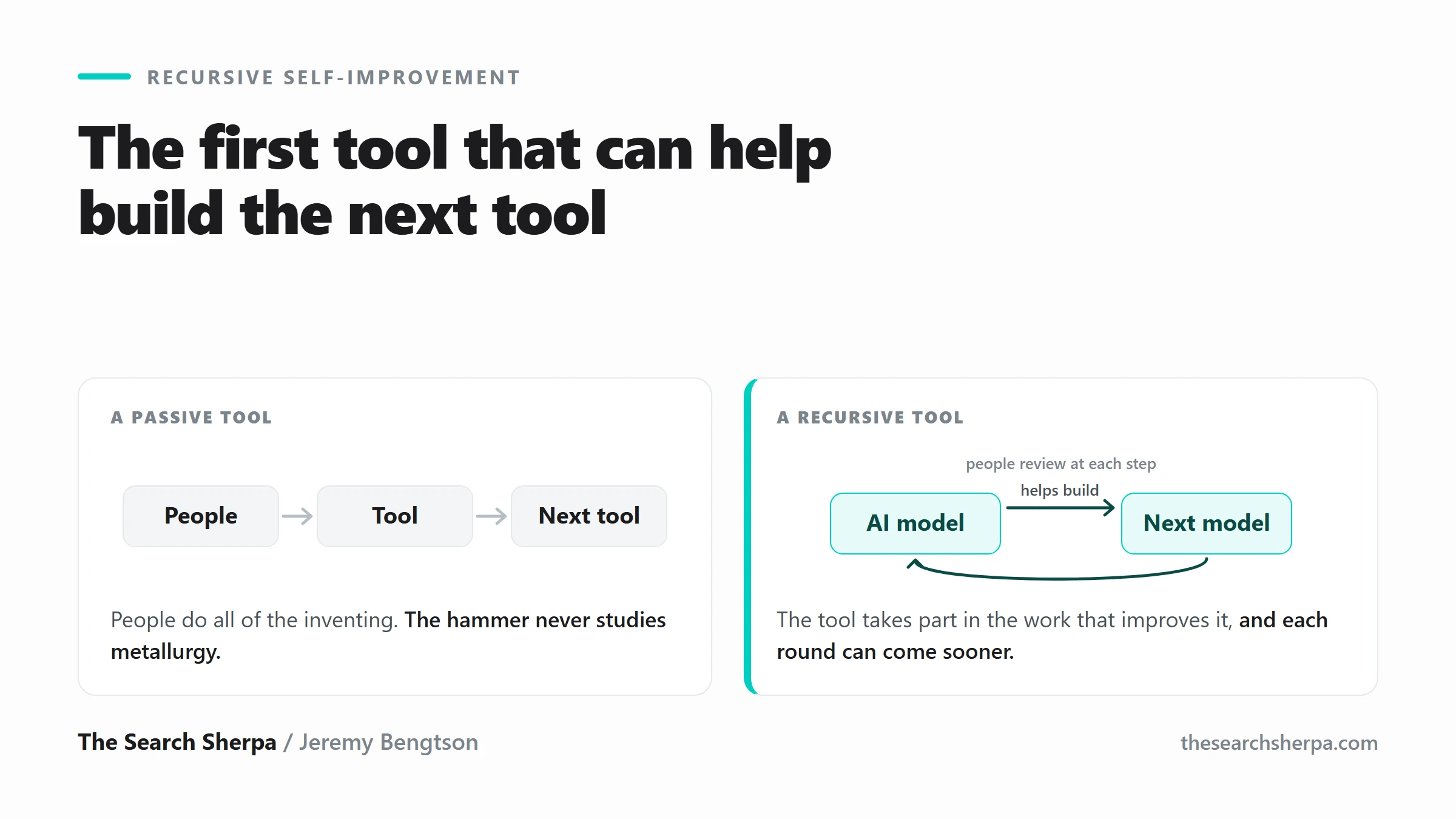
Recursive Self-Improvement: What Happens When AI Helps Build Better AI
Join Over 400,000 Entrepreneurs Getting Our Weekly Newsletter
Recent Posts
October 3, 2026
A 66-second short from Jeremy Bengtson on why AI is the first tool that can help build the next tool, and why forecasts
October 3, 2026
Recursive self-improvement is when AI helps build the next AI, so each round can come sooner. Here is where the idea came from,
October 2, 2026
Write honest local title tags and meta descriptions yourself, with Google’s own rules, fictional examples, and a free Claude skill. Or ask The