

By Jeremy Bengtson, founder of The Search Sherpa.
Dentistry is one of the most competitive local searches in healthcare, and the practice owners who call me ask two questions first. What does dental SEO cost, and will it bring in patients who actually show up. Both are fair questions, and most dental marketing companies answer neither one straight. This guide does.
I am going to give you honest price ranges for dental SEO in 2026, show the 90-day scope behind a number, and spend real time on what decides whether it is worth it: what a new patient is worth to your practice, and what you pay to get one. A dental patient is not a one-time job, which changes the math most pricing guides skip. No hype and no promises I cannot keep.
If you are still weighing whether this is the right investment at all, start with what the work actually involves on our dental SEO services page. This guide assumes you are past that question and want real numbers.
What does dental SEO cost in 2026?
For most single-location dental practices, dental SEO costs between about 1,000 and 3,000 dollars a month, with smaller markets on the lower end and dense metros on the higher end. Multi-location groups run higher, because every office needs its own profile, pages, and local signals. There is no single flat rate, because the price depends on your market, your competition, and how much groundwork your site already has.
Dental SEO usually costs about 1,000 to 3,000 dollars a month for a single-location practice, and more for a multi-location group, or it can start as a one-time strategy roadmap in the low thousands. Dental sits in the competitive middle of local SEO pricing, because your real competition is every other practice within driving distance rather than the whole country.
That range is the same shape we publish for every industry we serve, and you can see how we price the work on our SEO pricing page. Our med spa SEO cost guide is the closest healthcare comparison, our contractor SEO cost guide covers the trades, our real estate SEO pricing guide covers agents and brokerages, and our AI search optimization cost guide covers the AI side of the same cluster.
If you would rather test the water first, we start most practices with a one-time Custom SEO Roadmap in the low thousands that audits your market and hands you the plan, credited toward a retainer if you continue. Be cautious of a company that hides pricing until a sales call, and equally cautious of a 199 dollar a month package that promises the top of Google, because the foundation that ranks a practice is not cheap to fake. We do not use long-term lock-in contracts, and you should expect that from anyone you hire.
What you are actually paying for at that price
A monthly number means nothing until you know what work sits underneath it. For a practice, almost all of it is local, and almost all of it aims at one moment: someone nearby needs a dentist, they search, and you are either an obvious option or you are not.
A dental SEO retainer pays for local search foundations: an optimized Google Business Profile, real pages for the procedures you want to book and the towns you draw from, technical and speed fixes, content that answers what patients ask, consistent listings across the directories Google reads, a steady review habit, and the tracking that shows whether it turned into a booked appointment.
The core of it is local. We optimize your Google Business Profile so you appear in the map pack when someone nearby searches for a dentist, and we build real pages for the procedures you want more of, implants, clear aligners, same-day crowns, emergency visits, instead of one thin page listing everything. We fix the technical and speed problems that hold a site back, publish content that answers what patients type, from implant cost to whether you take their insurance, and keep your name, address, and phone consistent everywhere Google looks. It is the same muscle behind our chiropractor SEO work.
More patients now start with an assistant, asking something like who is a good dentist near me that takes my insurance and can see me this week. Getting cited in those answers is the same foundation work aimed at a new kind of reader, which is why we build AI search optimization into the dental plan rather than billing it separately. Our local SEO page covers the fundamentals in plain English.
What a 90-day dental SEO plan includes
A fair way to judge a price is to look at the scope behind it. Here is the honest shape of a first 90 days for a dental practice. Your plan shifts based on what your site already has, but the bones are the same.
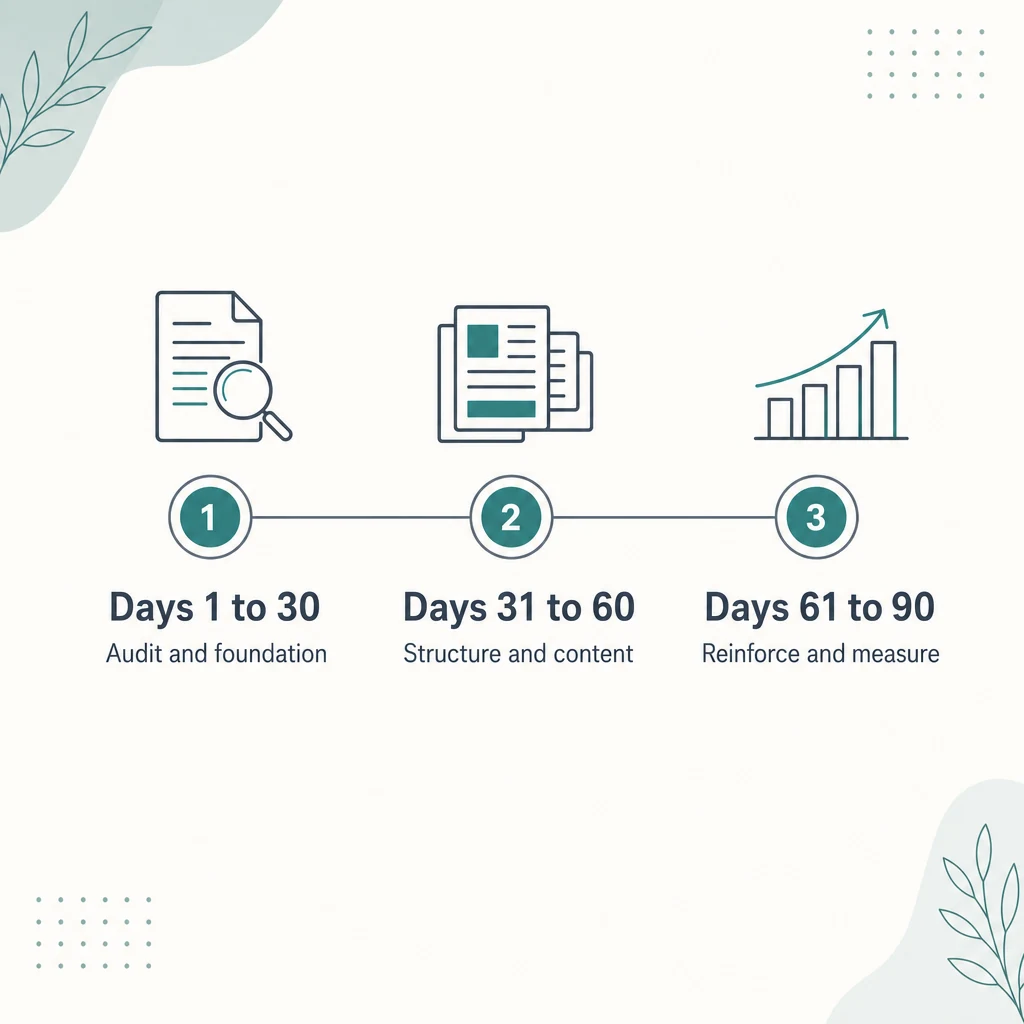
Days 1 to 30: audit and foundation
The first month is about seeing clearly and fixing what is broken. That means an audit of how you show up in Google and the map pack today, a technical and speed check, a review of your Google Business Profile down to categories, services, and booking link, a look at which practices win your towns, and a priority list of the searches that end in a booked appointment. We also set the baseline numbers, because you cannot show progress from a number nobody recorded.
Days 31 to 60: structure and content
The second month is where the fixes ship. We clean up your site structure so each important page has one clear headline and a direct answer, build or rewrite the procedure and town pages that carry your local visibility, add schema so search engines and AI assistants understand who you are and where you practice, tighten your listings across the directories that feed Google, and publish pages answering your highest-value questions about cost, insurance, and a first visit.
Days 61 to 90: reinforce and measure
The third month connects everything and checks the scoreboard. We reinforce your local signals, keep listings consistent, earn early links and reviews, and pull the first real report against the month-one baseline. Ninety days is usually enough to see early movement in map pack visibility and calls. Measurable movement generally lands in the three to six month window, and durable results compound over six to twelve.
The new patient economics of dental SEO
This is the section that decides everything, and it is where dental differs from the trades. A roofer wins one large job and moves on. A practice wins a patient who returns twice a year, brings a family, and eventually needs a crown or an implant. So the unit to judge is not a click or a lead. It is a new patient, and what that patient is worth across the years they stay.
Judge dental SEO on cost per new patient, not cost per click. Bought channels charge you again for every patient and rent you the relationship, while SEO builds rankings, a profile, and reviews you own, so the cost of each new patient tends to fall as the work compounds. Run it against your own average production per new patient, which your practice management software already reports.
What a new patient is worth to your practice
I will not quote you a national average, because it would be meaningless. Production per new patient swings enormously with your payer mix, whether your chairs are filled with hygiene or with restorative and implant cases, and how your case acceptance runs. Pull your own number instead. Most practice management systems report production per new patient over the first twelve months, and your front desk knows how many you saw last month. Those two numbers are the basis for judging any marketing spend, including mine.
What a new dental patient costs when you buy one
Now compare the ways you can buy a patient instead of earning one. What matters is not only price. It is who owns the relationship, and what happens the day you stop paying.
| Channel | What you buy | Exclusive or shared | If you stop paying |
|---|---|---|---|
| Dental lead and directory marketplaces | An inquiry, often sent elsewhere too | Shared with competing practices | It stops that day |
| Search ads (Google PPC) | A click, not an appointment | Exclusive to you | It stops that day |
| Discount and membership platforms | A booking with a fee attached | Shared platform relationship | You lose the channel |
| Dental SEO | Rankings, a profile, and reviews you own | Exclusive, an asset you own | The asset keeps working |
Every paid row has the same shape. You rent attention, you pay again next month, and the price tends to rise as more practices bid. The bottom row is the only one where the money buys something that stays with you. That does not make ads wrong. It makes them a different line item with a different job, which is why most practices run both for a while.
The number that actually matters: cost per booked new patient
A lead is not a patient, and in dentistry the gap between the two is usually the front desk. A call comes in, and it either gets answered, scheduled, and shows up, or it quietly does not. For illustration only, if a retainer is 2,000 dollars a month and produces ten new patients, your cost per new patient is 200 dollars, and if half those calls go to voicemail the real number doubles and no ranking fixes it. That is a made-up illustration, not an average. The version worth acting on is built from your own call log and production report, which is why we set tracking up in month one.
Where SEO changes the math
Buying patients is a cost that repeats forever and rises as more practices bid on the same zip codes. SEO is a fixed monthly investment that builds an asset you own, and as your rankings, profile, and reviews compound, the flow of new patients tends to grow while your effective cost per patient falls. A practice with high production per new patient can cover a retainer on a few accepted cases, while a hygiene-heavy practice needs steadier volume to reach the same place. That is an illustration of the math, not a promise of results, and your real numbers depend on your case acceptance, your fees, and your market.
Is dental SEO worth it for your practice?
For most established dental practices, yes, as long as it is priced honestly and measured properly. A patient you earn through search is exclusive to you, costs less over time, and stays attached to an asset that compounds instead of disappearing the month you stop paying. Practices with a solid recall system and a front desk that answers the phone get the most out of it, because search only delivers the call.
The honest caveat is timing. SEO is not an instant faucet. Most practices see measurable movement in about three to six months, and real momentum in a competitive dental market usually takes six to twelve. That is why many run search ads alongside SEO for immediate calls while the organic engine builds. Ads bridge the gap this month. SEO gets cheaper and stronger every year, so do both and shift toward organic as it matures.
How to judge a dental SEO proposal
Two or three quotes will rarely describe the same job. One is a monthly retainer, one is a build fee plus a retainer, one is a percentage. Put them on the same footing with three direct questions to every provider, including me. What does this cost and what is included. What is billed separately, whether that is content, ad spend, a new website, call tracking, or extra locations. And what specific numbers will you report each month. If a provider cannot answer those in plain language before you sign, the reporting will not get clearer later.
I also want to be plain about what I can and cannot promise. We do not promise rankings, lead counts, or a set number of new patients, because no honest provider can control how Google ranks you or how many patients call. What I can do is quote an honest range, ship a clear scope, and report the real numbers, calls, form fills, booking clicks, rankings, and profile actions, so you always know where your money went. Anyone who guarantees you first place or a flood of new dental patients should worry you.
Frequently asked questions
How much does dental SEO cost?
For most single-location dental practices, dental SEO costs about 1,000 to 3,000 dollars a month, with smaller markets lower and dense metros higher, and multi-location groups higher still because every office needs its own profile, pages, and local signals. It can also start as a one-time strategy roadmap in the low thousands. There is no flat rate, because cost depends on your market, your competition, and the work already in place.
What makes one dental SEO quote higher than another?
Three things move the price most: how many practices compete for the same few miles of map, how much foundation your site already has, and how many locations and procedures you want to be found for. Ask what is included at the quoted price and what is billed separately, because content, call tracking, a new website, ad spend, and extra locations turn a low quote into a higher one.
Is dental SEO worth it for a dental practice?
For most established practices, yes. A new patient is not a one-time job, so the value of the patients you earn through search compounds across hygiene visits, restorative work, and family referrals, while your effective cost per patient falls as rankings and reviews build. The trade-off is time, and the honest way to judge it is cost per new patient measured against your own production per new patient.
How is dental SEO different from buying dental leads?
Bought leads and paid directory placements are usually shared with competing offices and stop the moment you stop paying. SEO builds an asset you own, your rankings, your Google Business Profile, and your reviews, and it produces patients who came looking for your practice specifically. The cost per patient tends to fall over time instead of rising, and the work keeps returning value after you slow your spend.
How long does dental SEO take to work?
Most practices see measurable movement in about three to six months, with early signs in map pack visibility and calls inside the first 90 days. Building real momentum in a competitive dental market usually takes six to twelve months. Anyone promising top rankings in 30 days is selling something they cannot control.
Does dental SEO include Google Business Profile and AI search?
Yes. For a dental practice, your Google Business Profile and the map pack are the heart of the plan rather than an add-on, because most nearby searches never leave that box. We also build in AI search readiness so your practice can be cited when someone asks an assistant like ChatGPT or Google AI Overviews for a dentist nearby.
If your practice is ready to become easier to find, easier to trust, and easier to choose across Google and AI search, we can build and measure the system behind it. Start with a conversation. We will look at your market and what comes next … no pressure and no contract. You can work with Jeremy or request a free website and SEO review any time. You can also call us at (217) 579-8791.
Ready to see how the pieces fit together before you talk pricing? The dental SEO services page walks through the local search, Google Business Profile, review and AI search work these numbers pay for.
Explore This Topic

SEO for Financial Services: What It Costs in 2026

SEO Consultant Cost (2026): Hourly, Project and Retainer Rates Explained

Google Business Profile Management Pricing (2026): What the Work Costs and What the Profile Is Worth

Reputation Management Pricing (2026): What Each Price Tier Buys, and What No Price Can Buy

Law Firm SEO Cost (2026): Pricing and the Math on a Signed Case
Join Over 400,000 Entrepreneurs Getting Our Weekly Newsletter
Recent Posts
September 22, 2026
SEO for financial services costs about $1,400 to $20,000 a month for a payments firm. See the work, the fee models, and a
September 21, 2026
SEO consultant cost in 2026: $75 to $200 an hour, $1,000 to $3,000 a month for a local business, plus how that compares
September 20, 2026
Google Business Profile management pricing in 2026: the profile is free, management runs about $330 to $890 a month, and here is the