
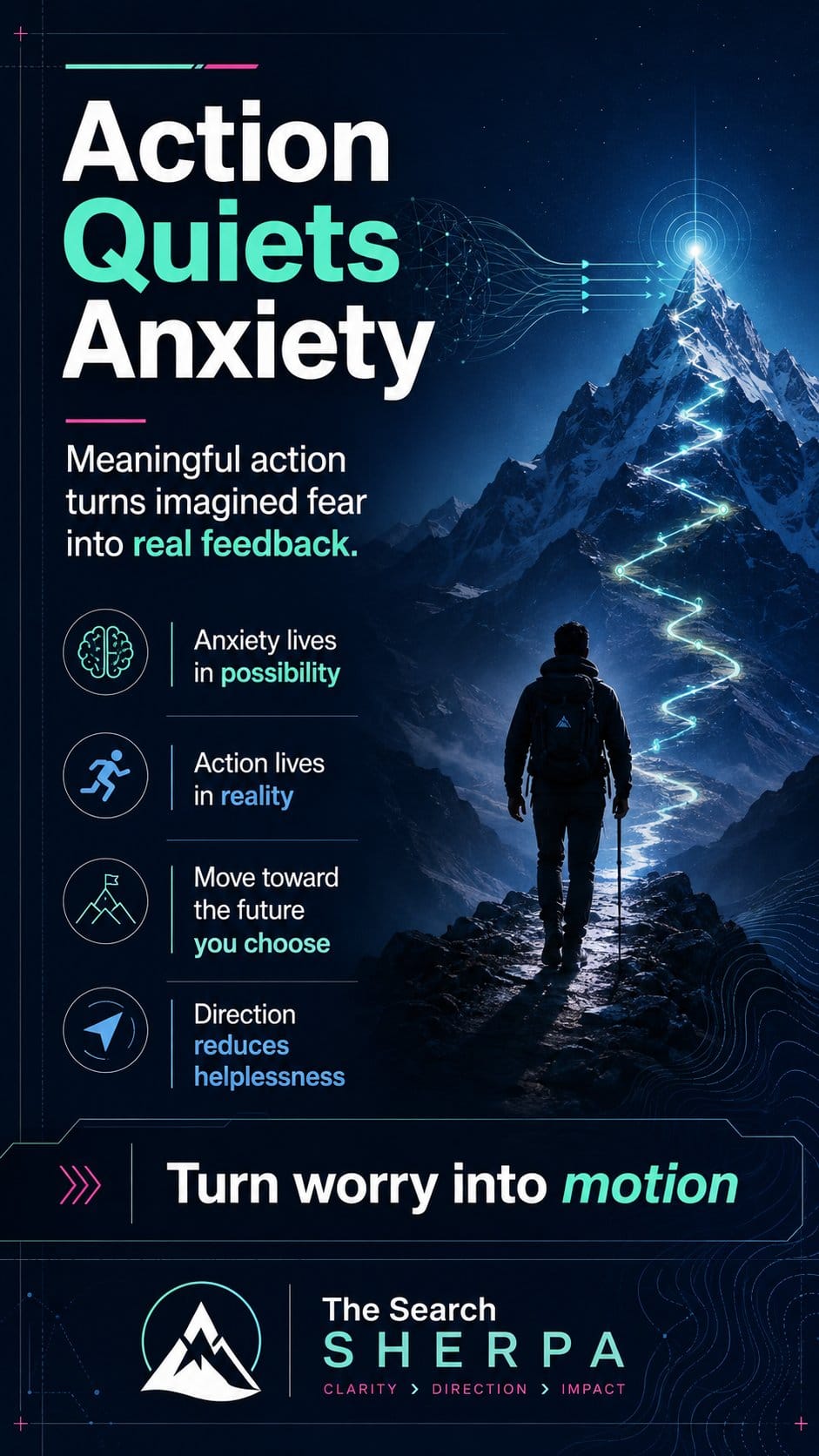
There exists a strange point in the development of a highly driven human being where success stops functioning as evidence that everything is going well.
Instead, success becomes evidence of everything else that should now be possible.
Achievement expands capacity.
Capacity expands expectation.
Expectation expands the definition of underperformance.
And the person climbing higher begins experiencing the peculiar sensation of feeling increasingly behind while objectively moving increasingly ahead.
This is the achievement anxiety paradox.
Knowledge Increases Resolution
The inexperienced mind worries because it cannot see far enough into the future.
The highly developed mind may worry because it can see too far.
Knowledge increases resolution.
Patterns become visible.
Dependencies become apparent.
Second-order consequences emerge.
Failure modes that would remain invisible to most people begin presenting themselves long before they happen.
Intelligence provides enormous power to anticipate reality, but anticipation has no natural stopping point.
There is always another variable.
Another scenario.
Another threat.
Another opportunity.
Another optimization.
Another path that could have been taken.
Another possible version of the future.
And perhaps most painfully, another possible version of yourself.
Achievement Becomes Evidence of Potential
This is why success rarely satisfies the person psychologically structured to pursue it.
Every achievement teaches them something about their capability.
And every discovery of capability creates a new obligation.
If I accomplished this, perhaps I can accomplish more.
If I learned this, what else should I know?
If I solved this problem, why am I not solving a larger one?
If I reached this level, what would happen if I applied twice the intelligence, twice the discipline, twice the technology, or twice the effort?
Achievement becomes evidence of potential.
Potential becomes expectation.
Expectation becomes pressure.
Pressure becomes anxiety.
The ladder builds itself while you climb it.
Yesterday’s Summit Becomes Today’s Baseline
This explains why there may never be a final level called success for certain people.
There is only the temporary conversion of an impossible goal into an ordinary baseline.
Yesterday’s summit becomes today’s elevation.
The extraordinary becomes expected.
The achievement that once would have caused celebration eventually becomes something whose absence would cause shame.
The psychology of progress gradually changes.
Early in life, you receive satisfaction from exceeding expectations.
Later, you receive little satisfaction from meeting your own expectations but experience enormous discomfort when failing to meet them.
Success loses emotional magnitude.
Failure retains it.
This creates an asymmetric psychological economy in which victories become increasingly cheap and failures increasingly expensive.
What the World Sees, and What You See
The outside world may see acceleration.
The individual feels insufficient velocity.
The outside world sees extraordinary accomplishment.
The individual sees unused capacity.
The outside world sees intelligence.
The individual sees everything they still do not understand.
The outside world sees discipline.
The individual remembers every hour wasted.
The outside world sees success.
The individual sees distance.
The Most Dangerous Competitor Is Imaginary
And the distance is no longer measured between themselves and other people.
The most dangerous competitor eventually becomes the theoretical version of oneself.
That opponent is immortal.
It never becomes tired.
It never becomes distracted.
It never wastes a day.
It makes perfect decisions using complete information.
It converts every hour into progress.
It learns infinitely.
It executes flawlessly.
It exists only in imagination, which means reality can never defeat it.
The more capable the real person becomes, the more powerful the imaginary person becomes alongside them.
The Cruel Mathematics of Potential
Potential therefore possesses an almost cruel mathematical property.
As you move toward it, it expands.
You develop discipline and immediately imagine what greater discipline could accomplish.
You acquire knowledge and become aware of vastly more knowledge.
You become efficient and begin noticing increasingly subtle inefficiencies.
You build something successful and suddenly perceive everything preventing it from becoming extraordinary.
The horizon does not approach.
Your ability to see farther improves.
When Action Becomes Medicine
This is where action as an antidote to anxiety develops its shadow.
Action initially gives anxiety somewhere useful to go.
Instead of imagining the future, you begin constructing it.
Instead of worrying about the problem, you solve it.
Instead of predicting outcomes, you create feedback.
This is healthy agency.
But the mind learns quickly.
Anxiety appears.
Action reduces it.
So action becomes medicine.
Eventually the person may no longer know whether they are working because the destination matters or because movement prevents uncomfortable thoughts from catching them.
Stillness begins feeling dangerous.
Rest resembles regression.
A quiet afternoon feels like lost potential.
Completion produces no peace because completion creates space, and space allows the mind to immediately discover the next inadequacy.
At this point productivity has ceased being merely a method of creating value.
It has become an emotional regulation system.
This creates one of the strangest conditions of high performance:
The individual can possess enormous evidence of competence while remaining psychologically terrified of inadequacy.
Success cannot cure this because success is being processed through the same mechanism generating the problem.
Every victory increases the standard.
Every improvement sharpens perception.
Every accomplishment expands the possible future.
Every demonstration of ability raises the minimum acceptable definition of the self.
More achievement cannot permanently resolve an anxiety produced by the requirement for more achievement.
Changing the Equation
The equation must eventually change.
There must come a point when the individual can say:
My capability determines what I can pursue.
It does not determine what I must prove.
Potential is an opportunity, not a debt.
Rest is not evidence of weakness.
Completion does not require immediate escalation.
The existence of a higher mountain does not invalidate the mountain already climbed.
And perhaps the greatest achievement available to the relentlessly achieving mind is eventually developing the ability to experience success without immediately converting it into another reason to feel inadequate.
The mature form of ambition is not the destruction of ambition.
It is learning to hold two truths simultaneously.
I can become more.
And I am not incomplete because I have not yet become it.
That may be the point where action stops being an escape from anxiety and becomes what it was always meant to be:
the deliberate expression of a life moving in a chosen direction.
Related reading
- Mind to Mind: deleting the steps between a thought and its understanding
- DNA as Columbus: human vessels, evolution, and consciousness
Frequently asked questions
What is the achievement anxiety paradox?
The achievement anxiety paradox is the pattern in which each success raises a person’s definition of enough, so accomplishment increases pressure instead of relieving it. The more a high performer achieves, the further ahead they feel they should be, which is how someone can feel increasingly behind while objectively moving increasingly ahead.
Why does success stop feeling satisfying for high achievers?
Because every achievement becomes evidence of greater potential, and potential becomes a new expectation. Victories start to feel cheap while failures stay expensive, so meeting your own standard brings little relief and missing it brings real discomfort.
Is action a cure for anxiety or a way to avoid it?
Action begins as healthy agency: instead of imagining a problem you solve it. But it can harden into an emotional regulation system, where stillness feels dangerous and rest feels like regression. The goal is action as a chosen direction, not as an escape from uncomfortable thoughts.
How do you break the cycle of achievement anxiety?
By changing the equation rather than adding more achievement. Capability can define what you are able to pursue without defining what you must prove. Potential becomes an opportunity rather than a debt, and you learn to hold two truths at once: you can become more, and you are not incomplete for not having become it yet.
Explore This Topic

SEO for Moving Companies (2026): How Movers Get Found in Local Search

How to Remove a Google Review (2026): What Google Will and Won’t Take Down

Local SEO for Home Services Companies Joliet IL

Watch: AI Is the First Tool That Can Help Build the Next Tool
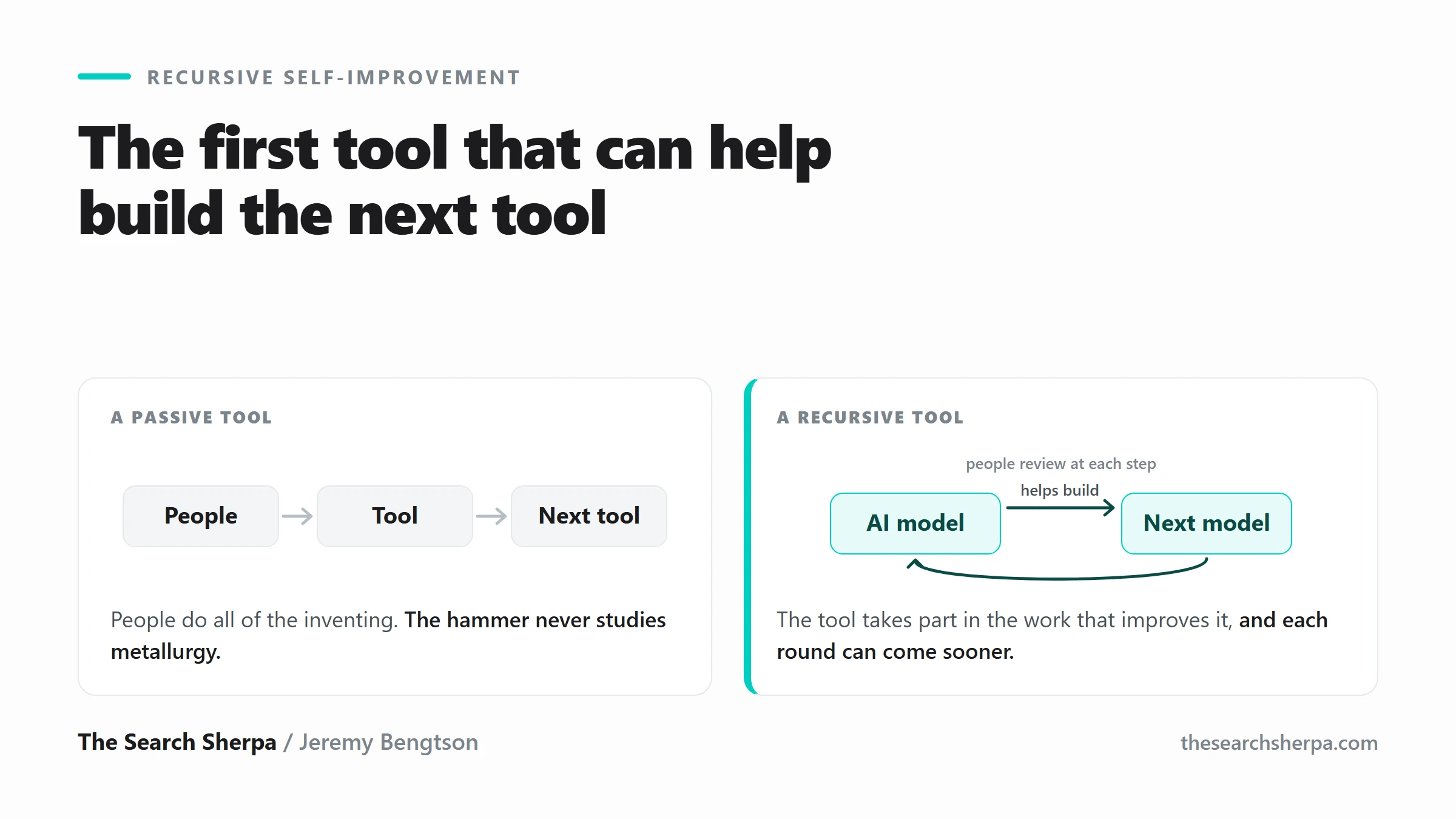
Recursive Self-Improvement: What Happens When AI Helps Build Better AI
Join Over 400,000 Entrepreneurs Getting Our Weekly Newsletter
Recent Posts
October 3, 2026
A 66-second short from Jeremy Bengtson on why AI is the first tool that can help build the next tool, and why forecasts
October 3, 2026
Recursive self-improvement is when AI helps build the next AI, so each round can come sooner. Here is where the idea came from,

July 9, 2026
A thought takes eight clumsy steps to become a message the other person understands. Here is why I am excited to delete all