
Your booking software has a list in it. Consultations that never turned into a treatment. Patients who came once for Botox and never rebooked.
You probably scroll past that list every week. Then you spend another month buying cold traffic on Google and Meta to find people who look exactly like it.
In a short video on the lead strategy he landed on, AI SEO creator Joshua Albanese makes the point plainly. His argument is that business owners are sitting on customer records they never look at. This guide applies that idea to a med spa, where the list is your patient records and the rules around it are stricter.
Table of Contents
What Your Patient Records Already Know
Your records are not only a treatment history. They are a record of what people near you were willing to pay for, and what they walked away from.
Three groups usually sit in that data. Each one is a different problem, and each one points at something different to publish.
- The consults who never booked. Something stopped them. Whatever they asked in that room is a question other people are typing into Google.
- The one and done patients. They bought once and left. Usually the next step was never made clear to them.
- The single service regulars. They already trust you. They simply do not know what else you offer.
That third group is the one owners underestimate. A patient who books filler every spring has already cleared the hardest hurdle, which is deciding to trust your clinic with their face.
The competitive pressure on that list is real. Medical spa locations in the United States grew from 8,899 in 2022 to 10,488 in 2023. That count comes from the American Med Spa Association’s 2024 Medical Spa State of the Industry Report.
The money followed. The Grand View Research Medical Spa Market report, on a 2023 base year, estimated the global medical spa market at $18.6 billion in 2023 and projects $49.4 billion by 2030.
Read that second figure carefully. It is global, and it covers medical spas specifically, so it describes market direction rather than your local opportunity. Anyone quoting it back to you as your addressable market is selling something.
What both numbers mean for you is simpler. In most markets, somebody newer is now competing for the same lapsed patients.
Handle the Privacy Part First
Patient records are protected health information. That changes what you may do with them, and it changes it before the marketing question is even on the table. Everything below is written as compliance-aware messaging, which is the only footing healthcare-ethical marketing can stand on.
The U.S. Department of Health and Human Services enforces this through its Office for Civil Rights. It describes sharing protected health information with a party that has no business associate agreement in place as an impermissible disclosure. Pasting a patient export into a consumer AI tool is that kind of sharing.
Two safeguards are recognized for this work. Neither one is a guarantee by itself, and they are meant to be used together.
- De-identification. The Safe Harbor method lists 18 identifiers that have to come out, names, phone numbers, email addresses, precise dates and photos among them. Free text is the hard part, because staff type names and identifying details into consultation notes.
- A business associate agreement. Any vendor that will touch identifiable data should have one signed and on file first.
Whichever system you run for records and scheduling, the same question applies. Software companies often market themselves as HIPAA compliant. HHS does not certify anyone as HIPAA compliant, so treat the phrase as a sales claim and ask for the signed agreement instead.
That is one half of the problem, the half where data leaves on purpose. The other half is data leaving by accident, through the tracking on your own site, which we cover under HIPAA aware tracking for med spas.
This is marketing guidance, not legal advice. Confirm any handling of patient data with the counsel or compliance advisor who supports your practice.
Reading the Data Without Guessing
Once the data is de-identified, the job is not to ask a chatbot for marketing ideas. The job is to count things.
Three columns carry almost all of the value. Pull those and leave the rest in the system where it belongs.
- Treatment category. What was actually purchased, grouped simply. Neurotoxin, filler, laser, body, skincare.
- How they first found you. Referral, walk in, ad, search, social. Imperfect data is still directional.
- Consultation notes. The free text your staff typed. This is the valuable column, because it holds the patient’s own words.
Patients do not ask about neuromodulators. They ask whether it will look obvious at work, how long the bruising lasts, and whether they can drive home afterward.
Count those phrasings and rank them. An objection that appears in 40 consultations is not an opinion any more. It is demand you can measure, and it is already specific to your city and your patient mix.
This is also where a tidy record system pays for itself. You want the notes, the bookings, and how they first found you lining up in one place. That is a reporting and CRM integration problem, and it is worth fixing before you build anything on top of it.
One warning about the counting. Do not let the loudest single complaint set your whole content plan.
One furious note about a bruise is memorable. The 40 quiet notes asking about downtime are the actual pattern, and they are the ones worth a page.
Turning What You Find Into Pages Patients Search For
A counted objection becomes a page. Not a blog post that mentions it in paragraph nine, but a page whose whole job is answering that one question.
Here is what that looks like in practice. Say 60 of your consultation notes mention some version of not wanting to look frozen or overdone.
That is not a blog post about Botox. That is a page built around looking natural. It answers the worry in its first two sentences, shows your own work, and names the injector who does the assessment. If that work includes patient photographs, marketing use of them needs the written authorization of the patient first.
The patient who eventually reads that page was never on your email list. They found it because they typed the same worry your existing patients said out loud in your consultation room.
That is the part worth sitting with. The list did not give you customers. It gave you the words that help the right people find you.
Reviews do a lot of the trust work on a page like that. That is why reputation management sits alongside the content rather than after it.
There is a myth worth clearing up before you write anything. You will read that an answer must run 40 to 60 words to win a featured snippet.
Google’s own documentation says there is no exact length requirement, and that you cannot mark a page as a snippet candidate at all. So write the clearest answer to the question, put it near the top of the page, and let the length follow the question.
The same caution applies to AI assistants. Google states that no special markup is required to appear in its AI features. ChatGPT and Perplexity publish no such lever either, so nobody can promise you a citation in an AI answer by adding schema.
What actually helps is ordinary. One page that answers one question well, business details that match everywhere they appear, and reviews that support what the page claims. That is the same connected visibility system, the one designed to make you easier to find, easier to understand, easier to choose.
Two of our pages go deeper than this one can. Our med spa SEO guide covers how the pages fit together. What ChatGPT cites when a patient asks for a med spa covers what answer engines actually pull from.
What This Does Not Do
This is not a revenue switch. We do not promise rankings, lead counts, or map placements, because no honest provider can.
It also will not rescue a thin website. Your records tell you what to write. They do not do the writing, and they do not make the page rank on their own.
You will also see acquisition cost and lifetime value figures quoted around this topic. Most of them trace back to a marketing agency’s own client list rather than to industry research, so we do not repeat them. Your own numbers are better data than an average built from someone else’s clients.
If you want the honest comparison between paying for traffic and earning it, we wrote that up separately in med spa PPC versus SEO. Both have a place. They just do different jobs.
How Long Before Any of This Shows Up?
The analysis is fast. You can group a few thousand records in an afternoon and know your top five objections by the end of it.
The visibility is slower. Most local SEO shows measurable movement in about three to six months, depending on competition and the condition of your site.
That gap is the whole reason to start with the data. You are not guessing which pages to build and then waiting three months to learn you guessed wrong.

Where to Start This Week
None of this needs a new platform or a signed contract to begin. It needs one afternoon and the export button you already have.
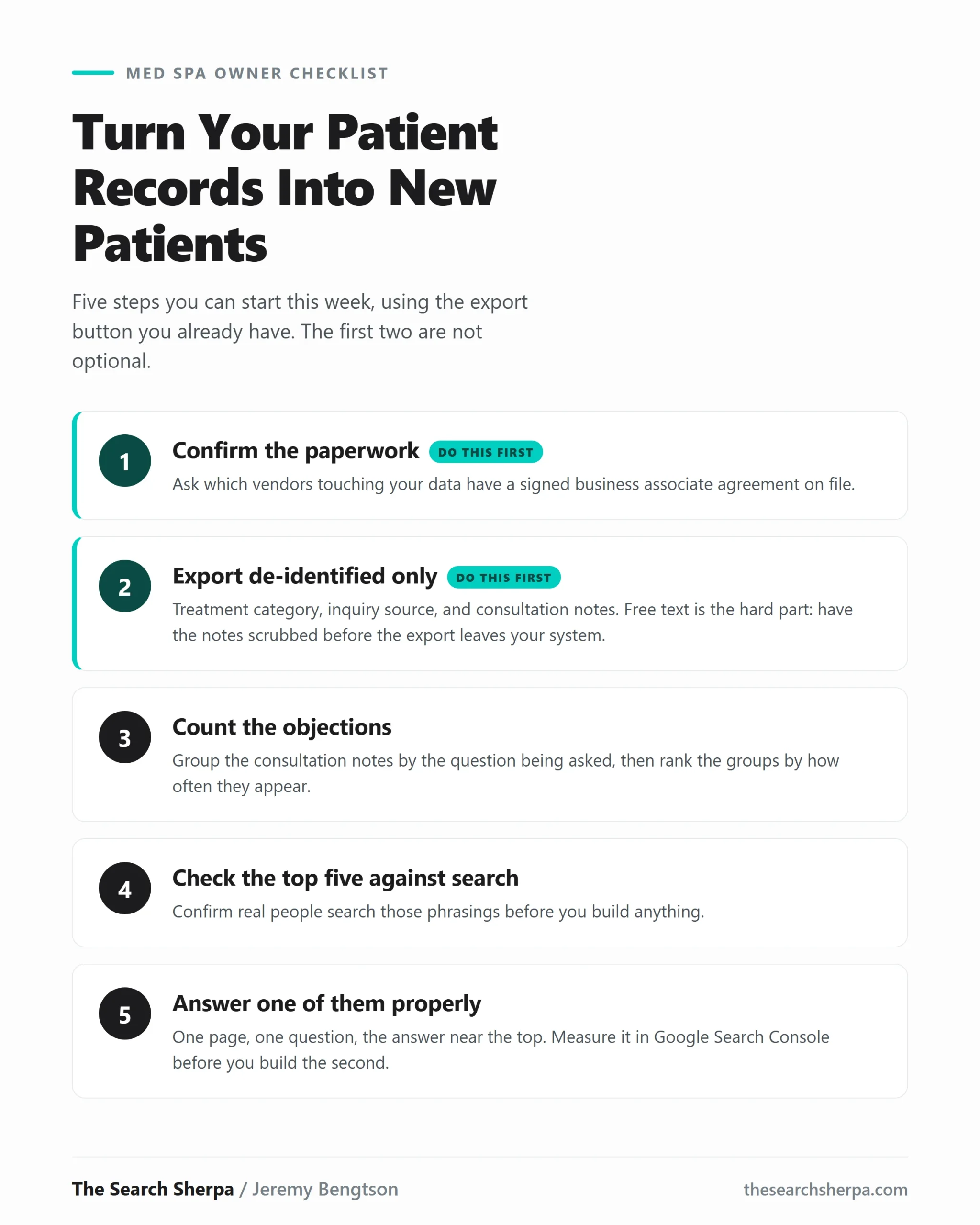
Work through these in order. The first two are not optional, because everything after them depends on the data leaving your system safely.
- Confirm the paperwork. Ask which vendors touching your data have a signed business associate agreement on file.
- Export de-identified only. Treatment category, inquiry source, and consultation notes. Have the notes scrubbed, or have your compliance advisor confirm the method, before the export leaves your system.
- Count the objections. Group the consultation notes by the question being asked, then rank the groups by how often they appear.
- Check the top five against search. Confirm real people search those phrasings before you build anything.
- Answer one of them properly. One page, one question, the answer near the top. Then measure it in Google Search Console before you build the second.
That fifth step is the one people skip. Building five pages before measuring one is how a content plan turns into a folder nobody opens again.
About The Search Sherpa
The Search Sherpa is led by Jeremy Bengtson, founder and the person you actually work with. Jeremy is based in Mokena, Illinois, holds a business degree from Western Illinois University, and is Semrush certified. The Search Sherpa LLC has served local businesses since 2024, including med spas, law firms, real estate professionals, home service contractors, and other professional services across Will County and the southwest Chicago suburbs.
We build one visibility system per client, so that your practice reads the same way to search engines, AI tools, and customers. We work the way healthcare-ethical marketing requires, with compliance-aware messaging first and visibility second. No black-hat tactics. No guaranteed rankings. Clients stay because the work earns it.
Frequently Asked Questions
These are the questions med spa owners ask first when this comes up. If yours is not here, ask it directly and we will answer it plainly.
Is it legal to use patient data for marketing?
Yes, within limits, and the limits are the whole answer. Aggregate patterns drawn from de-identified data are a different thing from a list of named patients handed to a vendor. The Office for Civil Rights treats sharing protected health information with a party that has no business associate agreement as an impermissible disclosure. Confirm your specific plan with the compliance advisor who supports your practice before any export happens.
Do I need an expensive AI tool to do this?
No. The analysis here is counting and grouping, which a spreadsheet handles for most single location practices. AI helps when the free-text consultation notes are long and messy, because reading several thousand of them by hand is the part people abandon. The tool matters far less than whether the data was de-identified before it got there.
How is this different from sending a reactivation email blast?
An email blast asks the same old list to buy again, and it stops working when the list is tired. This uses the same records to decide what to publish, so the pages can keep helping the right people find you and reach out, including people who were never on your list. Both can run at once. Only one of them builds on itself over time.
What does this cost?
Cost depends on your site, your competition, and your goals, and we break the drivers down on our med spa AI search optimization cost page. The analysis itself is something an owner can start alone, with a spreadsheet and an afternoon. We would rather you did that first than paid anyone to tell you what your own records already say.
How many records do I need before this is worth doing?
Fewer than most owners expect. A few hundred consultation notes is usually enough for the same three or four worries to surface repeatedly, and repetition is the whole signal. If you have fewer than that, read them all yourself in one sitting and write down what people keep asking, because at that size a tool adds nothing.
Will this get my med spa cited by ChatGPT?
No, and nobody can promise otherwise. We answer that question in full on what ChatGPT cites when a patient asks for a med spa.
If you want a second pair of eyes on what your records are telling you, that is a conversation worth having. Talk to Jeremy about your practice, or call (217) 579-8791 … no pressure.
Explore This Topic

Join Over 400,000 Entrepreneurs Getting Our Weekly Newsletter
Recent Posts

October 12, 2026
A YouTube demo shows only part of a provider’s work. Learn what to verify about AI review, access, backups, testing, ownership, and support

October 12, 2026
Watch a 129-second AI Dialogue about coding permissions, approval fatigue, and the risk of giving an AI agent control you cannot evaluate.

October 3, 2026
A 66-second short from Jeremy Bengtson on why AI is the first tool that can help build the next tool, and why forecasts