
Recursive self-improvement is when an AI system helps improve the process that builds the next AI system. Each round of improvement can make the next round faster. The idea is decades old. What changed in 2026 is that the companies building AI started publishing numbers about it.
Some of those numbers show real progress. Some are a company describing itself. For most people who run a business, the useful question is narrower than the headlines: what actually changes, and what still holds up.
Jeremy Bengtson, founder of The Search Sherpa, makes the core argument in a one-minute short. Electricity, the car, the internet, and the spreadsheet all changed the world, but none of them helped design its own next version. Watch the short and read its full transcript. This guide goes further into the evidence on both sides.
Table of Contents
Recursive Self-Improvement, in Plain English
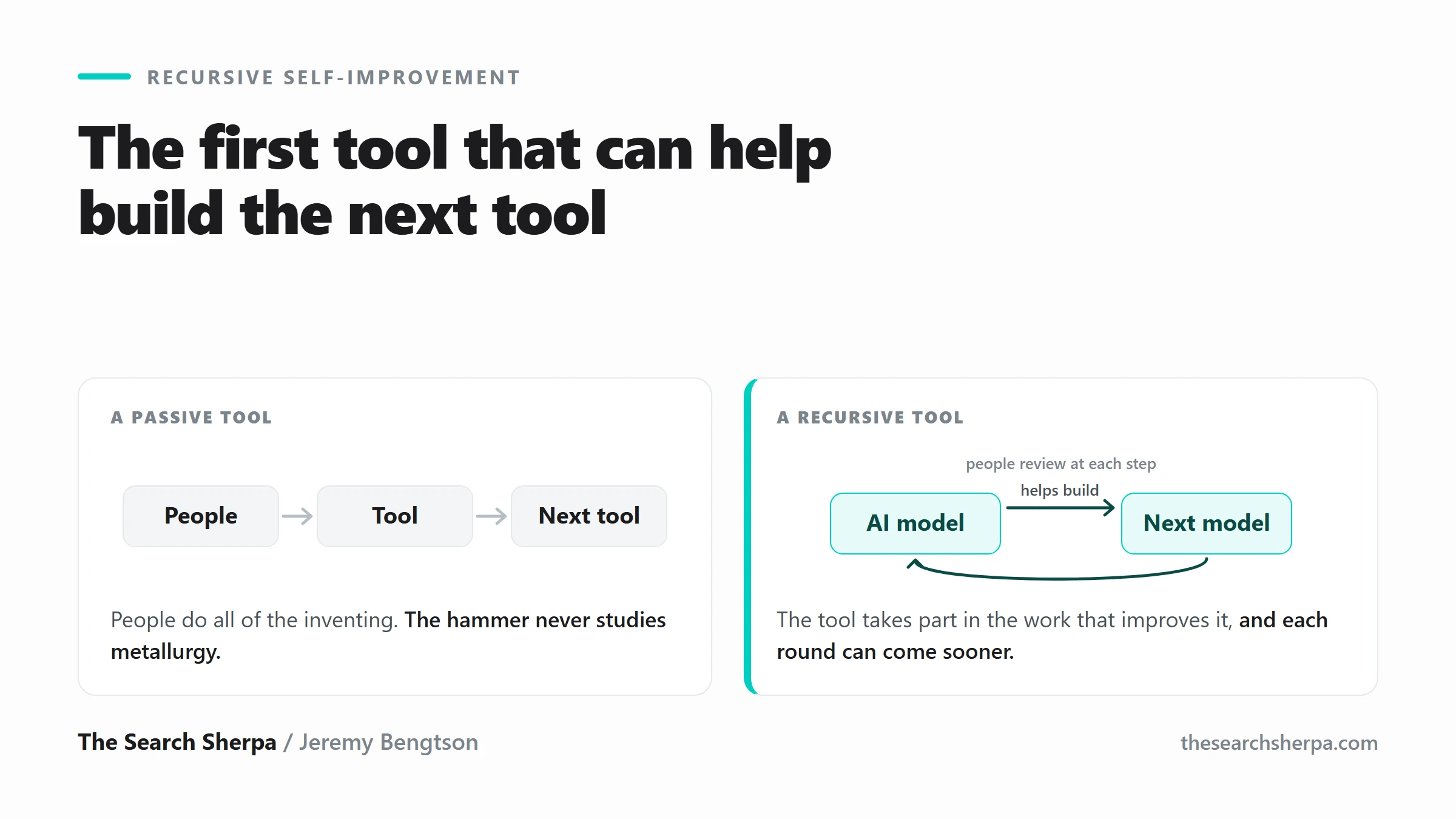
Most tools are passive. People study the tool, find a better design, and build the next version. The tool itself takes no part in that work.
Recursive self-improvement describes a tool that does take part. The loop has three steps, and each one feeds the next.
- An AI model helps with the research and engineering behind AI, such as writing code, running experiments, or checking results.
- The next model arrives sooner, or arrives better, because of that help.
- The better model helps more, and the loop turns again.
Recursive self-improvement is a feedback loop in which an AI system contributes to building its own successor, so each improvement can speed up the next one.
It is not one switch that flips. “Safest to say it’s a spectrum,” as IEEE Spectrum put it in a May 2026 explainer. The table below sorts that spectrum into four levels, because each headline is usually making a claim about only one of them.
| Level | What it looks like | What was reported in 2026 |
|---|---|---|
| AI as a tool | Code suggestions a person accepts or rejects | Routine across the industry |
| AI collaborates | AI writes most of the code; people set goals and review the work | Google says 75% of its new code is AI-generated and approved by engineers (April) |
| AI leads tasks | AI carries a task end to end from a short prompt, under supervision | Anthropic says Claude leads 26% of its AI research and development work (August) |
| AI trains its successor | A model trains its next version with no human doing the research | Not reported by any lab. Anthropic co-founder Jack Clark puts his own odds at about 60% by the end of 2028 |
Where the Idea Came From
The idea is older than the technology now testing it. In 1966 the English mathematician I. J. Good published a paper about what he called an ultraintelligent machine. It appeared in Advances in Computers.
His reasoning was short. Designing machines is intellectual work. A machine better than any person at intellectual work could therefore design even better machines. Good wrote that there would then “unquestionably be an ‘intelligence explosion,’” and that human intelligence would be left far behind.
He attached a condition that is often left out. The first such machine, he wrote, would be “the last invention that man need ever make, provided that the machine is docile enough to tell us how to keep it under control.”
In 2003 the computer scientist Jürgen Schmidhuber described a formal version called the Gödel machine. It is a problem solver that “rewrites any part of its own code as soon as it has found a proof that the rewrite is useful.” In a 2026 note he observed that the major AI labs are now all talking about the subject.
Software helping to build software is not new by itself. Programmers have long written compilers in the language the compiler translates. Once such a compiler can compile its own source code, it is called self-hosting. What is new is AI taking part in research decisions, not only in the mechanical steps.
Why the Electricity Comparison Breaks Down
When people try to predict what AI will do, they reach for the technologies we already lived through. Electricity, the automobile, the internet, and the spreadsheet. Economists have a name for that group.
Timothy Bresnahan and Manuel Trajtenberg called them general purpose technologies. They spread into many industries, they keep improving, and they set off new inventions around them. A 2023 paper by researchers at OpenAI and the University of Pennsylvania concluded that large language models “exhibit traits of general-purpose technologies.”
The history of those technologies is mostly a history of waiting. The economic historian Paul David found that factory electrification did not lift manufacturing productivity “before the early 1920s.” That was “four decades after the first central power station opened for business.”
Computers repeated the pattern. In 1987 the economist Robert Solow wrote, “You can see the computer age everywhere but in the productivity statistics.” Later work by Erik Brynjolfsson, Daniel Rock, and Chad Syverson described a productivity J-curve. Productivity dips while companies reorganize around a new technology, then rises later.
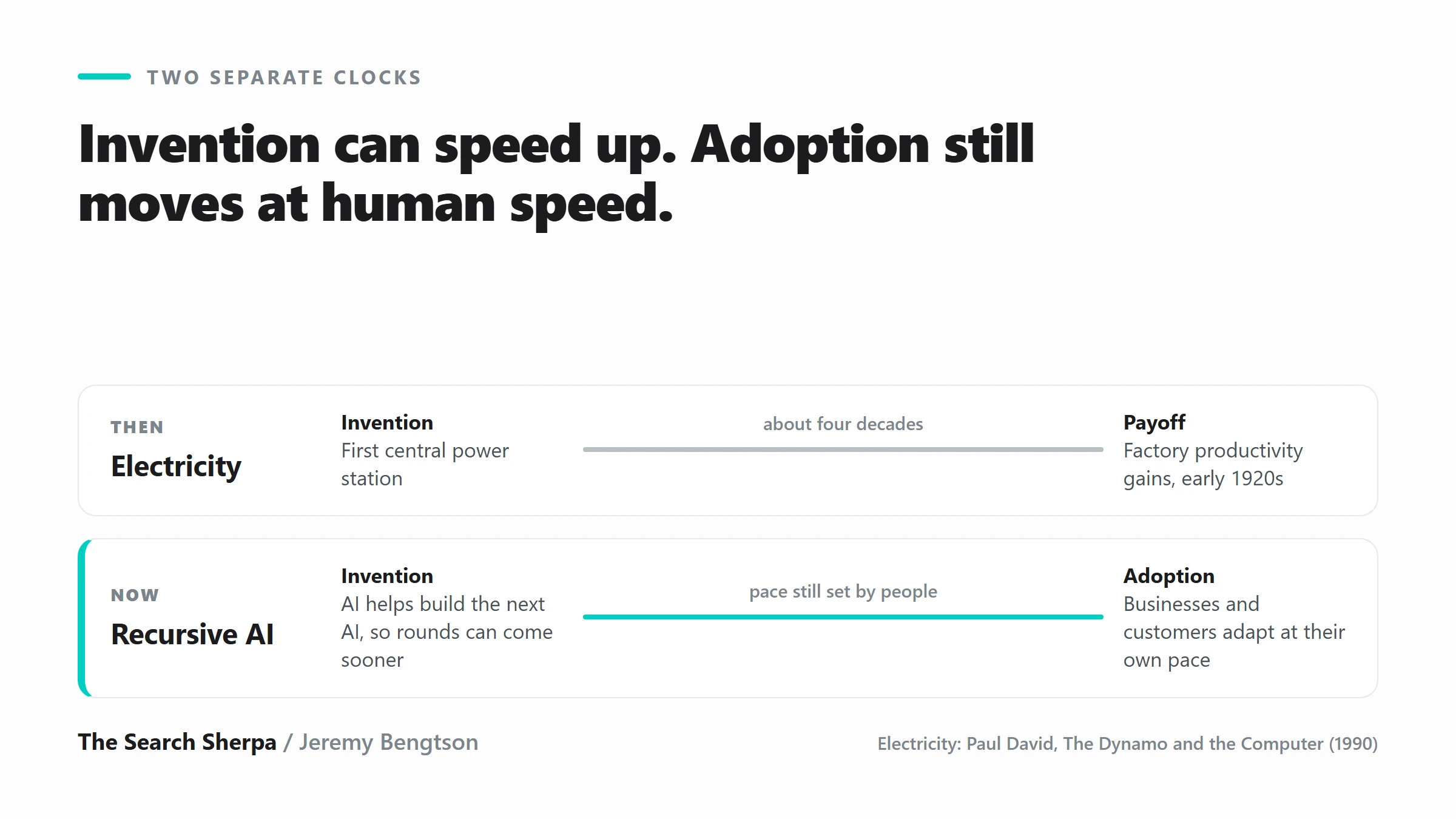
That history is the basis of the strongest counterargument. Arvind Narayanan and Sayash Kapoor call AI a normal technology, in the same sense as electricity and the internet. They argue that diffusion is limited by how fast people, organizations, and institutions can adapt. They expect a gradual increase in automation of AI development, not a single moment when recursive self-improvement arrives.
Both views can be right at once. Adoption can stay slow because people and businesses change slowly. Invention can still speed up, because the tool now helps with the inventing. Forecasts built on the dynamo and the spreadsheet assume people do all of the inventing.
That is the point of Jeremy’s short. The future does not have to become infinite for the old forecasts to fail. It only has to move faster than their assumptions.
Is Recursive Self-Improvement Happening Yet?
Partly. AI companies report that AI now does a large and growing share of the work of building AI. None reports a model that trains its next version on its own.
Most of the numbers below come from the companies themselves. They are worth knowing, but they are not independent measurements. Each row names its source and date, and marks which kind of evidence it is.
| Date | Source | What was reported | Type |
|---|---|---|---|
| May 2025 | Google DeepMind | AlphaEvolve sped up a kernel in Gemini’s architecture by 23%, cutting Gemini’s training time by 1% | Company report |
| Feb 2026 | OpenAI | Called GPT-5.3-Codex its first model that was instrumental in creating itself | Company report |
| Apr 2026 | 75% of all new code at Google is AI-generated and approved by engineers | Company report | |
| May 2026 | METR | Frontier Risk Report: companies did not report evidence of dramatic speed-ups in the overall pace of progress from automating AI research | Independent review |
| May 2026 | Anthropic | More than 80% of the code merged into its codebase was authored by Claude | Company report |
| Aug 2026 | Anthropic | Claude leads 26% of its AI research and development work; not fully autonomous on any measured part | Company report |
| Sep 2026 | OpenAI | Reached its goal of an automated research intern; research uses 3.1 agent-workdays for every human workday | Company report |
Read the caveats as closely as the headlines. Anthropic says its own figure of eight times more code merged per engineer is “almost certainly an overstatement of the true productivity gain.” It also writes that recursive self-improvement “is not inevitable.” OpenAI separates useful research automation from rapid recursive self-improvement, which it says is not necessarily an outcome to pursue.
The broader trend has an independent measurement. METR, a research group that measures what AI systems can do, found that the length of tasks frontier AI can complete doubled about every seven months from 2019 to 2025.
AI is also speeding up science outside AI. The 2024 Nobel Prize in Chemistry recognized Demis Hassabis and John Jumper for an AI model that predicts the structure of proteins. The Nobel committee called it the solution to a 50-year-old problem.
What the Skeptics Found
The case against a fast takeoff is just as specific. It comes from researchers who tested the claims rather than argued about them.
In a 2026 case study, 24 researchers, including Sayash Kapoor and Arvind Narayanan, gave AI agents two open-ended AI research projects. The agents “completed all of the engineering without human help, yet could not make substantial progress towards answering the research questions.” The authors rejected both papers.
Epoch AI, a research group that studies trends in AI, argues that automating AI research alone “likely won’t dramatically accelerate AI progress.” Its reason is that much of research has been automated already, without a dramatic acceleration. A separate Epoch analysis notes that computing requirements could prevent a software-only intelligence explosion.
The economist Daron Acemoglu estimated in 2024 that AI would add no more than 0.66 percent to total factor productivity over 10 years. He called the effects “nontrivial but modest.”
Even the optimists hedge. Jack Clark, a co-founder of Anthropic, called the 2026 evidence suggestive rather than conclusive. He said the biggest missing piece is whether AI can come up with “paradigm-shifting ideas.” Anthropic also names human code review as a new bottleneck.
The honest reading today is a faster loop with people still at the checkpoints. It is not a runaway loop.
What This Means for a Local Business Owner
Most of this happens inside a handful of AI labs. The part that reaches a local business moves more slowly, and that matters for how you plan.
Invention can speed up while daily habits change at human speed. Whitespark’s 2026 Local Search Ranking Factors survey found that discovery of local businesses “is still predominantly done through Google’s local results.” BrightLocal’s 2026 Local Consumer Review Survey found that 45 percent of consumers use ChatGPT and other AI tools for local recommendations.
BrightLocal also found that 88 percent of AI users check whether a review is legitimate or look for the source. So customers are adding AI to how they search. They have not stopped using Google’s local results, and they still check what AI tells them.
Google’s own guidance is plain. It says there are no additional requirements to appear in AI Overviews or AI Mode, and no special optimizations are necessary. In other words, the fundamentals still apply.

Five things hold up whether recursive self-improvement arrives in two years or in 20. The list draws on Whitespark’s 2026 factors and Google’s guidance, and each item helps in ordinary search as well as in AI answers.
- A dedicated page for each service. Whitespark’s 2026 survey ranks this first for local organic rankings and second for AI search visibility.
- The same facts about your business everywhere. Your name, address, phone, hours, and services should match across your website, your Google Business Profile, and directories. That consistency is the core of digital brand entity optimization.
- Mentions on respected local and industry sites. Expert best-of lists, industry sites, news articles, and association pages sit near the top of Whitespark’s AI visibility factors.
- Plain answers to real customer questions. Write them in the words your customers use, so search engines, AI tools, and customers all understand your business the same way. That is the job of answer engine optimization.
- A shorter planning cycle. Review your plan every quarter instead of every year, because the tools your customers use can change between annual reviews. A written SEO roadmap makes that review quick.
None of this is a bet on one future. It is the same visibility system we build for every client, designed to help your business show up clearly whether the next customer starts on Google Maps, in Google AI Overviews, or in ChatGPT.
If you are weighing the cost, our guides on whether AI search optimization is worth it for a small business and how to adjust your SEO budget for AI search walk through the trade-offs. Our AI search optimization work covers ChatGPT, Perplexity, Gemini, and Google AI Overviews.
We help your business stay understandable across Google, ChatGPT, Perplexity, and Google AI Overviews. AI helps us work faster. It does not guarantee AI visibility, and we will never tell you otherwise. We do not promise rankings, lead counts, or map placements, because no honest provider can. Most local SEO shows measurable movement in about three to six months, depending on competition and the condition of your site.
If you want your business to be easier to find, easier to understand, and easier to choose, start with a conversation. We will look at where you stand and what comes next … no pressure and no contract.
Schedule a Digital Visibility Consultation, or request a website and SEO review. You can also call (217) 579-8791.
About The Search Sherpa
The Search Sherpa is led by Jeremy Bengtson, founder and the person you actually work with. Jeremy is based in Mokena, Illinois, holds a business degree from Western Illinois University, and is Semrush certified. The Search Sherpa LLC has served local businesses since 2024, including med spas, law firms, real estate professionals, home service contractors, and other professional services across Will County and the southwest Chicago suburbs.
We use AI every day in our own work, and we explain what it can and cannot do in plain English. No black-hat tactics. No guaranteed rankings. No contracts. Clients stay because the work earns it.
Frequently Asked Questions
Does recursive self-improvement exist yet?
Partly. AI companies report that AI now writes most of their code and leads a growing share of their research tasks, with people still supervising. Anthropic said that as of August 2026, Claude leads 26 percent of its AI research and development work but is not fully autonomous on any measured part of it. No lab reports a model that trains its own successor without human researchers.
Who came up with the idea of an intelligence explosion?
The English mathematician I. J. Good, in a 1966 paper in the series Advances in Computers. He argued that a machine better than people at intellectual work could design even better machines. He added that the first such machine would be the last invention people need make, provided it could be kept under control.
Is recursive self-improvement the same as the singularity?
No. Recursive self-improvement is a mechanism: AI helping to build better AI. The technological singularity is one outcome some people think that mechanism could lead to, a point of runaway change. Other researchers, including Arvind Narayanan and Sayash Kapoor, expect a gradual increase in automation instead of a single moment.
Will AI improving itself change how customers find my business?
Over time it may, but not overnight. Whitespark’s 2026 survey found that local discovery still runs mainly through Google’s local results, while BrightLocal’s 2026 consumer survey found 45 percent of consumers use ChatGPT and other AI tools for local recommendations. The steady plan is to keep the basics strong and review your plan more often.
Do I need to do anything special to show up in Google AI Overviews?
No, according to Google. Its documentation says there are no additional requirements to appear in AI Overviews or AI Mode, and no special optimizations are necessary. Clear service pages, accurate business information, and helpful answers matter for ordinary results and AI features alike.
Can you guarantee my business shows up in ChatGPT or AI Overviews?
No, and you should be cautious of anyone who does. We help your business stay understandable across Google, ChatGPT, Perplexity, and Google AI Overviews, but AI answers come from systems no provider controls. We do not promise rankings, lead counts, or map placements, because no honest provider can.
Explore This Topic

Watch: AI Is the First Tool That Can Help Build the Next Tool
Recursive Self-Improvement: What Happens When AI Helps Build Better AI
Local SEO Title Tags and Meta Descriptions: How to Write Your Own (With a Free Claude Skill)
Local SEO Agencies Near Me: Southwest Chicago Suburbs
Med Spa Marketing Ideas: 12 for 2026, in Priority Order
Join Over 400,000 Entrepreneurs Getting Our Weekly Newsletter
Recent Posts
October 3, 2026
A 66-second short from Jeremy Bengtson on why AI is the first tool that can help build the next tool, and why forecasts
October 2, 2026
Write honest local title tags and meta descriptions yourself, with Google’s own rules, fictional examples, and a free Claude skill. Or ask The
September 28, 2026
Watch AI SEO creator Joshua Albanese explain why a local business should ask some happy customers for a Reddit post as well as