

By Jeremy Bengtson, founder of The Search Sherpa.
A woman in New Lenox sits at her kitchen table after the kids are in bed and types “divorce lawyer near me” into her phone. Local SEO for law firms is the work that shapes what she sees next: the map results, the firm websites below them, and the reviews she reads before she calls anyone.
She is far from alone. Across the US, “divorce lawyer near me” averages about 40,500 searches a month in Google Ads data we pulled through DataForSEO on October 8, 2026. This guide covers how local search works for a firm, which pages to build, the Illinois rules on what those pages say, and how to judge the work.
How local SEO works for a law firm
Local SEO for a law firm helps nearby people find the firm in Google’s map results and local listings. It covers the Google Business Profile, one page for each practice area, honest location pages, and reviews. Done well, it is ethical legal marketing: every claim stays inside the rules of professional conduct.
Google is plain about the limits: “There’s no way to request or pay for a better local ranking on Google.” It says “Local results are mainly based on relevance, distance, and popularity.” “Relevance is how well a Business Profile matches what someone is searching for.” “Distance refers to how far each business is from the customer who’s searching.” “Prominence means how well-known a business is,” and it rests in part on “how many websites link to your business and how many reviews you have.”
For a firm, that means naming the work you take in clients’ words, being clear about where your office is, and earning reviews and local links over time.
The Search Sherpa is a local SEO and digital visibility consultancy based in Mokena, Illinois, founded by Jeremy Bengtson in 2024. This guide is the law firm chapter of our local SEO service.
Google Business Profile rules for law firms
Start with the name. Google’s guidelines for representing your business say “Your name should reflect your business’s real-world name, as used consistently on your storefront, website, stationery, and as known to customers.” Adding service or location words, such as “Divorce Lawyer Joliet,” breaks that rule and can get the profile suspended.
A virtual office location “isn’t eligible for a Business Profile,” and “Businesses can’t list an office at a co-working space unless that office maintains clear signage, receives customers at the location during business hours, and is staffed during business hours by your business staff.” One location gets one profile: “Do not create more than one page for each location of your business, either in a single account or multiple accounts.” A firm with several offices can follow local SEO for each location.
Ownership matters too. Google’s page on profile owners and managers says “A Business Profile can have multiple owners but only one primary owner.” The firm should hold that role. In our own work, you own the domain, the hosting, the Google Business Profile and the analytics properties, and we operate through manager access. See choosing Google Business Profile categories and our Google Business Profile management service.
Profiles for individual attorneys
Google lists lawyers among individual practitioners, whose profiles “may include title or degree certification (for example Dr., MD, JD, Esq., CFA).” An attorney qualifies when “They operate in a public-facing role” and “They can be contacted directly at the verified location during stated hours.” And “Support staff should not create their own Business Profiles,” and “A practitioner shouldn’t have multiple Business Profiles to cover all of their specializations.”
Practice-area and location pages: build, combine or skip
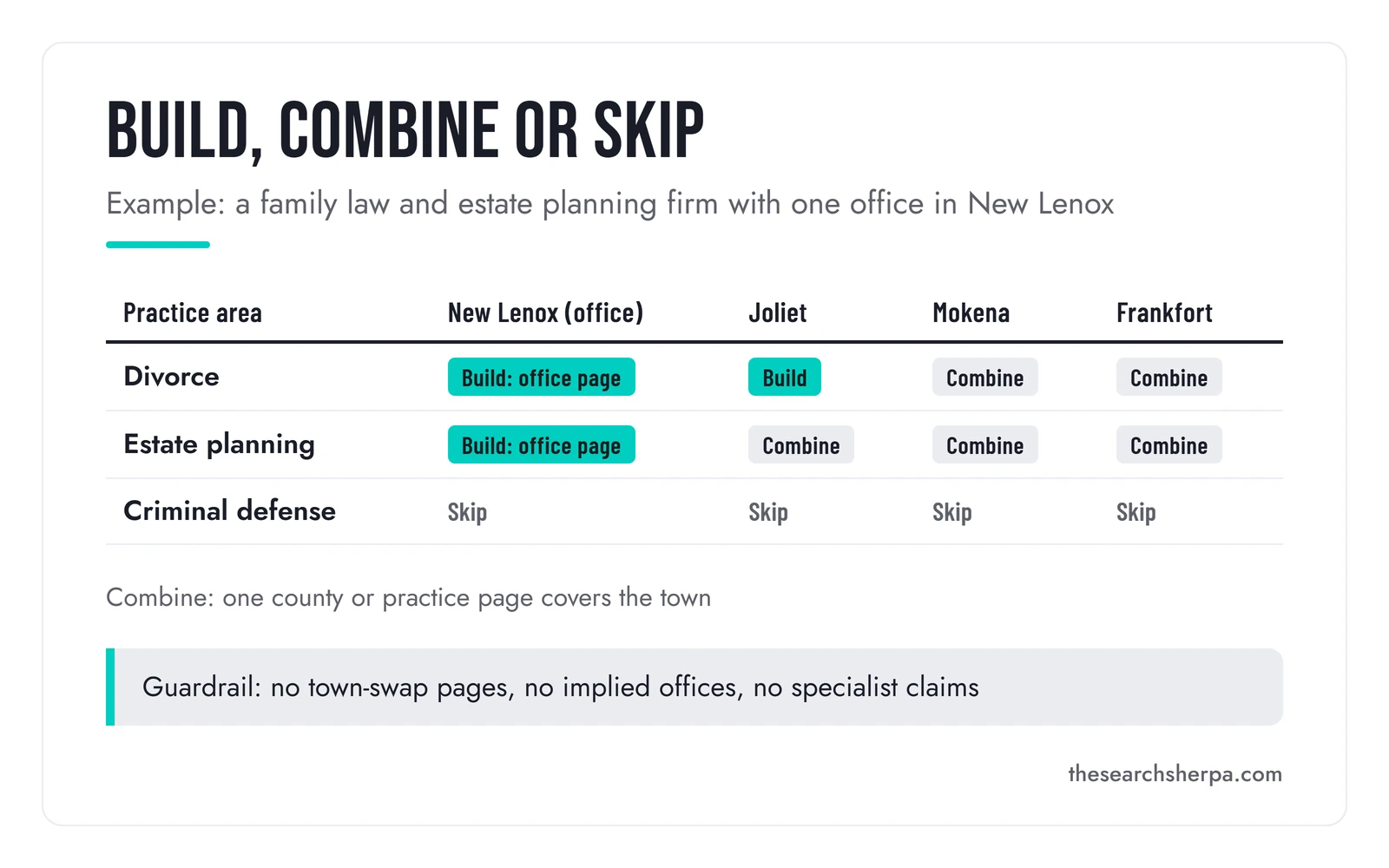
Build one main page for each practice area at the office, and a town page only when the town has real searches and something true and specific to say about it. Combine thin towns into one county or practice page. Skip any practice area the firm does not take, and never imply an office the firm does not have.
Here is a worked example, not a client: a family law and estate planning firm with one office in New Lenox. Illinois Rule 7.4(a) says “A lawyer may communicate the fact that the lawyer does or does not practice in particular fields of law,” so the rows are the fields the firm takes. The counts are 12-month averages from the same Google Ads pull.
| Search | Average monthly searches | Page decision |
|---|---|---|
| divorce attorney new lenox | 20 | Build the main divorce page at the New Lenox office |
| divorce lawyer new lenox | No data | Covered by the same office page |
| divorce lawyer joliet | 480 | Build a Joliet divorce page |
| divorce lawyer will county | 260 | Build one Will County divorce page |
| divorce lawyer mokena | 40 | Combine into the Will County page |
| divorce lawyer frankfort il | 20 | Combine into the Will County page |
| estate planning attorney new lenox | No data | Build the one estate planning page at the New Lenox office |
| estate planning attorney joliet, mokena or frankfort il | No data | Combine into the New Lenox estate planning page |
The New Lenox cells are the office pages. Each practice area the firm takes gets one main page at the office, carrying the office address, even where the town search returned no data. Joliet has the searches, and enough to say, for its own divorce page. Mokena and Frankfort draw a few searches each, which one Will County divorce page can serve. No estate planning town search returned data, so Joliet, Mokena and Frankfort fold into the one estate planning page built at the New Lenox office. Criminal defense gets no pages, because the firm does not take it.
The doorway page trap
The shortcut is a town-swap page, the same text with a new town name. Google’s spam policies for Google web search say “Doorway abuse is when sites or pages are created to rank for specific, similar search queries. They lead users to intermediate pages that aren’t as useful as the final destination.” Its examples include “Having multiple domain names or pages targeted at specific regions or cities that funnel users to one page.” The same policies say “Scaled content abuse is when many pages are generated for the primary purpose of manipulating search rankings and not helping users.” The matrix combines thin towns for that reason: a town-swap page is the doorway pattern just quoted.
What earns a location page
A town page earns its place when it tells a reader something a page about another town would not. A Joliet page can start with the courthouse, which the circuit court lists as the Will County Courthouse at 100 West Jefferson Street in Joliet, then cover which attorney handles matters there and the questions local people ask. It should also say where your office is. Rule 7.2(a) says “Any communication made pursuant to this paragraph shall include the name and office address of at least one lawyer or law firm responsible for its content.” Never word a page or a profile so it suggests an office you do not have.
Ethics guardrails for law firm marketing in Illinois
Ethical legal marketing means every page, profile and review request is checked against the Illinois Rules of Professional Conduct before it goes live. Four rules touch local SEO most: Rule 7.1 on misleading communications, Rule 7.2 on advertising, Rule 7.4 on specialist claims and Rule 1.6 on confidentiality.
This is marketing guidance, not legal advice. The Illinois Rules of Professional Conduct and your firm’s own ethics counsel govern what your firm may say. The Attorney Registration and Disciplinary Commission “operates under the authority of the Illinois Supreme Court, which has sole authority to regulate the admission and discipline of lawyers in Illinois.” Its free Ethics Inquiry Program gives guidance by phone but says “We cannot give either legal advice or a binding advisory opinion.”
The base rule is Rule 7.1 on communications about a lawyer’s services: “A lawyer shall not make a false or misleading communication about the lawyer or the lawyer’s services.” Its first comment says “This Rule governs all communications about a lawyer’s services, including advertising permitted by Rule 7.2.” So we write and structure the pages; you or your ethics counsel clear the claims before anything goes live.
Specialist, expert and certified
SEO copy reaches for “expert” and “specialist.” Paragraph (c) of Rule 7.4 on fields of practice and specialization says “Except when identifying certificates, awards or recognitions issued to him or her by an agency or organization, a lawyer may not use the terms “certified,” “specialist,” “expert,” or any other, similar terms to describe his qualifications as a lawyer or his qualifications in any subspecialty of the law.” Even then, “the reference must be truthful and verifiable” and must carry the statement the rule requires, set out in the FAQ below. In titles, headings and profile descriptions, write the field itself, such as divorce lawyer or estate planning attorney.
Results, testimonials and expectations
Comment [3] to Rule 7.1 says “An advertisement that truthfully reports a lawyer’s achievements on behalf of clients or former clients may be misleading if presented so as to lead a reasonable person to form an unjustified expectation that the same results could be obtained for other clients in similar matters without reference to the specific factual and legal circumstances of each client’s case.” Treat results pages, testimonials and “best in the county” headlines as copy your ethics counsel clears first.
Reviews and new inquiries
Google says “More reviews and positive ratings can help your business’s local ranking.” Paragraph (b) of Rule 7.2 on advertising says “A lawyer shall not give anything of value to a person for recommending the lawyer’s services,” with listed exceptions. Comment [5] says “A communication contains a recommendation if it endorses or vouches for a lawyer’s credentials, abilities, competence, character, or other professional qualities.” Your ethics counsel decides how that applies to a review.
Google’s policy settles the marketing side. Its tips for getting more reviews call incentives for reviews “fake & misleading content” that “is strictly prohibited.” Its prohibited and restricted content policy says merchants may not “Discourage or prohibit negative reviews, or selectively solicit positive reviews from customers,” and it removes content “based on a conflict of interest,” including “current or former employment.” Staff do not review their own firm.
What works is a plain, consistent ask. We build a review habit into how your staff already close out a matter, and we never offer incentives or ask only happy customers. Google also says merchants should not “request that specific content be included.” See our review and reputation management.

Search only opens the door. A good provider also asks who answers new inquiries, how fast they hear back, and which ones came from search. No page fixes an unanswered phone.
Replying to reviews without breaking confidentiality
Google reminds owners that “Your replies are public and help you build good relationships with customers.” Before any lawyer replies, Rule 1.6 on confidentiality of information is worth reading in full. Paragraph (a) says “A lawyer shall not reveal information relating to the representation of a client unless the client gives informed consent, the disclosure is impliedly authorized in order to carry out the representation, or the disclosure is permitted by paragraph (b) or required by paragraph (c).”
Google’s own advice points the same way: “Never share a reviewer’s private information or engage in personal attacks.” For a law firm, keep replies short, and keep them general so the reply does not reveal a matter. Ask your ethics counsel before you answer a review that describes one. For a review that breaks Google’s rules, see how to remove a Google review.
How to choose and judge local SEO work for a law firm
These questions sort careful work from risky work. Chicago firms hiring outside help can also use the checklist in choosing a Chicago SEO consultant.
| Question to ask | A good answer | A red flag |
|---|---|---|
| Who owns the profile, the website and the analytics? | The firm, with the provider as a manager | The provider, in its own name |
| Who clears claims before a page goes live? | The firm or its ethics counsel, every time | “We know the bar rules, no need to check” |
| Which practice-area and town pages will you build? | A short list tied to real searches and your work | A page for every town, with the same text |
| How will you get reviews? | Ask every client the same way | Gifts, discounts, or asking only happy clients |
| What will you report each month? | Work done, visibility change and real inquiries | Rankings alone, on summary slides |
| What will you not promise? | Rankings, case counts and map placements | A set number of new cases |
Before you sign, every line of this checklist should be a yes.
- The firm is the primary owner of its profile, website and analytics.
- Each practice-area page matches work the firm actually takes.
- Each location page has something true and local to say, plus the real office address.
- No page uses “specialist,” “expert” or “certified” unless Rule 7.4(c) is met.
- Review requests go to every client the same way.
- Your ethics counsel has cleared every claim.
For the general version of this test, read what to look for in a local SEO company, and for reports, what your SEO agency should be showing you.
Red flags
Google’s page Do you need an SEO? says “Be careful if a company is secretive or won’t clearly explain what they intend to do,” and “Ultimately, you are responsible for the actions of any companies you hire.” For a law firm, add town-swap pages, “expert” headlines, gifts for reviews, staff reviews, a provider that owns your profile, and any promise of a set number of cases. As our law firm cost guide puts it, your firm, not your marketing provider, is responsible for compliance wherever it advertises.
What local SEO for a law firm costs and how long it takes
Price has its own page: what law firm SEO costs and the math on a signed case. It says “Law firm SEO usually costs 2,000 to 10,000 dollars a month at the legal specialist agencies that publish their pricing, while a small local firm more often sits in the 1,000 to 3,000 dollars a month band that covers local businesses generally.”
Small local businesses generally invest $1,000 to $3,000 monthly for map pack visibility and local search. SEO packages priced below $500 per month cannot sustain the labor-intensive work required for legitimate organic growth. Every engagement begins with a $2,000 Custom SEO Roadmap, built over approximately four weeks. If you choose to work with us on the execution, the $2,000 is credited fully toward your first month of retainer services. We do not use long-term lock-in contracts. Cost depends on your site, your competition, and your goals. We will be clear about pricing before any work begins.
Most local SEO shows measurable movement in about three to six months, depending on competition and the condition of your site. We do not promise rankings, lead counts, or map placements, because no honest provider can. Paid ads, social media and email marketing are separate services we do not sell.
Frequently asked questions
What is the typical cost of SEO for a law firm?
Law firm SEO usually costs about $2,000 to $10,000 a month at the legal specialist agencies that publish their pricing, and a solo or two-attorney practice in one suburb usually belongs at the bottom of that range or under it. A small local firm more often sits in the $1,000 to $3,000 a month band. Cost depends on your site, your competition, and your goals.
Does SEO work for law firms?
It can, when the firm’s profile and pages match what nearby people search for and the firm earns reviews and links honestly. Most local SEO shows measurable movement in about three to six months, depending on competition and the condition of your site. No honest provider can promise a ranking or new cases.
How much does a local SEO cost?
Small local businesses generally invest $1,000 to $3,000 monthly for map pack visibility and local search. With us, every engagement begins with a $2,000 Custom SEO Roadmap. If you choose to work with us on the execution, the $2,000 is credited fully toward your first month of retainer services.
Should each attorney at a firm have a Google Business Profile?
Under Google’s individual practitioner rules, a public-facing attorney who can be contacted directly at the verified location during stated hours can have one, titled with the attorney’s name only. The firm keeps its own profile for the location. Support staff should not create their own Business Profiles, and no attorney should hold one profile per practice area.
Can a law firm give clients a gift for leaving a review?
Not under Google’s rules, which prohibit incentives such as free or discounted goods or services in exchange for reviews. Illinois Rule 7.2(b) also says “A lawyer shall not give anything of value to a person for recommending the lawyer’s services,” with exceptions the rule lists. Ask every client the same way, and let your ethics counsel answer how the rule applies.
Can a lawyer call themselves a specialist in Illinois?
Only within Rule 7.4(c), which bars “certified,” “specialist,” “expert” and similar terms as descriptions of a lawyer’s qualifications, except when identifying a certificate, award or recognition issued by an agency or organization. Even then, the reference must be truthful and verifiable, and must state that the Supreme Court of Illinois does not recognize certifications of specialties in the practice of law and that the certificate, award or recognition is not a requirement to practice law in Illinois.
Talk through your firm’s local search
If you want a plain read on your firm’s profile, pages and review habit, see our SEO pricing or book a call with Jeremy. You talk directly to the person doing the work and see the actual plan before any work begins. You can also call (217) 579-8791.
Explore This Topic

Hiring an SEO Consultant Chicago Businesses Can Trust

On-Page SEO Services: Improving the Pages You Already Have

Landscaping SEO for Landscapers: Two Kinds of Buyer, Two Kinds of Search

SEO Audit Services: A Prioritized Plan, Not a List of Problems

Multi-Location SEO: Local SEO for Businesses With Two or More Locations
Join Over 400,000 Entrepreneurs Getting Our Weekly Newsletter
Recent Posts
October 8, 2026
How to choose an SEO consultant in Chicago: consultant, agency, or freelancer, a decision tree, a vetting checklist, red flags, and rates in
October 8, 2026
On-page SEO services improve the pages you already have: titles, headings, copy, links, alt text, and schema. What is included, how it runs,
October 8, 2026
Landscaping SEO builds the pages and Google Business Profile work behind lawn care contracts and design-build projects. What it includes and costs.