
By Jeremy Bengtson, founder of The Search Sherpa.
When a furnace quits on a January night, the homeowner does not wait for a referral. They pick up a phone and search for furnace repair near them. HVAC SEO is the work that makes your heating and cooling company the one they find and call, in Google Search and Google Maps, in the towns your trucks actually serve.
It is not one task. It is a Google Business Profile set up the way Google’s rules ask, a page for each job you want more of, honest reviews, a site that loads quickly on a phone, and tracking that shows which calls came from search. This page covers what the work includes, who it fits, how it runs through the seasons, and how to start.
What is HVAC SEO?
HVAC SEO is the work that gets a heating and cooling company found in Google Search and Google Maps by homeowners who need a repair, a tune-up, or a new system in the towns it serves. It covers the Google Business Profile, a page for each service, reviews, technical fixes, seasonal content, and call tracking. The goal is more calls from the right towns, not a ranking report.
Google’s help page on how Google ranks local results says, “Local results are mainly based on relevance, distance, and popularity.” It is just as plain about shortcuts: “There’s no way to request or pay for a better local ranking on Google.”
Distance depends on where the searcher is standing, so you cannot change it. Relevance and prominence are what HVAC SEO works on. Google defines relevance as “how well a Business Profile matches what someone is searching for,” and prominence as “how well-known a business is,” adding that “More reviews and positive ratings can help your business’s local ranking.” It is the same work behind our local SEO services and our contractor SEO and marketing, applied to a trade. The aim is a company that is easier to find, easier to understand, and easier to choose, built as one visibility system.
Who HVAC SEO fits, and who it does not
HVAC SEO pays off when the company can take the calls it brings in. It tends to fit an HVAC company that:
- Serves homeowners in a defined set of towns and wants more repair, maintenance, and replacement calls from those towns.
- Has room on the schedule, or a plan to add a truck, when the calls increase.
- Answers the phone when it says it does, including after hours if it offers that service.
- Wants to own its website, content, and data rather than rent leads that are also sold to other companies.
- Can give organic search a few months to build while the work compounds.
It is not the right move yet when any of these is true:
- The schedule is already full through the season and nobody can take more calls.
- The business needs calls this week. SEO builds over months. Paid ads, including Local Services Ads, are a separate channel that can run sooner, and we do not sell or manage them.
- The budget is below $500 a month, which cannot sustain the work.
- The goal is a promised spot in the map. We do not promise rankings, lead counts, or map placements, because no honest provider can.
What is included in HVAC SEO
Every engagement is scoped to the market, but the parts are the same.
| Part of the work | What it covers for an HVAC company |
|---|---|
| Google Business Profile | The primary category, the services you offer, accurate hours, a service area that matches where your trucks go, real photos, and replies to reviews |
| Service pages | A page for each job you want more of, such as furnace repair, AC repair, heat pump service, system replacement, and maintenance plans |
| Service-area pages | A page for a town only where the demand justifies it, written for that town, never one page that lists every town |
| Technical and on-page work | Crawling and indexing, speed on a phone, titles and headings, internal links, and structured data using the schema.org HVACBusiness type |
| Reviews and citations | Asking for a review at the close of each job, replying to reviews, and the same name, address, and phone number everywhere Google checks |
| Seasonal content | Tune-up, maintenance, and replacement pages published before the season they serve |
| Tracking and reporting | Call tracking, form tracking, Search Console reporting, and the calls count in the Business Profile performance report |
| Not part of the work | Google Ads, Local Services Ads, and social media management. We do not sell them; tracking keeps those calls separate if you run them |
Start with the service and town pages. As our contractor hub puts it, “A single page that lists nine towns does not rank in nine towns.” Google’s spam policies name “Blocks of text that list cities and regions that a web page is trying to rank for” as keyword stuffing, and treat “pages targeted at specific regions or cities that funnel users to one page” as doorway abuse. A town page earns its place with real content, or it does not get built.
Reviews need the same care. Google’s tips for getting more reviews say reviews “must reflect a genuine experience,” and that offering incentives for them “is considered fake & misleading content and is strictly prohibited.” The Federal Trade Commission’s final rule banning fake reviews prohibits “providing compensation or other incentives conditioned on the writing of consumer reviews expressing a particular sentiment, either positive or negative.” Our review and reputation management work builds the request into the close of each job instead.
Google Business Profile, calls, and service area

Google’s line is short: “Businesses with complete and accurate info are more likely to show up in local search results.” Our page on Google Business Profile optimization for contractors covers the full setup; here is what matters most for HVAC.
Categories, services, and seasonal hours
Google’s guidelines for representing your business ask you to “Use as few categories as possible to describe your overall core business,” and to choose categories that complete the statement “This business IS a” rather than “this business HAS a.” Stuffing a service and a town into the name is a shortcut that risks the profile: “Including unnecessary information in your business name isn’t permitted, and could result in the suspension of your Business Profile.”
The guidelines say “If applicable, you may use your current seasonal hours as your regular hours,” allow special hours for holidays, and add, “To highlight times for specific services, you can also set More hours.” If you take emergency calls after the office closes, the profile should show when a customer can reach a person. SEO for electrical contractors covers how electricians should state an after-hours policy.
Service area for a company without a storefront
Google defines a service-area business as “A business that visits or delivers to customers directly but doesn’t serve customers at their business address.” Its page on managing service areas sets out the rules:
- “If you don’t serve customers at your business address, remove your address from your Business Profile.”
- “Service-area businesses can only have one profile for the whole area that they serve.”
- You can list as many as 20 service areas by city, postal code, or other area, but “You can’t set your service area as a radius distance around your business.”
- “The boundaries of your overall area shouldn’t be more than about 2 hours of driving time from where your business is based.”
Be accurate rather than ambitious. Google asks you to “be as specific and accurate as possible,” and a service area that matches where your trucks really go also shows which towns deserve their own page.
Calls you can trace back to search
The guidelines say to “Use a local phone number instead of a central call center helpline number whenever possible.” Google’s Business Profile performance report counts “Calls: The number of times a customer clicked on the call button on your Business Profile,” but it also notes that “Performance data includes views, searches, and actions from both organic search results and Google Ads.” So we set up call tracking, form tracking, and Search Console reporting on your website, to show which calls came from the map, from an organic page, or from paid. That separation is the core of what your SEO agency should be showing you.
Planning HVAC SEO around the heating and cooling seasons
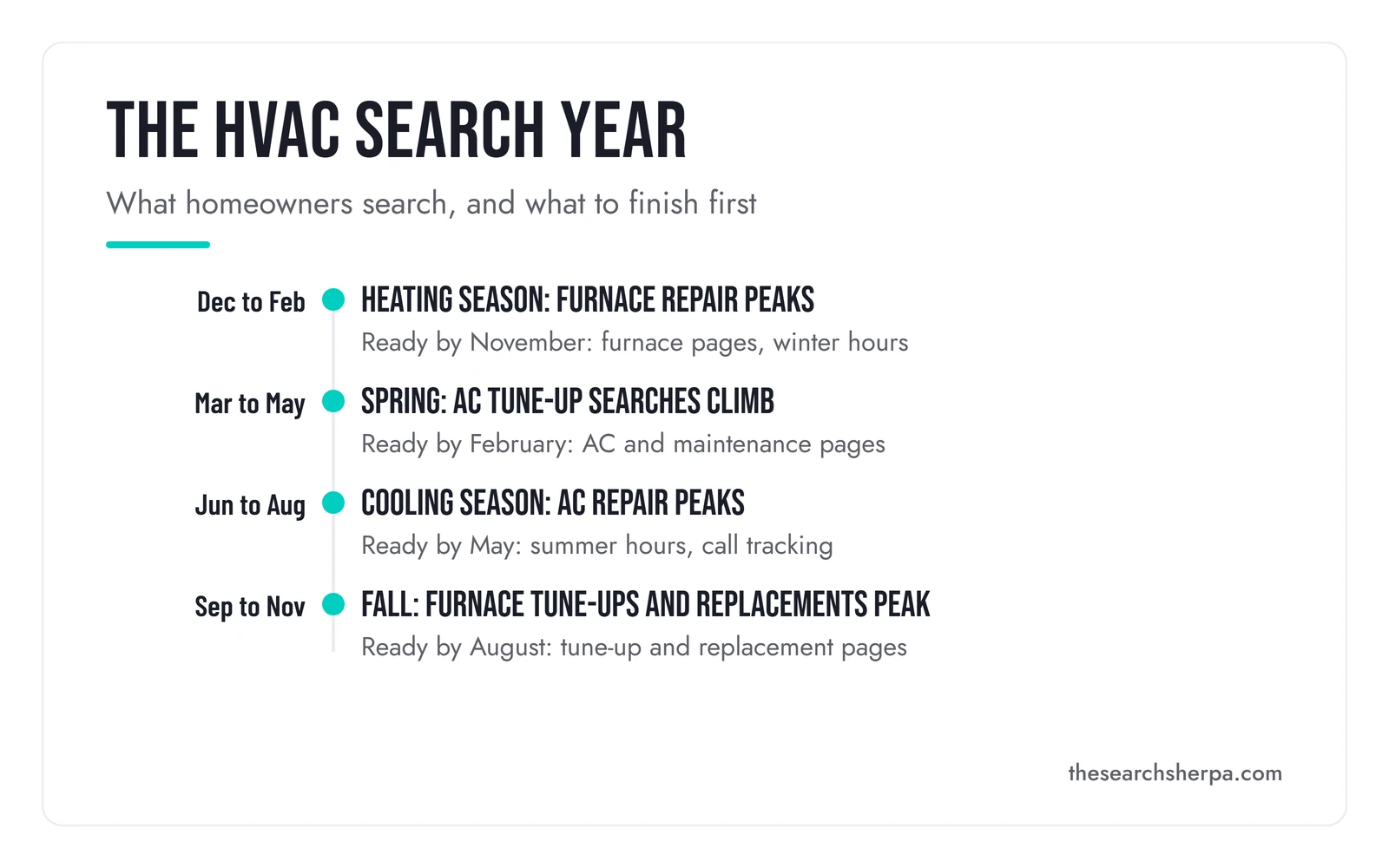
HVAC searches follow the weather: in national search data, furnace repair searches peak in winter and AC repair searches peak in summer. Furnace tune-up searches peak in October, and furnace replacement and AC replacement searches are highest in September and October. The SEO work for each season should be published and crawled before that season starts, not begun once the phones get busy.
ENERGY STAR’s maintenance checklist tells homeowners to book “annual pre-season check-ups” and explains why: “Contractors get busy once summer and winter come, so it’s best to check the cooling system in the spring and the heating system in the fall.” The calendar below uses the NOAA meteorological seasons, which group whole months, so “meteorological winter includes December, January, and February.”
The search data agrees. In Google search volume via DataForSEO (United States, the 12 months from September 2025 to August 2026, pulled October 8, 2026), furnace repair searches were highest in January, at about 450,000, and lowest in June, at about 60,500. AC repair searches were highest in July and lowest in December. Furnace tune-up searches peaked in October, and searches for furnace replacement and AC replacement were highest in September and October. Weather shifts the timing each year, so treat these months as a planning guide, not a forecast.
December to February: heating season
This is when the January furnace call happens, and searches for “furnace not working” peak with it. Everything for heating season should be live by November: a furnace repair page, a no-heat page if you offer emergency service, winter and holiday hours on the profile, and fresh reviews from fall tune-ups. During the season, answer the calls, reply to reviews, and log where each call came from.
March to May: the spring shoulder
AC tune-up searches climbed in March and kept rising into summer, which matches ENERGY STAR’s advice to check the cooling system in the spring. By February, the AC repair, AC tune-up, and maintenance plan pages should be published, added to the services on your Google Business Profile, and crawled. Spring is also the window for technical fixes and larger site changes, before the summer calls arrive.
June to August: cooling season
AC repair searches peak in July, and searches for “air conditioner not working” peak with them. By May, summer hours should be set, call tracking tested, and every AC page loading quickly on a phone. Avoid a site rebuild in the middle of the peak, when a broken form does the most damage.
September to November: the fall shoulder
This is furnace tune-up and replacement season. ENERGY STAR’s page on when to replace heating and cooling equipment lists signs such as “Your equipment needs frequent repairs and your energy bills are going up.” Its tips for hiring a heating and cooling contractor tell homeowners to “Get written, itemized estimates” and to look up the “license and insurance requirements for contractors in your state.”
A replacement page that answers those questions, with your license and insurance details and how you size a system, should be live by August, along with a furnace tune-up page. Google’s guide to people-first content asks whether a page shows “first-hand expertise and a depth of knowledge,” which is exactly what your technicians have. Our SEO content strategy work plans these pages a season ahead.
How HVAC SEO work runs
Every engagement follows the same four steps. The order matters more than the speed.
- Visibility Review. We look at your Google Business Profile, site, reviews, and towns, and compare them with the HVAC companies that appear when your customers search.
- Strategy Map. We decide which jobs and towns come first, usually starting where your close rate and margins are already best, and set the seasonal calendar for the year ahead.
- Build and Optimize. We fix the profile, the technical problems, and the existing pages, then publish new pages in the order the calendar sets.
- Measure and Refine. We track calls, forms, and search visibility, report what changed, and adjust the plan before the next season.
The first two steps happen inside the Custom SEO Roadmap, which takes about four weeks and ends with a plan you keep whether or not you hire us to run it. That roadmap is also our SEO audit for local businesses.
Most local SEO shows measurable movement in about three to six months, depending on competition and the condition of your site. Our pricing page adds that meaningful pipeline results “usually take six to twelve months to fully materialize.” That is why the calendar matters: a page needs time to earn trust before its season. The SEO for landscaping companies page also says to start before the spring rush.
We build on WordPress, and you own what we build. As our contractor hub says, “You own the code, the content, and the data.” If the site itself holds you back, our custom WordPress design with SEO built in starts from the same plan. No contracts. Clients stay because the work earns it.
What HVAC SEO costs
Small local businesses generally invest $1,000 to $3,000 a month in SEO, and a single-market HVAC company usually pays $1,000 to $2,500 a month. Every engagement starts with a $2,000 Custom SEO Roadmap that is credited toward the first month if you hire us, and packages below $500 a month cannot sustain the work.
Cost depends on your site, your competition, and your goals. Covering several towns costs more, because each town needs its own pages and local signals: $2,500 to $4,500 a month for a multi-town service area, and $4,500 to $7,500 or more a month for multi-location programs.
Those figures come from our pricing page and our guide to HVAC SEO cost and pricing tiers. That guide covers what each tier buys, what an HVAC job is worth, and how the seasons affect budget. The roadmap fee is credited “fully toward your first month of retainer services” if you hire us, and if you take the plan to your own team instead, “it is yours to keep.” We do not use long-term lock-in contracts.
Frequently asked questions
What SEO services are available for HVAC companies?
The main services are Google Business Profile optimization, a service page for each job, town pages where demand justifies them, technical and on-page fixes, review and citation work, seasonal content, and call and form tracking. With us, they are planned together in one roadmap. Paid ads and social media management are separate services that we do not offer.
How does HVAC SEO work?
HVAC SEO improves the local ranking factors a company can influence, because Google says local results are mainly based on relevance, distance, and popularity, and distance is fixed by where the searcher is. The profile and service pages show which jobs you do and where, reviews and citations build prominence, and tracking shows which calls each piece produced.
How much does it cost to hire someone for SEO?
With us, hiring starts with a $2,000 Custom SEO Roadmap that takes about four weeks and is credited toward your first month if you go ahead. After that, small local businesses generally invest $1,000 to $3,000 a month. Cost depends on your site, your competition, and your goals.
How much should I expect to pay for SEO?
A single-market HVAC company should expect $1,000 to $2,500 a month. Companies covering several towns pay $2,500 to $4,500 a month, and multi-location programs $4,500 to $7,500 or more a month. Packages below $500 a month cannot sustain the work.
How long does HVAC SEO take to work?
Most local SEO shows measurable movement in about three to six months, depending on competition and the condition of your site. Results you can tie to new revenue usually take six to twelve months. Starting before a season gives the pages time to be crawled and trusted before the calls peak.
Do you run Local Services Ads or Google Ads for HVAC companies?
No. We do not sell or manage Local Services Ads, Google Ads, or any other paid ads. If you run them, we set up tracking so paid calls stay separate from organic calls in your reports.
How to start HVAC SEO
Starting does not require handing over passwords. Here is how it runs:
- Book a call. We talk through your towns, your trucks, and the jobs you want more of.
- Start the roadmap. You complete an intake workbook, and we hold a 30-minute Direction Call to set the goals.
- Review the plan. Over about four weeks we audit your site, profile, competitors, and keywords, then walk through the findings on a 60-minute Strategy Call.
- Decide. Hire us to run the plan, with the $2,000 credited toward the first month, or hand the plan to your own team.
We work from one office in Mokena. The service area includes Mokena, Frankfort, New Lenox, Tinley Park, Orland Park, Homer Glen, Manhattan, Lockport, and Joliet. Our page on local SEO in the southwest Chicago suburbs explains how one office serves that area.
To compare engagement levels, see our SEO pricing and packages. The first conversation is what our connect page describes: “No aggressive sales tactics, no pressure, just an honest discussion about where you are and where you want to be.” When you are ready, book a call or call (217) 579-8791.
Explore This Topic

Hiring an SEO Consultant Chicago Businesses Can Trust

On-Page SEO Services: Improving the Pages You Already Have

Landscaping SEO for Landscapers: Two Kinds of Buyer, Two Kinds of Search

SEO Audit Services: A Prioritized Plan, Not a List of Problems

Multi-Location SEO: Local SEO for Businesses With Two or More Locations
Join Over 400,000 Entrepreneurs Getting Our Weekly Newsletter
Recent Posts
October 8, 2026
How to choose an SEO consultant in Chicago: consultant, agency, or freelancer, a decision tree, a vetting checklist, red flags, and rates in
October 8, 2026
On-page SEO services improve the pages you already have: titles, headings, copy, links, alt text, and schema. What is included, how it runs,
October 8, 2026
Landscaping SEO builds the pages and Google Business Profile work behind lawn care contracts and design-build projects. What it includes and costs.