

By Jeremy Bengtson, founder of The Search Sherpa.
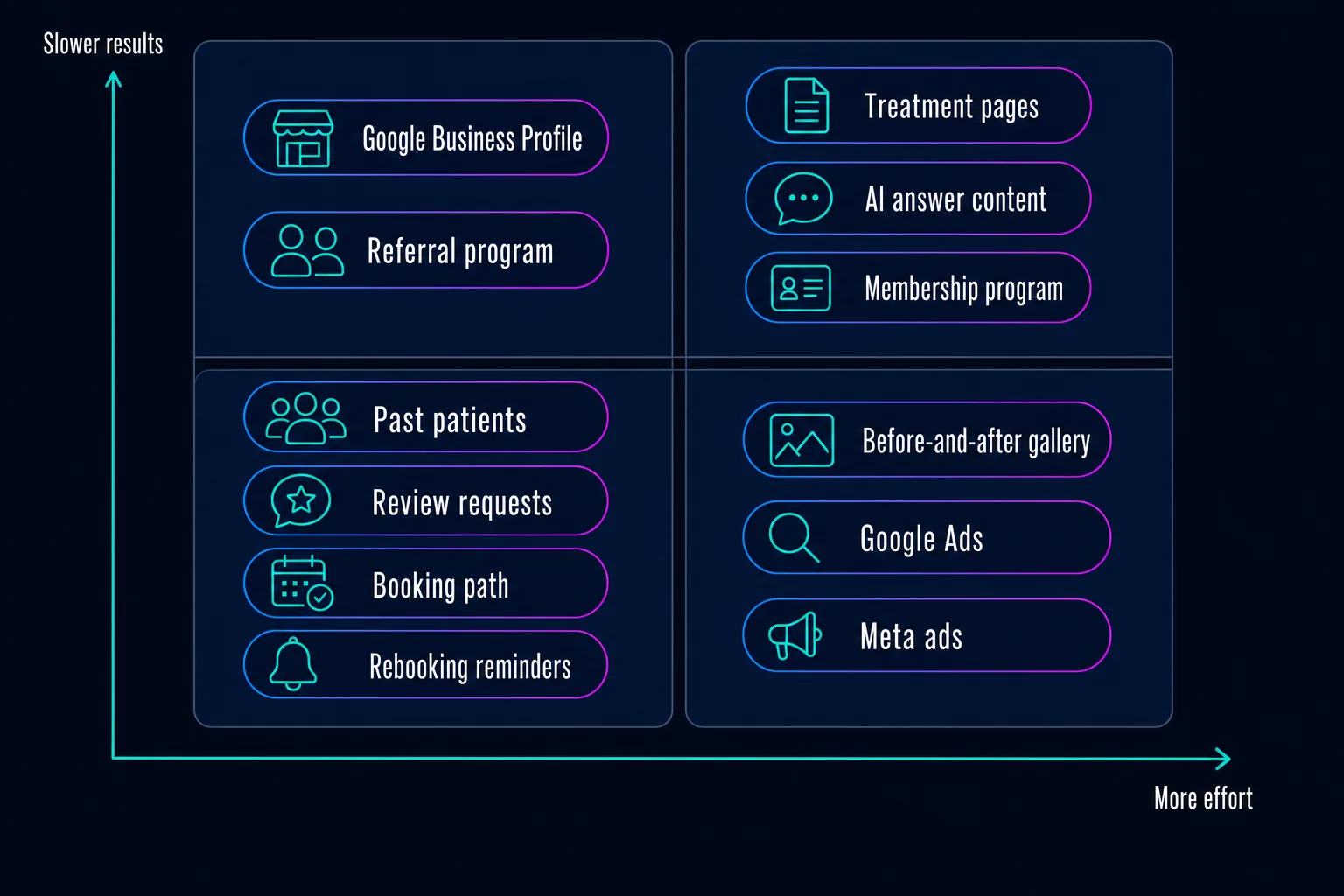
Start with the med spa marketing ideas that take the least effort and money: bringing back past patients, asking every patient for a review, sending rebooking reminders, and asking for referrals. Then make your practice easy to find and book online. Paid ads and a membership program come last.
Below, each idea carries its effort, cost band, and the compliance trap most idea lists skip.
Which med spa marketing ideas come first?
Start with the patients you already have. Reactivation, review requests, and rebooking reminders cost little and, in our working estimate, can show results within weeks. Ads and memberships cost more or take longer, so they come last.
Cost is in bands because we did not find per-tactic costs for med spas in a source we could verify: low is staff time and software you likely have, medium is paid help, high is an ongoing ad budget. Times are our working estimate; the two search rows use our published timelines.
| Order | Idea | Effort | Cost band | Time to first results |
|---|---|---|---|---|
| 1 | Reactivate past patients | Low | Low | Days to weeks |
| 2 | Review requests | Low | Low | Weeks |
| 3 | Rebooking reminders | Low | Low | Weeks |
| 4 | Referral program | Low | Low | Months |
| 5 | Booking path | Low to medium | Low | Weeks |
| 6 | Google Business Profile | Low to medium | Low | Three to six months |
| 7 | Before-and-after gallery | Medium | Low | Weeks |
| 8 | Treatment pages | Medium | Medium | 60 to 90 days |
| 9 | AI answer content | Medium | Medium | Months |
| 10 | Google Ads | Medium | High, ongoing | Days, once approved |
| 11 | Meta ads | Medium | High, ongoing | Days, once approved |
| 12 | Membership program | High | Medium | Months |
The order follows one rule: lowest effort first, then the lowest cost band, with faster first results breaking any tie.
First: the patients you already have
AmSpa’s 2024 report found that an average of 73% of medical spa patients are repeat patients, so rebooking and reactivation come before marketing aimed at strangers.
Reactivate past patients
Your booking software holds consultations that never turned into a treatment, patients who came once and stopped, and regulars who only buy one service. Give each group its own reason to return. Our guide to med spa lead generation from the patients you already have walks through all three.
Effort and cost: Low: an export, a few segments, a few messages. In our working estimate, results can show within days.
Compliance trap: Patient records. HHS’s guidance on business associates says the HIPAA Rules apply to covered entities, including “health care providers who transmit health information in electronic form in connection with a covered transaction”. Business associates are generally those engaged by a covered entity for services “that involve the use or disclosure of PHI” (protected health information), and the rules permit disclosing PHI to one “if the covered entity obtains satisfactory assurances, in the form of a contract or other written arrangement”, called a business associate agreement. This is marketing guidance, not legal advice. Confirm any handling of patient data with the counsel or compliance advisor who supports your practice.
Ask every patient for a review
In BrightLocal’s 2026 Local Consumer Review Survey of 1,002 US adults, 97% of consumers read reviews for local businesses, 31% will only use a business with 4.5 stars or more, and 74% look for reviews written in the last three months.
Build the ask into checkout: a text or email after each visit with a direct review link, plus a QR code at the desk. Reply to every review: BrightLocal found 80% of consumers say they are likely to use a business that responds to all of its reviews. Our guide on how to get more Google reviews sets out the routine.
Effort and cost: Low; many booking tools can send the request automatically.
Compliance trap: Google’s tips on getting reviews say “Offering incentives, like free or discounted goods or services, in exchange for customers to post reviews” is “considered fake & misleading content and is strictly prohibited.” The FTC’s 2024 final rule on fake reviews separately bans “providing compensation or other incentives conditioned on the writing of consumer reviews expressing a particular sentiment, either positive or negative”, and the FTC’s endorsement guidance says asking only customers you expect to be happy “would be misleading if it substantially skews the favorability of the reviews.” So: no discounts for reviews, no undisclosed staff reviews, and ask everyone. Our med spa reputation management page explains how we reply without confirming that a reviewer is a patient.
Send rebooking reminders by email and text
A reminder timed to each patient’s last treatment prompts them to rebook before they drift elsewhere. The usual interval for each treatment is a clinical call for your medical director. Once it is entered in your booking software, each reminder can link straight to booking.
Effort and cost: Low. The software sends the reminders; the work is setting each interval.
Compliance trap: For telemarketing or advertising texts sent with an automatic telephone dialing system, the FCC’s TCPA rules require prior express written consent, “an agreement, in writing, bearing the signature of the person called”, as quoted in the Eleventh Circuit’s January 24, 2025 opinion in Insurance Marketing Coalition v. FCC. The court vacated the FCC’s 2023 one-to-one consent rule as beyond the agency’s authority and noted that the 2012 order setting the written-consent requirement was not at issue. Whether a cosmetic reminder fits the rule’s health care message exception is a question for your counsel.
Start a referral program
Friends who notice a patient’s results may ask who did them. Give each patient a referral card or link carrying their name, add a referred-by field to your booking form, and send the thank-you only after the friend’s first paid visit.
Effort and cost: Low. We found no reliable source on referral returns, so count referred bookings from that field monthly and keep the program only if it pays.
Compliance trap: Never tie the reward to a review. If a rewarded patient posts about you, the FTC’s guidance says a connection consumers would not expect, like that reward, should be disclosed clearly and conspicuously. Ask your counsel whether your state limits rewards for medical referrals.
Next: be easy to find and book
A common path to a first visit runs from a search to a map listing, photos and reviews, a treatment page, and a booking page.
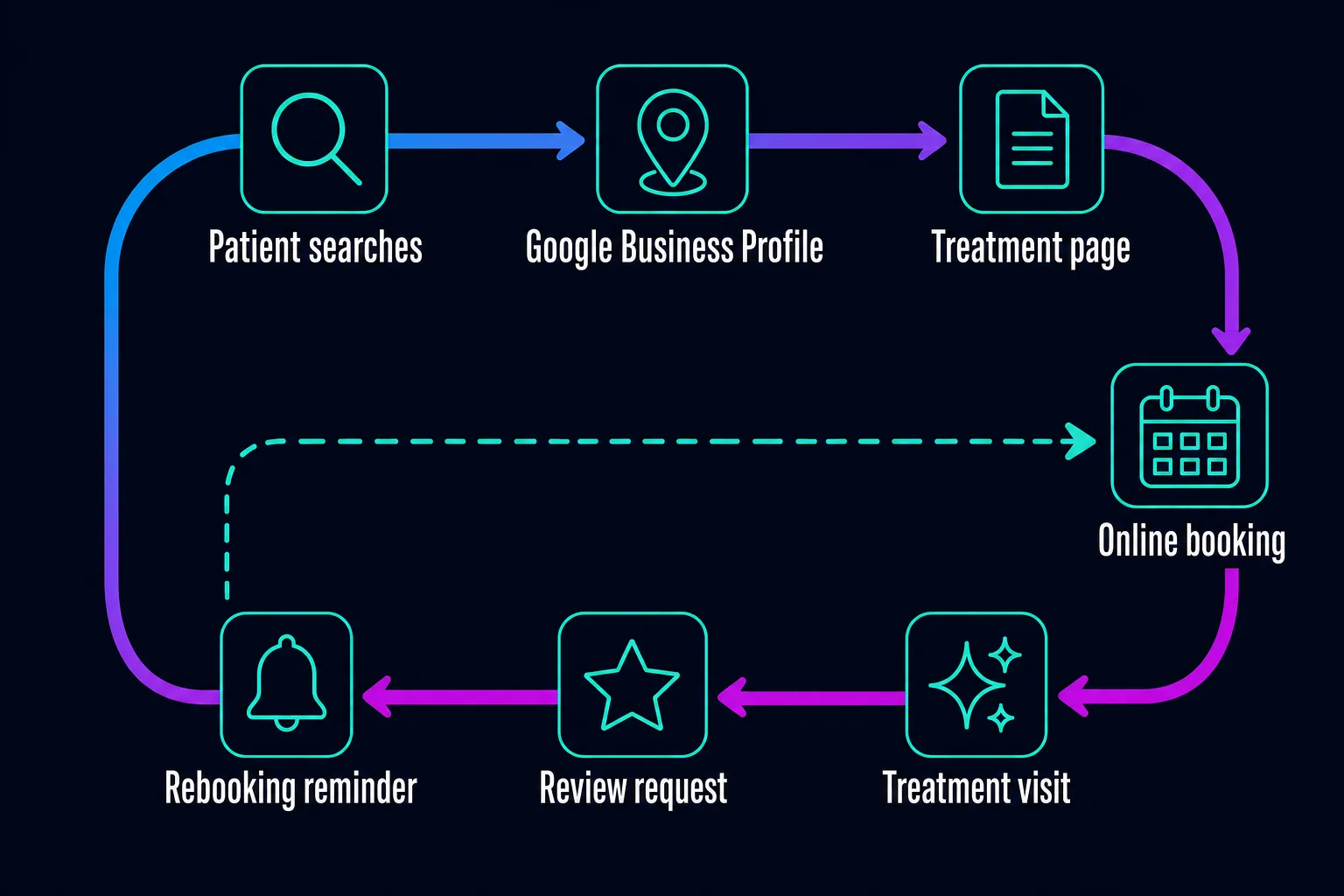
Fix the booking path before you buy traffic
The American Med Spa Association’s 2024 industry report says “Patients spend an average of $527 during a medical spa visit”, so each lost booking costs real money. Search for your business on your phone, tap the booking button, and count the screens and dead ends.
Effort and cost: Low to medium: setup and testing in booking software you likely already have.
Compliance trap: Tracking. In online tracking guidance that a court partly vacated in 2024, HHS’s Office for Civil Rights says “Tracking technologies on a regulated entity’s unauthenticated webpage that permits individuals to schedule appointments or use a symptom-checker tool without entering credentials may have access to PHI in certain circumstances.” We are not a HIPAA consultancy, but on our own med spa marketing service we set up marketing tracking carefully to avoid passing protected health information to advertising platforms.
Complete your Google Business Profile, treatment by treatment
Your Google Business Profile, your map listing, should read like your treatment menu: each service by name, real photos, and hours that match your booking software. Google’s guidance on local ranking says “Local results are mainly based on relevance, distance, and popularity” and defines relevance as “how well a Business Profile matches what someone is searching for”, so a profile that never mentions laser hair removal has little to match when someone searches for it. Our Google Business Profile optimization checklist covers every field.
Effort and cost: Low to medium: a few hours, then a monthly routine. Our published estimate for meaningful Map Pack gains is three to six months.
Compliance trap: Patient photos on the profile follow the gallery rules below, and reviews follow the review rules above.
Publish a before-and-after gallery
A gallery lets a patient weighing a treatment for their face or body see work by your own providers before booking a consultation. Shoot every set under the same light, angle, and distance, file it by treatment, and caption each one with the treatment, the number of sessions, and the time between photos.
Effort and cost: Medium, mostly staff time: consistent photos and a signed authorization from each patient.
Compliance trap: Under the FTC Endorsement Guides, 16 CFR 255.2, a consumer endorsement about a key attribute “will likely be interpreted as representing that the endorser’s experience is representative of what consumers will generally achieve”. A caption saying results may vary is a weak fix for an atypical result; the same section says such disclaimers “are unlikely to be effective.” HHS’s summary of the HIPAA Privacy Rule says “A covered entity must obtain an authorization to use or disclose protected health information for marketing”, except for face-to-face communications and gifts of nominal value, and it lists “Full face photographic images and any comparable images” among identifiers.
Give every treatment its own page
One page per treatment: what it is, who it suits, what a visit involves, aftercare, and a booking button. A services page listing twenty treatments gives Google little to match against a search for any one of them. Our med spa SEO guide covers how to structure these pages.
Effort and cost: Medium: writing, photos, and medical director review. Our med spa SEO cost breakdown shows what agency help runs; our published estimate is 60 to 90 days for treatment and neighborhood terms to move.
Compliance trap: Clinical statements belong to your medical director, not your marketer, and outcome promises do not belong anywhere.
Answer the questions patients ask before they book
BrightLocal’s 2026 survey found that use of ChatGPT and other generative AI tools for local recommendations rose from 6% the year before to 45%. Write short answers to the questions staff hear at every consultation: how long a treatment lasts, how many sessions it takes, what recovery looks like. AI tools can lift passages like these into answers, the heart of answer engine optimization. Our breakdown of what ChatGPT cites when a patient asks for a med spa shows its sources, from treatment pages to Yelp and Reddit.
Effort and cost: Medium, and it overlaps with the treatment pages. Expect months, not weeks.
Compliance trap: The FTC’s 2024 rule bans reviews that “misrepresent that they are by someone who does not exist, such as AI-generated fake reviews”. Staff posting on Reddit as if they were patients misrepresents who is speaking, and the FTC’s guidance says a connection between a marketer and an endorser that consumers would not expect should be disclosed clearly and conspicuously.
Last: paid reach and memberships
Google Ads reaches people already searching for a treatment; Meta ads reach people who were not looking yet.
Google’s policy says US advertisers may use prescription drug terms in ads and landing pages without certification, in accordance with local laws and regulations, but must be certified to keyword-target them.
Run Google Ads on treatment searches
Search ads on treatment terms, such as lip filler plus your town, reach people choosing a provider. Build one ad group per treatment, send each to its matching treatment page rather than the home page, add negative keywords for job and training searches, and count booked consultations, not clicks. Our comparison of med spa PPC vs. SEO covers how to split a budget.
Effort and cost: Medium effort plus an ongoing budget. In our working estimate, results start within days of approval and stop when the budget does.
Compliance trap: Neurotoxins are prescription drugs. Google’s restricted drug terms policy says “While you don’t need to be certified in order to use prescription drug terms in ads and landing pages, you must be certified in order to keyword-target these terms.” Google’s certification categories include telemedicine providers, which matters if you prescribe weight loss medication through online visits. Google also publishes a non-exhaustive list of monitored prescription drugs and active ingredients, and it includes Botox, Dysport and Xeomin, so check every product you advertise against that list.
Use Meta ads to create demand
Meta’s health and wellness advertising policy allows ads targeted to people 18 or older to promote cosmetic procedures such as dermal fillers, chemical peels, and micro-needling, including ads that “depict before and after transformations”. Target adults within driving distance, send each ad to its treatment page, and call every new lead the same day.
Effort and cost: Medium effort plus an ongoing budget.
Compliance trap: Meta bars cosmetic ads that “Contain statements of inferiority about physical appearance”, and it bars health-ad clickbait such as “promises of specific outcomes within a set timeframe without disclaimers or qualifiers”. For illustration, an ad asking whether you are tired of your wrinkles, or one promising ten years younger in two weeks, is the kind of copy those lines target, and the FTC’s typical-results rule still applies.
Offer a membership program
A membership charges patients a monthly fee for a set number of treatments or a percentage off them, which gives regulars a reason to keep their visits on schedule.
Effort and cost: High. Pricing, billing, and training take work, and a membership priced wrong can lose money on every visit. Test the math on your own visit and spending data first.
Compliance trap: Have counsel review the recurring-billing and cancellation terms, and never tie a member perk to a review.
The compliance checklist before anything goes live
Most of the traps above come down to eight checks.
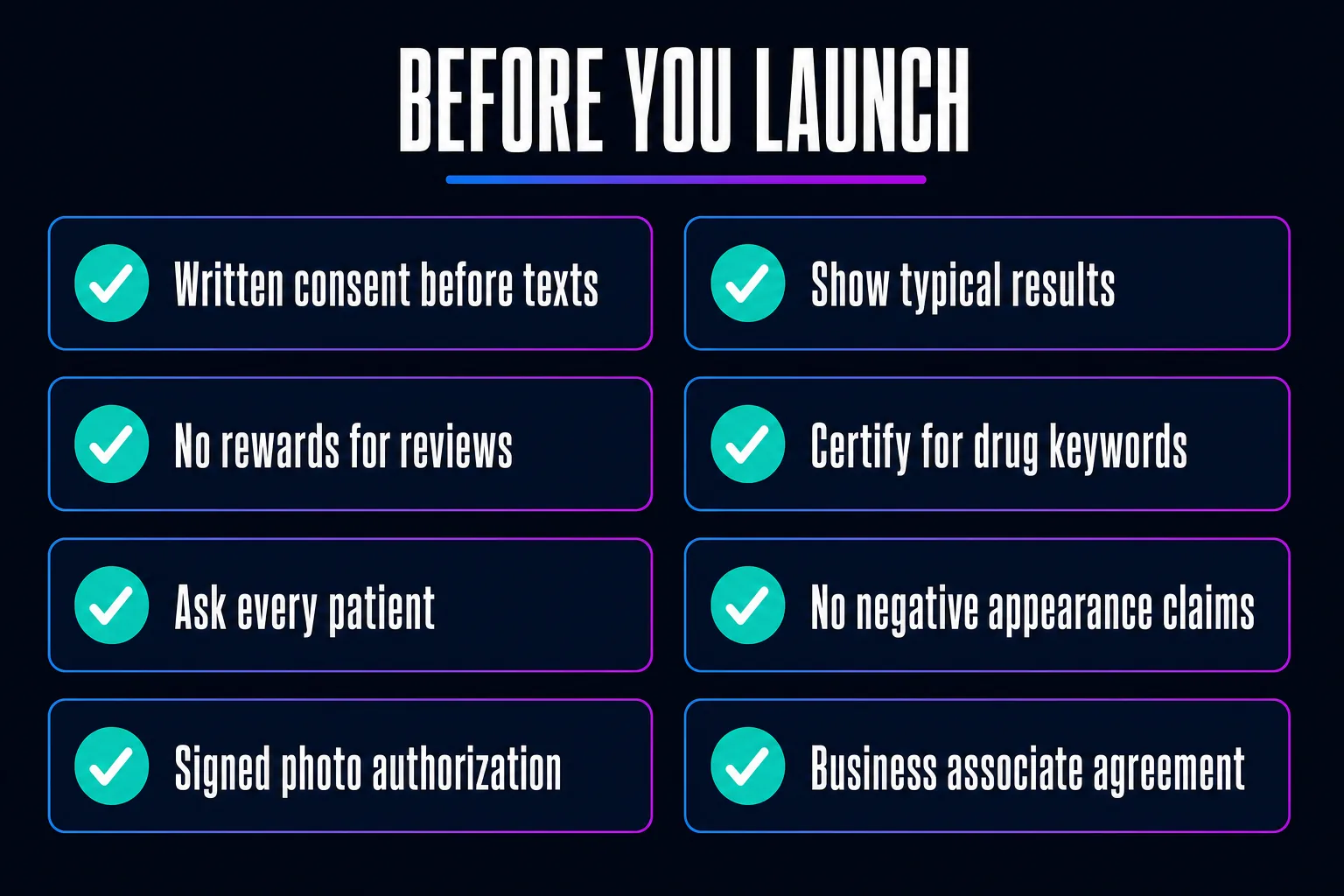
- Written consent before texts: signed, in advance, for advertising or telemarketing texts sent with an automatic telephone dialing system.
- No rewards for reviews: no discount, gift, or perk.
- Ask every patient: not only the happy ones.
- Signed photo authorization: the marketing authorization HHS describes.
- Show typical results: or disclose what is typical.
- Certify for drug keywords: before keyword targeting.
- No negative appearance claims: and no promised result by a date.
- Business associate agreement: the written assurance HHS describes before a covered practice discloses PHI to a vendor.
Where to start, and what it costs
Work down the table, adding paid ads once your pages are ready and a membership once you have data to price it.
If you hire help for search, our published rate for local businesses is $1,000 to $3,000 a month, and a single-location suburban med spa sits at $1,500 to $2,500. We start with a $2,000 Custom SEO Roadmap, credited toward your first month if you hire us to carry out the plan. Packages below $500 a month cannot sustain the work.
Cost depends on your site, your competition, and your goals. We will be clear about pricing before any work begins. Most local SEO shows measurable movement in about three to six months, depending on competition and the condition of your site. We do not promise rankings, lead counts, or map placements, because no honest provider can.
Frequently asked questions
What are some good marketing ideas for a med spa?
Start with the patients you already have: reactivation, review requests, rebooking reminders sent with consent, and referrals. Then fix online booking and build your Google Business Profile, treatment pages, and answers to patient questions. Add ads and a membership last.
How do you get clients for a med spa?
Be easy to find, easy to trust, and easy to book: a common path runs from a search to the map listing and reviews, then a treatment page and online booking. Then keep them: AmSpa’s 2024 report found that an average of 73% of medical spa patients are repeat patients.
What are the most profitable med spa services?
We found no verifiable source ranking med spa services by profit margin, so check your own books for margins before shifting marketing toward one service. Demand is easier to see: the American Society of Plastic Surgeons’ June 2025 report put neuromodulator injections first among minimally invasive procedures in 2024, at 9,883,711, ahead of 5,331,426 hyaluronic acid fillers.
What are the current trends in the med spa industry?
More competition and more AI. AmSpa’s 2024 report counted 10,488 medical spas in 2023, up from 8,899 in 2022. Injectables lead demand: the American Society of Plastic Surgeons’ June 2025 release counted 9,883,711 neuromodulator injections among more than 28.5 million minimally invasive procedures in 2024; the release does not say how the count was gathered. And BrightLocal’s 2026 survey found AI tool use for local recommendations rose from 6% the year before to 45%.
Can a med spa advertise Botox on Google?
Yes, with limits. In the US, Google’s policy allows prescription drug terms in ad text and landing pages without certification, in accordance with local laws and regulations, but keyword targeting those terms requires certification. Google’s non-exhaustive prescription drug list names Botox, Dysport and Xeomin, so check your ads against it.
How long does med spa marketing take to work?
In our working estimate, reactivation and review requests can show results within days or weeks, and paid ads start once approved. Search takes longer: our published estimate is 60 to 90 days for treatment terms and three to six months for meaningful Map Pack gains.
If you want help choosing where to start, see our SEO pricing or request a free website and SEO review. We are founder-led out of Mokena, Illinois, and work with med spas across Will County and the southwest Chicago suburbs to make them easier to find, easier to understand, and easier to choose. You can also call (217) 579-8791. Start with a conversation, no pressure and no contract.
Explore This Topic
Join Over 400,000 Entrepreneurs Getting Our Weekly Newsletter
Recent Posts

October 1, 2026
Therapist SEO cost in 2026: about $1,000 to $3,000 a month for a local practice, the caseload math to judge it, and the

September 30, 2026
Local SEO in DuPage County: $1,000 to $3,000 a month for Naperville and Downers Grove, from a Mokena firm.

September 29, 2026
Local SEO in south Cook County runs $1,000 to $3,000 a month. Orland Park, Tinley Park, and nearby suburbs.