

By Jeremy Bengtson, founder of The Search Sherpa.
A therapist deciding on SEO is weighing a monthly fee against a caseload, so this guide gives the price first and then the math. For a solo or small group practice, therapist SEO costs about $1,000 to $3,000 a month in 2026, the band we publish for local businesses. The median marketing spend in Heard’s 2026 survey of 1,950 therapists and wellness practitioners was $500 a year, so for most practices this is a new kind of budget. The sections below cover what the fee buys, what one new client is worth, what each way of getting found costs, and what is different about marketing a therapy practice.
What does therapist SEO cost in 2026?
Therapist SEO usually costs $1,000 to $3,000 a month for a solo or small group practice serving one area. A group practice with several offices, or one in a competitive regional market, sits in the $3,000 to $8,000 a month band. Packages below $500 a month cannot sustain the work.
Our SEO for therapists page describes the service without a price, so these bands come from our SEO pricing page, which also sets out what each one covers. Cost depends on your site, your competition, and your goals.
Most practices spend far less. In Heard’s survey, referrals (83 percent of respondents) and online directories (82 percent) led; only 31 percent used Google or SEO (27 percent of solo practitioners, 57 percent of group practices). The median spend works out to about $42 a month ($500 divided by 12).
What you are paying for in therapist SEO
SEO money buys work, not placement. Google says “There’s no way to request or pay for a better local ranking on Google,” and that local results rest on relevance, distance, and prominence (Google Business Profile Help). Distance you cannot change. Prominence, Google says, draws on how many websites link to your business and how many reviews you have.
So the fee pays for specialty pages, a complete Google Business Profile, accurate listings, links from local and professional sites, and a fast site. Our local SEO services page lists the scope, and our guide to the difference between SEO, local SEO, and a Google Business Profile shows how they fit. Being described accurately by AI search tools is answer engine optimization, built on the same pages.
What changes the price of therapist SEO
| Factor | Toward the low end | Toward the high end |
|---|---|---|
| Practice size | One clinician, one office | Several clinicians or offices |
| Specialties | One or two | Many, each needing its own page |
| Market | A suburb with few nearby practices | A dense metro market where many practices chase the same searches |
| Site condition | A sound site that needs content | A slow or outdated site that needs work first |
Whether you take insurance or are private pay changes the math more than the price, as the caseload section shows. For group practices with several kinds of clinicians, our page on mental health marketing covers multi-provider practices, and our page on psychiatry marketing covers prescribers.
What a 90-day therapist SEO plan includes
Days 1 to 30: audit and foundation
The first month is the $2,000 Custom SEO Roadmap: technical site audit, Google Business Profile review, backlink assessment, competitor analysis, keyword opportunity mapping, and content strategy. For a therapist, competitors are the practices and directory profiles that show up for your specialties nearby.
Days 31 to 60: structure and content
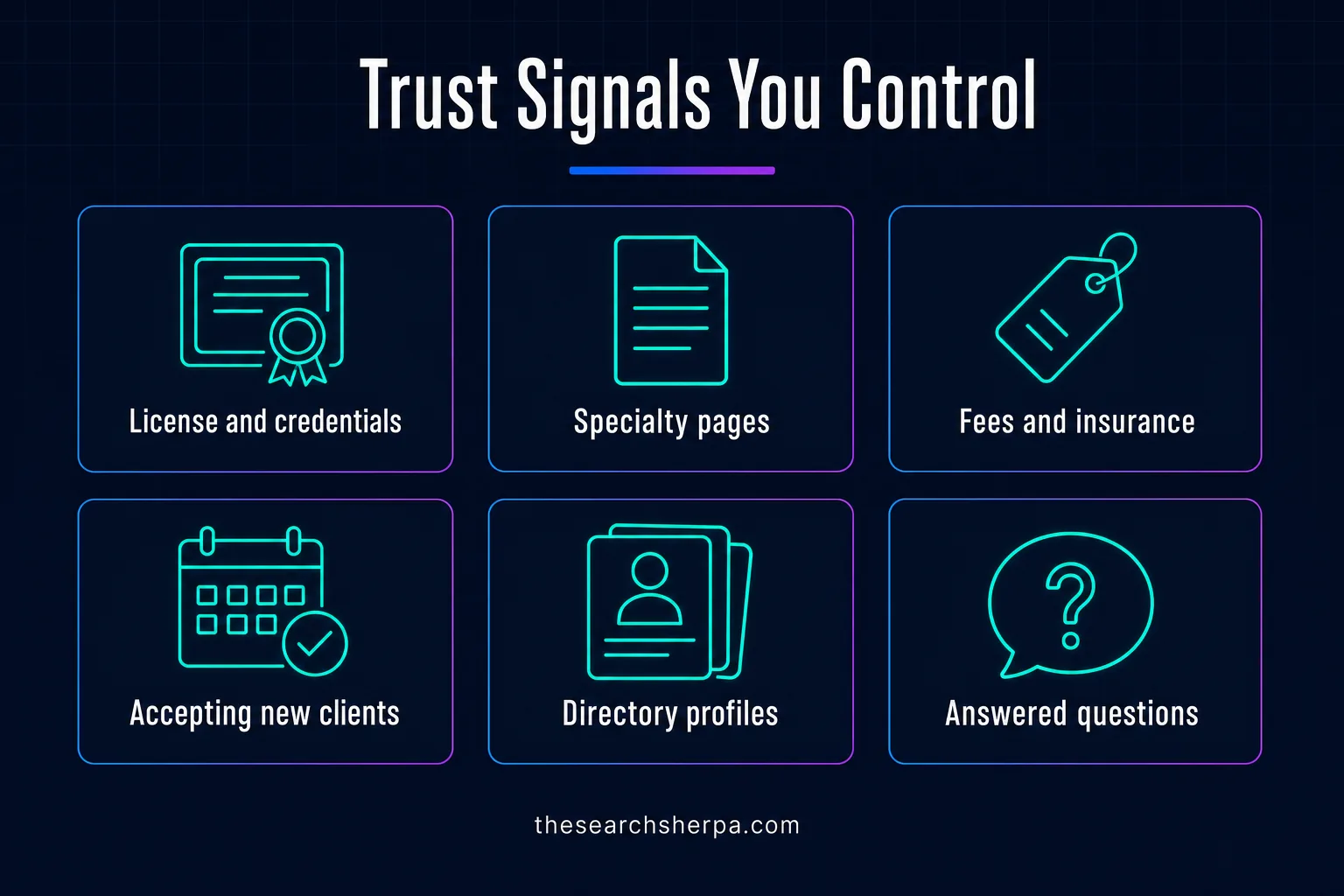
Month two builds what a prospective client looks for before reaching out: a page per specialty, clinician bios with license and training, fees and insurance, whether you are accepting new clients, and how intake works. You review every page against your profession’s advertising rules before it goes live.
Days 61 to 90: reinforce and measure
Month three adds matching directory profiles, local and professional links, and inquiry tracking that keeps client information out of ad tools. Most local SEO results take three to six months, depending on competition and the condition of your site; revenue you can trace to search usually takes six to twelve months. Here is what your SEO agency should be showing you each month.
The caseload math: what one new client is worth
A new private-pay client who attends 10 sessions brings in $1,300 to $1,850 at the fees respondents reported to Heard, or $950 to $1,250 at the insurance rates they reported. At $1,000 a month, SEO covers its cost in revenue at about one-half to one new client a month; at $3,000 a month, at about two to three.
Session fees and sessions attended
Heard’s respondents came from all 50 states and DC. Heard puts individual sessions at $130 to $185 and average reimbursement across major insurers at $95 to $125 per session. Heard calls its findings “Not guidance for setting your own rates, which should always be based on your individual practice, market, and costs.” The figures are national; use your own fee.
No source we read publishes how many sessions the average client attends, so this example assumes 10; use your own average. Multiply your fee by that number, then divide your SEO spend by the result.
| SEO spend | Private pay, $1,300 to $1,850 per client | Insurance, $950 to $1,250 per client |
|---|---|---|
| $1,000 a month | 0.5 to 0.8 new clients a month | 0.8 to 1.1 new clients a month |
| $3,000 a month | 1.6 to 2.3 new clients a month | 2.4 to 3.2 new clients a month |
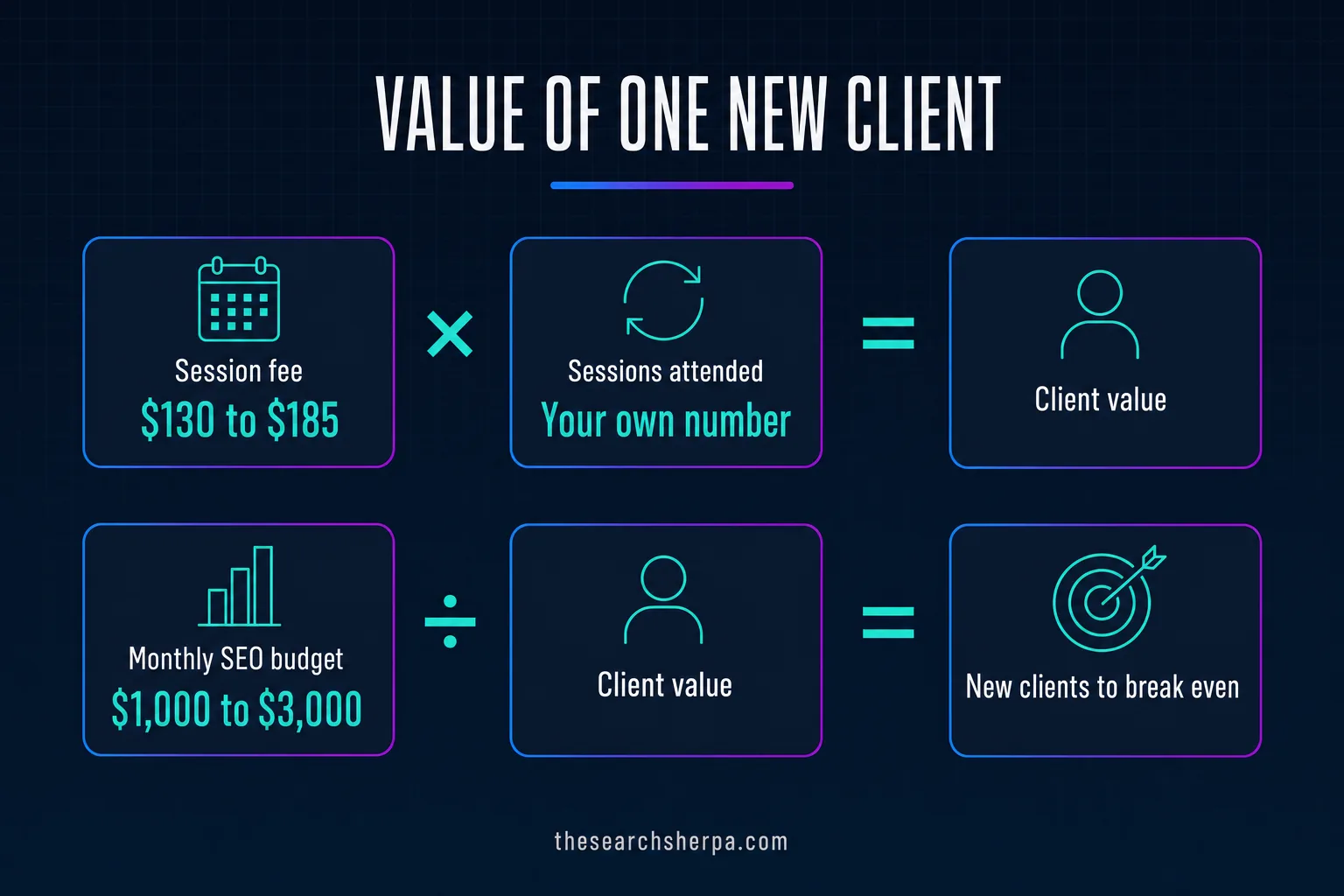
Two cautions. This is revenue, not profit. And Heard puts the median solo caseload at 18 clients per week, so one new weekly client changes a solo schedule. With a waitlist, SEO is about filling your hours with the clients you are best placed to help, not volume.
What each acquisition channel costs
| Channel | What it costs | What you get | What you do not control |
|---|---|---|---|
| Directory listing | Free to $29.95 a month. Psychology Today lists $29.95 a month with no contract; $29.95 times 12 comes to $359.40 a year. TherapyDen offers a free profile with an optional paid Premium plan | A profile among other therapists’ profiles | Where you appear and who appears beside you |
| Paid search | You pay for every click. Google data via DataForSEO, September 2026, puts the estimated average click price for “therapist near me” at $22.61 nationally and $23.98 in the Chicago location target. We found no published cost per client for therapist ads | Placement above the results while you pay | Audience targeting, which Google limits for sensitive categories |
| Organic SEO | A monthly fee in the local band above | Pages on your own website and a Google Business Profile you control | Timing, and Google’s ranking decisions |
Google’s personalized advertising policy lists sensitive interest categories, which include health and abuse and trauma, and says advertisers promoting products and services in them “are unable to use advertiser-curated audiences.” If your services fall there, that narrows how you can aim an ad. A click price is a bid estimate, not the cost of a client.
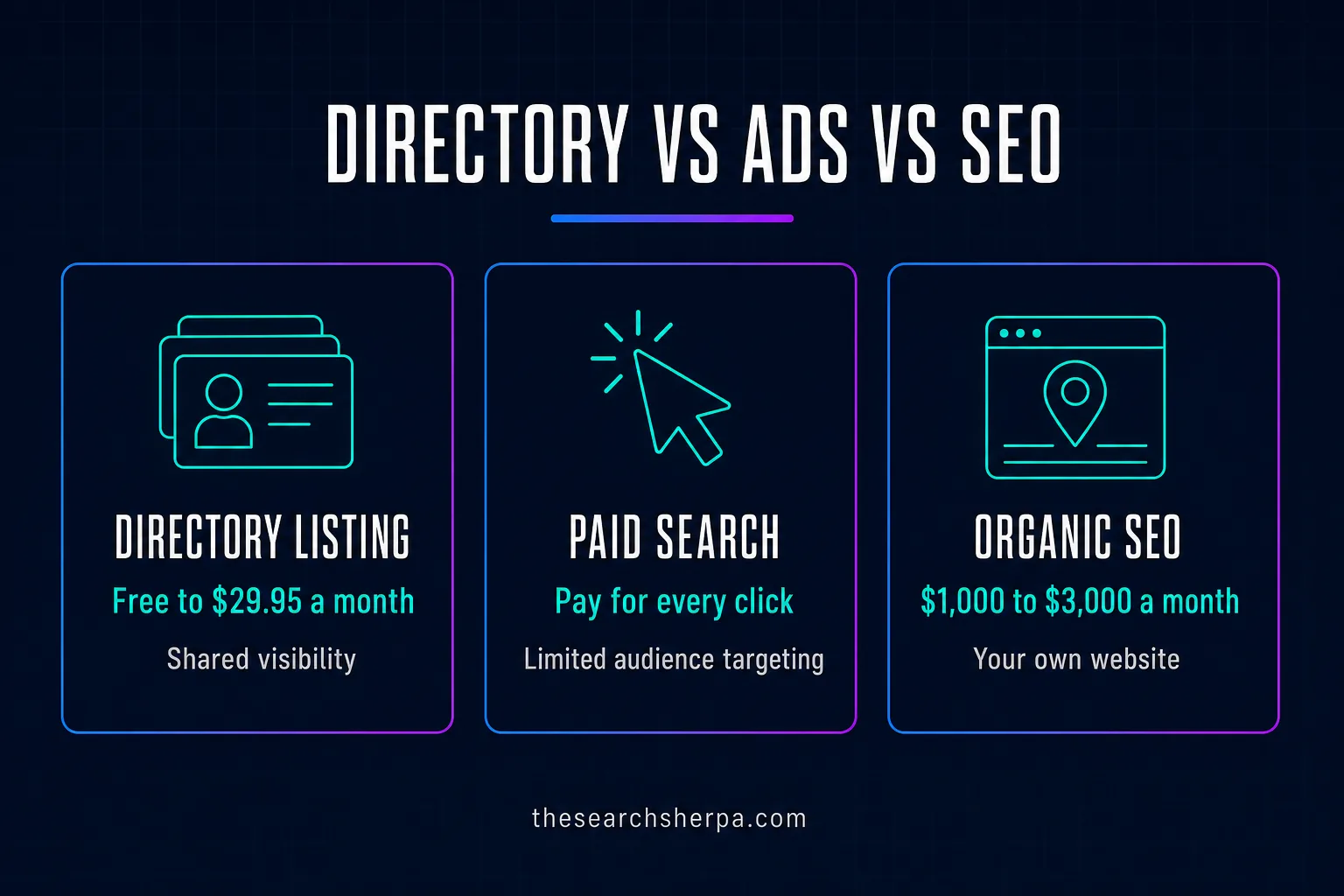
The difference is time. Directory fees and ad clicks buy visibility for the month you pay, and a directory shows you on a page of similar profiles you cannot control. SEO builds pages and a Google Business Profile that stay yours, so if it earns clients, the same fee spreads across more of them; the first months are cost before return. For most practices the answer is both: keep the listing, which costs little and carries no contract, and point it at a site that answers a prospective client’s questions.
What makes marketing a therapy practice different
Be careful before copying the review playbook other local businesses use. The APA code restricts soliciting testimonials from current therapy clients, the 2014 ACA code from current and former clients, and the NASW code from current clients, each along with others vulnerable to undue influence. Whether a review request counts as a testimonial is a question for your code and your board. Privacy rules also shape what a practice website can track. A therapist SEO plan builds trust through credentials, specialty pages, and directory profiles instead.
What the ethics codes say about testimonials
The APA Ethics Code, Standard 5.05: “Psychologists do not solicit testimonials from current therapy clients/patients or other persons who because of their particular circumstances are vulnerable to undue influence.” The same code counts directory listings as public statements (5.01), and under 5.02(a) psychologists who engage others to create or place public statements that promote their practice “retain professional responsibility for such statements.”
The 2014 ACA Code of Ethics, Standard C.3.b, as quoted in the ACA’s Counseling Today: “Counselors who use testimonials do not solicit them from current clients, former clients, or any other persons who may be vulnerable to undue influence. Counselors discuss with clients the implications of and obtain permission for the use of any testimonial.” A revision is under way; NBCC reports the goal is to present it to the ACA Governing Board at its fall 2026 meeting.
The NASW Code of Ethics, Standard 4.07(b): “Social workers should not engage in solicitation of testimonial endorsements (including solicitation of consent to use a client’s prior statement as a testimonial endorsement) from current clients or from other people who, because of their particular circumstances, are vulnerable to undue influence.”
Illinois adds a licensing layer: the acts for professional counselors and clinical social workers each list “solicitation of professional services by using false or misleading advertising” as a ground for discipline. LMFTs and other license holders should read their own code.
Why the usual review playbook does not transfer
Google says “More reviews and positive ratings can help your business’s local ranking.” For a plumber, that means asking every customer. For a therapist, a review request may count as soliciting a testimonial, which each code above limits; whether it does is a question for your code and your board, not a marketing provider. So a plan that depends on asking every client for a review carries risk. Google counts links from other websites toward prominence too, so a plan can put more of its effort into links and into the trust signals on your own pages. How a practice may display the reviews it already has is also a question for your code and your board.
Tracking technologies on a practice website
Whether HIPAA reaches your website depends on whether your practice is a HIPAA covered entity, a question for your compliance advisor. HHS lists psychologists among the health care providers that are covered entities, “but only if they transmit any information in an electronic form in connection with a transaction for which HHS has adopted a standard.” If your practice is covered, the HHS Office for Civil Rights guidance on online tracking technologies speaks to your website.
HHS says tracking technologies on a regulated entity’s “user-authenticated webpages generally have access to PHI,” that those on a public page letting individuals “schedule appointments or use a symptom-checker tool without entering credentials may have access to PHI in certain circumstances,” such as an email address or the reason for seeking care, and that tracking vendors are business associates if they handle PHI on the entity’s behalf.
One part is gone. HHS’s page notes that on June 20, 2024, a federal court in the Northern District of Texas, in American Hospital Association v. Becerra, vacated “a portion of this guidance document,” the part saying HIPAA obligations are triggered when a tracker connects a visitor’s IP address with a visit to a public, no-login page about specific health conditions or healthcare providers. HHS says it “is evaluating its next steps in light of that order.”
Our practice on therapist sites is business associate agreements where needed and no protected health information in tracking pixels or retargeting. Those are safeguards; they do not decide a practice’s obligations. This is marketing guidance, not legal advice. Confirm any handling of patient data with the counsel or compliance advisor who supports your practice.
Is therapist SEO worth it for a private practice?
It is worth it when you have open hours or a specialty to grow, the break-even in the caseload table (about one-half to three new clients a month) is within reach, and you can give it six to twelve months. It is not worth it if your caseload is full of the clients you want or $1,000 a month would strain the practice; start with a complete Google Business Profile, a directory listing, and one strong specialty page.
We do not promise rankings, lead counts, or map placements, because no honest provider can. What we commit to is a written plan, a plain monthly report, and no long-term contract.
How to read a therapist SEO quote
A quote for a therapy practice should show, in writing:
- What gets done each month, item by item.
- Which specialty pages get built, and how you review them against your ethics code.
- How inquiries are tracked without sending client information to ad platforms.
- What the monthly report shows, and who you talk to.
- How you leave, and who owns the site, the content, and the Google Business Profile.
Google’s advice on hiring help applies: “Be careful if a company is secretive or won’t clearly explain what they intend to do.” It also notes that nobody can promise the top spot, and that “you are responsible for the actions of any companies you hire” (Google Search Central). Comparing a freelancer with a firm? See our breakdown of SEO consultant rates.
Frequently asked questions
How much does therapist SEO cost?
For a solo or small group practice serving one area, therapist SEO usually costs $1,000 to $3,000 a month, after a one-time $2,000 Custom SEO Roadmap credited in full toward the first month of retainer work. Cost depends on your site, your competition, and your goals.
How much does SEO cost in Chicago?
Our SEO pricing page puts local SEO at $1,000 to $3,000 a month. Our guide to local SEO cost in the Chicago suburbs gives $1,000 to $2,500 a month for a single-location suburban business and $2,500 to $4,500 for a competitive category or multi-town reach. Where a therapy practice falls depends on its site, its competition, and its goals, which the $2,000 roadmap settles before any retainer.
Can I do SEO myself?
Often, for the basics. Google’s own guidance says that if you run a small local business, you can probably do much of the work yourself. A therapist can complete a Google Business Profile, keep directory profiles accurate, and write a clear page for each specialty. Paid help makes sense when the site has technical problems, competition is heavy, or your hours are worth more in session.
What are the best SEO keywords for therapists?
No authority publishes a best list, but the data points one way. In Google search volume via DataForSEO, September 2026, “therapist near me” drew 368,000 searches a month nationally, while specialty searches were smaller and cheaper per click: “couples therapy near me” drew 49,500 and “anxiety therapist near me” 8,100. The practical keywords are your specialties plus your town, on pages that answer real questions.
Is the therapist market oversaturated?
No source we found measures saturation. The Bureau of Labor Statistics projects employment of substance abuse, behavioral disorder, and mental health counselors to grow 18 percent from 2025 to 2035, much faster than the average for all occupations. That is a national figure for one group of therapists, not a local one. More providers means more competition for the same searches.
Can a therapist ask clients for Google reviews?
It depends on your license, and the codes differ. On soliciting testimonials, the APA code covers current therapy clients, the 2014 ACA code current and former clients, and the NASW code current clients, each along with others vulnerable to undue influence. Whether a review request counts as a testimonial is for your code and your board to answer. Until you have that answer, a plan built on asking every client for a review is the wrong plan for a therapy practice.
The Search Sherpa is a founder-led SEO practice in Mokena, Illinois. If you want your practice to be easier to find, easier to understand, and easier to choose, start with a conversation, with no pressure and no contract. Review what SEO costs in 2026, see how it works when you work with The Search Sherpa, or book a conversation about your practice. You can also call (217) 579-8791.
Explore This Topic

Join Over 400,000 Entrepreneurs Getting Our Weekly Newsletter
Recent Posts

October 1, 2026
12 med spa marketing ideas in priority order, lowest effort and cost first, with the Google Ads, review, photo, and texting rules that

September 30, 2026
Local SEO in DuPage County: $1,000 to $3,000 a month for Naperville and Downers Grove, from a Mokena firm.

September 29, 2026
Local SEO in south Cook County runs $1,000 to $3,000 a month. Orland Park, Tinley Park, and nearby suburbs.