
By Jeremy Bengtson, founder of The Search Sherpa.
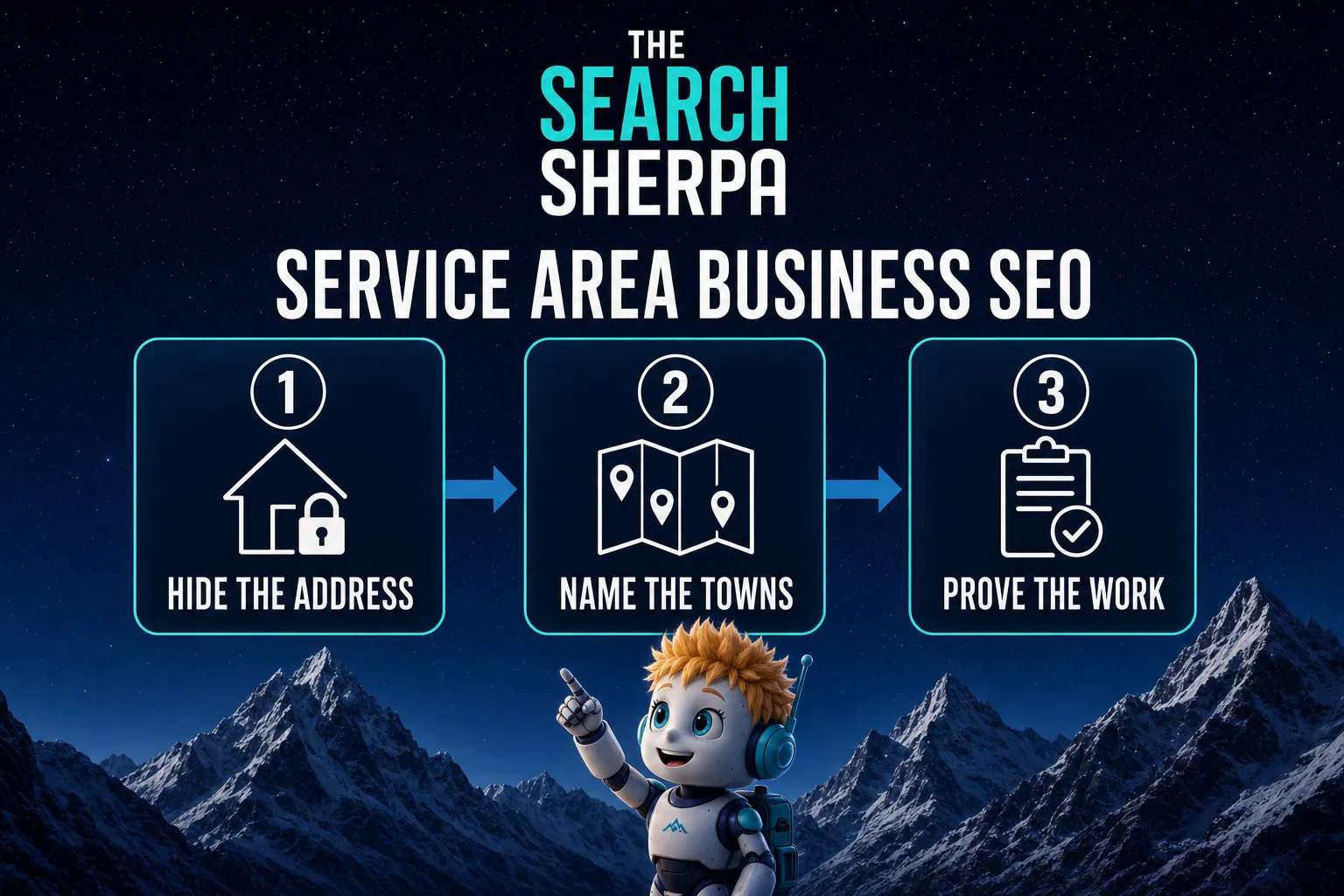
Service area business SEO is how a contractor without a storefront gets found in the towns it drives to. The short version is simple. Hide the home address on your Google Business Profile, name the towns you actually serve, and give searchers in each town a reason to trust you.
This guide is for plumbers, HVAC companies, electricians, landscapers and other trades that drive to the job. It covers the profile settings Google asks for and why map visibility thins out at a town line. It also shows how to reach more towns without doorway pages, with local rules and Census counts for Mokena, Frankfort, New Lenox, Tinley Park, Manhattan and Lockport.
The Search Sherpa is a founder-led SEO practice in Mokena, Illinois. We serve clients remotely and meet by appointment in Mokena, and we have no office in any other town. If your business has two or more staffed locations, our guide to multi-location SEO for businesses with two or more locations fits better. If you are choosing a firm, our note on how a search for local SEO agencies near you works covers that question.
What service area business SEO means for a contractor
Service area business SEO is the work of making a contractor who travels to customers easy to find in each town it serves. For a Will County trade, that means a Google Business Profile with the home address hidden, a service area named town by town, and a website that proves the work in each of those towns.
Google’s help page on managing service areas defines a service-area business as one that “visits or delivers to customers directly but doesn’t serve customers at their business address.” Its examples are “cleaning services or plumbers.” A plumber, electrician or landscaper who works at the customer’s home fits that description.
Service-area, hybrid or storefront: choose the true one
Google also recognizes a hybrid business, one that “serves customers at its business address but also directly visits or delivers to them.” The same page adds: “If your business doesn’t have permanent on-site signage, it’s not eligible as a storefront and should be listed as a service-area business.” Google’s guidelines for representing your business use an auto repair shop with roadside service as the hybrid example. A landscaper whose yard customers never visit is a service-area business. A shop with signs, posted hours and staff at the counter may be hybrid. Pick the type that is true today, because every other setting follows from it.
Set up your Business Profile the way Google asks
The map result is your Business Profile, so start there. Google’s guidelines say it plainly: “If you’re a service-area business, you should hide your business address from customers.” The example is close to home for many trades: “if you’re a plumber and run your business from your residential address, clear the address from your Business Profile.”
Name as many as 20 towns, never a radius
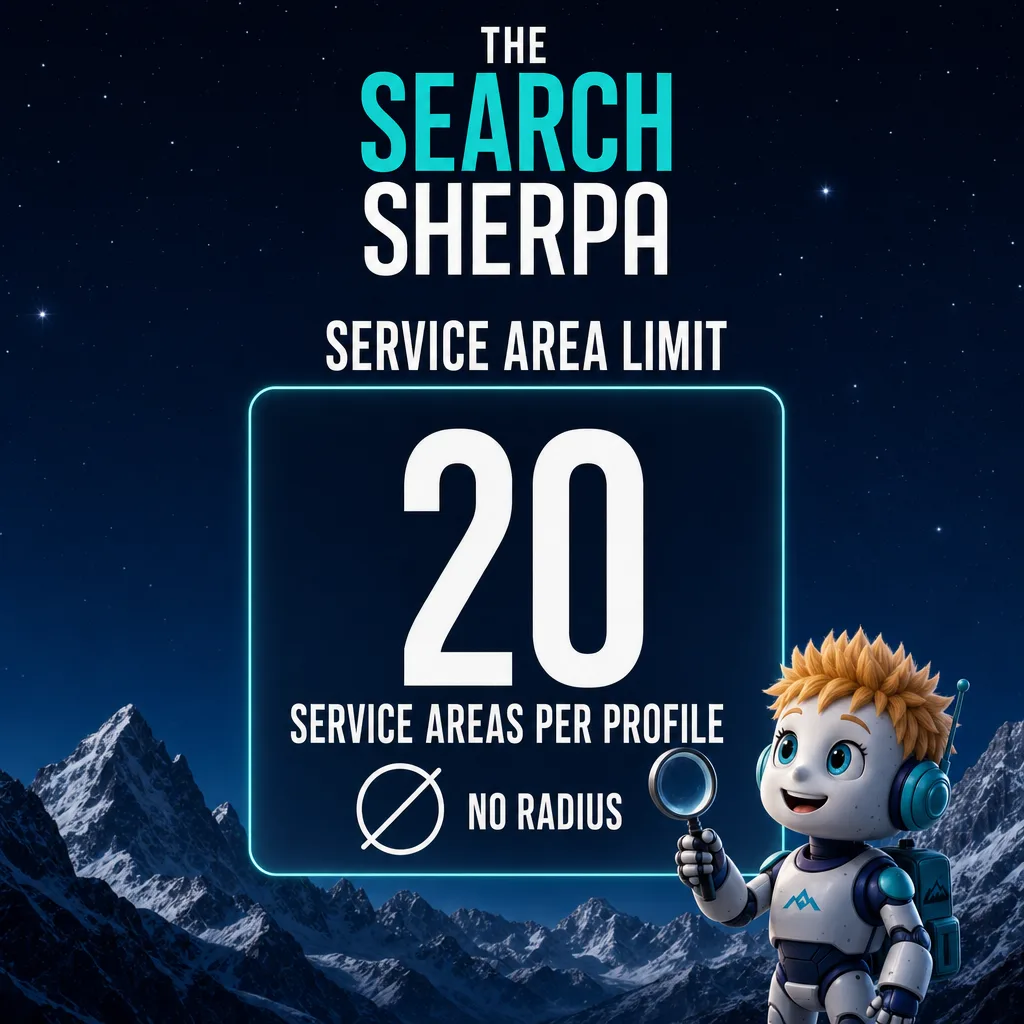
Google’s service area page says you can set as many as 20 service areas “based on the cities, postal codes, or other areas you serve.” It also says “You can’t set your service area as a radius distance around your business,” and that “The boundaries of your overall area shouldn’t be more than about 2 hours of driving time from where your business is based.” The guidelines add that “For some businesses, larger service areas may be appropriate.”
For a crew based in Mokena, that means a list, not a circle. Name the towns you actually work in, such as Mokena, Frankfort, New Lenox, Tinley Park, Manhattan and Lockport. Add postal codes only where a town name is not precise enough. Google asks you to “be as specific and accurate as possible.” Leave off any town where you would turn the job down.
One profile under your real name
Google says “Service-area businesses can only have one profile for the whole area that they serve.” A second profile for the next town is out. The exception is a second real location with its own staff and its own service area, which Google allows as a separate profile. A rented mailbox does not count. The guidelines say a rented address you do not operate from, “also known as a virtual office,” is not eligible. The name has its own rule: “Including unnecessary information in your business name isn’t permitted, and could result in the suspension of your Business Profile.” So “Smith Plumbing” stays “Smith Plumbing,” not “Smith Plumbing Mokena Frankfort.” Our Google Business Profile management service covers this setup and its upkeep.
Why map visibility thins out at the town line
Your service area tells customers where you work. It does not move your base. Google says local results are mainly based on relevance, distance, and popularity, and it measures distance from the searcher to the business. So distance helps you near your base and works against you farther out, where your website has to do more of the work.
Google’s page on how local ranking works says “Local results are mainly based on relevance, distance, and popularity.” It defines distance as “how far each business is from the customer who’s searching,” and adds: “If a customer doesn’t share where they are, Google uses what it knows about their location.” The page does not say that adding a town to your service area changes that distance.
One interchange, three towns, two counties
Town lines here sit close together. In November 2025, the Illinois Department of Transportation announced a lighting project at the I-80 and La Grange Road interchange “in Mokena, Orland Park and Tinley Park.” One interchange touches three towns. The county changes too. In the Census ZIP Business Patterns file for 2023, the ZIP codes for Mokena (60448), Frankfort (60423), New Lenox (60451), Manhattan (60442) and Lockport (60441) carry the county name Will. Both Tinley Park ZIP codes, 60477 and 60487, carry Cook.
So a crew in one village may be the nearest choice for a searcher next door, or a distant one. It depends on where the searcher stands. Plan your profile for the towns near your base. Plan your website for the rest.
Prominence reaches farther than distance
Google describes prominence as “how well-known a business is,” based partly on “how many websites link to your business and how many reviews you have.” It also says “More reviews and positive ratings can help your business’s local ranking.” Prominence is the factor you can build across town lines. A finished job in Tinley Park or Lockport can produce a review that names the work. A supplier or the local chamber can link to your site. The same page adds: “There’s no way to request or pay for a better local ranking on Google.” Our guide to SEO for contractors covers the trade side of this work.
Cover more towns in organic search without doorway pages
Organic results are where a contractor can reach past its base, because a page about a town can be the right result for a search that names the town. It is also where doorway pages come from. Google’s spam policies describe doorway abuse as pages “created to rank for specific, similar search queries.” The examples include “Having multiple domain names or pages targeted at specific regions or cities that funnel users to one page” and “Creating substantially similar pages that are closer to search results than a clearly defined, browseable hierarchy.”
A town page earns its place when it would help someone in that town even if search engines did not exist. Before one goes live, make sure it carries these five things.
- Jobs you actually did in that town, described with the customer’s permission
- The services you offer there, each linked to its service page
- The village or city contractor rule you meet, with your registration or license status
- Photos from local jobs, not stock images
- Who shows up, how scheduling works, and how to reach you
If you cannot fill that list for a town, keep the town in your service area and leave it off your page list for now. Twenty thin pages are a doorway risk. Six useful ones are a service.
A site structure for one base and many towns
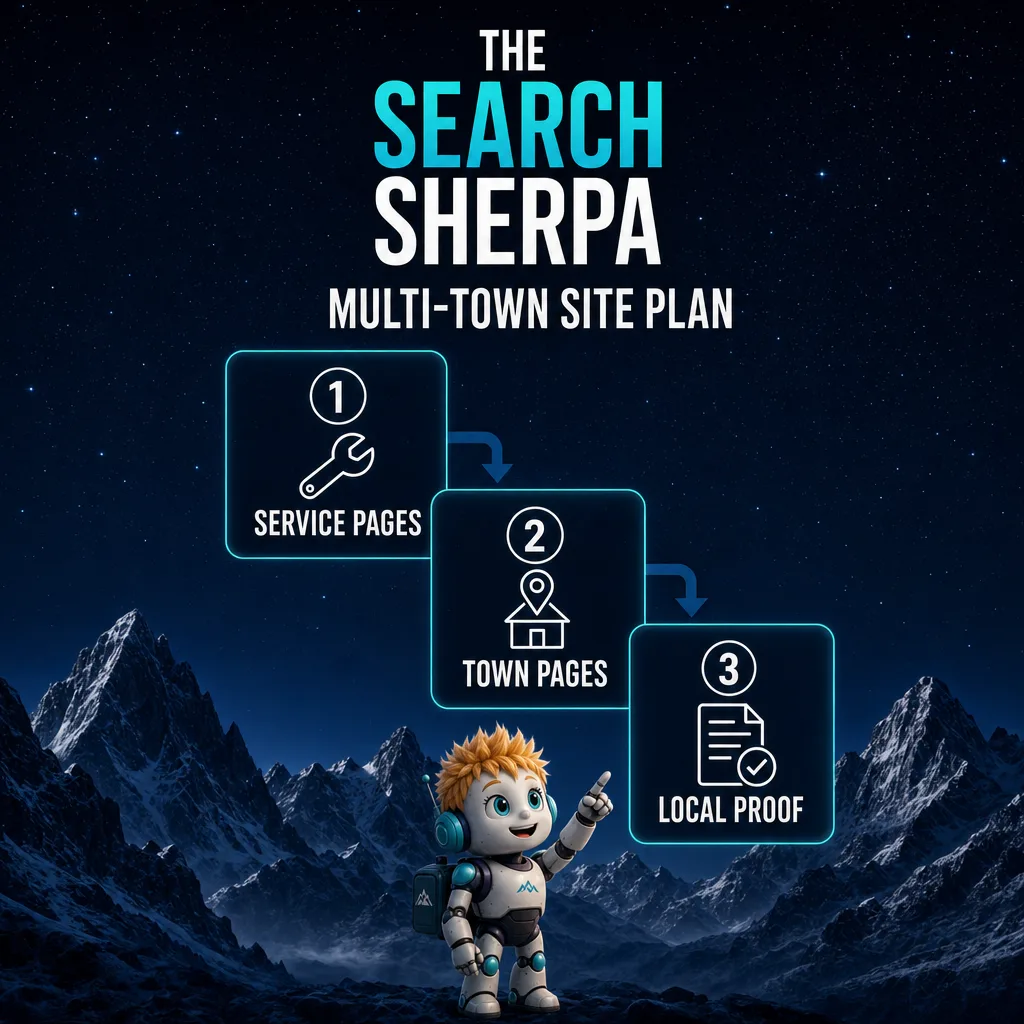
Build the site around services first and towns second. Each service, such as water heater replacement, panel upgrades or lawn care, gets its own page. Town pages link to the services you perform there, and each service page links back to the towns where you have real work to show. Google’s link best practices say Google “uses links as a signal when determining the relevancy of pages and to find new pages to crawl.” The same page says Google can generally crawl a link only when it is an HTML anchor element with an href attribute, so keep these links in plain HTML.
Our guides to HVAC SEO, electrician SEO and landscaper SEO cover the service pages for each trade. The site itself has to load fast and stay organized as it grows. That is the job of a WordPress site built for search and of technical SEO.
Six towns, six contractor rules, and the Census counts
Each town on this list sets its own rule for contractors. The table pairs Census QuickFacts counts with what each village or city website says about contractors. Population is the Census estimate for July 1, 2025. Households cover 2020 to 2024.
| Town | Population, July 1, 2025 estimate | Households, 2020 to 2024 | What the town’s website says about contractors |
|---|---|---|---|
| Mokena | 19,897 | 7,374 | Mokena contractor registration includes a $150 fee, a general liability insurance certificate at $500,000 each occurrence, and a $10,000 surety bond |
| Frankfort | 21,365 | 6,789 | Frankfort contractor license required; exempt contractors must register with the village |
| New Lenox | 28,893 | 9,134 | New Lenox contractor registration required; no building permit for an unregistered contractor |
| Tinley Park | 55,140 | 22,320 | Tinley Park contractor licensing: licensed with the Village or State before work starts |
| Manhattan | 10,943 | 3,632 | Manhattan contractor registration required; registrations expire one year after you register |
| Lockport | 27,822 | 9,903 | Lockport contractor registration required; $100 annual fee |
Use the counts to size the work in each town, not to judge the town. In the Census County Business Patterns 2023 county file, Will County has 17,085 employer establishments. Of those, 1,328 are specialty trade contractors, including 293 plumbing, heating and air-conditioning contractors and 152 electrical contractors. Another 378 are landscaping services. These are county counts, not the crews working in one town.
Turn a registration into proof on the page
A registration is a fact a customer can check, which makes it strong trust copy. Mokena’s village code says “No person shall be a contractor within the village without first having registered therefor as herein provided.” New Lenox says “No building permit will be issued for work to be done in the Village involving any contractor who is not registered.” Tinley Park says contractors “must be licensed with the Village or State (proof of state licensed required) prior to starting work.”
If you hold the registration, say so on that town’s page in plain words, with the date it renews. If you do not hold it, do not imply it. Rules change, so confirm each one with the village or city before you publish it. This is marketing guidance, not legal advice.
Write it so answer engines can repeat it
When a customer asks ChatGPT, Perplexity, Gemini, Bing Copilot, Claude or Google AI Overviews for an electrician near Frankfort, the most useful answer is a plain statement. It says who you are, where you are based, what you do, and which towns you serve. Your pages should make that statement easy to find and easy to quote.
For Google’s own AI features, the rules are the ordinary ones. Google’s page on AI features and your website says “There are no additional requirements to appear in AI Overviews or AI Mode, nor other special optimizations necessary.” To be a supporting link, it says, a page must be “indexed and eligible to be shown in Google Search with a snippet.” So the work is the same: clear pages, crawlable links and accurate facts.
Write one sentence on your site that states the relationship directly. For example: “Smith Plumbing is based in Mokena, Illinois, and serves Frankfort, New Lenox, Tinley Park, Manhattan and Lockport.” Use the same facts in your profile description and your main listings. Then match them in structured data. Use one business entry at your real base, list the towns as the area served, and add no business entry for a town where you have no office. Our answer engine optimization work covers this layer in more depth.
What service area business SEO costs
For a contractor serving several towns from one base, SEO usually costs $1,000 to $3,000 a month, the band we publish for local businesses. Before monthly work comes a one-time $2,000 roadmap, fully credited toward future services if you choose to move forward with us. Packages below $500 a month cannot sustain the work.
These figures come from our page on what SEO costs a local business in 2026. Cost depends on your site, your competition, and your goals. We will be clear about pricing before any work begins. The pricing page names four kinds of work in the local band:
- Google Business Profile optimization
- Local citation cleanup
- Service-plus-city landing pages
- Targeted content built to capture customers in your immediate service area
For a service area business, the service-plus-city pages are the town pages above, built only where you have real work to show. Most local SEO shows measurable movement in about three to six months, depending on competition and the condition of your site. Our pricing page says results you can clearly tie to new revenue usually take six to twelve months. We do not promise rankings, lead counts, or map placements, because no honest provider can. To scope the work for your towns, Book a Free Discovery Call.
What to ask any SEO provider about service areas
A few questions sort out most proposals. Will you add town names to my business name? Will you create a second profile for another town? Will you publish a page for every ZIP code? Can you show me a town page you built and the real jobs on it? Who does the work, and what will the first three months contain? A yes to any of the first three questions points toward a Google rule quoted above.
Frequently asked questions
Should a service area business hide its address on Google?
Yes, if customers do not come to you. Google’s guidelines say a service-area business should hide its business address from customers, and they use a plumber who runs the business from a home address as the example. Show an address only if your team receives customers there during your stated hours, which makes you a hybrid business.
How many service areas can a Google Business Profile have?
Twenty at most. Google’s service area help says you can name as many as 20 cities, postal codes, or other areas, and it does not let you set the area as a radius around your base. The overall boundary should not be more than about 2 hours of driving time from where the business is based, though Google says larger areas may suit some businesses.
How do I change my Google business address to a service area?
Edit the profile, remove the address, and enter your towns instead. Google’s help says that if you do not serve customers at your business address, you should remove the address and only enter your service area. Pick each town or postal code from the suggestions, and allow time for review, because Google says approved edits can take as long as 48 hours to show.
Can I rank on Google Maps in towns where I am not based?
Sometimes, but distance works against you. Google says local results are mainly based on relevance, distance, and popularity, and it measures distance from the searcher to the business. Google’s ranking page does not say a service area changes that distance. For towns farther out, rely on organic town pages and on prominence, which Google ties to links and reviews.
Are town pages for every city I serve doorway pages?
Not if each page is useful on its own. Google’s spam policies list doorway examples that include pages targeted at specific regions or cities that funnel users to one page. A town page that shows real local jobs, the contractor rule you meet there, and the services you offer in that town is built to stand on its own.
How long does service area business SEO take?
Most local SEO shows measurable movement in about three to six months, depending on competition and the condition of your site. Our pricing page says results you can clearly tie to new revenue usually take six to twelve months. We do not promise rankings, lead counts, or map placements in any town, because no honest provider can.
The Search Sherpa is a founder-led SEO practice in Mokena, Illinois, and you work directly with Jeremy Bengtson. If you run a contracting business that serves several towns from one base and want to be easier to find, easier to understand, and easier to choose, Book a Free Discovery Call. You can also review SEO pricing for local businesses first, or call (217) 579-8791.
Explore This Topic
Service Area Business SEO: How Will County Contractors Rank Across Town Lines

Google Business Profile Suspended? How to Appeal and What to Fix First
Google Business Profile Verification in 2026: Methods, Delays and Fixes

SEO for Auto Repair Shops (2026): How Independent Shops Get Found
SEO for Real Estate Investors: How Motivated Sellers Find You
Join Over 400,000 Entrepreneurs Getting Our Weekly Newsletter
Recent Posts
November 11, 2026
Google Business Profile suspended? The causes in Google’s own guidelines, the evidence to prepare, how to appeal once, and what not to do
November 10, 2026
Google Business Profile verification in 2026: the methods Google offers, why checks stall, what to fix first, and how home-based businesses verify.
November 9, 2026
SEO for auto repair shops in 2026: Google Business Profile categories, repair pages, honest reviews, estimate and warranty copy, and what SEO costs.