

By Jeremy Bengtson, founder of The Search Sherpa.
Medical practice SEO helps patients find your physicians and your clinic when they search Google for care nearby. It is search engine optimization for primary care, pediatric, and specialist practices, built on compliance-aware messaging.
Picture a parent looking for a new pediatrician. They type pediatrician near me, scan the map results, open two or three practice websites, and read the reviews.
In the US, pediatrician near me averages about 246,000 Google searches a month. Primary care doctor near me averages about 40,500, and doctors accepting new patients near me about 8,100. Those are 12-month averages of Google search volume via DataForSEO, pulled October 8, 2026.
Medical practice SEO makes the basics easy for those patients and for Google to find. That means where you are, whether you take new patients, and who your doctors are.
What medical practice SEO is
Medical practice SEO is search engine optimization for physician practices and outpatient clinics. It improves the website, the provider pages, the Google Business Profiles, and the reviews that patients see first. The goal is a practice that is easier to find, easier to understand, easier to choose.
Medical SEO and doctor SEO describe this same work. Healthcare SEO is the broader term, and this page covers physician practices and outpatient clinics. It uses the same basics as any local SEO, with a higher bar for accuracy, credentials, and patient privacy.
At The Search Sherpa in Mokena, Illinois, we build one visibility system instead of selling disconnected tasks. It connects local SEO, your website, your Google Business Profile, and your content, so every part agrees.
What Google weighs in local results
Local SEO for doctors starts with Google’s own words. Its help page on how local ranking works says, “Local results are mainly based on relevance, distance, and popularity.”
For Google, relevance is how well a profile “matches what someone is searching for.” Distance is “how far each business is from the customer who’s searching.” On popularity, Google says, “More reviews and positive ratings can help your business’s local ranking.”
Google also says, “There’s no way to request or pay for a better local ranking on Google.” So the steady work is complete, accurate information and real patient reviews. Our local SEO services page explains these factors in more depth.
Why health pages face a higher bar
Google treats health as a Your Money or Your Life topic, or YMYL. Its guide to creating helpful, reliable content explains the stakes. It says its systems “give even more weight to content that aligns with strong E-E-A-T” for those topics.
E-E-A-T stands for experience, expertise, authoritativeness, and trustworthiness. Google adds, “Of these aspects, trust is most important.” The same guide says YMYL content “must be highly accurate and consistent with established expert consensus.”
Google’s Search Quality Rater Guidelines say, “Pages on clear YMYL topics require the most scrutiny for Page Quality rating.” Raters do not set rankings, though. The guidelines say “No single rating can directly impact how a particular webpage, website, or result appears in Google Search.”
Google’s guide asks, “Do pages carry a byline, where one might be expected?” It also says fabricating creator profiles with AI-generated headshots or false credentials “is a form of deception.”
We know the line between marketing a service and making clinical claims, and we stay on the right side. Medical statements on your pages should be reviewed by your clinicians.
Who medical practice SEO fits, and who it does not
This work fits physician practices and outpatient clinics that want patients to find them in Google Search and Google Maps. That includes family medicine, internal medicine, and pediatric practices.
It also fits specialist practices, such as orthopedics, cardiology, allergy, or medical dermatology. Group practices with several doctors under one name fit too. Practices with more than one office should also read SEO for several locations.
Dental offices should read our page on SEO for dental practices, and chiropractic offices our page on chiropractor SEO.
Med spas belong on our med spa marketing page. Clinics with weight loss or GLP-1 programs should read our page on medical weight loss marketing.
It is not a fit if you want a promise of rankings or a set number of new patients. Nor is it a fit if you mainly want paid ads, Local Services Ads, social media management, or email marketing. The Search Sherpa does not sell those services.
Provider pages and credentials
A provider page introduces one doctor to a patient who is deciding whether to call. It should say who the doctor is, what they do, where they practice, and whether they take new patients.
Whoever builds your site, a good provider page passes a compliance-aware checklist like this one. The first six items sit on the page, where patients can check them. The last four are internal checks before it goes live.
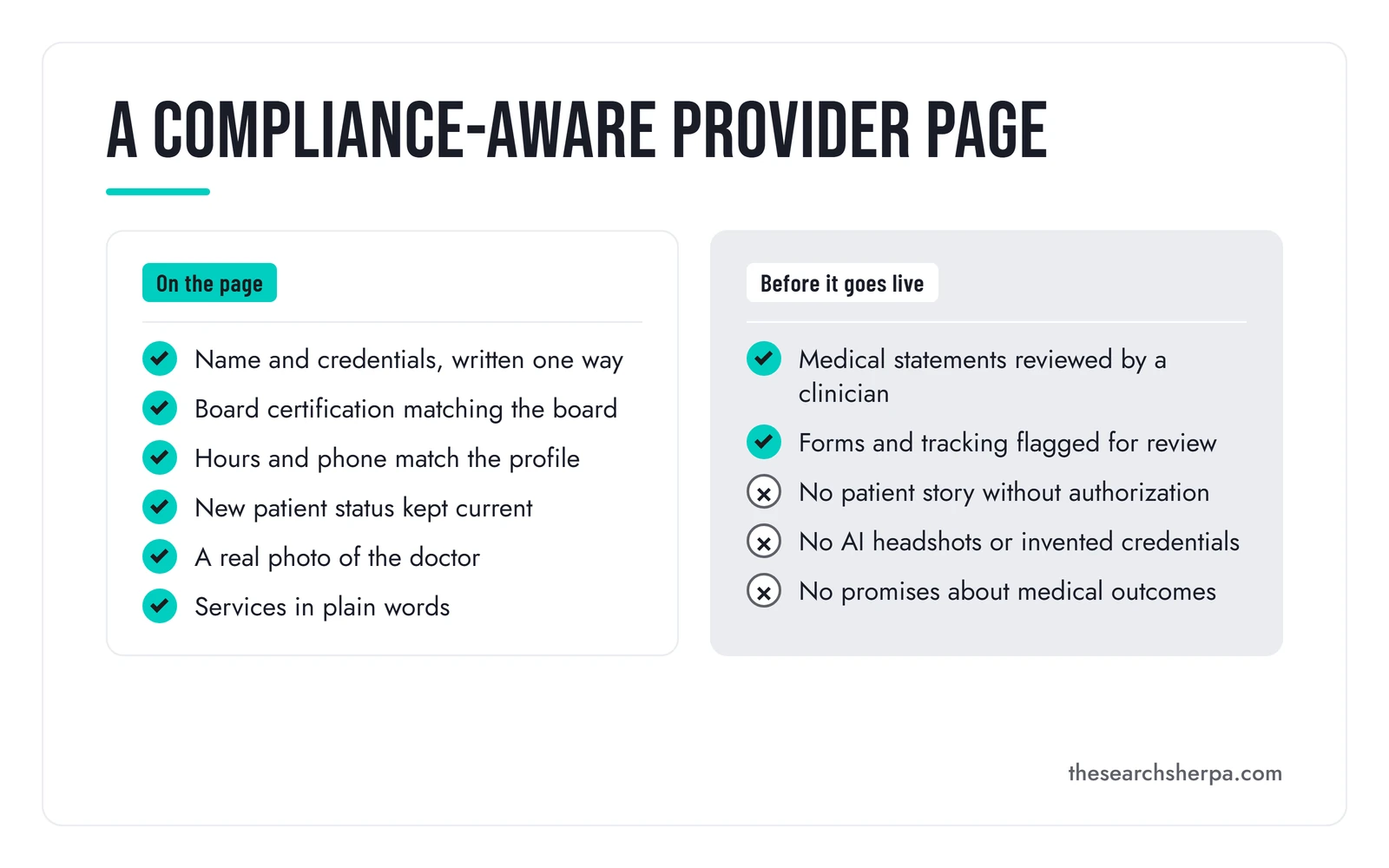
- Name and credentials written one way, such as MD or DO, everywhere they appear.
- Board certification shown only as the certifying board lists it.
- Hours and phone number that match the practice’s Google Business Profile.
- New patient status kept current, so patients are not turned away after they call.
- A real photo of the doctor, taken for the page.
- Services described in plain words.
- Medical statements reviewed by a clinician before the page goes live.
- Forms and tracking flagged for compliance review.
- No patient story without the written authorization HHS describes below.
- No AI headshots or invented credentials, and no promises about medical outcomes.
Credentials patients can check
The American Board of Medical Specialties runs Certification Matters, a lookup that asks, “Is My Doctor Board Certified?” Illinois offers a state License Lookup for professional licenses.
So every title on the page should match those records exactly. Google’s rater guidelines list an example of harmfully misleading information. It is “a creator blatantly misrepresenting their medical credentials for a video on medical topics.”
Schema markup for doctors and clinics
Schema markup labels a page’s facts so search engines can read them. Schema.org defines an IndividualPhysician type as “An individual medical practitioner.” Clinics get a MedicalClinic type.
Properties for an individual practitioner include medicalSpecialty, isAcceptingNewPatients, and usNPI. Schema.org describes an NPI as “a unique 10-digit identification number issued to health care providers in the United States by the Centers for Medicare and Medicaid Services.”
Markup only helps when it matches what the visible page says. Page-level schema like this is part of our on-page SEO services.
Practice and practitioner Google Business Profiles
Google’s Business Profile guidelines define an individual practitioner as “a public-facing professional, typically with their own customer base.” In Google’s words, “Doctors, dentists, lawyers, financial planners, and insurance or real estate agents are all individual practitioners.”
Google then gives two conditions for a dedicated profile. First, the doctor operates “in a public-facing role.” Second, the doctor “can be contacted directly at the verified location during stated hours.”
Google adds, “Support staff should not create their own Business Profiles.” A solo doctor at a branded practice follows a separate rule, covered next.
Several doctors, or one doctor, at a location
When several public-facing doctors share a location, Google says “The organization should create a Business Profile for this location, separate from that of the practitioner.” Each doctor’s profile then uses only the doctor’s name, not the practice name.
A solo doctor at a branded practice is different. Google says it is best for that doctor to share one profile with the organization, named “[brand/company]: [practitioner name].”
Google also says “A practitioner shouldn’t have multiple Business Profiles to cover all of their specializations.” A profile may include a title or degree, such as Dr. or MD.
Names, categories, and departments
For the practice’s own profile, Google asks for the business’s real-world name. That means the name “as used consistently on your storefront, website, stationery, and as known to customers.” Google warns, “Including unnecessary information in your business name isn’t permitted, and could result in the suspension of your Business Profile.”
For categories, Google asks for “the fewest number of categories it takes to describe your overall core business.” Its test is whether a category completes the statement “This business IS a,” not “this business HAS a.” Our guide to choosing Google Business Profile categories walks through it.
Larger clinics may have departments. Google says departments within “businesses, universities, hospitals, and government institutions may have their own Business Profiles on Google.” It adds, “Publicly-facing departments that operate as distinct entities should have their own page.”
Keeping every profile accurate is ongoing work, which our Google Business Profile management service covers.
Reviews within the rules, and patient privacy
A medical practice can ask patients for honest reviews, with no incentive and no screening for happy patients. Replies are public, so they stay free of any patient details. HHS’s Office for Civil Rights has settled with a practice over an impermissible disclosure of patient information in review replies.
Asking for reviews the right way
Google’s Maps content policy lets merchants “Solicit or encourage the posting of content that does represent a genuine experience.” It does not let them offer incentives or “selectively solicit positive reviews from customers.”
Google adds that merchants “should not require or pressure users to leave ratings or write reviews while on the premises.” It also bars requests for specific content, “including content that identifies a staff member.” So a front desk should not ask patients to name their doctor.
The FTC’s rule on consumer reviews and testimonials took effect on October 21, 2024. The FTC’s questions and answers take up asking for reviews only from customers a business thinks are happy. The answer reads, “The rule does not contain a specific prohibition against such conduct. But this practice could violate the FTC Act.”
A good request is general and goes out the same way every time. We keep review requests clear of patient health information, so no request is tied to a patient’s treatment or records. Our page on reputation and review management covers the ongoing side.

Replies, testimonials, and website tracking
OCR settled with a dental practice “over the impermissible disclosure of patient protected health information (PHI) in response to online reviews.” A careful reply thanks the reviewer and offers to talk offline, with no care details. When a review breaks Google’s policies, our guide on how to remove a Google review explains how flagging works.
In a September 30, 2025 settlement announcement, OCR Director Paula M. Stannard said, “Generally, a valid, written HIPAA authorization from an individual is necessary before a covered entity or business associate can post that individual’s PHI in a website testimonial or through a social media campaign.”
Website tracking is the third area. HHS’s bulletin on online tracking technologies says, “Regulated entities are not permitted to use tracking technologies in a manner that would result in impermissible disclosures of PHI to tracking technology vendors or any other violations of the HIPAA Rules.” It adds that banners asking visitors to accept or reject tracking “do not constitute a valid HIPAA authorization.”
On June 20, 2024, a federal court in Texas vacated part of the bulletin.
The vacated part concerned public pages that need no login. It covered tracking that ties a visitor’s IP address to such a page about specific conditions or providers. HHS says it “is evaluating its next steps in light of that order.”
The rest of the bulletin remains on the HHS site. It says tracking technologies on pages that need a login, such as a patient portal, “generally have access to PHI.”
Business associate agreements and de-identification are safeguards, not proof of compliance. HHS’s page on business associates says a practice may share PHI with one after obtaining “satisfactory assurances” in a written agreement. The tracking bulletin calls it “insufficient” for a vendor to agree to remove or de-identify PHI after receiving it.
In its FAQ on certifying compliance, HHS says it does not endorse or recognize private Security Rule certifications. So a vendor calling itself HIPAA compliant is making a marketing claim, not reporting an HHS finding.
OCR counts most health care providers as covered entities, so these obligations sit with the practice. The Search Sherpa is a visibility specialist, not a HIPAA compliance officer or an attorney. We keep marketing data handling careful and flag anything that needs your compliance advisor to confirm.
This is marketing guidance, not legal advice. Confirm any handling of patient data with the counsel or compliance advisor who supports your practice.
What is included, and how the work runs
Here is what each part of the work covers.
| Part of the work | What it covers | Why it matters to a practice |
|---|---|---|
| Visibility Review | Your website, local search presence, Google Business Profile, reviews, and competitors | Shows where patients lose track of you before they call |
| Local SEO | Google Business Profile completeness and accuracy, and a consistent name, address, and phone number across the web | Conflicting details make Google less confident about where you are |
| Website and service pages | Service pages, headings, and titles that say plainly what you offer, plus internal links | Patients and Google can see which care you provide |
| Technical SEO | Site speed, mobile-friendliness, clean structure, and schema markup | Pages work well on a phone and are easy for Google to read |
| Reviews | A steady review habit, with requests kept clear of patient health information | Reviews can help local ranking and patient trust |
| Content | Service content that markets your care without making clinical claims | Pages stay within compliance-aware messaging |
| Reporting | Plain-English reporting, with Google Search Console and analytics checks | You see what changed without a wall of numbers |
| Ownership | Your Google accounts stay in your name, month to month, with no contract | Your profiles, website, and data stay yours |
The work runs in four steps.
- Visibility Review. We look at your website, your local search presence, your Google Business Profile, your reviews, and your competitors.
- Strategy Map. We build a prioritized plan for your website, local SEO, content, technical fixes, and trust signals. You get a plan you can understand and approve before anything starts.
- Build and Optimize. We improve your service pages, internal links, schema, local profile, review habit, and conversion paths. The visibility system gets built and refined.
- Measure and Refine. We track real movement, watch how patients search, and improve the work over time. You get plain-English reporting.
You work directly with Jeremy Bengtson, the founder. We use tools like Semrush, Rank Math, and Google Search Console to guide decisions, not to bury you in charts. For what a monthly report should hold, read what your SEO agency should be showing you.
Most local SEO shows measurable movement in about three to six months, depending on competition and the condition of your site. A newer practice in a busy market takes longer than an established one in a smaller area. We do not promise rankings, lead counts, or map placements, because no honest provider can.
What medical practice SEO costs
For most local practices, monthly SEO runs between about $1,000 and $3,000. Every engagement begins with a $2,000 Custom SEO Roadmap, credited toward your first month if you continue with us.
Cost depends on your site, your competition, and your goals. We will be clear about pricing before any work begins.
Our pricing page says, “Small local businesses generally invest $1,000 to $3,000 monthly for map pack visibility and local search.”
The same page warns that “SEO packages priced below $500 per month cannot sustain the labor-intensive work required for legitimate organic growth.”
Pricing is set once we have seen your site and your market. No contracts. Clients stay because the work earns it.
Frequently asked questions
What is SEO in healthcare?
SEO in healthcare is search engine optimization for doctors, clinics, and other providers. It helps patients find a practice in Google Search and Google Maps. Google holds health pages to a higher standard, because it treats health as a Your Money or Your Life topic.
How much does it cost to hire someone to do SEO?
For most local practices, monthly SEO runs between about $1,000 and $3,000. Packages below $500 a month cannot sustain the work. With us, the first step is a $2,000 Custom SEO Roadmap, credited toward your first month if you continue.
Is SEO being phased out?
No. Google’s guide to AI features and your website says, “The best practices for SEO remain relevant for AI features in Google Search (such as AI Overviews and AI Mode).” It adds that those features have no additional requirements, so a well-built practice website still matters.
Can a medical practice ask patients for Google reviews?
Yes, within Google’s rules, which allow requests for reviews of a genuine experience with no incentive. Google bars selectively asking for positive reviews. HHS’s Office for Civil Rights has also settled with a practice over patient information disclosed in review replies.
How long does medical practice SEO take to work?
Most local SEO shows measurable movement in about three to six months, depending on competition and the condition of your site. A newer practice in a busy market takes longer than an established one in a smaller area.
Do you run Google Ads or Local Services Ads for medical practices?
No. We do not sell paid ads, Local Services Ads, social media management, or email marketing. We focus on organic visibility: your website, your Google Business Profiles, your reviews, and your content.
How to start
The first step is the Custom SEO Roadmap. Over approximately four weeks, it covers a technical site audit, Google Business Profile review, backlink profile assessment, and competitor analysis. It also covers keyword opportunity mapping and a content strategy.
If you continue with us, “the $2,000 is credited fully toward your first month of retainer services.” If you hand the plan to your own team instead, “it is yours to keep.”
If you want your practice to be easier to find, start with a conversation. Review our SEO pricing, then book a call with Jeremy or call (217) 579-8791. There is no pressure and no contract.
Explore This Topic

Hiring an SEO Consultant Chicago Businesses Can Trust

On-Page SEO Services: Improving the Pages You Already Have

Landscaping SEO for Landscapers: Two Kinds of Buyer, Two Kinds of Search

SEO Audit Services: A Prioritized Plan, Not a List of Problems

Multi-Location SEO: Local SEO for Businesses With Two or More Locations
Join Over 400,000 Entrepreneurs Getting Our Weekly Newsletter
Recent Posts
October 8, 2026
How to choose an SEO consultant in Chicago: consultant, agency, or freelancer, a decision tree, a vetting checklist, red flags, and rates in
October 8, 2026
On-page SEO services improve the pages you already have: titles, headings, copy, links, alt text, and schema. What is included, how it runs,
October 8, 2026
Landscaping SEO builds the pages and Google Business Profile work behind lawn care contracts and design-build projects. What it includes and costs.