
By Jeremy Bengtson, founder of The Search Sherpa.
A business owner sent me a proposal last month and asked one question: is this a fair price? It was for social media and content, and the number was $4,000 a month. I could not answer honestly without knowing what was underneath it, and neither could he. That is the real problem with this category. The prices are not secret so much as they are unexplained.
So I went and checked. Every price in this guide came off a provider’s own live pricing page, a Clutch profile, or a named survey, and each one is captured and linked. Where a widely repeated number did not survive that check, I say so plainly, including the ones that came from my own research pile. You should be able to open the source and see the same figure I saw.
How much does social media management cost per month?
For most small businesses, done-for-you social media management runs between about $500 and $3,000 a month. That is not my estimate. That is the range LYFE Marketing publishes on its own pricing page as the typical spend, with an entry package at $750 a month covering 12 posts across two platforms plus a one-time $300 setup fee. Their full published span runs from $500 to more than $20,000 a month depending on business size.
Social media management for a small business typically costs $500 to $3,000 per month in 2026. Scheduling software alone runs $29 to $449 per month but nobody writes or posts for you. Packages that include strategy, scripting, and publishing generally start around $2,000 to $3,000 per month.
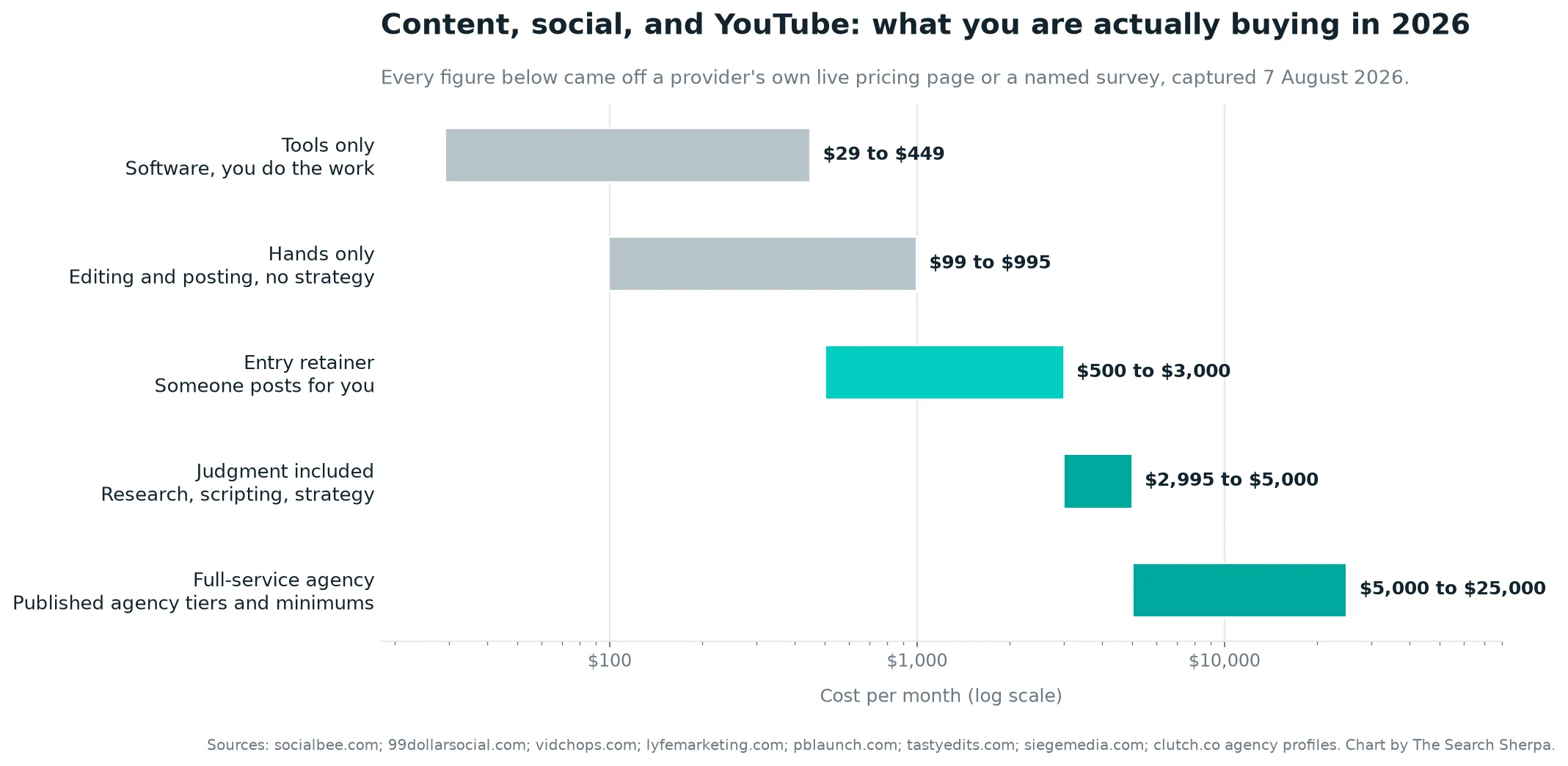
The number by itself tells you very little. What matters is which of three very different things you are buying. You can buy software, you can buy hands, or you can buy judgment. They are priced roughly ten times apart, and most confusion in this market comes from comparing one against another.
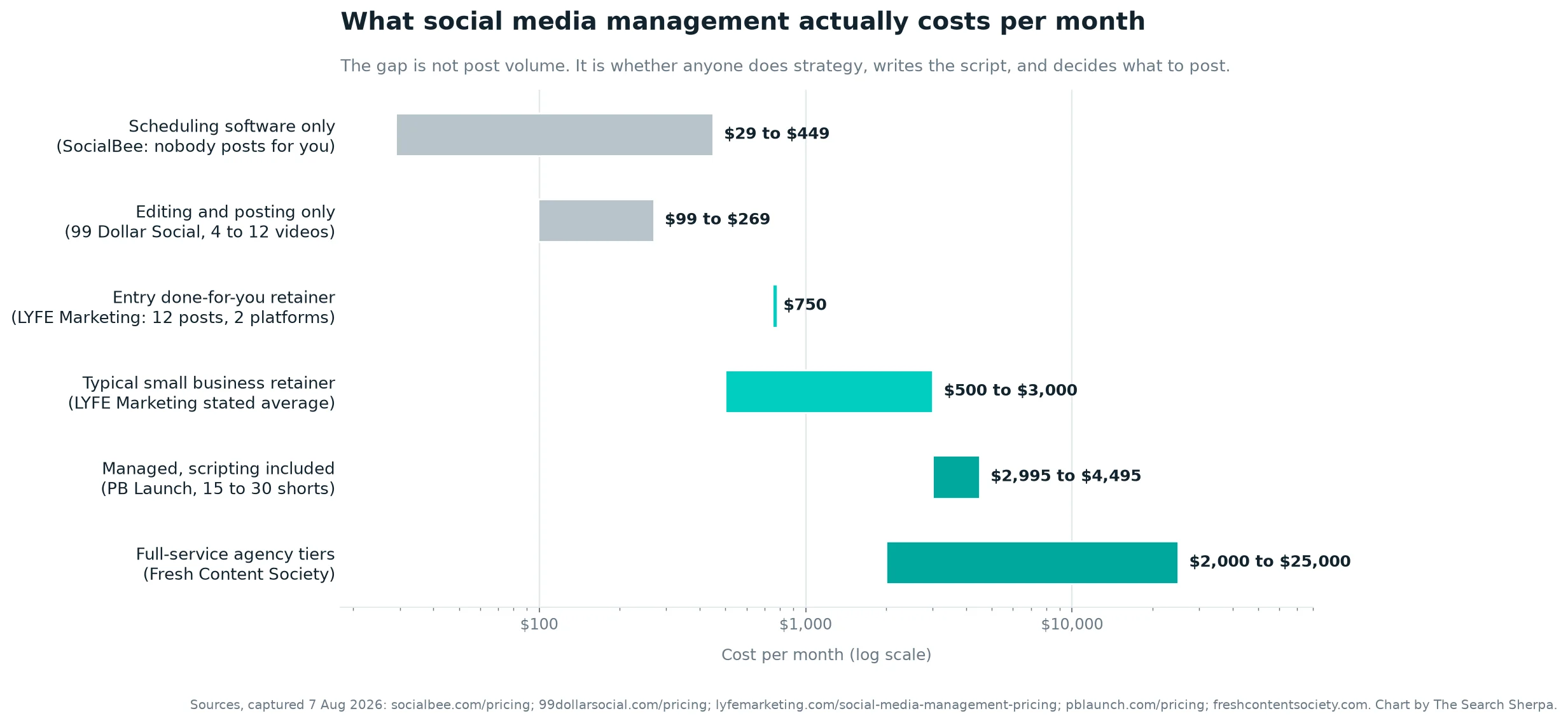
Here is the same picture as a table, with what each tier actually includes.
| What you are buying | Published price | What it does not include |
|---|---|---|
| Scheduling software (SocialBee) | $29 to $449/mo | Everything. You write it, you post it. |
| Editing and posting (99 Dollar Social) | $99 to $269/mo | Strategy, scripting, filming |
| Entry retainer (LYFE Marketing) | $750/mo plus $300 setup | Limited to 12 posts, two platforms |
| Typical small business retainer | $500 to $3,000/mo | Varies widely, ask line by line |
| Managed with scripting (PB Launch) | $2,995 to $4,495/mo | You still film the footage yourself |
| Full-service agency tiers | $2,000 to $25,000+/mo | Usually quoted, rarely published |
One more reference point worth knowing. Sprout Social, which sells software in this category, publishes its own research putting basic social management between $500 and $5,000 a month and a fully built-out program near $19,000 a month. Clutch, which collects verified client reviews, puts the average United States content marketing rate at $100 to $149 an hour. Offshore teams on the same platform show under $25 an hour. That spread is not a discount. It is a different service.
Why most published pricing guides cannot be trusted
Before you compare a single quote, you need to know how bad the published information in this category is. I want to show you two examples, and the second one is more uncomfortable than the first because it came from my own desk.
Most agency pricing listicles are marketing, not research. Before you trust any published price range, open the provider’s own live pricing page and confirm the number yourself. If the range has no source link, treat it as an advertisement.
The first example is a widely shared article ranking the ten best personal branding agencies in the United States, with a tidy monthly price range next to each firm. The publisher ranked itself first. When each listed company was checked against company registries, Clutch profiles, and their own websites, most of them turned out to be small design freelancers based in the United Kingdom, not American personal branding agencies. One had no meaningful public footprint at all. The single genuinely large firm on the list, a global business-to-business agency, carries a documented minimum project size above $50,000, while the article assigned it a band of $3,500 to $7,500 a month. None of the ten price ranges carried a source.
The second example is the correction to that article. I had research in hand that debunked the listicle and then offered its own list of ten American agencies with its own prices. It seemed reasonable. So I had every claim in it checked too, and several did not hold up.
- One firm was described as charging $2,000 to $5,700 monthly. Its live pricing page shows $2,000 as the only monthly tier, and $5,700 as a one-time twelve-week project fee. The company is also headquartered in Canada, not the United States.
- Another was said to start around $21,000 for project work. That figure traces back to a single content-mill website. The firm’s Clutch profile lists pricing as undisclosed, and the one real client review on file shows $8,000. The agency has also been part of Hawke Media since 2024, which the description did not mention.
- A third was credited with retainers starting around $5,000. That brand no longer exists. It was absorbed into Intero Digital and its domain now redirects there.
- A fourth was presented as a firm with United States reach. Its primary base is Dubai.
I am not telling you this to be clever about someone else’s article. I am telling you because I nearly published those numbers myself, and the only reason I did not is that every figure got checked against a live page before it went in. That is the standard I would want from anyone quoting you a price, and it is the standard the rest of this guide is held to.
For the record, here is what did survive verification in that same category. Ascendant Group Branding lists a minimum project size above $25,000 and rates above $300 an hour on its Clutch profile. Neither Weber Shandwick nor Edelman publishes pricing at all, and the $20,000 to $50,000 monthly figures you see quoted for them come from third-party buyer guides, not from the firms.
What content creation actually costs
Written content has the widest price spread of anything in this guide. The same deliverable, one 1,500-word article, ranges from about $35 to about $1,500 depending entirely on who writes it and what they do before they start writing.
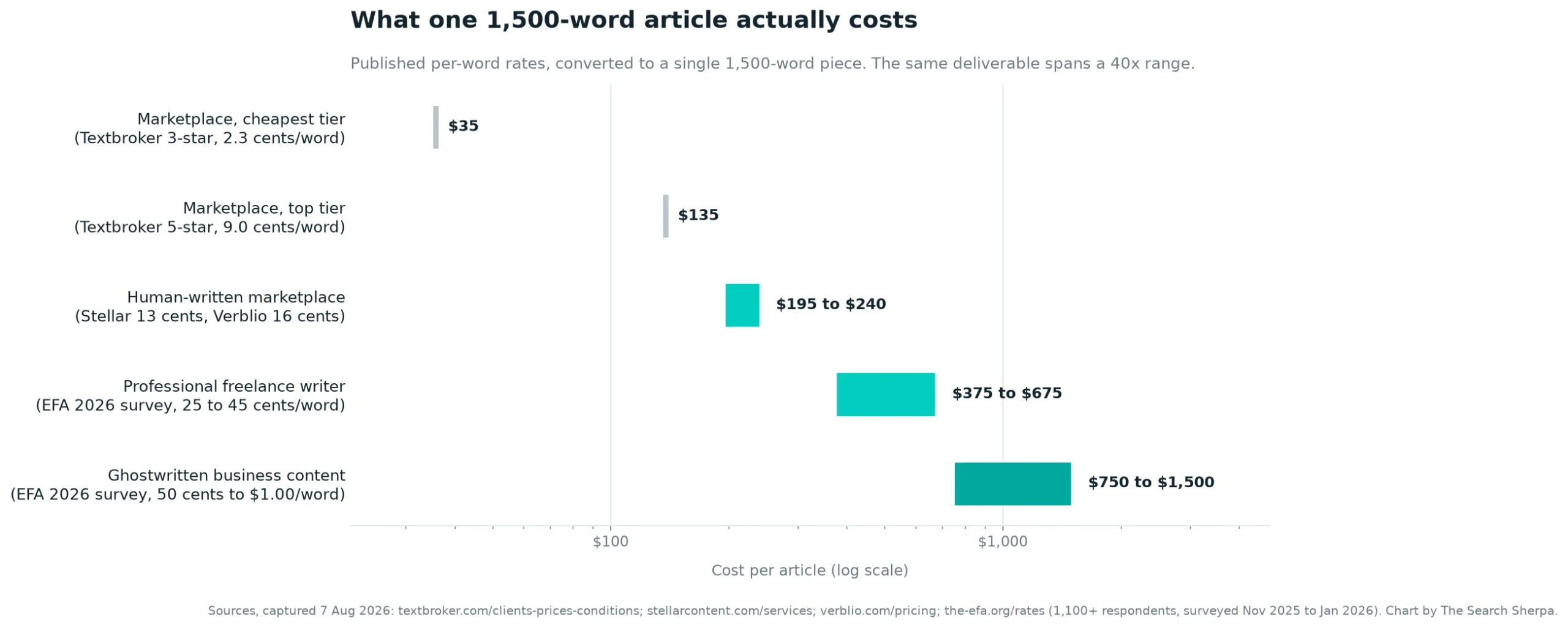
The clearest evidence for what the cheap end leaves out comes from a marketplace’s own price list. Textbroker sells writing by quality tier, and it describes its own tiers honestly. The 2.3 cents per word tier is labeled average-quality writing. The phrase professional-quality writing ready for use is reserved for the 9.0 cents per word tier. The vendor is telling you, in its own price list, that the bottom tier is not publish-ready.
Other marketplaces publish openly too. Verblio charges 6 cents per word for a hybrid of artificial intelligence and human editing, plus a $49.50 monthly platform fee, and 16 cents per word for fully human writing. Stellar, formerly Crowd Content, starts at 13 cents per word self-serve. Compose.ly publishes managed content from $700 a month for artificial-intelligence-assisted work and $900 a month for human-written, with a separate SEO service line from $2,500 a month.
Now compare that to what experienced writers actually charge. The Editorial Freelancers Association 2026 rate chart surveyed more than 1,100 members between November 2025 and January 2026. Median blog writing came in at 25 to 45 cents per word, and ghostwritten business and marketing content at 50 cents to $1.00 per word. That is five to ten times the marketplace floor for the same word count.
The same survey contains a detail I find more useful than any of the headline numbers. Copyediting business content runs 3 to 4 cents per word. Writing it runs 25 to 45 cents. Editing is roughly a tenth the cost of writing, which tells you exactly how much of a low quote can possibly be going toward original thinking.
At the agency level, most firms stop publishing. Siege Media is a useful exception and states a content marketing minimum of $8,000 a month in its own FAQ. Clutch profiles put Brafton at $5,000 and above, Grow and Convert at $10,000 a month, and Foundation at $25,000 and above. Animalz, a well-known content agency, published a post about why nobody shares content pricing publicly and then put its own numbers behind an email form.
One trap worth naming. WebFX publishes SEO content plans from $600 a month, and that price buys analysis and recommendations, not written articles. It is clearly described on their page. It is also exactly the kind of line a busy owner skims past and assumes includes the writing. Read what the deliverable is, not what the category is called.
What YouTube strategy actually costs
YouTube is where the gap between editing and strategy is easiest to see, because one vendor publishes every rung of the ladder. That makes it possible to isolate what scripting and planning actually add to a price.
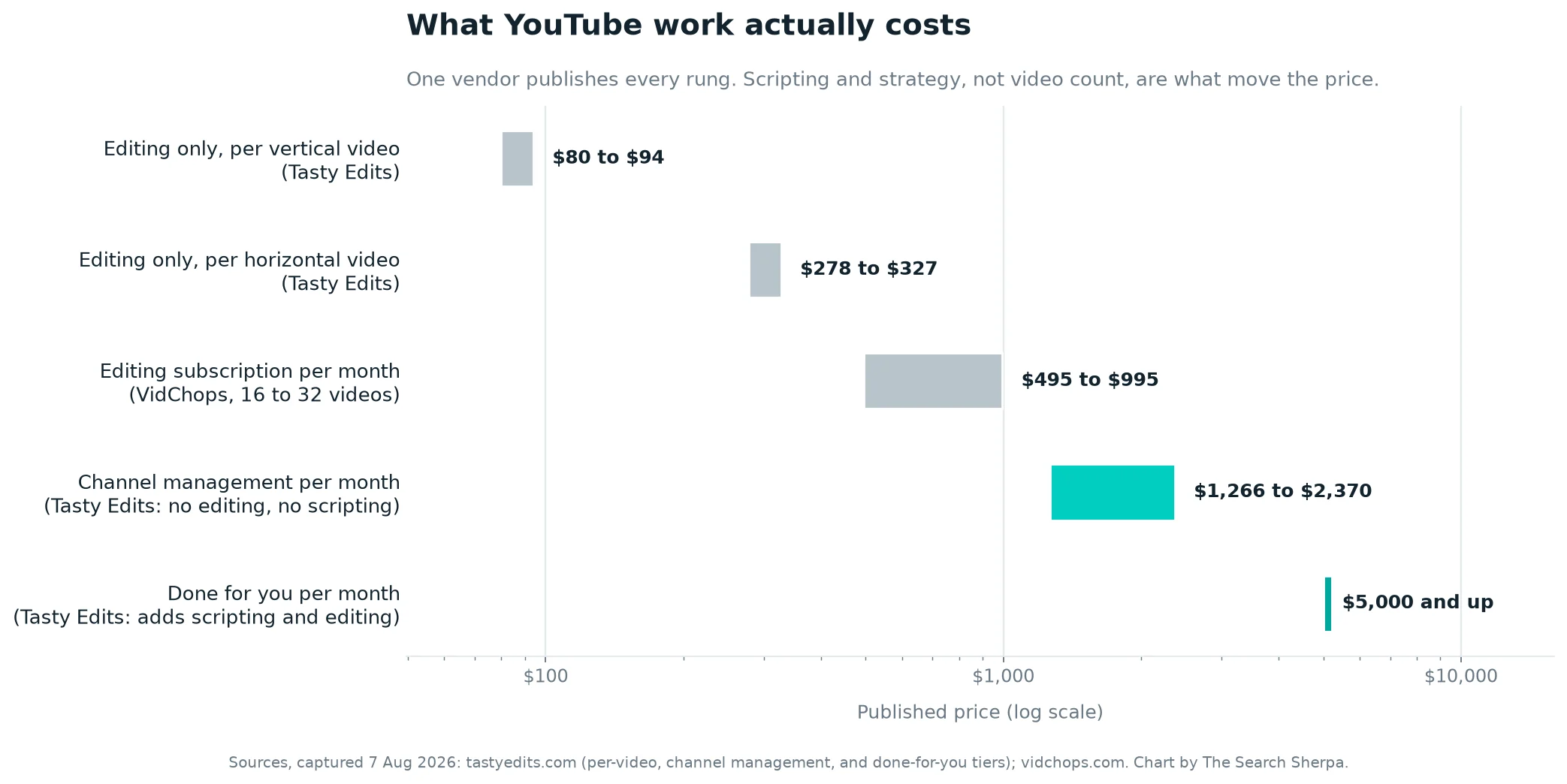
Editing alone is cheap and getting cheaper. Tasty Edits publishes $80 to $94 per vertical video and $278 to $327 per horizontal video. VidChops runs $495 a month for four credits and $995 a month for eight with unlimited revisions. Vidpros publishes $1,000 a month for a part-time dedicated editor and $4,000 a month for full-time.
Channel management without editing or scripting sits at $1,266 to $2,370 a month at that same vendor. Their done-for-you tier, which adds scripting and editing, starts at $5,000 a month. That single vendor comparison is the cleanest answer to what strategy costs that I found anywhere: roughly double, for the same channel.
Scriptwriting on its own is far cheaper than most guides claim, and this is where I have to correct my own starting research. It suggested short-form scripts start around $20 and that ghostwritten long-form scripts run $1,500 to $15,000. Live marketplace listings do not support either end. Short scripts on Fiverr start at $5. A Fiverr Pro documentary writer publishes $80 for a ten-minute script, $150 for twenty minutes, and $500 for a sixty-minute script of more than 8,000 words. Experienced YouTube scriptwriters on Upwork, including some with more than 100 million views behind them, list between $4 and $15 an hour. No live listing above $500 for a standalone script turned up anywhere.
If you are budgeting full video production rather than channel management, the working benchmark across multiple industry sources is $1,000 to $10,000 per finished minute, with a 2026 median closer to $2,000 to $2,500. Those are third-party estimates rather than a single named survey, so treat them as a planning range and not a quote.
What the cheap end actually leaves out
Put the three categories side by side and the same pattern shows up in all of them. The low tier is never a discount on the same work. It is a smaller amount of work.
- Research. Nobody is looking at what your customers search, what competitors already rank for, or which questions are unanswered. This is the first thing cut and the most expensive to skip.
- Strategy. Somebody has to decide what to publish and why. At $99 a month, that person is you.
- Original expertise. A 2.3 cents per word writer does not know your industry. For healthcare, legal, and financial businesses, content that cannot show real expertise tends to get suppressed rather than ranked.
- Editing and fact-checking. Priced separately almost everywhere, and usually absent at the bottom tier.
- Structure that machines can read. Schema markup, clean headings, and answer-first passages are what let search engines and AI tools quote you. Volume posting does none of it.
This is the same arithmetic behind our position on SEO pricing, where we have said for a while that packages under $500 a month cannot fund the labor they claim to cover. The published rate cards in this article are the proof, from vendors who have no reason to make our argument for us.
How to read a proposal without getting talked into something
You do not need to become an expert in this to buy well. You need about six questions, and the answers tell you almost everything.
- Who actually writes it, and can I see three pieces they wrote? Not agency samples. That person’s work.
- What happens before writing starts? If there is no research or brief step, you are buying volume.
- Is this per post, per month, or per credit? Ask for the effective cost per finished piece. Vendors price in different units on purpose.
- Do I own it if I leave? Get it in writing. Your content and your data should always be yours.
- What does month three look like versus month one? Good answers involve measurement and adjustment. Weak answers involve more of the same.
- What is the exit? Long lock-in contracts protect the agency, not you. We do not use them, and you should ask why anyone does.
Also be honest about the tradeoff you are making. If your budget is genuinely $300 a month, a scheduling tool plus your own hour a week will usually beat a $300 done-for-you package. Spending a small budget on someone else’s low-effort output is the one option that reliably produces nothing.
Where this fits with search and AI visibility
The reason I care about this beyond the invoice is that content is no longer only read by people. It is read by search engines, and increasingly by ChatGPT, Perplexity, Gemini, and Google AI Overviews when they assemble an answer about your business.
Those systems do not reward volume. They quote sources that are clearly structured, factually specific, and consistent with everything else they can find about you. That is why we treat content as part of one visibility system rather than a monthly quota, and it is what our SEO content strategy work is built around. The structural side, making sure the machines understand who you are and what you offer, is entity optimization, and the answer-engine side is AI search optimization. If you want the same sourced treatment for that side of the work, we wrote about what AI search optimization costs as well.
None of that requires the biggest budget on this page. It requires that the money you do spend goes toward research, structure, and real expertise rather than toward filling a calendar.
Frequently asked questions
How much does social media management cost?
For most small businesses, $500 to $3,000 per month. Entry done-for-you packages start near $750 a month for around 12 posts across two platforms. Scheduling software alone is $29 to $449 a month, but it does not write or post anything for you. Packages that include strategy and scripting generally begin around $2,000 to $3,000 a month.
How much does a social media management package cost?
Published packages in 2026 run from $99 a month for editing and posting only, through $750 a month for a small entry retainer, and on to $2,995 to $4,495 a month for managed programs that include scripting and research. Full-service agency tiers are published between $2,000 and $25,000 a month. Ask what the effective cost per finished piece is, because vendors price in different units.
Is it worth paying a social media manager?
It depends on whether you are buying hands or judgment. Paying someone to post content you still have to plan rarely pays for itself. Paying for research, strategy, and content built to be found in search and quoted by AI tools usually does, though it typically takes three to six months to show measurable movement, depending on your competition and the condition of your site.
Can AI replace a social media manager?
Not the strategy, and not for regulated industries. Artificial intelligence has genuinely lowered production costs, which is visible in published rates. Verblio charges 6 cents per word for hybrid work against 16 cents for fully human writing. What it does not replace is deciding what is worth saying, and verifying that it is true. Published content that cannot demonstrate real expertise tends to be suppressed rather than rewarded.
How much should a small business budget for content creation?
A useful floor is what one genuinely good article costs. Professional freelance blog writing ran 25 to 45 cents per word in the Editorial Freelancers Association 2026 survey, so a 1,500-word piece lands between about $375 and $675. Four strong pieces a quarter beats twelve thin ones, and costs less.
What does YouTube channel management cost per month?
Editing-only subscriptions publish at $495 to $995 a month. Channel management without editing or scripting publishes at $1,266 to $2,370 a month. Done-for-you management that adds scripting and editing starts around $5,000 a month. Many agencies in this category do not publish pricing at all.
Why do so many agencies hide their pricing?
Some scopes genuinely vary. But the pattern is worth noticing: marketplaces that sell a defined unit publish openly, while agencies selling judgment usually do not. One well-known content agency published an article about pricing transparency and then placed its own numbers behind an email form. Gated pricing is not automatically a problem. Gated pricing plus a vague scope is.
How do I check whether a published price range is real?
Open the provider’s own pricing page and confirm the number. Then check whether the company is where the article says it is, and whether it still operates under that name. When we ran that check on a widely shared agency listicle, most listed firms were small overseas freelancers rather than the American agencies described, and none of the price ranges carried a source.
Getting a straight answer about your own numbers
If you are holding a proposal right now and cannot tell whether it is fair, that is not a knowledge gap on your part. It is a scope that has not been explained. Send it over and I will tell you what is actually in it and what is missing, whether or not we ever work together.
If your business is ready to become easier to find, easier to understand, and easier to choose, we can help you build the visibility system behind that growth. Start with a conversation. We will look at where you stand and what comes next … no pressure and no contract. You can schedule a Digital Visibility Consultation or request a website and SEO review. Founder-led from Mokena, Illinois. No contracts. Clients stay because the work earns it.
Every price in this article was captured from the named source on 7 August 2026. Pricing pages change without notice, so confirm current figures before making a decision.
Explore This Topic

SEO for Financial Services: The Work and What It Costs

SEO Consultant Cost (2026): Hourly, Project and Retainer Rates Explained

Google Business Profile Management Pricing (2026): What the Work Costs and What the Profile Is Worth

Reputation Management Pricing (2026): What Each Price Tier Buys, and What No Price Can Buy

Law Firm SEO Cost (2026): Pricing and the Math on a Signed Case
Join Over 400,000 Entrepreneurs Getting Our Weekly Newsletter
Recent Posts
September 22, 2026
SEO for financial services costs about $1,400 to $20,000 a month for a payments firm. See the work, the fee models, and a
September 21, 2026
SEO consultant cost in 2026: $75 to $200 an hour, $1,000 to $3,000 a month for a local business, plus how that compares
September 20, 2026
Google Business Profile management pricing in 2026: the profile is free, management runs about $330 to $890 a month, and here is the