
By Jeremy Bengtson, founder of The Search Sherpa.
SEO for property management is the work of making a management company easy to find, easy to check, and easy to call when a rental property owner searches for help. This guide is about winning owner clients for your firm. It is not about filling vacancies: rental listings, listing syndication, tenant screening, and apartment or vacation-rental leasing marketing are separate work, and this guide leaves them out.
One thing does carry over. Every page and ad a management company publishes about the homes it rents is covered by fair housing law, so this guide includes the advertising rules and gives only examples that follow them.
What SEO for property management includes
SEO for property management, in this guide, means getting found by rental owners who are looking for a manager. The searches we plan for look like property management company in [town] and property management fees in [town]. The work is the Google Business Profile, service and fee pages, area pages, honest reviews, and copy that follows fair housing law. Filling a vacancy is a separate job.
Most of the parts match any local service business. Here is how SEO, local SEO, and a Business Profile differ. You serve owners and residents, and the owner is the one hiring you.

Owner searches, not renter searches
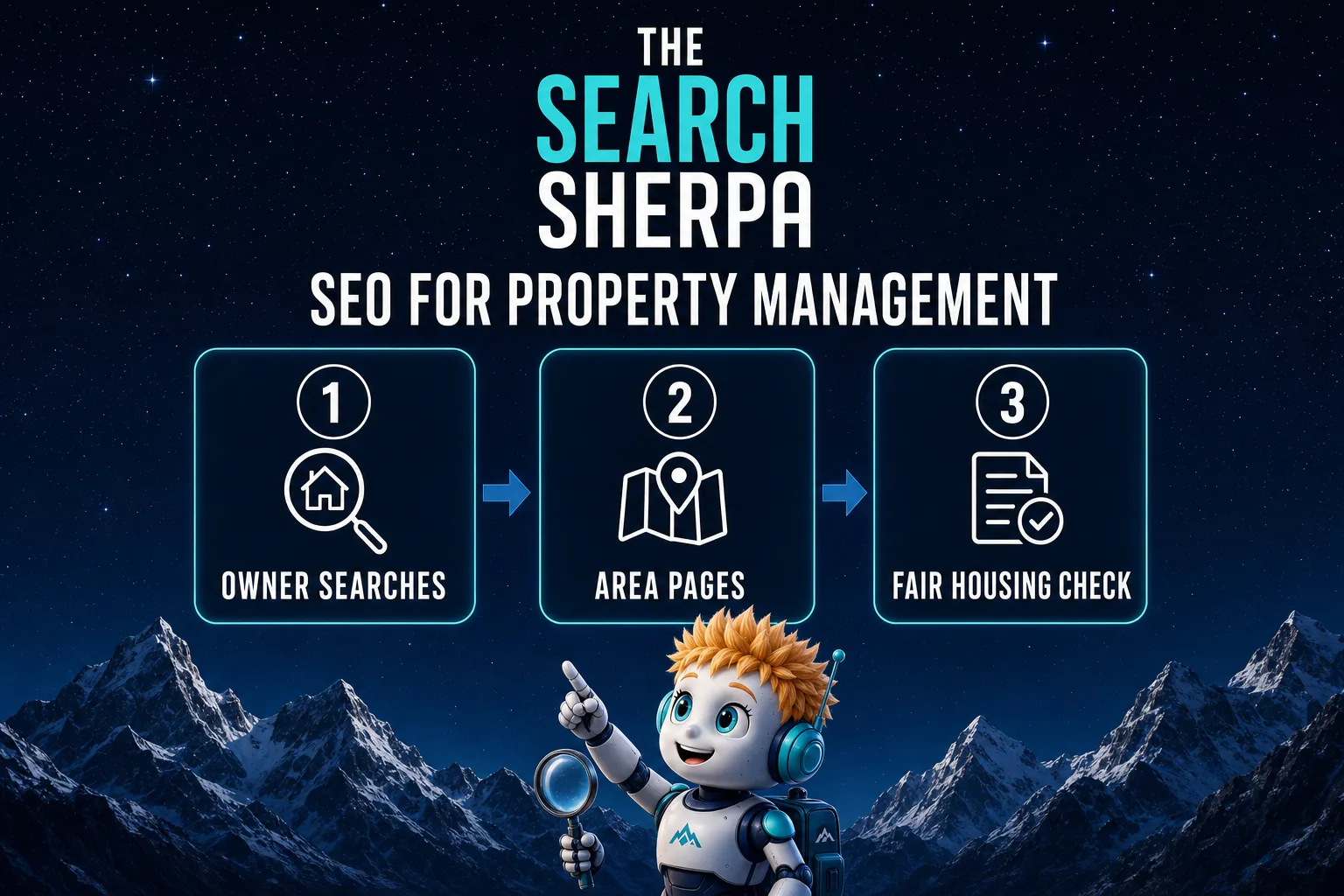
An owner looking for a manager wants to know what you do, what it costs, which towns you cover, and how you report. Build the site around those answers, using searches an owner types, such as property management company in [town], property manager near me, and property management fees in [town]. Renter searches such as apartments for rent in [town] belong to listing pages and portals. That work is out of scope for this guide. If you are a real estate agent rather than a manager, our page on SEO for real estate agents fits better.
What SEO does not do
SEO does not buy position. Google’s page on how local results are ranked says “There’s no way to request or pay for a better local ranking on Google.” Its guide on whether you need an SEO adds that “Google never accepts money to include or rank sites in our search results.” SEO makes your firm easier to find and easier to trust. It does not set rents, fill units, or sign owners for you.
Your Google Business Profile as a property management company
The map results draw on your Google Business Profile: name, category, address or service area, hours, photos, and reviews. Google’s Business Profile guidelines set the rules that matter most for a firm that covers many towns.
Office, service area, or both
Google says “Service-area businesses, or businesses that serve customers at their locations, should have one profile for the central office or location with a designated service area.” If owners visit your office, you can show the address and still set a service area, but Google says “your business location should be staffed by your team and able to receive customers during its stated hours.” A rented mailing address you do not operate from, “also known as a virtual office,” is not eligible. One office means one profile, not one profile per town.
Name and categories
Google says “Your name should reflect your business’s real-world name, as used consistently on your storefront, website, stationery, and as known to customers,” and that adding unnecessary information to the name “isn’t permitted, and could result in the suspension of your Business Profile.” Leave the city and words like best or affordable out of the name. For categories, Google says “Use as few categories as possible to describe your overall core business from the provided list,” and “Do not use categories solely as keywords or to describe attributes of your business.” Its category help page says “Select a primary category that best describes your business.” If the list includes Property management company and that is your core business, make it the primary. Then add the services you sell to owners, photos of the office and the people owners will meet, and the same name, address, and phone you use on the site. See our guide to choosing Google Business Profile categories and our Business Profile optimization checklist.
How Google ranks local results, and the links a manager can earn
Google says “Local results are mainly based on relevance, distance, and popularity.” It describes prominence as how well-known a business is, based partly on “how many websites link to your business and how many reviews you have,” and says “More reviews and positive ratings can help your business’s local ranking.” Distance depends on where the searcher is, so the parts you can work on are relevance and prominence. Our list for a manager: one complete profile for the office, the same name, address, and phone on the site and on every directory, service and fee pages that answer owner questions, and a steady flow of honest reviews. Claim the association and chamber listings you are entitled to. Google’s spam policies name “Buying or selling links for ranking purposes” as link spam, so buy no links.
Pages that answer owner questions
Your website does the work the profile cannot. It explains the service in enough detail that an owner can decide to call. Those pages need to be public, usable on a phone, and show a tap-to-call number. An owner-portal login is not a stand-in for that page. Give owners their own contact form, separate from resident maintenance requests.
Service pages and a fee page
Give each main service its own page: leasing, rent collection, maintenance coordination, owner reporting, and whatever else you actually provide. Say which property types you manage. The leasing page explains that service to an owner. It is not a vacant-unit listing. Also publish one page on how you charge. Write it so it can answer property management fees in [town] and how much does property management cost with your real fees, what is included, and what is not. Publish an occupancy figure, a rent level, or a door count only when you can document that exact figure. NARPM’s Code of Ethics, which binds its members, says “The Property Manager shall ensure that all advertising is clear and forthright and includes only accurate and truthful statements about the property or services advertised to the Property Manager’s reasonable knowledge.” That is a good standard for any service page, member or not.
Area pages
Write one page for each area you genuinely serve. Include facts that are true of that area: who covers it, how inspections and showings work there, and the kinds of properties you manage there. Do not copy one page and swap the town name. Our notes on one page per area you serve explain the structure.
Licensing language on your site
We do not give legal advice, and nothing in this section says that you are licensed or that you are not. Illinois licenses real estate brokers under the Real Estate License Act of 2000. Its definitions section, 225 ILCS 454/1-10, lists, among other things, acts that make someone a “broker” when done for another and for compensation, or with the expectation of compensation. They include one who “Supervises the collection, offer, attempt, or agreement to collect rent for the use of real estate” and one who “Advertises or represents oneself as being engaged in the business of buying, selling, exchanging, renting, or leasing real estate.” Section 5-20 exempts, among others, an owner or lessor who performs those acts “only as it relates to the owned or leased property.” The Act names the Department of Financial and Professional Regulation as its regulator. Whether your arrangement needs a license is a question for the Department or an attorney.
The same definitions section defines a “Blind advertisement” as a real estate advertisement used by a licensee “that does not include the sponsoring broker’s complete business name,” or, for electronic ads, does not link directly to a display with the required disclosures. The Act uses this term for licensee advertisements. Ask the Department or an attorney whether it applies to you. Either way, publish your company’s real name on every page.
Reviews from owners and residents: ask every client, offer nothing
Google’s policy on fake engagement does not allow merchants to “Discourage or prohibit negative reviews, or selectively solicit positive reviews from customers,” and it bans incentives “such as payment, discounts, free goods and/or services” in exchange for a review. That rules out a fee credit for a review, and it rules out asking only the owners or residents you expect to be happy.
Google’s review tips say “you can ask customers to visit a Google link or scan a QR code.” If you ask owners, ask every owner at the same point, such as after the first full quarter of reports. If you also ask residents, ask every resident at the same point. Reply to the reviews that come in, including complaints about deposits or repairs. The same page says “Your replies are public” and “Never share a reviewer’s private information.” Leave lease details, protected characteristics, and how someone pays for housing out of the reply, and invite the person to contact the office. Here is a realistic system for getting Google reviews.
Fair housing rules for your marketing copy
Federal law bars any notice, statement, or advertisement about renting or selling a dwelling that indicates a preference, limitation, or discrimination based on a protected characteristic. Illinois adds more protected bases, including source of income, immigration status, and an arrest record. Describe the property and your service, never the kind of person it is for.
The federal rule
The Fair Housing Act, 42 U.S.C. 3604(c), makes it unlawful “To make, print, or publish, or cause to be made, printed, or published any notice, statement, or advertisement, with respect to the sale or rental of a dwelling that indicates any preference, limitation, or discrimination” based on race, color, religion, sex, handicap, familial status, or national origin. HUD’s regulation, 24 CFR 100.75, says written notices and statements include “any applications, flyers, brochures, deeds, signs, banners, posters, billboards or any documents used with respect to the sale or rental of a dwelling.”
The regulation also lists “Using words, phrases, photographs, illustrations, symbols or forms which convey that dwellings are available or not available to a particular group of persons” because of a protected characteristic, and “Selecting media or locations for advertising the sale or rental of dwellings which deny particular segments of the housing market information about housing opportunities” for the same reasons. So photos, headlines, and the choice of where an ad runs all count.
Illinois adds more protected bases
In Illinois, the Illinois Human Rights Act, 775 ILCS 5/3-102(F), reaches any notice, statement, advertisement, or sign, and even a form of application, “that indicates any preference, limitation, or discrimination based on unlawful discrimination or unlawful discrimination based on familial status, immigration status, source of income, or an arrest record.” Section 3-102(H) also covers “criteria or methods that have the effect of subjecting individuals to unlawful discrimination” on those bases. Holding every applicant to the same written criteria does not, by itself, answer that test. Copy about who may apply, or how rent may be paid, has to stay neutral on each protected basis. Ask a fair housing attorney whether your city or county adds rules of its own.
Fair Housing-safe examples
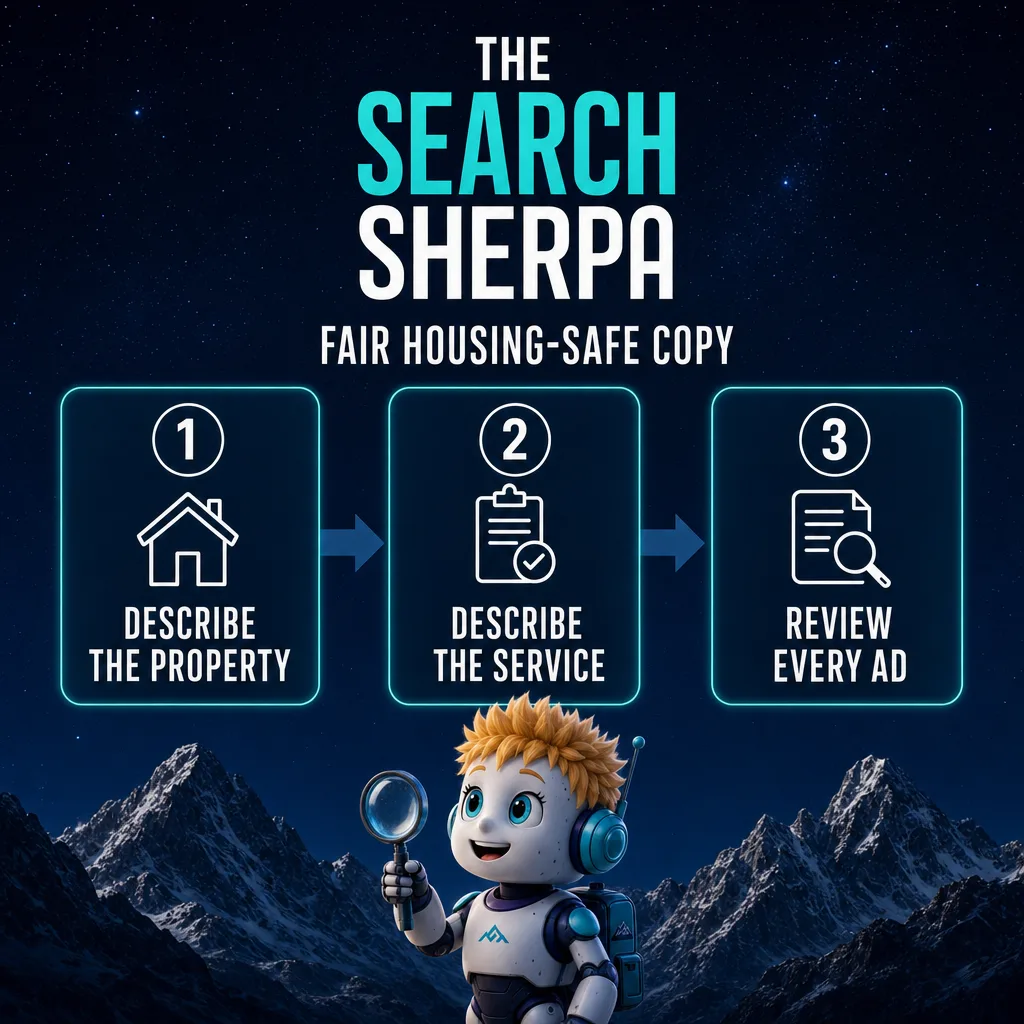
The safe pattern is the same everywhere: describe the property, the location, and your service. Do not describe the people a home suits. The unit-description row is there because managers still publish listings. This guide does not plan those pages. Every example below follows the safe pattern, and you should still have your own counsel review your templates.
| Where it appears | Fair Housing-safe example | Why it stays neutral |
|---|---|---|
| Service page headline | Residential Property Management in Will County | Describes the service and the area |
| Title tag | Property Management in [Town], IL | [Company Name] | Names the service, the place, and the firm |
| Unit description, if you publish one | Two-bedroom apartment with in-unit laundry, one assigned parking space, and a fenced yard | Describes only the home |
| Search ad | Residential Property Management | Leasing, Rent Collection, Maintenance Coordination | Describes only the services offered to owners |
| Application page | All applicants are reviewed under the same written criteria | Names no protected class. Uniform wording is not proof the criteria are lawful. Have counsel review the criteria, including Illinois source-of-income rules. |
NARPM’s code also asks its members to “operate consistent with fair housing laws and regulations.” HUD’s Fair Housing Act overview is a plain-language starting point. This is marketing guidance, not legal advice. Confirm your obligations with a fair housing attorney.
What SEO for a property management company costs
For a local property management company, SEO usually costs $1,000 to $3,000 a month, the band we publish for local businesses. Before monthly work comes a one-time $2,000 roadmap, fully credited toward future services if you choose to move forward with us. Packages below $500 a month cannot sustain the work.
These figures come from our page on what SEO costs a local business in 2026, and the roadmap has its own page, the Custom SEO Roadmap. Cost depends on your site, your competition, and your goals. We will be clear about pricing before any work begins.
Our pricing page also says what the local band covers. It names four kinds of work:
- Google Business Profile optimization
- Local citation cleanup
- Service-plus-city landing pages
- Targeted content built to capture customers in your immediate service area
Our pricing page says most businesses see early ranking movement within three to six months of consistent work, and that results you can clearly tie to new revenue usually take six to twelve months. Read those figures as the ranges published for local businesses in general. We do not promise rankings, lead counts, revenue, occupancy, or map placements for your firm, because no honest provider can. This work helps owners find your company. It does not fill units. Track what changes with a monthly local SEO scorecard. To scope the work for your firm, Book a Consultation.
What to ask any SEO provider
Google’s guide to hiring an SEO suggests asking for examples of past work, whether the provider follows Google Search Essentials, what results to expect and when, and whether every change to your site will be shared. It also says to walk away from anyone who promises first place. For a management company, also ask who checks your ad and page copy against fair housing law before it goes live. Insurance agencies run a similar check before they publish, as our guide to SEO for insurance agencies explains. Our checklist on what to look for in a local SEO company covers the rest.
Frequently asked questions
How much does SEO for property management cost?
For a local property management company, SEO usually costs $1,000 to $3,000 a month, the band on our pricing page. A one-time $2,000 roadmap is fully credited toward future services if you choose to move forward with us, and packages below $500 a month cannot sustain the work. The right figure depends on your site, your competition, and your goals.
Can I do SEO on my own?
Often, yes. Google says “If you run a small local business, you can probably do much of the work yourself,” and recommends starting with its SEO starter guide.
Does SEO for property management fill vacancies?
Not directly. The SEO in this guide helps rental property owners find and hire your management company. Filling a vacancy runs through listings and leasing marketing, which is a separate job. If your site also lists vacancies, keep those listings in their own section, apart from the owner pages. Both kinds of page must follow fair housing law.
Can a property management company set a service area on Google?
Yes. Google says a service-area business should have one profile for its central office with a designated service area. If owners visit the office, the office must be staffed and able to receive customers during its stated hours. A virtual office is not eligible.
What words should property managers avoid in ads?
Avoid any word, phrase, or photo that indicates a preference, limitation, or discrimination based on a protected characteristic. Do not publish lines that say a home suits one kind of household, that turn away children, or that refuse a lawful source of income, and do not use a photo that presents the home as meant for one kind of household. Federal law covers race, color, religion, sex, handicap, familial status, and national origin, and Illinois adds bases including source of income, immigration status, and an arrest record. Describe the property and the service, not the people it suits. Have counsel review your templates. This list is not the whole statute.
Does a property manager need a license in Illinois?
It depends on the arrangement. Among other things, Illinois defines a broker to include someone who, for another and for compensation, supervises rent collection or advertises a business of renting or leasing real estate, and it exempts owners acting only for their own property. Ask the Illinois Department of Financial and Professional Regulation or an attorney about your situation.
The Search Sherpa is a founder-led SEO practice in Mokena, Illinois, and you work directly with Jeremy Bengtson. If you run a property management company and want owners to find you, understand you, and choose you, Book a Consultation. You can also review SEO pricing for local businesses first, or call (217) 579-8791.
Explore This Topic

Join Over 400,000 Entrepreneurs Getting Our Weekly Newsletter
Recent Posts

October 15, 2026
SEO for insurance agencies in 2026: Google Business Profile setup, line and town pages, honest reviews, ad-rule checks, and what local SEO costs.

October 12, 2026
A YouTube demo shows only part of a provider’s work. Learn what to verify about AI review, access, backups, testing, ownership, and support

October 12, 2026
Watch a 129-second AI Dialogue about coding permissions, approval fatigue, and the risk of giving an AI agent control you cannot evaluate.