

By Jeremy Bengtson, founder of The Search Sherpa.
SEO audit services are a paid review of your website, your Google Business Profile, and your local competitors. A good audit ends in a ranked plan that says what to fix first. A report lists problems; a plan ranks them. This page explains what you buy, how the work runs, and how to judge any auditor.
The Search Sherpa is a founder-led SEO practice in Mokena, Illinois. Our audit is the Custom SEO Roadmap, a four-week diagnostic at one published price. You work directly with Jeremy Bengtson, from the first call to the final walkthrough.
What SEO audit services are, and what you actually buy
SEO audit services are an expert review of how your business shows up in search, ending in a ranked plan. A report lists problems. A plan ranks them by impact and effort, so you know what to fix first and what to skip.
Google’s own Search Essentials says “most sites pass the technical requirements without even realizing it.” So a long list of technical issues is not the product. The product is the order.
Google sets the same standard in its guide to hiring an SEO. It says an audit “should be about giving you realistic estimates of improvement, and an estimate of the work involved.” That sentence is a fair test for any audit you buy. It asks for two things: how much a fix could help, and how much work it takes.
What you are really buying is judgment. Part of our job is telling you which findings matter most for your business right now. The rest of this page shows how we do that, and how to check whether any provider does it well.
Who an SEO audit fits, and who it does not
An audit is a decision tool. It pays off when a decision is coming and you want facts before you spend. It is the wrong purchase when you need something else first.
An audit fits when
- You are planning a redesign or a new site. Google’s hiring guide calls a redesign a great time to bring in help, and says the earlier, the better.
- Your calls from search have flattened or dropped, and nobody can say why. Google’s guide to creating helpful content suggests auditing a drop. Ask which pages were hit, and for what types of searches.
- You are about to sign a monthly retainer with anyone, including us. An audit shows what the money should go to first.
- You want a second opinion. Google’s helpful content guide also suggests asking people you trust, who are unaffiliated with your site, for an honest assessment.
- Your business is missing from Google and you want the cause, not a guess. These are the common reasons a business is not showing up on Google.
Hold off on an audit when
- You need calls this week. An audit produces a plan. We do not run paid ads.
- You have no budget for any fixes afterward. A plan with nothing behind it just sits in a drawer.
- Your site is small, nothing urgent is broken, and you enjoy doing the work. Google says a small local business can probably do much of the work itself.
- You are not sure you need outside help at all. Read about when to hire an SEO consultant first.
What our SEO audit includes
Our audit is the Custom SEO Roadmap. It delivers nine assets in four weeks. Every diagnostic happens off-site, so it needs no passwords or backend access. Here is what each asset covers and what you do with it.
| Deliverable | What it covers | What you do with it |
|---|---|---|
| Confirmed Real Entity Audit | Name, address, and phone consistency, your Google Business Profile status, aggregator submissions, and duplicate listing cleanup | Correct wrong details and remove duplicates, so customers and Google see one accurate business |
| Keyword Database | Every service term, variant, and location modifier your business should target, prioritized by intent | Decide which pages to write, rename, or merge |
| Ideal Site Map | A site structure aligned to how your customers search and how Google indexes | Hand it to your web developer, or use it to plan a redesign |
| Technical SEO Checkup | The technical blockers holding back your rankings, from page speed and Core Web Vitals to crawl errors | Clear the quick, high-impact blockers first |
| GEO Readiness Report | Your content structure and entity signals, for visibility in ChatGPT, Perplexity, and Google AI Overviews | Find the pages that need clearer, plainer answers |
| Local Link and Citation Strategy | The local directories, industry citations, and authority links your market requires | Earn listings and links in the order the plan sets |
| Competitor Gap Analysis | What your top local competitors do right, and where they are vulnerable | Pick the gaps you can close soonest |
| Strategy Slide Deck | Every finding, every priority, and every recommended next step in one shareable presentation | Share it with your team, your developer, or your next provider |
| 60-Minute Strategy Call | A recorded walkthrough of the full roadmap with Jeremy, plus questions and answers | Leave with an execution path you understand |
You also receive a prioritized action plan with timelines. Page-level fixes in that plan fall under on-page SEO for existing pages. Everything in the package is yours to keep, whether you continue with us or not. GEO here means generative engine optimization: visibility in ChatGPT, Perplexity, and Google AI Overviews.

The local checks touch the same ground as ongoing Google Business Profile management, but the audit only diagnoses. It tells you what is wrong, why it matters, and in what order to fix it. Google says local results are mainly based on relevance, distance, and popularity. The plan stays focused on the parts you can change.
How the SEO audit runs, step by step
The Roadmap takes about four weeks. The clock starts after you complete the intake workbook and have your Direction Call. The work runs in this order:
- The intake workbook. You map your target locations, core services, and top competitors.
- The 30-minute Direction Call. We lock in your goals, and this call starts the four-week clock.
- The analysis. We review your digital footprint off-site. That covers entity signals, your Google Business Profile, technical blockers, and generative engine optimization readiness.
- The build. We assemble the keyword database and the ideal site map. We also map the local citation and link building strategy.
- Delivery. You receive the strategy slide deck. Then we hold a 60-minute Strategy Call to walk through the data and answer every question. All calls are recorded for your team.
Because the work happens off-site, it needs no passwords or backend access. Your part is the workbook and two calls.
Where AI tools fit in the work
AI helps us work faster. It does not decide which fix matters most for your business. That call needs someone who knows your market. The Roadmap page describes the result as a custom-built, human-analyzed strategy.
The same care applies to any software in the process. Audit tools have limits too. Google notes that third-party SEO tools do not have access to its internal ranking data. It advises checking a tool’s audit against official Google guidance before you make significant changes. A good auditor does that checking for you, and shows you the source.
How findings get ranked: impact against effort
Every finding gets two scores: how much it could help, and how much work it takes. High impact and low effort gets fixed now. Low impact and high effort gets skipped, even when a tool flags it as urgent.
Google’s SEO Starter Guide is candid about this. It says “not all changes you make to your website will result in noticeable impact in search results.” It also says some of its suggestions “might not even apply to your business.” Triage keeps you from spending months on the wrong ones.
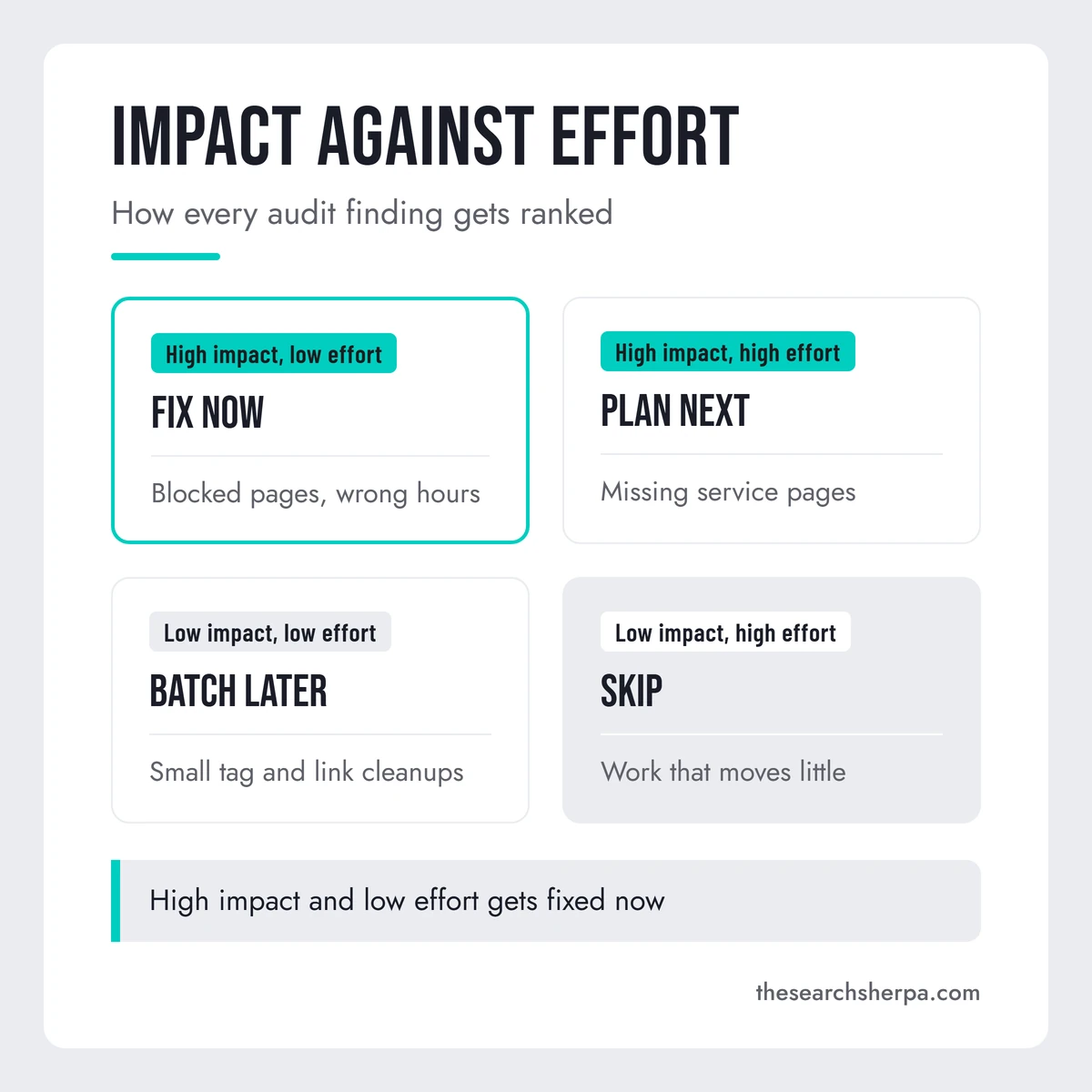
Each finding lands in one of four boxes:
- Fix now (high impact, low effort). Problems that stop customers or Google from finding you, and that take little time to correct. Examples: a key service page blocked from Google’s index, or wrong hours and phone details on your Google Business Profile.
- Plan next (high impact, high effort). Work that matters but takes weeks. Examples: missing service pages, or a site structure that buries the pages that book jobs. These go on the timeline with an owner.
- Batch later (low impact, low effort). Small tag and link cleanups, like a weak title on a page few people visit. Group them and finish them in one sitting.
- Skip (low impact, high effort). Work that costs a lot and moves little. Examples: adding a keywords meta tag, which Google does not use, or chasing every unindexed URL on a small site.
Google’s guide to how Search works puts it this way: “Google Search works in three stages, and not all pages make it through each stage.” Our page on fixing technical SEO problems shows where pages get stuck.
The skip box needs the same care. Google’s page indexing report help says “Non-indexed URLs can be fine.” It also says a site with fewer than 500 pages probably does not need that report. Ranking those URLs low is part of the job.
The same issue can land in different boxes for different businesses. A slow page matters more when it is the page that books your jobs. That context is what a tool cannot supply, and what the plan adds.
How to judge an SEO audit provider
Use these questions with any provider, including us. Most come straight from Google’s own advice on hiring an SEO.
Questions to ask before you buy
- Can you show me examples of your previous work? Then check the business references they give you.
- Do you follow the Google Search Essentials?
- What results do you expect, in what timeframe, and how will you measure success?
- What is your experience in my industry, and in my city?
- Will you explain each recommendation and the reasoning behind it?
- Do you cite official Google documentation as evidence for your recommendations?
- Does each fix come with an estimate of the work involved?
A good auditor asks you questions too. Google says your SEO should ask what makes you unique, who your competitors are, and how customers find you. An auditor who skips those questions is guessing at your priorities.
Red flags in an SEO audit
A good audit names the few fixes that matter, explains why, and estimates the work. A poor one hands you a long list, promises a top spot, or hides its methods.
- A promise of the top spot. Google warns that no one can promise a top ranking in its results.
- Secrecy. Google says to “be careful if a company is secretive or won’t clearly explain what they intend to do.”
- Paid links. Buying links for ranking purposes breaks Google’s spam policies. Sites that break them may rank lower or not appear at all.
- A demand for a link back. In Google’s words, “You should never have to link to an SEO.”
- A request for write access. If an auditor asks for Search Console, Google’s advice is to grant read access only at this stage. Site owners in Search Console see sensitive Google Search information about your site. This check is for any auditor who asks. Our Roadmap diagnostic happens off-site and needs no passwords or backend access.
- Pay-to-rank talk. Google says it never accepts money to include or rank sites in its search results.
- A raw tool export with no order. If the deliverable is a crawler printout, you bought a report, not a plan.
Google also reminds owners that they are responsible for the actions of any company they hire. For a broader hiring checklist, see what to look for in a local SEO company.
What an SEO audit costs, and what happens after
Our price is published. The Custom SEO Roadmap is a $2,000 investment. Work with us on the execution, and the $2,000 is credited fully toward your first month of retainer services. If you hand the playbook to your in-house team instead, it is yours to keep. Start the $2,000 Custom SEO Roadmap when you are ready.
For the market range and what moves the price, read our guide to SEO audit cost.
What happens after the audit
You have three paths, and all three are fine.
- Do it yourself. That is a good instinct, and many fixes are within an owner’s reach. Page titles are a good first task: here is how to write your own title tags and meta descriptions.
- Hand it to your developer or in-house team. The deck, keyword database, and site map are built so a developer of your choice can act on them.
- Hire us to implement it. The Roadmap fee comes off your first invoice, and the work runs through our local SEO services. Small local businesses generally invest $1,000 to $3,000 monthly for map pack visibility and local search.
Cost depends on your site, your competition, and your goals. Packages priced below $500 per month cannot sustain the labor-intensive work that real organic growth needs.
Most local SEO shows measurable movement in about three to six months, depending on competition and the condition of your site. Google’s starter guide adds that some changes might take effect in a few hours, while others could take several months. We do not promise rankings, lead counts, or map placements, because no honest provider can. No long-term lock-in contracts. Clients stay because the work earns it.
Once fixes begin, track them. Google says you might want to check Search Console around once a month. If you hire anyone to carry out the plan, know what your SEO agency should be showing you every month.
Frequently asked questions
What are SEO audit services?
SEO audit services are a paid review of your website, your Google Business Profile, and your competitors. The result should be a ranked plan, not a raw list of problems. Ours is the Custom SEO Roadmap: nine assets in four weeks, built off-site, with no passwords or backend access needed.
How much does a SEO audit cost?
Our audit, the Custom SEO Roadmap, costs $2,000. If you continue with us, the full $2,000 is credited toward your first month of retainer services. If you do not, the findings and strategy are yours to keep.
Can ChatGPT do an SEO audit?
Partly. OpenAI says ChatGPT “can produce incorrect or misleading outputs” and advises using it “as a first draft, not a final source.” It may also fail to load parts of a website. OpenAI also says to always verify data and technical information. Use it for a first pass, then have a person verify and rank the work.
Is SEO still worth it in 2026?
It depends on your site and your market, which is exactly what an audit answers. Search is changing, not disappearing. People still use Google. They also ask ChatGPT, Perplexity, and Gemini, and they see Google AI Overviews before they ever click. Google says the best practices for SEO remain relevant for AI features such as AI Overviews and AI Mode. That shared foundation is also where AI search optimization starts.
Do I need an SEO consultant for a website audit?
Not always. Google says a small local business can probably do much of the work itself. A consultant earns the fee by ranking the findings and estimating the work. Rates vary, and our guide to what an SEO consultant costs covers them.
How long does an SEO audit take?
Ours takes about four weeks. The clock starts after you complete the intake workbook and have your Direction Call. At the end you get the strategy slide deck and a recorded 60-minute Strategy Call.
Can I fix the audit findings myself?
Yes, and that is a good instinct. Not everything needs to be done by us. You can split the work: keep the tasks you enjoy, like replying to reviews, and hand off the technical fixes. The Strategy Call is where we map who does what.
How to start your SEO audit
Starting takes one conversation. Tell us your service area, your main services, and what is not working. We will say plainly whether an audit is the right next step, or whether a smaller fix will do. We are based in Mokena. Our service area includes Mokena, Frankfort, New Lenox, Tinley Park, Orland Park, Homer Glen, Manhattan, Lockport, and Joliet.
See how we price SEO services, or contact The Search Sherpa to ask about the Custom SEO Roadmap. You can also call (217) 579-8791. No pressure, and no lock-in contract.
Explore This Topic

Hiring an SEO Consultant Chicago Businesses Can Trust

On-Page SEO Services: Improving the Pages You Already Have

Landscaping SEO for Landscapers: Two Kinds of Buyer, Two Kinds of Search
SEO Audit Services: A Prioritized Plan, Not a List of Problems

Multi-Location SEO: Local SEO for Businesses With Two or More Locations
Join Over 400,000 Entrepreneurs Getting Our Weekly Newsletter
Recent Posts
October 8, 2026
How to choose an SEO consultant in Chicago: consultant, agency, or freelancer, a decision tree, a vetting checklist, red flags, and rates in
October 8, 2026
On-page SEO services improve the pages you already have: titles, headings, copy, links, alt text, and schema. What is included, how it runs,
October 8, 2026
Landscaping SEO builds the pages and Google Business Profile work behind lawn care contracts and design-build projects. What it includes and costs.